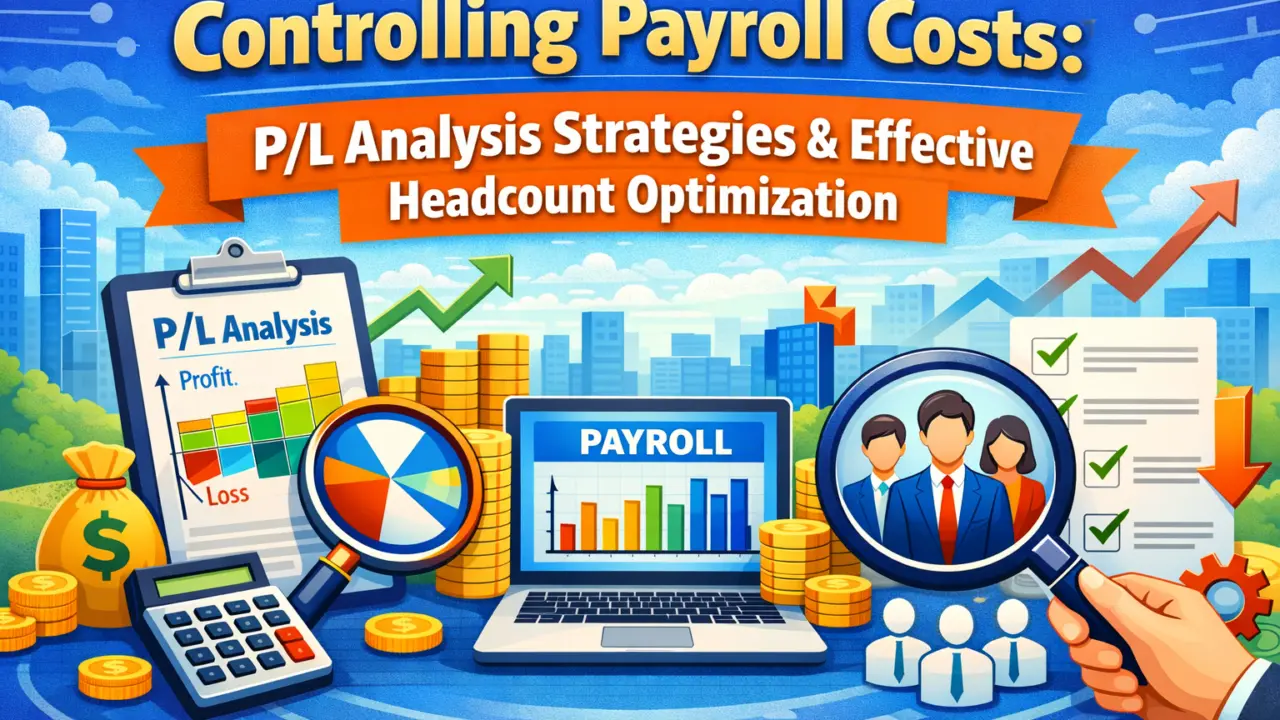
For sustainable growth, businesses must master Payroll Control: Labor Cost Analysis and Headcount Optimization. Effective HR cost management and headcount optimization are critical for maximizing profitability.
What Is Payroll Control: Labor Cost Analysis and Headcount Optimization?
In today’s volatile economic environment, company survival depends on both revenue growth and internal cost management. Payroll Control: Labor Cost Analysis and Headcount Optimization is not about arbitrarily cutting salaries or eliminating positions. Rather, it is a strategic management process involving monitoring, analyzing, and adjusting total workforce costs to align with organizational financial health and business objectives.
Fundamentally, payroll control ensures every dollar spent on human resources delivers equivalent or greater value. Profit and Loss (P/L) analysis breaks down cost layers—from base salary, benefits, and insurance to hidden costs—providing comprehensive financial visibility. Concurrently, headcount optimization positions the right people in the right roles, in appropriate quantities, at optimal times to maximize productivity without creating organizational bloat. This is the “strategic foundation” of modern HR management in Vietnam.
The Importance of Controlling Labor Costs in the P/L Report
1. Direct Impact on Profit Margin and Financial Health
In most businesses, especially labor-intensive sectors like manufacturing, food and beverage, or services, personnel costs often constitute 20% to 50% of total operating expenses. Therefore, small payroll fluctuations create significant ripple effects on Net Profit. If revenue underperforms but payroll remains static or increases from salary adjustments, profit margins erode rapidly.
Deep analysis of labor costs in P/L statements helps leadership understand revenue-to-labor-cost correlations. When ratios exceed industry safety thresholds, this signals inefficient, bloated operations. Financial health extends beyond profit to Return on Investment (ROI) in human capital. Effective payroll control improves Earnings Before Interest, Taxes, Depreciation, and Amortization (EBITDA), thereby increasing enterprise value for investors and stakeholders.
2. Ensuring Liquidity and Stable Cash Flow
Unlike variable costs that can be flexibly reduced or deferred (marketing, procurement), payroll is a “Committed Cost” with strict payment timing requirements. In Vietnam, labor laws governing salary payment deadlines are rigorous; late payments create serious legal risks and internal trust crises. Thus, payroll directly impacts monthly Cash Flow.
Without strict planning and control, businesses easily face short-term cash shortages during payroll periods, especially during holidays like Tet when 13th-month bonuses or performance bonuses are due. P/L analysis helps Finance and HR accurately forecast short-term and long-term cash requirements for personnel. This ensures operational liquidity, maintains stability, preserves employee confidence, and avoids expensive short-term financing just to meet payroll obligations.
3. Enhancing Competitiveness Through Rational Cost Structure
In fierce market competition, product and service pricing determines market share. Labor costs significantly impact Cost of Goods Sold (COGS) or service delivery costs. If payroll spirals uncontrolled, product costs increase, reducing price competitiveness. Conversely, a rational, lean personnel cost structure enables flexible pricing strategies or budget reallocation to research, technology, and marketing initiatives.
Competitiveness stems from workforce quality, not just low costs. Payroll control means paying strategically, not poorly. By eliminating redundant positions (optimizing headcount) and concentrating budget on key value drivers, businesses attract and retain genuine talent. A lean organization with strong employee compensation will always outcompete a bloated organization with low average pay and poor productivity.
Methodology for Analyzing Labor Costs in P/L Structure

1. Identifying Cost Components: Salary, Bonus, Benefits, and Deductions
Accurate HR P/L analysis begins by identifying all Total Cost of Workforce (TCOW) components. Many Vietnam businesses mistakenly focus only on Gross Base Salary, ignoring related costs, leading to budget overruns. A comprehensive labor cost analysis must include four main categories: Direct Salary Costs, Mandatory Benefits, Voluntary Benefits, and HR Operational Costs.
Specifically, mandatory costs under current Vietnam law are substantial, including Social Insurance, Health Insurance, and Unemployment Insurance (totaling approximately 21.5% paid by employer) plus Trade Union fees (2%). Additionally, variable compensation includes commissions, KPI bonuses, and 13th-month bonuses. Finally, hidden costs such as recruitment, training, health screenings, uniforms, and employee events must be accounted for.
2. Formula for Labor Cost Percentage
The most critical metric is Labor Cost Percentage.
Formula:
3. Variance Analysis: Actual Versus Budget Versus Forecast
Management requires dynamic analysis through Variance Analysis. Monthly or quarterly, Compensation and Benefits departments must compare Actual figures against approved Budget and latest Forecast. Discrepancies typically stem from Rate Variance (salary increases, overtime costs) or Volume Variance (headcount changes). Deep analysis enables shift from reactive to proactive strategic decisions.
Headcount Optimization Strategy

1. The Correlation Between Headcount, Productivity, and Revenue
View headcount in relation to productivity and revenue, not as an isolated number. Optimization strategies should rely on metrics like Revenue per Employee or Profit per Employee.
$$Revenue per Employee = frac{Total Revenue}{Full-Time Equivalent (FTE)}$$
Optimization means maximizing output value per FTE. Revenue growth must outpace headcount expansion.
2. Annual Headcount Planning Process
Align headcount planning with the annual business plan, combining top-down strategic goals with bottom-up departmental needs. Before approving new hires, justify each position’s contribution using “Zero-based Budgeting”—proving necessity for the upcoming year rather than automatically continuing prior-year structures.
3. Flexible Staffing Models
To manage market volatility, modern businesses adopt flexible staffing models: Core Staff (long-term, critical positions) and Contingent Workforce (outsourcing, seasonal, freelance roles). This strategy converts Fixed Costs into Variable Costs, allowing payroll to expand or contract in sync with actual revenue performance.
Common Mistakes and Solutions in Payroll Management in Vietnam
1. Mechanical Headcount Reduction Without Performance Evaluation
“Across-the-board cuts” (e.g., eliminating 10% uniformly) often trigger “brain drain” and operational gaps. Solution: Implement performance-based screening using KPI and OKR data to identify lower performers and streamline processes to eliminate non-value-added activities before reducing staff numbers.
2. Ignoring Hidden Costs
The largest hidden cost is Turnover Cost (recruitment, training, productivity loss). Replacing an employee can cost 150-200% of annual salary. Solution: Monitor Turnover Rate and invest in Employee Engagement and internal development. Retention often costs less than recruitment.
3. Lack of HR Technology Application
Manual Excel management creates errors and lacks real-time visibility. Solution: Invest in Human Resources Information Systems (HRIS) or Enterprise Resource Planning (ERP) systems to set budget caps and leverage People Analytics for trend forecasting and financial scenario planning.
Conclusion
Payroll control through P/L analysis and headcount optimization balances people with numbers. For Vietnam businesses, mastering this balance is essential. Leadership must shift from viewing HR as a “cost burden” to seeing it as a “strategic investment,” ensuring sustainable equilibrium between Profit and People.
For questions or support, contact Wacontre Accounting Services at (028) 3820 1213 or [email protected]. Our experienced professionals deliver comprehensive, efficient service. (Japanese-speaking clients: (050) 5534 5505)