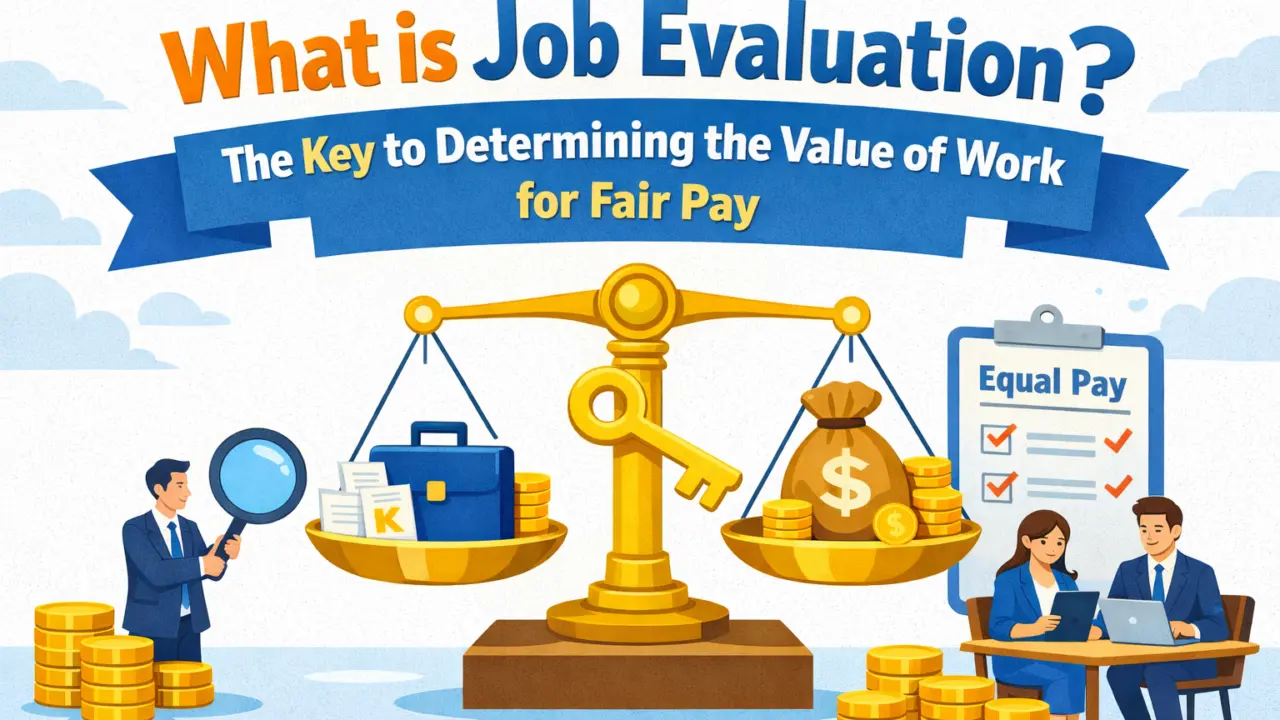
Job Evaluation is essential for businesses to accurately determine job value. Implementing this job assessment method ensures fair compensation, motivates employees, and creates a transparent, competitive salary structure aligned with market standards.
What Is Job Evaluation?
Job Evaluation is a systematic process for determining the relative value of positions compared to others within the same organization.
Essentially, it is the process of “weighing and measuring” each position’s characteristics:
- Position importance and organizational impact.
- Work difficulty and complexity.
- Contribution level to organizational objectives.
This process generates a critical database for establishing a Salary Structure, ensuring positions with higher value receive appropriate compensation.
Distinguishing Job Evaluation From Performance Appraisal
Many people, including experienced HR professionals, confuse these two distinct concepts. The distinction is clear:
- Job Evaluation: Assesses THE JOB. It evaluates position requirements and responsibilities. The core principle: “Evaluate the position, not the person filling it.”
- Performance Appraisal: Assesses THE PERSON. It evaluates how well the employee performs in that role and whether they meet their Key Performance Indicators.
Job Evaluation’s ultimate purpose is creating a rational Salary Structure, eliminating subjective bias in compensation decisions—a common challenge in SMEs across Vietnam.
Why Do Businesses Need to Determine Job Value?
Although Job Evaluation requires time and resources, the long-term governance benefits are substantial:
1. Ensuring Internal Equity
Fairness is the most critical psychological factor influencing employee satisfaction.
- Employees naturally compare their contribution-to-reward ratio with colleagues.
- Without standardized evaluation, salary disparities breed dissatisfaction.
- Job Evaluation provides a uniform measuring standard. When every position uses consistent criteria, salary differences reflect job value, creating fairness and acceptance.
2. Increasing External Competitiveness
How can you assess whether your salaries are above or below competitors?
- Job Evaluation standardizes job titles and levels across the organization.
- It enables easy benchmarking against market salary surveys (Mercer, compensation reports, etc.).
- It prevents overpaying or losing talent through underpayment relative to market rates.
3. Foundation for the 3P Compensation System
In the 3P model (Position, Person, Performance):
- The first P – Pay for Position – directly results from Job Evaluation.
- It serves as the structural foundation. A weak foundation destabilizes both Pay for Person and Pay for Performance components.
The 4 Most Common Job Evaluation Methods
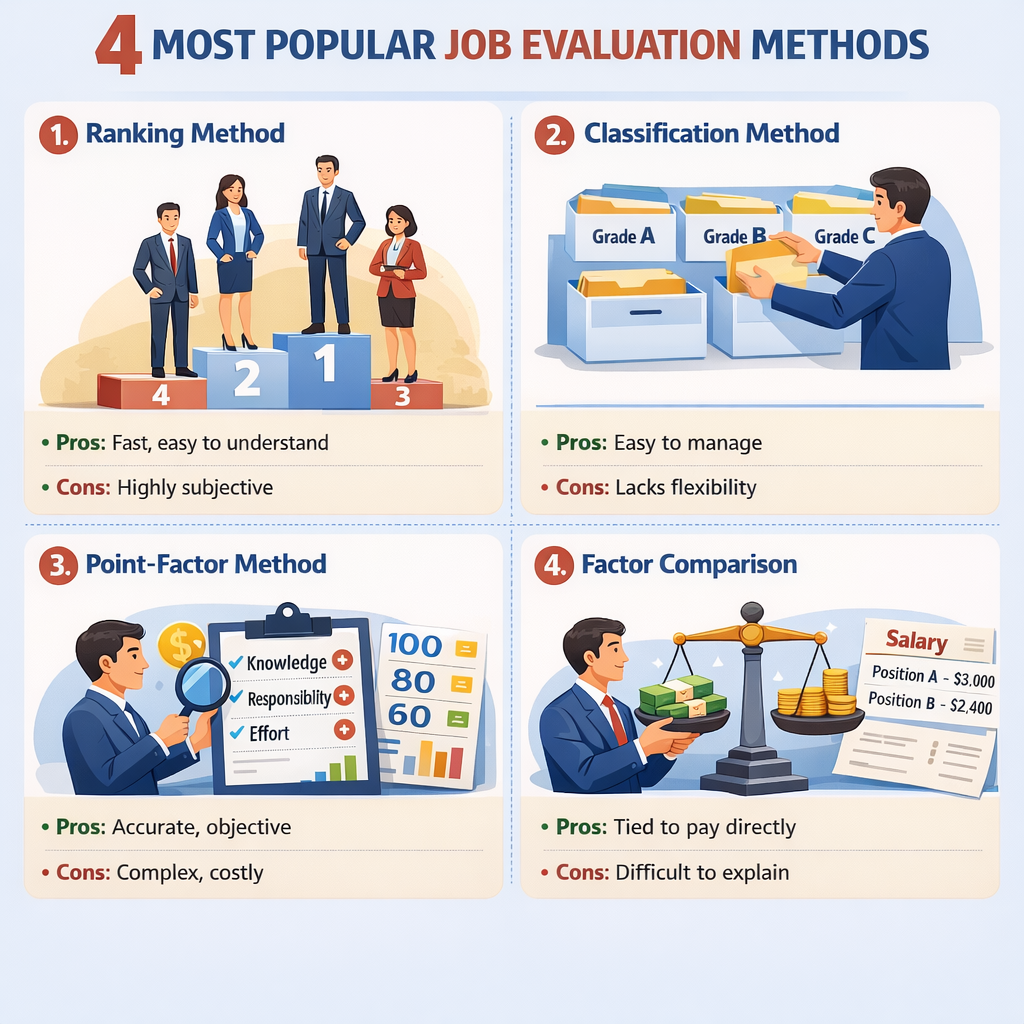
Depending on organizational size and budget, businesses can select from four primary methods:
1. Ranking Method
The simplest and most traditional approach. The committee arranges positions from highest to lowest value based on overall assessment.
- Advantages: Quick, low-cost, easily understood. Best for small organizations with fewer than 30 employees.
- Disadvantages: Highly subjective. Difficult to articulate specific justification for differences. Impractical for larger organizations.
2. Classification Method
Commonly used by government agencies and large institutions. The organization establishes standardized Grade levels with clear descriptions, then assigns positions to these grades.
- Advantages: Scalable for large organizations, creates consistency.
- Disadvantages: Lacks flexibility. Sometimes actual job requirements don’t align with standard grades, creating forced categorization.
3. Point-Factor Method
The “Gold Standard” preferred by multinational corporations. Jobs are decomposed into Compensable Factors such as Knowledge, Responsibility, and Mental Effort, then scored in detail.
- Advantages: High accuracy and objectivity. Converts value into numerical scores. Easy to explain and justify to employees.
- Disadvantages: Complex and time-consuming to develop. Requires significant investment.
4. Factor Comparison Method
Combines ranking and point-factor approaches, linking job value directly to monetary value from the outset.
- Advantages: Produces specific salary figures based on realistic market data.
- Disadvantages: Difficult to communicate methodology to employees. Requires complete recalculation when market conditions shift. Less commonly used than Point-Factor method.
5-Step Process to Implement Job Evaluation
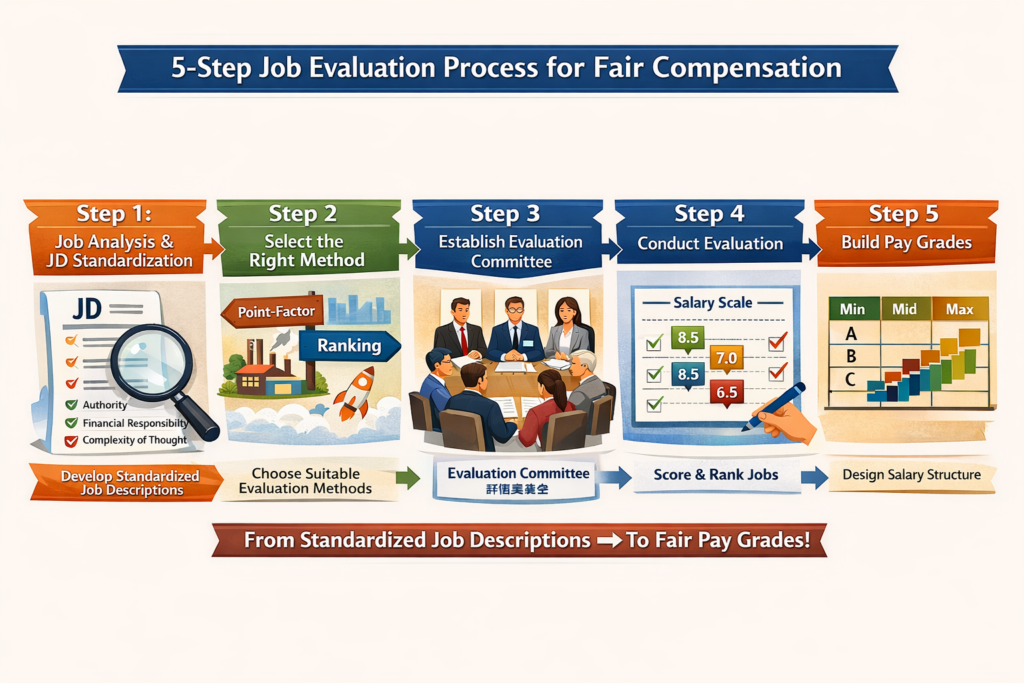
For successful implementation, follow this standard roadmap:
Step 1: Job Analysis and Job Description Standardization
- You cannot evaluate what you don’t understand. Gather information and create standardized Job Descriptions.
- For evaluation purposes, descriptions must detail: Authority scope, financial responsibility, and problem-solving complexity.
- Critical Note: Inaccurate input data will inevitably produce inaccurate evaluation results.
Step 2: Select the Appropriate Method
- Consider organization size, budget, and corporate values.
- Large manufacturing companies should use Point-Factor. Young startups may use Ranking.
- Avoid unnecessary complexity that wastes resources without proportional benefit.
Step 3: Establish the Evaluation Committee
- Members: CEO, HR Director, and key Department Heads.
- Requirements: Thorough operational knowledge and proper training in scoring methodology to minimize bias.
Step 4: Execution (Scoring)
- Committee members review each job description against established criteria.
- Members score independently, then discuss findings to build consensus.
- Results compile into a matrix showing scores or rankings for all positions.
Step 5: Grading and Salary Structure Development
- Group positions with similar scores into the same Pay Grade.
- Combine with external market data to design a Salary Scale (Minimum – Midpoint – Maximum).
- Calculate overlap between grades to ensure smooth progression opportunities.
Key Considerations for Vietnam Implementation
1. Avoid Confusing “The Person” With “The Job”
This is the most frequent error. Committees often score a position highly out of “respect” for the current employee (seniority, loyalty).
- Solution: Consistently ask: “If we hired someone new for this role, what would the requirements be?” Strictly separate personal feelings from objective criteria.
2. Ensure Transparency and Communication
Employees often perceive Job Evaluation as a salary reduction mechanism.
- Solution: Conduct town-hall meetings explaining the fairness objective.
- Commit publicly to the principle: No salary reduction (red-circle protection) when current pay exceeds the new grade band; increase where current pay falls below.
3. Regular System Updates
The business environment changes rapidly (VUCA conditions). A position valued 5 years ago may differ significantly today.
- Solution: Review the system every 2-3 years or when restructuring occurs to ensure job values remain current and accurate.
Conclusion
Job Evaluation is far more than a payroll calculation exercise; it represents a strategic HR management initiative.
It establishes the solid foundation for a fair workplace where every contribution receives proper recognition. Through proper understanding and correct execution, businesses can transform compensation into a powerful tool to improve performance and retain top talent.
For questions or support, contact Wacontre Accounting Services at (028) 3820 1213 or [email protected]. Our experienced professionals deliver comprehensive, efficient service. (Japanese-speaking clients: (050) 5534 5505)