
Wondering why top talents leave? Understanding Turnover Rate and implementing strategic HR solutions are vital for effective talent management and long-term success.
Why do top employees quit?
“Why do top employees quit?” is not only a question managers ask themselves when facing the departure of a key employee, but also a term that reflects the reality of talent management in organizations. It refers to the phenomenon in which high-performing individuals who make important contributions to a company’s growth decide to terminate their employment in order to seek new opportunities.
Understanding this concept means a business must re-examine the entire employee experience journey. Top employees are often people with strong self-learning ability, creative thinking, and high adaptability, so their standards for an ideal workplace are usually higher than average.
When a strong employee leaves, it is not simply the loss of one box on the organizational chart. It is a loss of professional knowledge, customer relationships, and, most importantly, a decline in the morale of those who remain. Therefore, decoding the reasons behind such departures is the first step in a sustainable human resource optimization strategy.
Analyzing Turnover Rate in a Business
1. Properly understanding Turnover Rate and the standard formula for HR
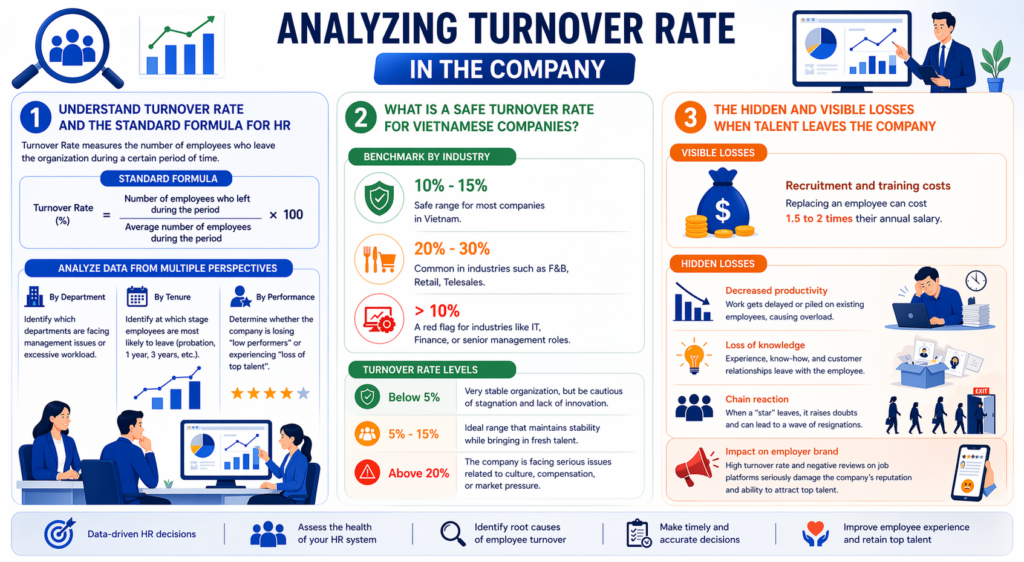
Turnover Rate is an important HR metric used to measure the number of employees leaving an organization within a certain period of time, usually by month, quarter, or year, compared with the organization’s average number of employees during that period. To manage human resources effectively, businesses need to clearly distinguish between the overall turnover rate and turnover among key employee groups.
The standard formula for calculating Turnover Rate is usually as follows:
Turnover Rate (%) = (Number of employees leaving during the period / Average number of employees during the period) x 100
The average number of employees is calculated by adding the number of employees at the beginning and end of the period, then dividing by two. Mastering this formula helps the HR department gain an objective view of workforce fluctuations and produce accurate reports for leadership about the health of the organization’s management system.
In addition, businesses should break down the data in several ways:
- By department: Identify which teams are having management issues or excessive workload pressure.
- By tenure: Determine when employees usually leave, such as during probation, after one year, or after three years.
- By performance: This is the most important dimension because it helps answer whether the company is losing “excess staff” or suffering from a real “brain drain.”
2. What turnover rate is considered a “safe threshold” for Vietnamese businesses?
There is no fixed number that applies to all industries, but in the Vietnamese market, the safe threshold generally ranges from 10% to 15% per year. However, in sectors such as F&B, retail, or telesales, the rate may rise to 20% to 30% and still be considered normal because of the nature of the work and frequent workforce shifts.
On the other hand, for technology companies, finance, or senior management positions, if the Turnover Rate exceeds 10%, it is already a red flag. In these fields, the departure of strong employees causes major disruption to long-term projects and requires substantial time to train replacements with similar capability.
Businesses should closely monitor turnover trends:
- Below 5%: The organization is highly stable, but it should be cautious about stagnation and lack of innovation.
- From 5% to 15%: An ideal range that maintains stability while still allowing for “new blood” in the organization.
- Above 20%: The business is likely facing serious problems in culture, compensation policies, or market pressure.
3. The visible and invisible losses when talent leaves the organization
The most visible loss is recruitment and training cost. According to HR management studies, the cost of replacing a capable employee can be 1.5 to 2 times that employee’s annual salary. This includes job advertising, interview time, recruiter or agency fees, and onboarding costs.
At the same time, invisible losses often have even more serious consequences:
- Reduced productivity: While searching for a replacement, work is delayed or shifted to current employees, creating overload.
- Loss of knowledge: The experience, work know-how, and customer relationships that a talented employee has built up leave with them.
- Chain reaction effect: When a “star” employee quits, it raises questions among remaining employees about the company’s future, potentially triggering a wave of resignations.
Especially in today’s business environment, the company’s employer brand can be seriously damaged if turnover is too high and negative reviews begin to appear on job-related social platforms.
The Core Reasons Why Talent Leaves an Organization
1. Direct managers: “Employees don’t leave companies, they leave their bosses”
This is the most common cause, yet one that businesses often overlook. A manager with an authoritarian leadership style, poor listening skills, or a tendency toward micromanagement can suffocate the creativity of top employees. Talented people always want trust and empowerment rather than control over every small detail.
The relationship between employees and their direct managers determines up to 70% of an employee’s level of engagement with the organization. If a manager does not know how to inspire, lacks the ability to provide direction, or regularly takes credit for subordinates’ achievements, talented employees will quickly become dissatisfied.
Signs of a manager who causes talent loss include:
- Lack of constructive feedback
- Favoritism and unfairness in assigning work and benefits
- Failure to protect employees’ interests in front of upper management decisions
- Forcing personal ego into professional processes
2. Lack of recognition and unclear career advancement paths
Top employees always have a strong desire to grow. If they feel stuck after years of contribution, or if their exceptional efforts are not properly recognized, they will start looking elsewhere. Recognition here is not only about salary and bonuses, but also praise, respect, and the opportunity to take on new challenges.
A non-transparent career path is a silent killer of loyalty. When employees cannot see where they will be in the next two or three years within the company, they will create that path for themselves at a competitor that promises clearer career progression.
To retain them, businesses should pay attention to the following:
- Build a transparent KPI and competency evaluation system
- Organize regular conversations about individual development aspirations
- Create expert career tracks alongside management tracks so employees have more growth options
3. Toxic company culture or lack of value alignment
Company culture is the invisible thread that connects members of an organization. A workplace filled with jealousy, internal cliques, or lack of mutual support will make decent and talented people feel isolated. Strong employees often have high self-respect and want to work in a professional environment where their personal values align with the organization’s shared values.
A lack of value alignment also occurs when what the company declares, such as its vision and mission, is completely different from what actually happens in practice. If a company talks about creativity but punishes minor mistakes made during experimentation, employees will feel deceived and lose trust.
Toxic cultural factors include:
- Poor communication and blocked information flow between departments
- Respect for seniority over capability
- Lack of diversity and inclusion
- Tolerance of unethical behavior for short-term sales targets
4. Prolonged work pressure causing work-life imbalance
In the digital era, the boundary between work and personal life has become increasingly fragile. Having to constantly respond to emails and messages after working hours, or work unpaid overtime, pushes employees into a state of burnout. Even the most resilient workers will eventually collapse if they do not have time to recover.
Top employees are often the ones who take on the most work because they are effective and reliable. Ironically, this “favor” from management can push them into a cycle of overload. Once their mental and physical health is affected, choosing to resign in order to protect themselves becomes almost inevitable.
Businesses should implement policies to protect employees:
- Encourage taking leave on time
- Respect employees’ private time outside office hours
- Build mental health support programs
Strategic Solutions to Optimize Turnover Rate and Retain Talent
1. Improve onboarding and recruit based on cultural fit
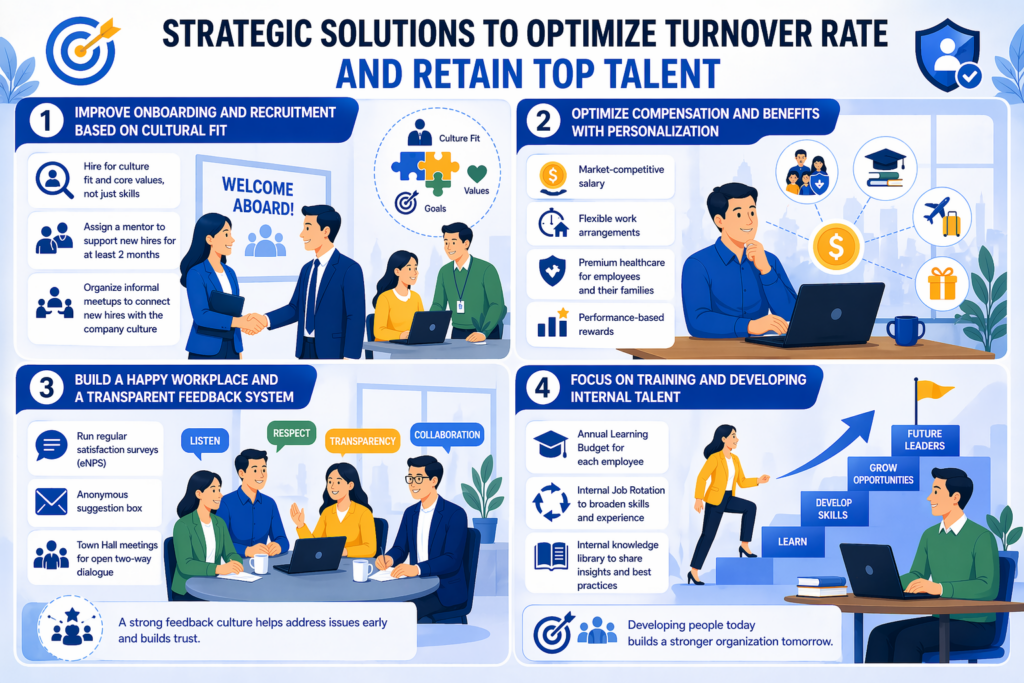
Retaining talent begins even before they officially become employees. Recruitment should not focus only on hard skills, but also pay special attention to alignment with the company’s culture and core values. A highly capable person whose mindset goes against the organization will soon become a “foreign cell” and leave quickly.
The next step is the onboarding process. The first 90 days are decisive in determining whether an employee will stay for the long term. A well-designed onboarding program helps new hires feel welcomed, understand expectations clearly, and get familiar with the tools they need to succeed.
Optimization steps include:
- Use personality and mindset assessments during recruitment
- Assign a mentor to guide new employees for at least the first two months
- Organize informal meet-ups so new hires can connect with the company culture
2. Optimize compensation and personalize benefits
Salary is not everything, but it is a necessary condition. Businesses need to ensure their salaries are competitive with the market through annual salary benchmarking. However, to truly retain top employees, benefit policies need to be more flexible and personalized.
Different employee groups have different needs. Younger employees care more about learning opportunities and travel, while employees with families often care more about health insurance and flexible working hours. Applying the same benefits formula to everyone is no longer effective.
Suggestions for modern compensation and benefits include:
- Flexible working: Allow remote work or flexible office hours
- Premium healthcare packages: Including coverage for employees’ family members
- Performance-based rewards for top contributors: Instead of equal distribution, focus the budget on those who contribute the most
3. Build a happy work environment and a transparent feedback system
A happy workplace is one where employees feel psychologically safe enough to speak up without fear of being judged. Businesses should build a transparent two-way feedback system. Instead of only having managers evaluate employees, employees should also be allowed to evaluate managers and contribute suggestions to the company’s operating processes.
A strong feedback culture helps solve conflicts while they are still small, preventing frustration from building up over time and leading to sudden resignations. When employees feel their voice matters, they become more responsible toward the organization.
Specific actions include:
- Conduct regular employee satisfaction surveys (eNPS)
- Create an anonymous suggestion box
- Organize Town Hall meetings where leadership answers employees’ questions
4. Focus on training and developing internal talent
Investing in employee development is the most profitable investment a company can make. Instead of fearing that “if we train them, they will leave,” companies should fear that “if we do not train them, they will stay and remain underdeveloped.” Outstanding employees always crave new knowledge. If the company gives them opportunities to study, attend international conferences, or join specialized training programs, they will feel valued.
In addition, succession planning helps top employees see a future for themselves in higher-level positions. This not only helps retain them, but also ensures the company has a ready pipeline of strong candidates for future leadership roles.
A training strategy should include:
- A personal learning budget for each employee every year
- Job rotation programs to refresh work routines and broaden skills
- Building an internal knowledge library to share experience among employees
Conclusion
Optimizing turnover rate is not something that can be done overnight. It is a long-term management journey that requires persistence and empathy. Businesses need to understand that talent is their most valuable asset, and when talented people resign, it is usually the result of prolonged disappointment rather than a sudden decision.
By focusing on improving manager-employee relationships, building clear career paths, optimizing benefits, and strengthening company culture, businesses can not only reduce the cost of replacing employees but also build a strong employer brand in the market. Start with the smallest changes in how you listen to and appreciate your employees, because they are the ones who will help the company weather difficulties and achieve sustainable success.
To empower your business in overcoming HR management challenges and staying fully committed to your strategic goals, we provide specialized solutions:
- [RPO Services]: A comprehensive recruitment process outsourcing solution.
- [BPO Services]: Strategic outsourcing to streamline business processes and optimize operational costs.