
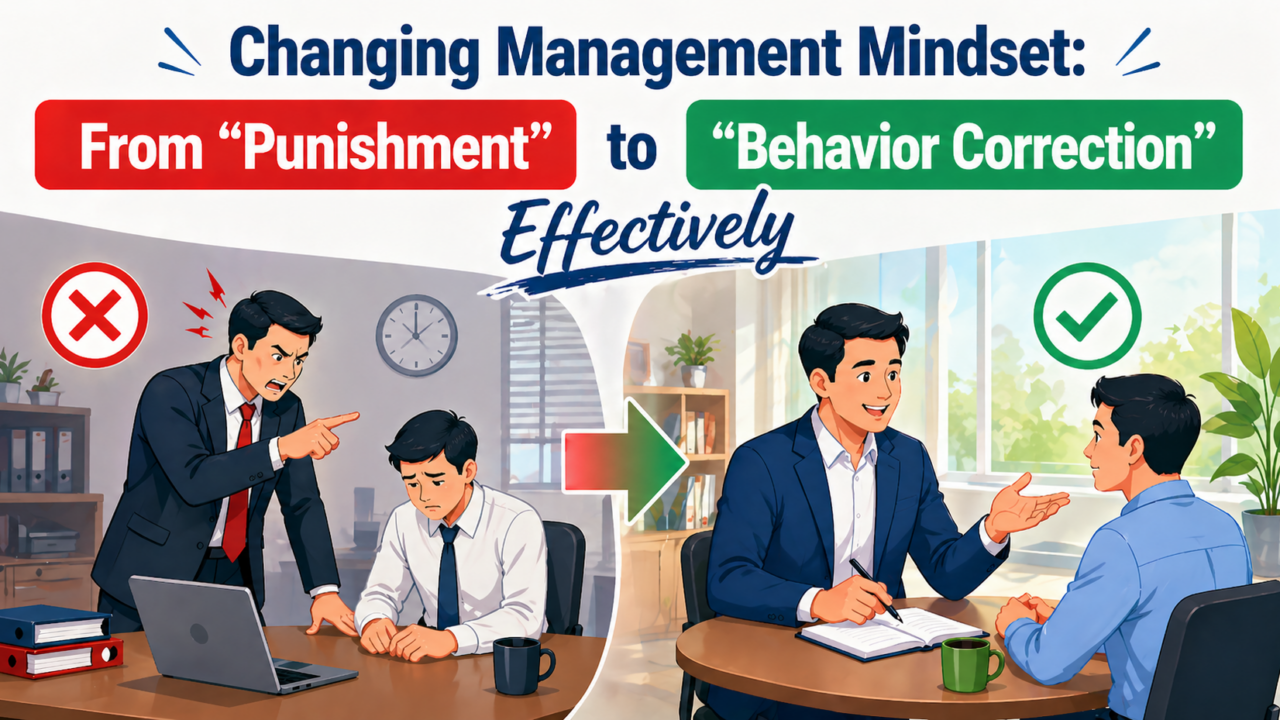
Modern workforce management requires shifting from punishment to behavioral correction to foster positive discipline, improve employee performance, and build a healthy corporate culture.
- What is the shift from punishment to behavioral correction?
- Why should businesses shift from punishment to behavioral correction?
- Core differences between “Punishment” and “Behavioral Correction”
- The process of applying “Behavioral Correction” in labor management
- Challenges when shifting management mindsets in the Vietnamese market
- Conclusion
What is the shift from punishment to behavioral correction?
In traditional HR management environments, when an employee makes a mistake, the company’s first instinct is often to apply disciplinary measures such as reprimands, salary deductions, or termination. This approach, known as “Punishment,” focuses on imposing negative consequences to deter recurrence. However, this mindset typically only addresses the symptoms of the problem and often triggers a culture of resentment or fear within the organization.
Shifting toward “Behavioral Correction” represents a significant advancement in modern labor management. Instead of focusing on making the employee “pay” for their mistake, behavioral correction focuses on understanding “why” the error occurred and how to help the employee improve. This is a process of guidance, support, and cognitive adjustment, empowering workers to recognize their responsibilities and voluntarily change toward a more positive direction.
This philosophy views mistakes as opportunities for training and development rather than excuses for elimination. It shifts the role of HR professionals and direct managers from “judges” to “mentors.” The ultimate goal is not blind compliance driven by fear, but a self-driven commitment from the employee to the company’s standards and values.
Why should businesses shift from punishment to behavioral correction?
1. Limitations of the traditional fear-based discipline model
A purely punitive model often creates a high-pressure atmosphere that stifles creativity. When employees work in constant fear of penalties, they tend to hide mistakes rather than reporting them to find solutions. This leads to latent risks for the business, where process flaws never come to light until they escalate into major disasters.
Furthermore, excessive punishment can severely damage employee self-esteem and engagement. An employee who is publicly reprimanded or faces unreasonable fines will develop a sense of dissatisfaction, leading to “quiet quitting.” While they remain physically present at the office, their productivity drops, and they lose the passion to contribute to the company’s collective growth.
Legally, applying rigid punitive measures can easily lead to unnecessary labor disputes. In Vietnam, labor discipline regulations are quite stringent; if a business focuses solely on punishment without a supportive correction process, they face significant legal risks should employees file complaints regarding the fairness and humanity of the disciplinary decision.
2. Promoting self-discipline and personal accountability
Behavioral correction helps employees understand the essence of regulations rather than just the penalties. When managers take the time to explain why a certain behavior impacts the team, employees begin to develop an accountability mindset. They understand that compliance is not about avoiding punishment but about ensuring smooth operations and protecting collective interests.
Self-discipline only arises from understanding. By encouraging employees to propose their own solutions to avoid repeating mistakes, businesses grant them a sense of ownership over their work. This creates a positive feedback loop: employees feel respected and are consequently motivated to self-adjust their behavior without the need for constant supervision.
Moreover, this mindset helps uncover hidden talent in individuals who once made mistakes. Many employees face performance issues not because of a lack of ability, but because they haven’t found the right working method or are facing personal difficulties. Behavioral correction coupled with support helps them overcome these hurdles and become key contributors in the future.
3. Building a humane work environment and sustainable engagement
A company that values behavioral correction builds a culture of trust and transparency. Employees feel safe knowing that if they make an honest mistake, they will be guided to do better rather than being crushed. Psychological Safety is a prerequisite for fostering innovation and teamwork in any organization.
When the work environment becomes more humane, talent retention rates increase significantly. In Vietnam’s competitive labor market, employees—especially Gen Z—do not just work for a salary; they work for growth. A business that knows how to “fix” a mistake rather than “remove” the person who made it builds an extremely reputable employer brand.
This sustainable engagement also brings direct economic value. The cost of recruiting and training a new employee is always much higher than retraining an existing one. Persisting with a behavioral correction model allows businesses to optimize HR resources, minimize turnover, and maintain stability in long-term operations.
Core differences between “Punishment” and “Behavioral Correction”
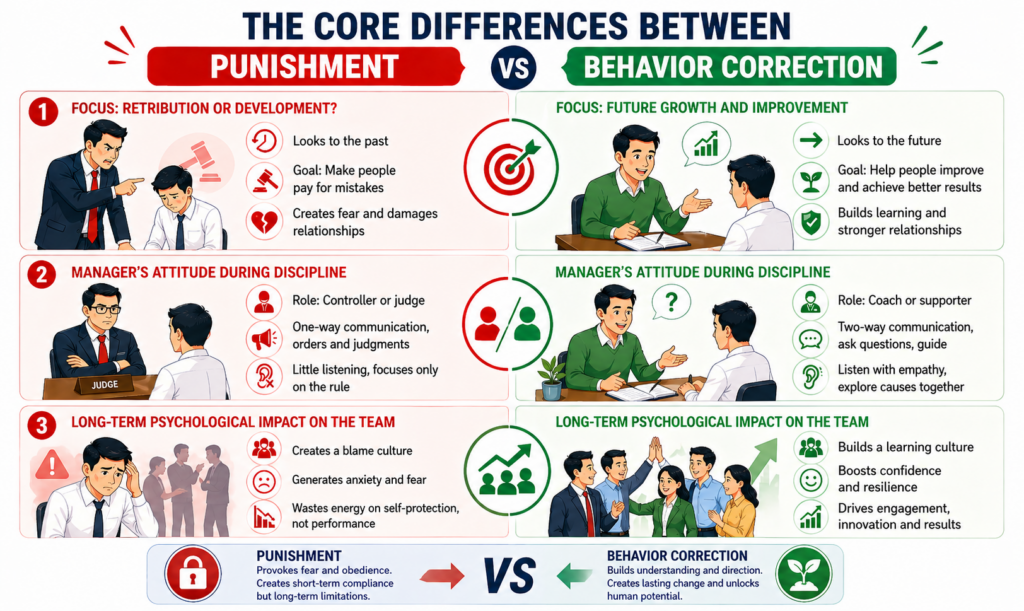
1. The Target: Retaliation or Development?
Punishment is often “backward-looking.” Its primary purpose is to make the worker suffer a consequence proportional to the mistake they made. It is akin to a sentence passed for deterrence but lacks a roadmap for improvement. This retaliation might satisfy a manager’s ego, but it leaves deep cracks in the labor relationship.
In contrast, behavioral correction is entirely “forward-looking.” The goal is not to make the employee feel bad about themselves but to help them understand how to achieve better results next time. It turns a mistake into a practical lesson—a “case study”—where both the employee and manager sit down to learn and improve the current workflow.
The difference also lies in the sustainability of results. Punishment may yield immediate change due to fear, but that change vanishes once supervision loosens. Behavioral correction aims for an internal cognitive shift, helping correct behaviors become a natural habit, regardless of whether someone is watching.
2. Managerial attitude during the disciplinary process
In the punishment model, the manager often acts as a controller or a judge. They stand in a superior position, passing judgment and imposing sanctions based on dry contractual terms. Communication in this context is usually one-way, authoritative, and lacks a listening ear for the objective reasons behind the error.
In the behavioral correction model, the manager acts as a coach or a supporter. Their attitude is one of calmness, empathy, and patience. Instead of using harsh critical language, they use open-ended questions to let the employee identify the problem themselves. They listen to the employee’s difficulties and discuss the barriers preventing them from performing well.
This change in attitude reduces hostility in disciplinary dialogues. When employees feel sincerity and a desire to help from their superiors, they are more likely to open up, admit faults, and commit to improvement. This is the foundation of Empathetic Leadership, a rising trend in the global HR industry.
3. Long-term psychological impact on the workforce
Prolonged punishment creates a “blame culture.” When a problem occurs, the first thing people do is shift responsibility to avoid being penalized. This destroys team solidarity and creates internal cliques. Constant anxiety drains employee energy, forcing them to focus on self-protection rather than professional excellence.
Behavioral correction nurtures a Growth Mindset. Employees learn that mistakes are part of the learning process and that they have the right to fix them. This builds confidence and resilience. When workers know the organization will support them during challenges, they are more willing to test new ideas and give their best to collective goals.
Long-term, this method produces a successor generation of leaders with positive mindsets. Employees managed through behavioral correction today will carry that mindset when they become managers in the future. This creates a sustainable cultural legacy where people are at the center and every mistake is transformed into a force for growth.
The process of applying “Behavioral Correction” in labor management
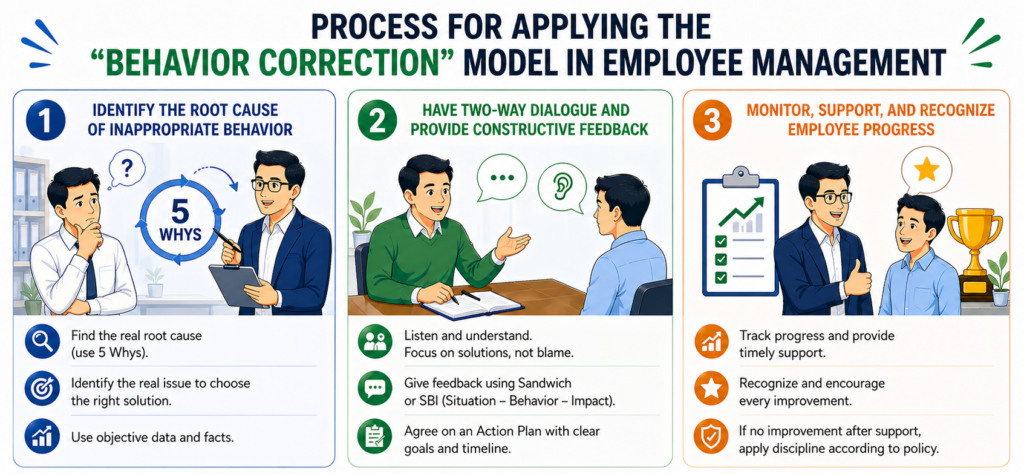
1. Identifying the root cause of inappropriate behavior
The first and most important step is to avoid jumping to conclusions. Instead of scolding an employee for being late or making an incorrect report, a manager should calmly investigate the true cause. The error might not stem from attitude, but from unclear instructions, a faulty tool, or serious personal crises the employee is facing.
Managers should use the “5 Whys” technique to dig deeper. Identifying the correct cause leads to the most accurate solution. If an employee fails due to a lack of skills, the solution is training; if they fail due to a lack of focus, the solution is workload adjustment or psychological support. Behavioral “healing” is only effective when the “disease” is correctly diagnosed.
This stage also requires objective data collection. Instead of saying, “You are often irresponsible,” point to specific data: “In the last two weeks, three reports were submitted past the deadline.” Basing the conversation on data keeps it professional, avoids the feeling of a personal attack, and helps the employee accept reality to begin changing.
2. Establishing two-way dialogue and constructive feedback
Once data is collected and the cause is understood, a private dialogue is essential. This is not an “arraignment,” but an exchange to find solutions. Managers need to create a safe, comfortable space for employees to present their perspective. The golden rule here is: “Praise publicly, correct privately.”
During the dialogue, use the “Sandwich” feedback technique or the SBI model (Situation – Behavior – Impact). Start by acknowledging the employee’s strengths, then clearly point out the behavior that needs correction and analyze its impact on the department’s performance. Most importantly, ask: “How can I help you ensure this doesn’t happen again?”
The outcome of the dialogue must be a specific Action Plan. This plan should have measurable goals and clear deadlines. Involving the employee directly in building this plan increases their sense of responsibility. Mutual agreement serves as a “psychological contract” ensuring the change is substantive.
3. Monitoring, supporting, and recognizing progress
Behavioral correction is an ongoing partnership, not a one-time event. After the dialogue, managers must closely monitor the employee’s improvement path. This monitoring is not intrusive surveillance but a form of care to promptly resolve any difficulties that arise as the employee changes old habits.
Every small step forward should be recognized and encouraged. Timely praise serves as a powerful mental boost, giving the employee confidence that they are on the right track. This recognition reinforces new positive behaviors, making them part of the worker’s new professional identity.
If behavior does not improve after a period of support, the business should then consider stricter disciplinary steps according to regulations. However, at this point, the employee will not feel wronged because they were given every opportunity and support to change. This ensures absolute fairness and genuine acceptance from the worker.
Challenges when shifting management mindsets in the Vietnamese market
1. Barriers from old management prejudices and leadership egos
In many Vietnamese enterprises—especially long-standing ones—an “authoritarian” or “paternalistic” management style remains deeply rooted. Many leaders believe that being soft and supporting employees is a sign of weakness that leads to being “taken advantage of.” They believe only “iron discipline” and heavy penalties maintain order and dignity.
Overcoming the personal ego to admit that old methods are no longer effective is a major challenge. Shifting to behavioral correction requires leaders to invest more time and effort into listening and understanding rather than just giving orders. This is a shift in “character,” not just “skill,” requiring great persistence and tolerance.
To resolve this, businesses need Leadership Development programs. When leaders see the actual data on improved performance and engagement after applying the new model, they will have the confidence to fully transform their management style.
2. Difficulty in changing the collective perception of employees
Not just managers, but employees themselves are often accustomed to a punishment culture. They may become wary or skeptical when a manager approaches them with a gentle, supportive tone. A “waiting for the trap” mentality can hinder initial dialogues and lead to a lack of sincerity from the employee.
Additionally, some employees may exploit the humanity of the behavioral correction method to delay change or evade responsibility. Without firm commitment and a tight monitoring process, behavioral correction can degenerate into leniency, causing unfairness toward employees who always comply with regulations.
The key here is consistency. Businesses must clearly communicate this new philosophy to all staff. Everyone needs to understand that “behavioral correction” does not mean “no discipline.” Discipline still exists, but it is enforced for the purpose of building and helping. Over time, as trust is established, collective skepticism will be replaced by support and cooperation.
3. Requirements for communication and empathy skills in HR teams
The HR team acts as the “architect” and coordinator of this transition. However, not all HR staff possess the skills to adjust behavior subtly. It requires keen psychological observation, negotiation skills, and the ability to resolve conflicts peacefully—skills often overlooked in traditional HR training.
HR must act as a mediator between angry direct managers and fearful employees. They need to establish codes of conduct and specific guidelines so other departments can apply the behavioral correction model consistently. If HR lacks the courage or empathy, this process can easily become hollow and purely formal.
Investing in specialized training for HR teams in organizational psychology and coaching is vital. When HR becomes true experts in behavioral correction, they become a solid pillar for the business in building high-quality human resources and a happy working environment.
Conclusion
Shifting from “Punishment” to “Behavioral Correction” is not just a trend but a necessity for businesses wanting to survive and thrive in the new era. Although this journey is challenging—especially in Vietnam with its unique cultural and psychological landscape—the benefits are invaluable. By focusing on human development, understanding root causes, and supporting improvement, businesses will build a team that is not only professionally skilled but also highly accountable and engaged. Remember, the ultimate goal of labor management is not to create people who are afraid to fail, but to create people who aspire to do things right and do them better every day.
To empower your business in overcoming HR management challenges and staying fully committed to your strategic goals, we provide specialized solutions:
- [RPO Services]: A comprehensive recruitment process outsourcing solution.
- [BPO Services]: Strategic outsourcing to streamline business processes and optimize operational costs.
For any inquiries, contact Wacontre Accounting Services via Hotline: (028) 3820 1213 or email [email protected] for prompt assistance. With a team of experienced professionals, Wacontre is committed to providing dedicated and efficient service. (For Japanese clients, please contact Hotline: (050) 5534 5505).