
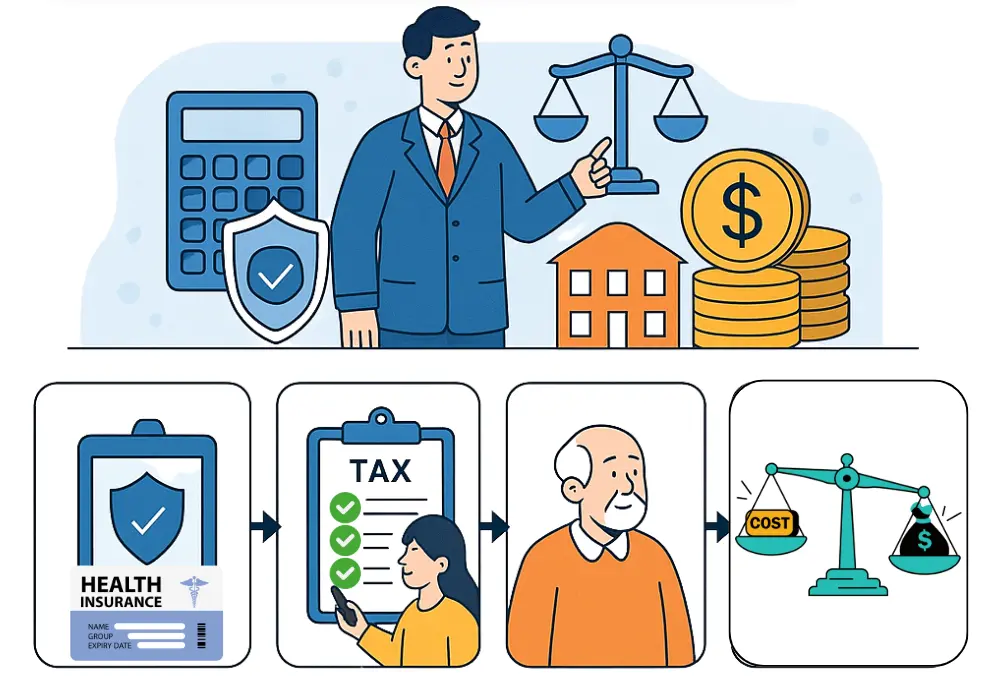
Calculating payroll deductions accurately is essential for compliance with Vietnam’s labor, tax, and social insurance regulations. This guide covers mandatory deductions including social insurance, health insurance, unemployment insurance, and personal income tax, with detailed formulas and practical examples.
Mandatory Payroll Deductions in Vietnam
1. Social Insurance (SI)
Employees contribute 8% of their insurable salary toward the social insurance fund, which covers retirement and death benefits. The insurable salary base includes the basic wage and approved allowances but cannot exceed 20 times the regional minimum wage.
Common Error: Including non-insurable allowances (meal allowance, transportation, business trip allowance) in the calculation, leading to overpayment or audit adjustments.
2. Health Insurance (HI)
Employees contribute 1.5% of their insurable salary for health insurance coverage. The salary base and ceiling are identical to social insurance. This deduction ensures access to medical examination and treatment benefits.
Important Note: Apply the same ceiling as social insurance to avoid overpayment.
3. Unemployment Insurance (UI)
Employees contribute 1% toward unemployment insurance. Unlike SI and HI, the UI ceiling is based on 20 times the regional minimum wage, not the base salary. This distinction is critical for accurate calculation.
Common Error: Confusing the regional minimum wage ceiling with the base salary ceiling, resulting in incorrect calculations.
4. Personal Income Tax (PIT)
PIT applies to taxable income after deductions. Accurate determination requires identifying:
- Taxable income and tax-exempt income
- Allowable deductions (SI, HI, UI, personal deduction, dependent deduction)
- Applicable tax rates
Common Error: Misclassifying taxable allowances as tax-exempt, leading to incorrect PIT calculations and audit findings.
Personal Income Tax Deductions and Thresholds
Personal Deduction
All resident employees with salary income are entitled to a personal deduction. The current thresholds are:
- Monthly: 11,000,000 VND
- Annual: 132,000,000 VND
Key Principle: Personal deduction applies for each month the employee is present at the company, not based on actual working days. This ensures consistent tax benefits and minimizes errors in year-end reconciliation.
Dependent Deduction
Employees may claim 4,400,000 VND/month for each eligible dependent. Dependents must be properly registered with supporting documentation per legal requirements.
Risk Areas: Failing to register dependents on time, claiming ineligible dependents, or miscalculating the support obligation timeline.
2026 Update: Effective January 1, 2026, deduction thresholds increased:
- Personal deduction: Increased from 11 million VND/month to 15.5 million VND/month (approximately 186 million VND/year).
- Dependent deduction: Increased from 4.4 million VND/month to 6.2 million VND/month per dependent.
Step-by-Step Payroll Deduction Calculation Process

Step 1: Determine the Insurable Salary Base
This foundational step determines the accuracy of all insurance calculations:
- Identify the base salary and insurable allowances
- Exclude non-insurable amounts (meal allowance, phone allowance, travel reimbursement, business trip allowance)
- Apply the appropriate ceiling (20 times the regional minimum wage for SI and HI; 20 times the regional minimum wage for UI)
- Verify consistency across all insurance types
Step 2: Calculate Insurance Contributions
Apply the prescribed rates to the insurable salary:
| Deduction Type | Employee Rate | Basis |
| Social Insurance | 8% | Insurable Salary |
| Health Insurance | 1.5% | Insurable Salary |
| Unemployment Insurance | 1% | Insurable Salary or Regional Minimum Wage (whichever is higher) |
| Personal Income Tax | Progressive Scale | Taxable Income after deductions |
Step 3: Calculate Taxable Income and Personal Income Tax
Formula: Taxable Income = Total Gross Income – Insurance Contributions – Personal Deduction – Dependent Deduction
Apply the progressive tax rate schedule to the taxable income. If taxable income is negative or below the threshold, no PIT is due.
Step 4: Calculate Net Salary
Formula: Net Salary = Gross Income – Total Deductions (SI + HI + UI + PIT)
Practical Example: Payroll Deduction Calculation
Employee Profile:
- Insurable Salary Base: 10,000,000 VND
- Total Gross Income: 12,000,000 VND (includes non-insurable allowance)
- Dependents: None
- Personal Deduction: 11,000,000 VND/month
- Regional Minimum Wage (Zone I): 4,680,000 VND
Calculation:
Social Insurance = 10,000,000 × 8% = 800,000 VND
Health Insurance = 10,000,000 × 1.5% = 150,000 VND
Unemployment Insurance = 10,000,000 × 1% = 100,000 VND
Total Insurance Contributions = 1,050,000 VND
Taxable Income = 12,000,000 – 1,050,000 – 11,000,000 = Negative 50,000 VND
Personal Income Tax = 0 VND (no tax owed)
Net Salary = 12,000,000 – 1,050,000 = 10,950,000 VND
Conclusion
Accurate payroll deduction calculations require thorough understanding of Vietnam’s tax, labor, and social insurance regulations, attention to detail, and systematic documentation. Businesses should implement standardized payroll processes, maintain detailed records, and regularly review regulations to ensure compliance and build employee trust. A well-managed payroll system demonstrates professionalism and protects the company from audit risks.
For assistance with payroll management, tax compliance, and HR services in Vietnam, contact Wacontre Accounting Services. Hotline: (028) 3820 1213 or email [email protected]. For Japanese clients, call (050) 5534 5505.
Register here to access our payroll deduction resources.