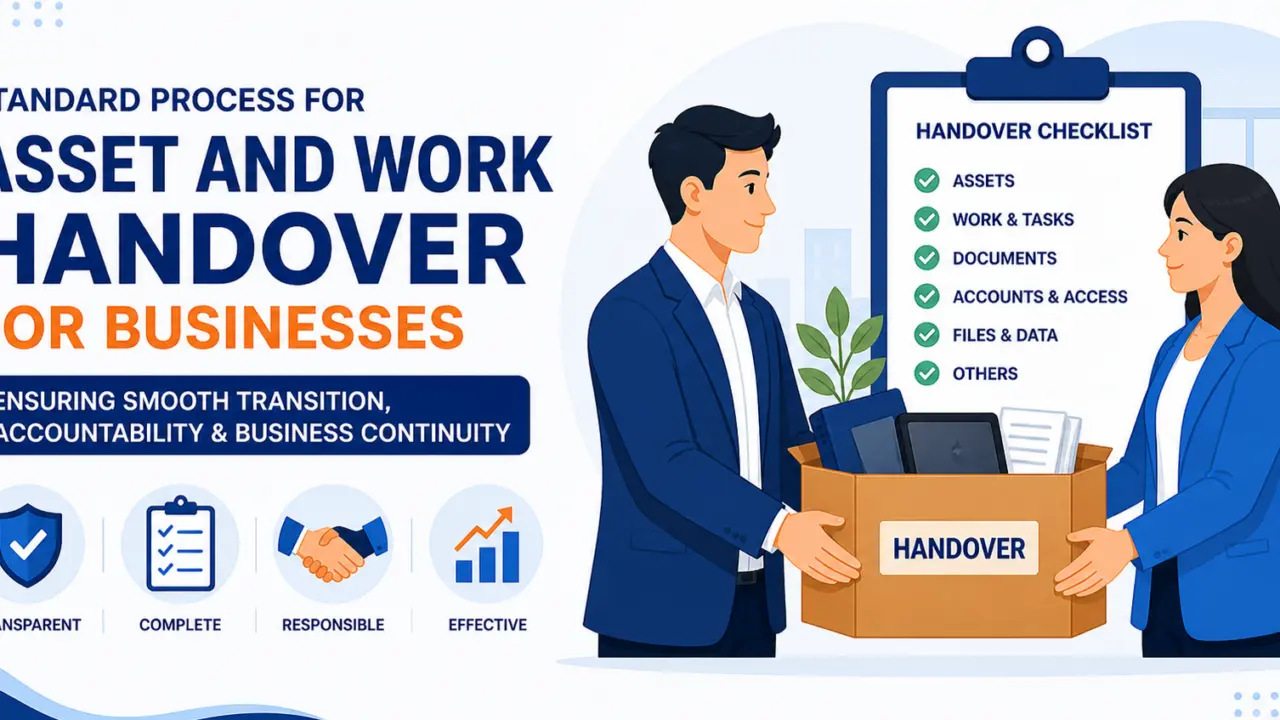
A professional asset and workload handover process is vital for continuity. Learn how to manage employee offboarding and asset transfer effectively within your organization.
What is the Asset and Workload Handover Process?
In human resource management, the asset and workload handover process is a systematic series of activities designed to transfer management rights, asset usage, and professional responsibilities from an outgoing employee to a successor or direct manager. This is far more than a mere administrative formality; it is a critical bridge that ensures organizational stability. This process encompasses inventorying hardware, transferring software accounts, digital data migration, and, crucially, updating the status of ongoing projects.
Implementing a structured handover helps businesses mitigate the risk of physical and intellectual property loss. For the employee, this represents their final responsibility, reflecting their professionalism and work ethics prior to the termination of their labor contract. A robust handover process ensures that no information gaps are left behind, enabling the newcomer to gain immediate traction without disrupting services for clients or partners.
The Importance of a Standardized Handover Process
1. Ensuring Business Continuity
When an employee vacates a position, the specialized knowledge and project momentum they hold must be transitioned seamlessly. Without a standardized process, a successor may spend excessive time retracing steps, leading to project delays and reduced departmental productivity. Organizations must recognize that the handover period is a “golden window” to preserve operational value.
Detailed handovers ensure that relationships with clients and partners remain unaffected. The successor will be well-versed in transaction history, outstanding commitments, and specific client preferences. This continuity not only upholds the company’s reputation but also maintains steady revenue during personnel transitions, which are often prone to volatility.
2. Protecting Corporate Assets and Data Security
Corporate assets extend beyond laptops and furniture to include intangible assets such as client databases, business strategies, and technological secrets. A rigorous handover process empowers IT and administrative departments to revoke system access immediately upon departure. This prevents the leakage of sensitive information to competitors.
Furthermore, the recovery of physical assets—such as laptops, mobile devices, access cards, or company vehicles—must be conducted based on a clear inventory list. Many enterprises in Vietnam face challenges in asset recovery without a signed handover minutes. A standardized process provides a solid legal foundation to protect the organization’s property rights.
3. Cultivating a Professional and Transparent Work Environment
A company with a clear handover policy leaves a lasting impression of professionalism on both departing and remaining staff. It demonstrates that the business respects the value of work and is prepared for any personnel shifts. This contributes to a transparent corporate culture where rights and responsibilities are clearly defined through signed documentation.
This transparency also alleviates pressure on HR departments and line managers. With pre-established templates and roadmaps, the execution becomes natural, minimizing negative emotions or misunderstandings. Departing employees feel valued when they are given the opportunity to formally summarize their achievements and hand them over to the organization with dignity.
Steps to Implement an Effective Handover Process
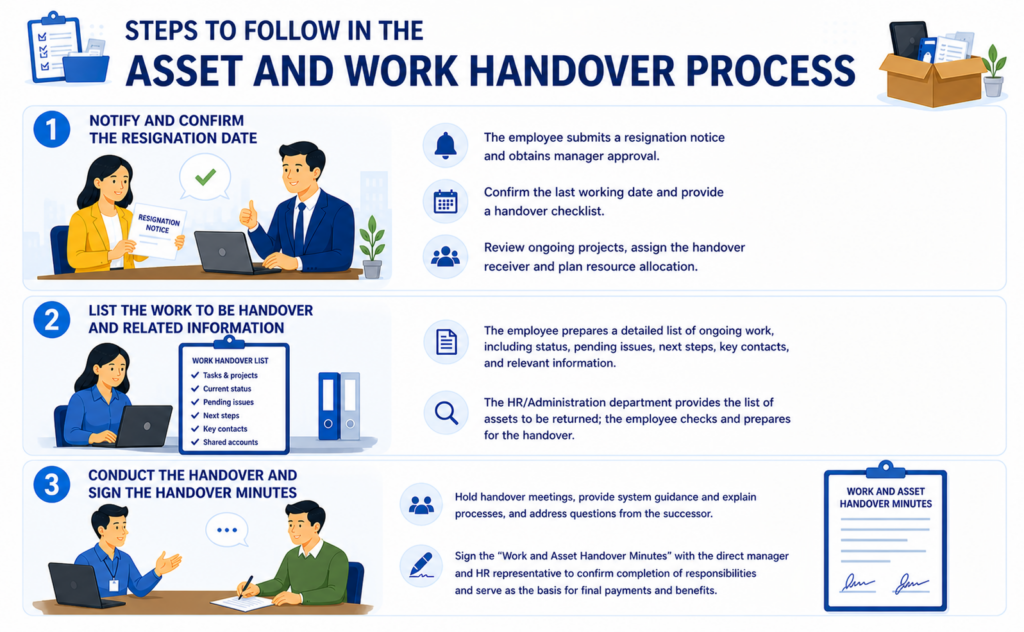
1. Notification and Confirmation of Departure Date
The first and most vital step is the formal submission and approval of the resignation notice. Once the final working day is determined—based on labor laws or mutual agreement—HR should immediately provide the employee with a checklist of handover items. Early confirmation allows the employee sufficient time to organize data files and mentally prepare for an optimal transition.
Direct managers should consult with the employee to audit ongoing projects and designate a successor. This is also the time for the business to reassess workloads for future recruitment or internal reallocation. Proactivity at this stage determines 50% of the overall success of the handover process.
2. Itemizing Work Tasks and Assets for Transfer
The departing employee is responsible for creating a detailed manifest of all current tasks, including completion status, pending issues, and proposed next steps. This manifest should include key contacts, shared account credentials, and storage locations for technical documents. The more detailed the documentation, the smoother the transition for the successor.
Simultaneously, the administration department provides a list of equipment issued to the employee at the start of their tenure. The employee must verify the functional status of all hardware before return. Cross-referencing the initial issuance list with the actual return is mandatory to ensure there are no unaccounted losses or damages.
3. Execution of Physical Transfer and Signing of Minutes
This phase involves direct handover meetings between the outgoing employee and the successor. During these sessions, the departing staff member demonstrates system usage, explains specific workflows, and addresses the successor’s queries. This should ideally occur at least one week before the final day to allow time for troubleshooting.
Once all parties agree on the content, the “Asset and Workload Handover Minutes” are signed, witnessed by the direct manager and an HR representative. This document serves as the primary legal record confirming the employee has fulfilled their obligations. It also acts as the basis for HR to process final salary payments, bonuses, and severance benefits.
Critical Assets and Documents to Consider
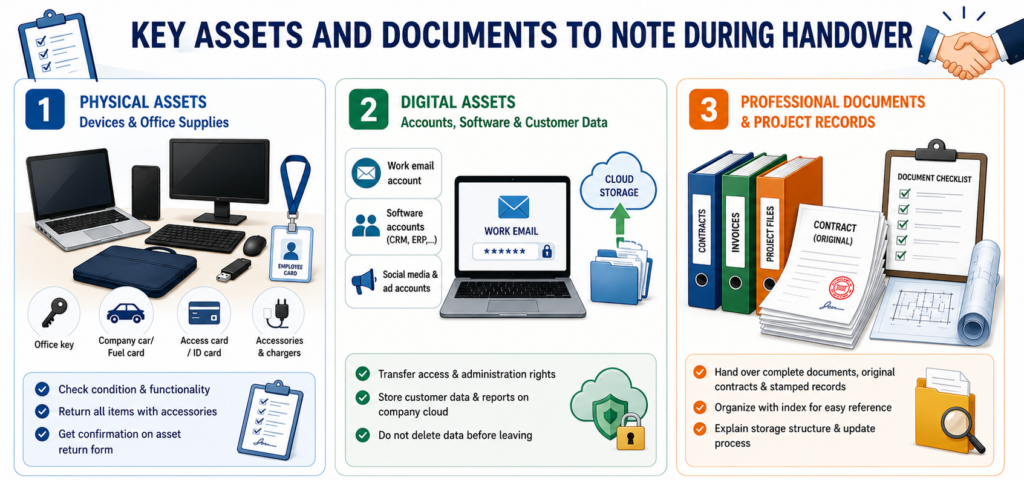
1. Physical Assets: Electronics and Stationery
This category typically includes laptops, company phones, monitors, peripherals, and storage devices like USBs or external hard drives. Additionally, items such as employee IDs, office keys, company cars, or fuel cards must be strictly recovered. Each device should undergo a physical and functional inspection to ensure it remains viable for future use.
2. Digital Assets: Email Accounts, Software, and Client Data
In the digital age, digital assets often carry higher value than physical ones. Employees must transfer administrative rights for social media pages, advertising accounts, management software (CRM/ERP), and specifically, official email accounts. Client data and strategic reports must be consolidated into shared cloud folders.
3. Professional Records and Project Documentation
For departments like accounting, engineering, or legal, handing over hard-copy files, original contracts, and stamped documents is paramount. These must be organized scientifically with a corresponding index. The loss of an original contract can lead to severe legal and financial repercussions for the business during audits or litigation.
Risks Associated with Lax Handover Processes
1. Loss of Confidential Information and Trade Secrets
If a handover does not include the revocation of access rights and a re-affirmation of Non-Disclosure Agreements (NDA), the business risks data theft. Former employees might use client data or technical “know-how” to benefit competitors or launch rival startups. This is a worst-case scenario that can result in significant financial damage.
2. Project Stagnation Due to Information Gaps
A superficial handover often leads to “lost” information. Successors may not know the current stage of a project or the nuances of verbal agreements with clients, leading to redundant work or costly errors. This stagnation erodes client trust in the organization’s professionalism and can result in the loss of key contracts.
Guidelines for Management and HR During Transition
1. Close Monitoring of Handover Milestones
HR should not merely appear on the final day to collect an ID badge. Instead, HR must collaborate with managers to track progress against a “Handover Checklist” weekly. Breaking down the process prevents a backlog of tasks on the final day and allows for timely intervention if an employee is uncooperative.
2. Conducting Exit Interviews to Optimize the Process
The exit interview is a valuable opportunity for HR to uncover the true reasons behind a resignation and gather feedback on the current handover protocol. Departing employees often provide objective insights into operational bottlenecks. This information helps the business improve the work environment and refine the handover process for future efficiency.
Conclusion
Establishing a standardized asset and workload handover process is a strategic investment in the long-term stability of a business. By maintaining strict control from the initial notice to the final signing, an organization protects both tangible and intangible assets while demonstrating excellence in human resource management. Ultimately, how an employee leaves and how a company sees them off is a definitive measure of that organization’s culture and professional standing.
To empower your business in overcoming HR management challenges and staying fully committed to your strategic goals, we provide specialized solutions:
- [RPO Services]: A comprehensive recruitment process outsourcing solution.
- [BPO Services]: Strategic outsourcing to streamline business processes and optimize operational costs.
For any inquiries, contact Wacontre Accounting Services via Hotline: (028) 3820 1213 or email [email protected] for prompt assistance. With a team of experienced professionals, Wacontre is committed to providing dedicated and efficient service. (For Japanese clients, please contact Hotline: (050) 5534 5505).