
New Personal Income Tax regulations for 2026 in Vietnam mark a significant policy shift to reduce the financial burden on residents and expats. The core change is the substantial increase in personal exemptions. This article provides a comprehensive breakdown of new exemption levels, the proposed progressive tax schedule changes, and implementation guidance to ensure compliance and optimize tax strategy for 2026.
- I. Overview of New Personal Income Tax Regulations for 2026
- 1. Purpose and Importance of the Amendment
- 2. Legal Basis and Effective Date
- 2. Compliance and Internal Communication
- 2. Compliance and Internal Communication
- 2. Compliance and Internal Communication
- 2. Compliance and Internal Communication
- 2. Compliance and Internal Communication
- 2. Compliance and Internal Communication
- 2. Compliance and Internal Communication
- 1. Updating Payroll Systems and Accounting Software
- 2. Compliance and Internal Communication
- V. Required Actions for Businesses and Taxpayers
- V. Required Actions for Businesses and Taxpayers
- V. Required Actions for Businesses and Taxpayers
- V. Required Actions for Businesses and Taxpayers
- V. Required Actions for Businesses and Taxpayers
- V. Required Actions for Businesses and Taxpayers
- V. Required Actions for Businesses and Taxpayers
- V. Required Actions for Businesses and Taxpayers
- V. Required Actions for Businesses and Taxpayers
- V. Required Actions for Businesses and Taxpayers
- V. Required Actions for Businesses and Taxpayers
- V. Required Actions for Businesses and Taxpayers
- V. Required Actions for Businesses and Taxpayers
- V. Required Actions for Businesses and Taxpayers
- V. Required Actions for Businesses and Taxpayers
- V. Required Actions for Businesses and Taxpayers
- V. Required Actions for Businesses and Taxpayers
- V. Required Actions for Businesses and Taxpayers
- V. Required Actions for Businesses and Taxpayers
- V. Required Actions for Businesses and Taxpayers
- V. Required Actions for Businesses and Taxpayers
- V. Required Actions for Businesses and Taxpayers
- IV. Key Points in the Draft Revised Personal Income Tax Law
- V. Required Actions for Businesses and Taxpayers
- IV. Key Points in the Draft Revised Personal Income Tax Law
- V. Required Actions for Businesses and Taxpayers
- IV. Key Points in the Draft Revised Personal Income Tax Law
- V. Required Actions for Businesses and Taxpayers
- IV. Key Points in the Draft Revised Personal Income Tax Law
- V. Required Actions for Businesses and Taxpayers
- IV. Key Points in the Draft Revised Personal Income Tax Law
- V. Required Actions for Businesses and Taxpayers
- IV. Key Points in the Draft Revised Personal Income Tax Law
- V. Required Actions for Businesses and Taxpayers
- IV. Key Points in the Draft Revised Personal Income Tax Law
- V. Required Actions for Businesses and Taxpayers
- IV. Key Points in the Draft Revised Personal Income Tax Law
- V. Required Actions for Businesses and Taxpayers
- III. Disposable Income Benefits
- IV. Key Points in the Draft Revised Personal Income Tax Law
- V. Required Actions for Businesses and Taxpayers
- III. Disposable Income Benefits
- IV. Key Points in the Draft Revised Personal Income Tax Law
- V. Required Actions for Businesses and Taxpayers
- III. Disposable Income Benefits
- IV. Key Points in the Draft Revised Personal Income Tax Law
- V. Required Actions for Businesses and Taxpayers
- III. Disposable Income Benefits
- IV. Key Points in the Draft Revised Personal Income Tax Law
- V. Required Actions for Businesses and Taxpayers
- III. Disposable Income Benefits
- IV. Key Points in the Draft Revised Personal Income Tax Law
- V. Required Actions for Businesses and Taxpayers
- III. Disposable Income Benefits
- IV. Key Points in the Draft Revised Personal Income Tax Law
- V. Required Actions for Businesses and Taxpayers
- III. Disposable Income Benefits
- IV. Key Points in the Draft Revised Personal Income Tax Law
- V. Required Actions for Businesses and Taxpayers
- III. Disposable Income Benefits
- IV. Key Points in the Draft Revised Personal Income Tax Law
- V. Required Actions for Businesses and Taxpayers
- III. Disposable Income Benefits
- IV. Key Points in the Draft Revised Personal Income Tax Law
- V. Required Actions for Businesses and Taxpayers
- III. Disposable Income Benefits
- IV. Key Points in the Draft Revised Personal Income Tax Law
- V. Required Actions for Businesses and Taxpayers
- III. Disposable Income Benefits
- IV. Key Points in the Draft Revised Personal Income Tax Law
- V. Required Actions for Businesses and Taxpayers
- III. Disposable Income Benefits
- IV. Key Points in the Draft Revised Personal Income Tax Law
- V. Required Actions for Businesses and Taxpayers
- III. Disposable Income Benefits
- IV. Key Points in the Draft Revised Personal Income Tax Law
- V. Required Actions for Businesses and Taxpayers
- III. Disposable Income Benefits
- IV. Key Points in the Draft Revised Personal Income Tax Law
- V. Required Actions for Businesses and Taxpayers
- III. Disposable Income Benefits
- IV. Key Points in the Draft Revised Personal Income Tax Law
- V. Required Actions for Businesses and Taxpayers
- II. Personal Exemption Increase – Effective from 2026 Tax Period
- III. Disposable Income Benefits
- IV. Key Points in the Draft Revised Personal Income Tax Law
- V. Required Actions for Businesses and Taxpayers
I. Overview of New Personal Income Tax Regulations for 2026
The New Personal Income Tax Regulations for 2026 represent critical adjustments to Vietnam’s personal income tax system, including a National Assembly Standing Committee Resolution increasing personal exemptions and extensive proposals for amending the Personal Income Tax Law (replacement). These changes aim to ensure fairness, reduce the tax burden on citizens amid inflation and rising costs, and modernize the system to align with economic growth and average income. The most direct and impactful change is the official increase of the 2026 personal exemption to VND 15.5 million/month, significantly boosting disposable income for workers.
1. Purpose and Importance of the Amendment
This round of personal income tax amendments is exceptionally significant for both tax policy and broader economic strategy. The primary objective is to balance state and individual interests, ensuring that basic living income is not taxed, thereby promoting social equity. The amendment is mandated because cumulative Consumer Price Index changes have exceeded 20% since the last adjustment in 2020, requiring National Assembly review per law. The reduction in tax obligations is expected to stimulate domestic consumption and fuel sustainable economic growth.
2. Legal Basis and Effective Date
The changes are based on two primary legal sources:
- National Assembly Standing Committee Resolution: Officially approved the personal exemption adjustment, effective immediately and applicable from the 2026 tax period (January 2026). This is the earliest and most certain regulation to take effect.
- Draft Personal Income Tax Law (Replacement): Expected passage by the National Assembly with effectiveness from July 1, 2026. This draft includes systemic changes such as the new progressive tax schedule and regulations for business individuals. Businesses must track the official passing date to prepare for the transitional period in 2026.
If you have questions, contact Wacontre via Hotline: (028) 3820 1213 or email [email protected] for prompt consultation and support. With our experienced team, Wacontre is ready to serve customers with enthusiasm and efficiency.

For businesses, proactive preparation—updating systems, training staff, ensuring strict dependent documentation compliance—ensures accurate implementation and stronger employee relations. Wacontre Accounting Services is committed to supporting your business in analyzing, advising on, and effectively implementing the 2026 regulations for full tax law compliance.
If you have questions, contact Wacontre via Hotline: (028) 3820 1213 or email [email protected] for prompt consultation and support. With our experienced team, Wacontre is ready to serve customers with enthusiasm and efficiency.
The 2026 Personal Income Tax regulations mark a significant milestone. The increase in personal exemptions to VND 15.5 million and VND 6.2 million per dependent demonstrates strong government support for the middle class, boosting disposable income and economic consumption.
For businesses, proactive preparation—updating systems, training staff, ensuring strict dependent documentation compliance—ensures accurate implementation and stronger employee relations. Wacontre Accounting Services is committed to supporting your business in analyzing, advising on, and effectively implementing the 2026 regulations for full tax law compliance.
If you have questions, contact Wacontre via Hotline: (028) 3820 1213 or email [email protected] for prompt consultation and support. With our experienced team, Wacontre is ready to serve customers with enthusiasm and efficiency.
Tax compliance is a primary business responsibility. A clear plan not only avoids penalties but reinforces company reputation with employees and government agencies.
The 2026 Personal Income Tax regulations mark a significant milestone. The increase in personal exemptions to VND 15.5 million and VND 6.2 million per dependent demonstrates strong government support for the middle class, boosting disposable income and economic consumption.
For businesses, proactive preparation—updating systems, training staff, ensuring strict dependent documentation compliance—ensures accurate implementation and stronger employee relations. Wacontre Accounting Services is committed to supporting your business in analyzing, advising on, and effectively implementing the 2026 regulations for full tax law compliance.
If you have questions, contact Wacontre via Hotline: (028) 3820 1213 or email [email protected] for prompt consultation and support. With our experienced team, Wacontre is ready to serve customers with enthusiasm and efficiency.
Tax compliance is a primary business responsibility. A clear plan not only avoids penalties but reinforces company reputation with employees and government agencies.
The 2026 Personal Income Tax regulations mark a significant milestone. The increase in personal exemptions to VND 15.5 million and VND 6.2 million per dependent demonstrates strong government support for the middle class, boosting disposable income and economic consumption.
For businesses, proactive preparation—updating systems, training staff, ensuring strict dependent documentation compliance—ensures accurate implementation and stronger employee relations. Wacontre Accounting Services is committed to supporting your business in analyzing, advising on, and effectively implementing the 2026 regulations for full tax law compliance.
If you have questions, contact Wacontre via Hotline: (028) 3820 1213 or email [email protected] for prompt consultation and support. With our experienced team, Wacontre is ready to serve customers with enthusiasm and efficiency.
Tax compliance is a primary business responsibility. A clear plan not only avoids penalties but reinforces company reputation with employees and government agencies.
The 2026 Personal Income Tax regulations mark a significant milestone. The increase in personal exemptions to VND 15.5 million and VND 6.2 million per dependent demonstrates strong government support for the middle class, boosting disposable income and economic consumption.
For businesses, proactive preparation—updating systems, training staff, ensuring strict dependent documentation compliance—ensures accurate implementation and stronger employee relations. Wacontre Accounting Services is committed to supporting your business in analyzing, advising on, and effectively implementing the 2026 regulations for full tax law compliance.
If you have questions, contact Wacontre via Hotline: (028) 3820 1213 or email [email protected] for prompt consultation and support. With our experienced team, Wacontre is ready to serve customers with enthusiasm and efficiency.
Tax compliance is a primary business responsibility. A clear plan not only avoids penalties but reinforces company reputation with employees and government agencies.
The 2026 Personal Income Tax regulations mark a significant milestone. The increase in personal exemptions to VND 15.5 million and VND 6.2 million per dependent demonstrates strong government support for the middle class, boosting disposable income and economic consumption.
For businesses, proactive preparation—updating systems, training staff, ensuring strict dependent documentation compliance—ensures accurate implementation and stronger employee relations. Wacontre Accounting Services is committed to supporting your business in analyzing, advising on, and effectively implementing the 2026 regulations for full tax law compliance.
If you have questions, contact Wacontre via Hotline: (028) 3820 1213 or email [email protected] for prompt consultation and support. With our experienced team, Wacontre is ready to serve customers with enthusiasm and efficiency.
- Specialized training: Organize in-depth training for Accounting, HR, and Finance teams on the new exemptions, potentially new tax schedules, and dependent documentation requirements;
- Transparent communication: Use internal channels to announce new exemption levels and net income impact. Transparency in dependent registration encourages employee compliance;
- Periodic review: Establish quarterly review processes for 2026 personal income tax calculations and dependent documentation, especially during any tax schedule transition, to detect and correct errors promptly.
Tax compliance is a primary business responsibility. A clear plan not only avoids penalties but reinforces company reputation with employees and government agencies.
The 2026 Personal Income Tax regulations mark a significant milestone. The increase in personal exemptions to VND 15.5 million and VND 6.2 million per dependent demonstrates strong government support for the middle class, boosting disposable income and economic consumption.
For businesses, proactive preparation—updating systems, training staff, ensuring strict dependent documentation compliance—ensures accurate implementation and stronger employee relations. Wacontre Accounting Services is committed to supporting your business in analyzing, advising on, and effectively implementing the 2026 regulations for full tax law compliance.
If you have questions, contact Wacontre via Hotline: (028) 3820 1213 or email [email protected] for prompt consultation and support. With our experienced team, Wacontre is ready to serve customers with enthusiasm and efficiency.
2. Compliance and Internal Communication
- Specialized training: Organize in-depth training for Accounting, HR, and Finance teams on the new exemptions, potentially new tax schedules, and dependent documentation requirements;
- Transparent communication: Use internal channels to announce new exemption levels and net income impact. Transparency in dependent registration encourages employee compliance;
- Periodic review: Establish quarterly review processes for 2026 personal income tax calculations and dependent documentation, especially during any tax schedule transition, to detect and correct errors promptly.
Tax compliance is a primary business responsibility. A clear plan not only avoids penalties but reinforces company reputation with employees and government agencies.
The 2026 Personal Income Tax regulations mark a significant milestone. The increase in personal exemptions to VND 15.5 million and VND 6.2 million per dependent demonstrates strong government support for the middle class, boosting disposable income and economic consumption.
For businesses, proactive preparation—updating systems, training staff, ensuring strict dependent documentation compliance—ensures accurate implementation and stronger employee relations. Wacontre Accounting Services is committed to supporting your business in analyzing, advising on, and effectively implementing the 2026 regulations for full tax law compliance.
If you have questions, contact Wacontre via Hotline: (028) 3820 1213 or email [email protected] for prompt consultation and support. With our experienced team, Wacontre is ready to serve customers with enthusiasm and efficiency.
Businesses should avoid manual updates due to high error risk. Work with software vendors for automatic updates, as even minor errors compound into major year-end discrepancies.
2. Compliance and Internal Communication
- Specialized training: Organize in-depth training for Accounting, HR, and Finance teams on the new exemptions, potentially new tax schedules, and dependent documentation requirements;
- Transparent communication: Use internal channels to announce new exemption levels and net income impact. Transparency in dependent registration encourages employee compliance;
- Periodic review: Establish quarterly review processes for 2026 personal income tax calculations and dependent documentation, especially during any tax schedule transition, to detect and correct errors promptly.
Tax compliance is a primary business responsibility. A clear plan not only avoids penalties but reinforces company reputation with employees and government agencies.
The 2026 Personal Income Tax regulations mark a significant milestone. The increase in personal exemptions to VND 15.5 million and VND 6.2 million per dependent demonstrates strong government support for the middle class, boosting disposable income and economic consumption.
For businesses, proactive preparation—updating systems, training staff, ensuring strict dependent documentation compliance—ensures accurate implementation and stronger employee relations. Wacontre Accounting Services is committed to supporting your business in analyzing, advising on, and effectively implementing the 2026 regulations for full tax law compliance.
If you have questions, contact Wacontre via Hotline: (028) 3820 1213 or email [email protected] for prompt consultation and support. With our experienced team, Wacontre is ready to serve customers with enthusiasm and efficiency.
Businesses should avoid manual updates due to high error risk. Work with software vendors for automatic updates, as even minor errors compound into major year-end discrepancies.
2. Compliance and Internal Communication
- Specialized training: Organize in-depth training for Accounting, HR, and Finance teams on the new exemptions, potentially new tax schedules, and dependent documentation requirements;
- Transparent communication: Use internal channels to announce new exemption levels and net income impact. Transparency in dependent registration encourages employee compliance;
- Periodic review: Establish quarterly review processes for 2026 personal income tax calculations and dependent documentation, especially during any tax schedule transition, to detect and correct errors promptly.
Tax compliance is a primary business responsibility. A clear plan not only avoids penalties but reinforces company reputation with employees and government agencies.
The 2026 Personal Income Tax regulations mark a significant milestone. The increase in personal exemptions to VND 15.5 million and VND 6.2 million per dependent demonstrates strong government support for the middle class, boosting disposable income and economic consumption.
For businesses, proactive preparation—updating systems, training staff, ensuring strict dependent documentation compliance—ensures accurate implementation and stronger employee relations. Wacontre Accounting Services is committed to supporting your business in analyzing, advising on, and effectively implementing the 2026 regulations for full tax law compliance.
If you have questions, contact Wacontre via Hotline: (028) 3820 1213 or email [email protected] for prompt consultation and support. With our experienced team, Wacontre is ready to serve customers with enthusiasm and efficiency.
Businesses should avoid manual updates due to high error risk. Work with software vendors for automatic updates, as even minor errors compound into major year-end discrepancies.
2. Compliance and Internal Communication
- Specialized training: Organize in-depth training for Accounting, HR, and Finance teams on the new exemptions, potentially new tax schedules, and dependent documentation requirements;
- Transparent communication: Use internal channels to announce new exemption levels and net income impact. Transparency in dependent registration encourages employee compliance;
- Periodic review: Establish quarterly review processes for 2026 personal income tax calculations and dependent documentation, especially during any tax schedule transition, to detect and correct errors promptly.
Tax compliance is a primary business responsibility. A clear plan not only avoids penalties but reinforces company reputation with employees and government agencies.
The 2026 Personal Income Tax regulations mark a significant milestone. The increase in personal exemptions to VND 15.5 million and VND 6.2 million per dependent demonstrates strong government support for the middle class, boosting disposable income and economic consumption.
For businesses, proactive preparation—updating systems, training staff, ensuring strict dependent documentation compliance—ensures accurate implementation and stronger employee relations. Wacontre Accounting Services is committed to supporting your business in analyzing, advising on, and effectively implementing the 2026 regulations for full tax law compliance.
If you have questions, contact Wacontre via Hotline: (028) 3820 1213 or email [email protected] for prompt consultation and support. With our experienced team, Wacontre is ready to serve customers with enthusiasm and efficiency.
Businesses should avoid manual updates due to high error risk. Work with software vendors for automatic updates, as even minor errors compound into major year-end discrepancies.
2. Compliance and Internal Communication
- Specialized training: Organize in-depth training for Accounting, HR, and Finance teams on the new exemptions, potentially new tax schedules, and dependent documentation requirements;
- Transparent communication: Use internal channels to announce new exemption levels and net income impact. Transparency in dependent registration encourages employee compliance;
- Periodic review: Establish quarterly review processes for 2026 personal income tax calculations and dependent documentation, especially during any tax schedule transition, to detect and correct errors promptly.
Tax compliance is a primary business responsibility. A clear plan not only avoids penalties but reinforces company reputation with employees and government agencies.
The 2026 Personal Income Tax regulations mark a significant milestone. The increase in personal exemptions to VND 15.5 million and VND 6.2 million per dependent demonstrates strong government support for the middle class, boosting disposable income and economic consumption.
For businesses, proactive preparation—updating systems, training staff, ensuring strict dependent documentation compliance—ensures accurate implementation and stronger employee relations. Wacontre Accounting Services is committed to supporting your business in analyzing, advising on, and effectively implementing the 2026 regulations for full tax law compliance.
If you have questions, contact Wacontre via Hotline: (028) 3820 1213 or email [email protected] for prompt consultation and support. With our experienced team, Wacontre is ready to serve customers with enthusiasm and efficiency.
- Update core parameters: By Q4/2025, IT and Accounting must plan to change exemption parameters in payroll systems (ERP, Excel, accounting software) effective January 1, 2026;
- Tax schedule flexibility: The system must seamlessly switch between current seven-bracket and proposed five-bracket schedules within 2026 if the new schedule takes effect mid-year, requiring effective date parameter settings;
- Stress testing: Conduct trial payroll runs for various employee groups (low, medium, high income, with/without dependents) using different exemption levels and tax schedules to ensure 100% calculation accuracy before official implementation.
Businesses should avoid manual updates due to high error risk. Work with software vendors for automatic updates, as even minor errors compound into major year-end discrepancies.
2. Compliance and Internal Communication
- Specialized training: Organize in-depth training for Accounting, HR, and Finance teams on the new exemptions, potentially new tax schedules, and dependent documentation requirements;
- Transparent communication: Use internal channels to announce new exemption levels and net income impact. Transparency in dependent registration encourages employee compliance;
- Periodic review: Establish quarterly review processes for 2026 personal income tax calculations and dependent documentation, especially during any tax schedule transition, to detect and correct errors promptly.
Tax compliance is a primary business responsibility. A clear plan not only avoids penalties but reinforces company reputation with employees and government agencies.
The 2026 Personal Income Tax regulations mark a significant milestone. The increase in personal exemptions to VND 15.5 million and VND 6.2 million per dependent demonstrates strong government support for the middle class, boosting disposable income and economic consumption.
For businesses, proactive preparation—updating systems, training staff, ensuring strict dependent documentation compliance—ensures accurate implementation and stronger employee relations. Wacontre Accounting Services is committed to supporting your business in analyzing, advising on, and effectively implementing the 2026 regulations for full tax law compliance.
If you have questions, contact Wacontre via Hotline: (028) 3820 1213 or email [email protected] for prompt consultation and support. With our experienced team, Wacontre is ready to serve customers with enthusiasm and efficiency.
Technical compliance is the priority:
- Update core parameters: By Q4/2025, IT and Accounting must plan to change exemption parameters in payroll systems (ERP, Excel, accounting software) effective January 1, 2026;
- Tax schedule flexibility: The system must seamlessly switch between current seven-bracket and proposed five-bracket schedules within 2026 if the new schedule takes effect mid-year, requiring effective date parameter settings;
- Stress testing: Conduct trial payroll runs for various employee groups (low, medium, high income, with/without dependents) using different exemption levels and tax schedules to ensure 100% calculation accuracy before official implementation.
Businesses should avoid manual updates due to high error risk. Work with software vendors for automatic updates, as even minor errors compound into major year-end discrepancies.
2. Compliance and Internal Communication
- Specialized training: Organize in-depth training for Accounting, HR, and Finance teams on the new exemptions, potentially new tax schedules, and dependent documentation requirements;
- Transparent communication: Use internal channels to announce new exemption levels and net income impact. Transparency in dependent registration encourages employee compliance;
- Periodic review: Establish quarterly review processes for 2026 personal income tax calculations and dependent documentation, especially during any tax schedule transition, to detect and correct errors promptly.
Tax compliance is a primary business responsibility. A clear plan not only avoids penalties but reinforces company reputation with employees and government agencies.
The 2026 Personal Income Tax regulations mark a significant milestone. The increase in personal exemptions to VND 15.5 million and VND 6.2 million per dependent demonstrates strong government support for the middle class, boosting disposable income and economic consumption.
For businesses, proactive preparation—updating systems, training staff, ensuring strict dependent documentation compliance—ensures accurate implementation and stronger employee relations. Wacontre Accounting Services is committed to supporting your business in analyzing, advising on, and effectively implementing the 2026 regulations for full tax law compliance.
If you have questions, contact Wacontre via Hotline: (028) 3820 1213 or email [email protected] for prompt consultation and support. With our experienced team, Wacontre is ready to serve customers with enthusiasm and efficiency.
1. Updating Payroll Systems and Accounting Software
Technical compliance is the priority:
- Update core parameters: By Q4/2025, IT and Accounting must plan to change exemption parameters in payroll systems (ERP, Excel, accounting software) effective January 1, 2026;
- Tax schedule flexibility: The system must seamlessly switch between current seven-bracket and proposed five-bracket schedules within 2026 if the new schedule takes effect mid-year, requiring effective date parameter settings;
- Stress testing: Conduct trial payroll runs for various employee groups (low, medium, high income, with/without dependents) using different exemption levels and tax schedules to ensure 100% calculation accuracy before official implementation.
Businesses should avoid manual updates due to high error risk. Work with software vendors for automatic updates, as even minor errors compound into major year-end discrepancies.
2. Compliance and Internal Communication
- Specialized training: Organize in-depth training for Accounting, HR, and Finance teams on the new exemptions, potentially new tax schedules, and dependent documentation requirements;
- Transparent communication: Use internal channels to announce new exemption levels and net income impact. Transparency in dependent registration encourages employee compliance;
- Periodic review: Establish quarterly review processes for 2026 personal income tax calculations and dependent documentation, especially during any tax schedule transition, to detect and correct errors promptly.
Tax compliance is a primary business responsibility. A clear plan not only avoids penalties but reinforces company reputation with employees and government agencies.
The 2026 Personal Income Tax regulations mark a significant milestone. The increase in personal exemptions to VND 15.5 million and VND 6.2 million per dependent demonstrates strong government support for the middle class, boosting disposable income and economic consumption.
For businesses, proactive preparation—updating systems, training staff, ensuring strict dependent documentation compliance—ensures accurate implementation and stronger employee relations. Wacontre Accounting Services is committed to supporting your business in analyzing, advising on, and effectively implementing the 2026 regulations for full tax law compliance.
If you have questions, contact Wacontre via Hotline: (028) 3820 1213 or email [email protected] for prompt consultation and support. With our experienced team, Wacontre is ready to serve customers with enthusiasm and efficiency.
V. Required Actions for Businesses and Taxpayers
1. Updating Payroll Systems and Accounting Software
Technical compliance is the priority:
- Update core parameters: By Q4/2025, IT and Accounting must plan to change exemption parameters in payroll systems (ERP, Excel, accounting software) effective January 1, 2026;
- Tax schedule flexibility: The system must seamlessly switch between current seven-bracket and proposed five-bracket schedules within 2026 if the new schedule takes effect mid-year, requiring effective date parameter settings;
- Stress testing: Conduct trial payroll runs for various employee groups (low, medium, high income, with/without dependents) using different exemption levels and tax schedules to ensure 100% calculation accuracy before official implementation.
Businesses should avoid manual updates due to high error risk. Work with software vendors for automatic updates, as even minor errors compound into major year-end discrepancies.
2. Compliance and Internal Communication
- Specialized training: Organize in-depth training for Accounting, HR, and Finance teams on the new exemptions, potentially new tax schedules, and dependent documentation requirements;
- Transparent communication: Use internal channels to announce new exemption levels and net income impact. Transparency in dependent registration encourages employee compliance;
- Periodic review: Establish quarterly review processes for 2026 personal income tax calculations and dependent documentation, especially during any tax schedule transition, to detect and correct errors promptly.
Tax compliance is a primary business responsibility. A clear plan not only avoids penalties but reinforces company reputation with employees and government agencies.
The 2026 Personal Income Tax regulations mark a significant milestone. The increase in personal exemptions to VND 15.5 million and VND 6.2 million per dependent demonstrates strong government support for the middle class, boosting disposable income and economic consumption.
For businesses, proactive preparation—updating systems, training staff, ensuring strict dependent documentation compliance—ensures accurate implementation and stronger employee relations. Wacontre Accounting Services is committed to supporting your business in analyzing, advising on, and effectively implementing the 2026 regulations for full tax law compliance.
If you have questions, contact Wacontre via Hotline: (028) 3820 1213 or email [email protected] for prompt consultation and support. With our experienced team, Wacontre is ready to serve customers with enthusiasm and efficiency.
Clear definitions of exempt income help businesses minimize tax collection risks. HR and Accounting must collaborate closely to review internal policies, ensuring compliance with new requirements to benefit from tax incentives.
V. Required Actions for Businesses and Taxpayers
1. Updating Payroll Systems and Accounting Software
Technical compliance is the priority:
- Update core parameters: By Q4/2025, IT and Accounting must plan to change exemption parameters in payroll systems (ERP, Excel, accounting software) effective January 1, 2026;
- Tax schedule flexibility: The system must seamlessly switch between current seven-bracket and proposed five-bracket schedules within 2026 if the new schedule takes effect mid-year, requiring effective date parameter settings;
- Stress testing: Conduct trial payroll runs for various employee groups (low, medium, high income, with/without dependents) using different exemption levels and tax schedules to ensure 100% calculation accuracy before official implementation.
Businesses should avoid manual updates due to high error risk. Work with software vendors for automatic updates, as even minor errors compound into major year-end discrepancies.
2. Compliance and Internal Communication
- Specialized training: Organize in-depth training for Accounting, HR, and Finance teams on the new exemptions, potentially new tax schedules, and dependent documentation requirements;
- Transparent communication: Use internal channels to announce new exemption levels and net income impact. Transparency in dependent registration encourages employee compliance;
- Periodic review: Establish quarterly review processes for 2026 personal income tax calculations and dependent documentation, especially during any tax schedule transition, to detect and correct errors promptly.
Tax compliance is a primary business responsibility. A clear plan not only avoids penalties but reinforces company reputation with employees and government agencies.
The 2026 Personal Income Tax regulations mark a significant milestone. The increase in personal exemptions to VND 15.5 million and VND 6.2 million per dependent demonstrates strong government support for the middle class, boosting disposable income and economic consumption.
For businesses, proactive preparation—updating systems, training staff, ensuring strict dependent documentation compliance—ensures accurate implementation and stronger employee relations. Wacontre Accounting Services is committed to supporting your business in analyzing, advising on, and effectively implementing the 2026 regulations for full tax law compliance.
If you have questions, contact Wacontre via Hotline: (028) 3820 1213 or email [email protected] for prompt consultation and support. With our experienced team, Wacontre is ready to serve customers with enthusiasm and efficiency.
Clear definitions of exempt income help businesses minimize tax collection risks. HR and Accounting must collaborate closely to review internal policies, ensuring compliance with new requirements to benefit from tax incentives.
V. Required Actions for Businesses and Taxpayers
1. Updating Payroll Systems and Accounting Software
Technical compliance is the priority:
- Update core parameters: By Q4/2025, IT and Accounting must plan to change exemption parameters in payroll systems (ERP, Excel, accounting software) effective January 1, 2026;
- Tax schedule flexibility: The system must seamlessly switch between current seven-bracket and proposed five-bracket schedules within 2026 if the new schedule takes effect mid-year, requiring effective date parameter settings;
- Stress testing: Conduct trial payroll runs for various employee groups (low, medium, high income, with/without dependents) using different exemption levels and tax schedules to ensure 100% calculation accuracy before official implementation.
Businesses should avoid manual updates due to high error risk. Work with software vendors for automatic updates, as even minor errors compound into major year-end discrepancies.
2. Compliance and Internal Communication
- Specialized training: Organize in-depth training for Accounting, HR, and Finance teams on the new exemptions, potentially new tax schedules, and dependent documentation requirements;
- Transparent communication: Use internal channels to announce new exemption levels and net income impact. Transparency in dependent registration encourages employee compliance;
- Periodic review: Establish quarterly review processes for 2026 personal income tax calculations and dependent documentation, especially during any tax schedule transition, to detect and correct errors promptly.
Tax compliance is a primary business responsibility. A clear plan not only avoids penalties but reinforces company reputation with employees and government agencies.
The 2026 Personal Income Tax regulations mark a significant milestone. The increase in personal exemptions to VND 15.5 million and VND 6.2 million per dependent demonstrates strong government support for the middle class, boosting disposable income and economic consumption.
For businesses, proactive preparation—updating systems, training staff, ensuring strict dependent documentation compliance—ensures accurate implementation and stronger employee relations. Wacontre Accounting Services is committed to supporting your business in analyzing, advising on, and effectively implementing the 2026 regulations for full tax law compliance.
If you have questions, contact Wacontre via Hotline: (028) 3820 1213 or email [email protected] for prompt consultation and support. With our experienced team, Wacontre is ready to serve customers with enthusiasm and efficiency.
Clear definitions of exempt income help businesses minimize tax collection risks. HR and Accounting must collaborate closely to review internal policies, ensuring compliance with new requirements to benefit from tax incentives.
V. Required Actions for Businesses and Taxpayers
1. Updating Payroll Systems and Accounting Software
Technical compliance is the priority:
- Update core parameters: By Q4/2025, IT and Accounting must plan to change exemption parameters in payroll systems (ERP, Excel, accounting software) effective January 1, 2026;
- Tax schedule flexibility: The system must seamlessly switch between current seven-bracket and proposed five-bracket schedules within 2026 if the new schedule takes effect mid-year, requiring effective date parameter settings;
- Stress testing: Conduct trial payroll runs for various employee groups (low, medium, high income, with/without dependents) using different exemption levels and tax schedules to ensure 100% calculation accuracy before official implementation.
Businesses should avoid manual updates due to high error risk. Work with software vendors for automatic updates, as even minor errors compound into major year-end discrepancies.
2. Compliance and Internal Communication
- Specialized training: Organize in-depth training for Accounting, HR, and Finance teams on the new exemptions, potentially new tax schedules, and dependent documentation requirements;
- Transparent communication: Use internal channels to announce new exemption levels and net income impact. Transparency in dependent registration encourages employee compliance;
- Periodic review: Establish quarterly review processes for 2026 personal income tax calculations and dependent documentation, especially during any tax schedule transition, to detect and correct errors promptly.
Tax compliance is a primary business responsibility. A clear plan not only avoids penalties but reinforces company reputation with employees and government agencies.
The 2026 Personal Income Tax regulations mark a significant milestone. The increase in personal exemptions to VND 15.5 million and VND 6.2 million per dependent demonstrates strong government support for the middle class, boosting disposable income and economic consumption.
For businesses, proactive preparation—updating systems, training staff, ensuring strict dependent documentation compliance—ensures accurate implementation and stronger employee relations. Wacontre Accounting Services is committed to supporting your business in analyzing, advising on, and effectively implementing the 2026 regulations for full tax law compliance.
If you have questions, contact Wacontre via Hotline: (028) 3820 1213 or email [email protected] for prompt consultation and support. With our experienced team, Wacontre is ready to serve customers with enthusiasm and efficiency.
Clear definitions of exempt income help businesses minimize tax collection risks. HR and Accounting must collaborate closely to review internal policies, ensuring compliance with new requirements to benefit from tax incentives.
V. Required Actions for Businesses and Taxpayers
1. Updating Payroll Systems and Accounting Software
Technical compliance is the priority:
- Update core parameters: By Q4/2025, IT and Accounting must plan to change exemption parameters in payroll systems (ERP, Excel, accounting software) effective January 1, 2026;
- Tax schedule flexibility: The system must seamlessly switch between current seven-bracket and proposed five-bracket schedules within 2026 if the new schedule takes effect mid-year, requiring effective date parameter settings;
- Stress testing: Conduct trial payroll runs for various employee groups (low, medium, high income, with/without dependents) using different exemption levels and tax schedules to ensure 100% calculation accuracy before official implementation.
Businesses should avoid manual updates due to high error risk. Work with software vendors for automatic updates, as even minor errors compound into major year-end discrepancies.
2. Compliance and Internal Communication
- Specialized training: Organize in-depth training for Accounting, HR, and Finance teams on the new exemptions, potentially new tax schedules, and dependent documentation requirements;
- Transparent communication: Use internal channels to announce new exemption levels and net income impact. Transparency in dependent registration encourages employee compliance;
- Periodic review: Establish quarterly review processes for 2026 personal income tax calculations and dependent documentation, especially during any tax schedule transition, to detect and correct errors promptly.
Tax compliance is a primary business responsibility. A clear plan not only avoids penalties but reinforces company reputation with employees and government agencies.
The 2026 Personal Income Tax regulations mark a significant milestone. The increase in personal exemptions to VND 15.5 million and VND 6.2 million per dependent demonstrates strong government support for the middle class, boosting disposable income and economic consumption.
For businesses, proactive preparation—updating systems, training staff, ensuring strict dependent documentation compliance—ensures accurate implementation and stronger employee relations. Wacontre Accounting Services is committed to supporting your business in analyzing, advising on, and effectively implementing the 2026 regulations for full tax law compliance.
If you have questions, contact Wacontre via Hotline: (028) 3820 1213 or email [email protected] for prompt consultation and support. With our experienced team, Wacontre is ready to serve customers with enthusiasm and efficiency.
- Exemption for reasonable lump-sum employee expenses: Tax exemption for lump-sum amounts provided to employees (phone, business travel, office supplies) is proposed, provided an internal expenditure policy exists. This offers businesses flexibility in structuring welfare and optimizing employee taxes.
- Digital economy income inclusion: The Draft supplements regulations on digital platform income and new digital asset taxation, ensuring the Law comprehensively covers technological-era income sources.
- State budget salary exemptions: Proposed tax exemption for state-funded salaries in specific professions (police, military).
Clear definitions of exempt income help businesses minimize tax collection risks. HR and Accounting must collaborate closely to review internal policies, ensuring compliance with new requirements to benefit from tax incentives.
V. Required Actions for Businesses and Taxpayers
1. Updating Payroll Systems and Accounting Software
Technical compliance is the priority:
- Update core parameters: By Q4/2025, IT and Accounting must plan to change exemption parameters in payroll systems (ERP, Excel, accounting software) effective January 1, 2026;
- Tax schedule flexibility: The system must seamlessly switch between current seven-bracket and proposed five-bracket schedules within 2026 if the new schedule takes effect mid-year, requiring effective date parameter settings;
- Stress testing: Conduct trial payroll runs for various employee groups (low, medium, high income, with/without dependents) using different exemption levels and tax schedules to ensure 100% calculation accuracy before official implementation.
Businesses should avoid manual updates due to high error risk. Work with software vendors for automatic updates, as even minor errors compound into major year-end discrepancies.
2. Compliance and Internal Communication
- Specialized training: Organize in-depth training for Accounting, HR, and Finance teams on the new exemptions, potentially new tax schedules, and dependent documentation requirements;
- Transparent communication: Use internal channels to announce new exemption levels and net income impact. Transparency in dependent registration encourages employee compliance;
- Periodic review: Establish quarterly review processes for 2026 personal income tax calculations and dependent documentation, especially during any tax schedule transition, to detect and correct errors promptly.
Tax compliance is a primary business responsibility. A clear plan not only avoids penalties but reinforces company reputation with employees and government agencies.
The 2026 Personal Income Tax regulations mark a significant milestone. The increase in personal exemptions to VND 15.5 million and VND 6.2 million per dependent demonstrates strong government support for the middle class, boosting disposable income and economic consumption.
For businesses, proactive preparation—updating systems, training staff, ensuring strict dependent documentation compliance—ensures accurate implementation and stronger employee relations. Wacontre Accounting Services is committed to supporting your business in analyzing, advising on, and effectively implementing the 2026 regulations for full tax law compliance.
If you have questions, contact Wacontre via Hotline: (028) 3820 1213 or email [email protected] for prompt consultation and support. With our experienced team, Wacontre is ready to serve customers with enthusiasm and efficiency.
The Draft also clarifies and supplements income items to align with contemporary realities:
- Exemption for reasonable lump-sum employee expenses: Tax exemption for lump-sum amounts provided to employees (phone, business travel, office supplies) is proposed, provided an internal expenditure policy exists. This offers businesses flexibility in structuring welfare and optimizing employee taxes.
- Digital economy income inclusion: The Draft supplements regulations on digital platform income and new digital asset taxation, ensuring the Law comprehensively covers technological-era income sources.
- State budget salary exemptions: Proposed tax exemption for state-funded salaries in specific professions (police, military).
Clear definitions of exempt income help businesses minimize tax collection risks. HR and Accounting must collaborate closely to review internal policies, ensuring compliance with new requirements to benefit from tax incentives.
V. Required Actions for Businesses and Taxpayers
1. Updating Payroll Systems and Accounting Software
Technical compliance is the priority:
- Update core parameters: By Q4/2025, IT and Accounting must plan to change exemption parameters in payroll systems (ERP, Excel, accounting software) effective January 1, 2026;
- Tax schedule flexibility: The system must seamlessly switch between current seven-bracket and proposed five-bracket schedules within 2026 if the new schedule takes effect mid-year, requiring effective date parameter settings;
- Stress testing: Conduct trial payroll runs for various employee groups (low, medium, high income, with/without dependents) using different exemption levels and tax schedules to ensure 100% calculation accuracy before official implementation.
Businesses should avoid manual updates due to high error risk. Work with software vendors for automatic updates, as even minor errors compound into major year-end discrepancies.
2. Compliance and Internal Communication
- Specialized training: Organize in-depth training for Accounting, HR, and Finance teams on the new exemptions, potentially new tax schedules, and dependent documentation requirements;
- Transparent communication: Use internal channels to announce new exemption levels and net income impact. Transparency in dependent registration encourages employee compliance;
- Periodic review: Establish quarterly review processes for 2026 personal income tax calculations and dependent documentation, especially during any tax schedule transition, to detect and correct errors promptly.
Tax compliance is a primary business responsibility. A clear plan not only avoids penalties but reinforces company reputation with employees and government agencies.
The 2026 Personal Income Tax regulations mark a significant milestone. The increase in personal exemptions to VND 15.5 million and VND 6.2 million per dependent demonstrates strong government support for the middle class, boosting disposable income and economic consumption.
For businesses, proactive preparation—updating systems, training staff, ensuring strict dependent documentation compliance—ensures accurate implementation and stronger employee relations. Wacontre Accounting Services is committed to supporting your business in analyzing, advising on, and effectively implementing the 2026 regulations for full tax law compliance.
If you have questions, contact Wacontre via Hotline: (028) 3820 1213 or email [email protected] for prompt consultation and support. With our experienced team, Wacontre is ready to serve customers with enthusiasm and efficiency.
3. Additions and Clarifications on Taxable and Exempt Income
The Draft also clarifies and supplements income items to align with contemporary realities:
- Exemption for reasonable lump-sum employee expenses: Tax exemption for lump-sum amounts provided to employees (phone, business travel, office supplies) is proposed, provided an internal expenditure policy exists. This offers businesses flexibility in structuring welfare and optimizing employee taxes.
- Digital economy income inclusion: The Draft supplements regulations on digital platform income and new digital asset taxation, ensuring the Law comprehensively covers technological-era income sources.
- State budget salary exemptions: Proposed tax exemption for state-funded salaries in specific professions (police, military).
Clear definitions of exempt income help businesses minimize tax collection risks. HR and Accounting must collaborate closely to review internal policies, ensuring compliance with new requirements to benefit from tax incentives.
V. Required Actions for Businesses and Taxpayers
1. Updating Payroll Systems and Accounting Software
Technical compliance is the priority:
- Update core parameters: By Q4/2025, IT and Accounting must plan to change exemption parameters in payroll systems (ERP, Excel, accounting software) effective January 1, 2026;
- Tax schedule flexibility: The system must seamlessly switch between current seven-bracket and proposed five-bracket schedules within 2026 if the new schedule takes effect mid-year, requiring effective date parameter settings;
- Stress testing: Conduct trial payroll runs for various employee groups (low, medium, high income, with/without dependents) using different exemption levels and tax schedules to ensure 100% calculation accuracy before official implementation.
Businesses should avoid manual updates due to high error risk. Work with software vendors for automatic updates, as even minor errors compound into major year-end discrepancies.
2. Compliance and Internal Communication
- Specialized training: Organize in-depth training for Accounting, HR, and Finance teams on the new exemptions, potentially new tax schedules, and dependent documentation requirements;
- Transparent communication: Use internal channels to announce new exemption levels and net income impact. Transparency in dependent registration encourages employee compliance;
- Periodic review: Establish quarterly review processes for 2026 personal income tax calculations and dependent documentation, especially during any tax schedule transition, to detect and correct errors promptly.
Tax compliance is a primary business responsibility. A clear plan not only avoids penalties but reinforces company reputation with employees and government agencies.
The 2026 Personal Income Tax regulations mark a significant milestone. The increase in personal exemptions to VND 15.5 million and VND 6.2 million per dependent demonstrates strong government support for the middle class, boosting disposable income and economic consumption.
For businesses, proactive preparation—updating systems, training staff, ensuring strict dependent documentation compliance—ensures accurate implementation and stronger employee relations. Wacontre Accounting Services is committed to supporting your business in analyzing, advising on, and effectively implementing the 2026 regulations for full tax law compliance.
If you have questions, contact Wacontre via Hotline: (028) 3820 1213 or email [email protected] for prompt consultation and support. With our experienced team, Wacontre is ready to serve customers with enthusiasm and efficiency.
For accounting service providers, this is a major opportunity to expand consulting and tax filing support for individual and business household clients. Experts must master deductible expense regulations to advise clients optimally under the new law.
3. Additions and Clarifications on Taxable and Exempt Income
The Draft also clarifies and supplements income items to align with contemporary realities:
- Exemption for reasonable lump-sum employee expenses: Tax exemption for lump-sum amounts provided to employees (phone, business travel, office supplies) is proposed, provided an internal expenditure policy exists. This offers businesses flexibility in structuring welfare and optimizing employee taxes.
- Digital economy income inclusion: The Draft supplements regulations on digital platform income and new digital asset taxation, ensuring the Law comprehensively covers technological-era income sources.
- State budget salary exemptions: Proposed tax exemption for state-funded salaries in specific professions (police, military).
Clear definitions of exempt income help businesses minimize tax collection risks. HR and Accounting must collaborate closely to review internal policies, ensuring compliance with new requirements to benefit from tax incentives.
V. Required Actions for Businesses and Taxpayers
1. Updating Payroll Systems and Accounting Software
Technical compliance is the priority:
- Update core parameters: By Q4/2025, IT and Accounting must plan to change exemption parameters in payroll systems (ERP, Excel, accounting software) effective January 1, 2026;
- Tax schedule flexibility: The system must seamlessly switch between current seven-bracket and proposed five-bracket schedules within 2026 if the new schedule takes effect mid-year, requiring effective date parameter settings;
- Stress testing: Conduct trial payroll runs for various employee groups (low, medium, high income, with/without dependents) using different exemption levels and tax schedules to ensure 100% calculation accuracy before official implementation.
Businesses should avoid manual updates due to high error risk. Work with software vendors for automatic updates, as even minor errors compound into major year-end discrepancies.
2. Compliance and Internal Communication
- Specialized training: Organize in-depth training for Accounting, HR, and Finance teams on the new exemptions, potentially new tax schedules, and dependent documentation requirements;
- Transparent communication: Use internal channels to announce new exemption levels and net income impact. Transparency in dependent registration encourages employee compliance;
- Periodic review: Establish quarterly review processes for 2026 personal income tax calculations and dependent documentation, especially during any tax schedule transition, to detect and correct errors promptly.
Tax compliance is a primary business responsibility. A clear plan not only avoids penalties but reinforces company reputation with employees and government agencies.
The 2026 Personal Income Tax regulations mark a significant milestone. The increase in personal exemptions to VND 15.5 million and VND 6.2 million per dependent demonstrates strong government support for the middle class, boosting disposable income and economic consumption.
For businesses, proactive preparation—updating systems, training staff, ensuring strict dependent documentation compliance—ensures accurate implementation and stronger employee relations. Wacontre Accounting Services is committed to supporting your business in analyzing, advising on, and effectively implementing the 2026 regulations for full tax law compliance.
If you have questions, contact Wacontre via Hotline: (028) 3820 1213 or email [email protected] for prompt consultation and support. With our experienced team, Wacontre is ready to serve customers with enthusiasm and efficiency.
For accounting service providers, this is a major opportunity to expand consulting and tax filing support for individual and business household clients. Experts must master deductible expense regulations to advise clients optimally under the new law.
3. Additions and Clarifications on Taxable and Exempt Income
The Draft also clarifies and supplements income items to align with contemporary realities:
- Exemption for reasonable lump-sum employee expenses: Tax exemption for lump-sum amounts provided to employees (phone, business travel, office supplies) is proposed, provided an internal expenditure policy exists. This offers businesses flexibility in structuring welfare and optimizing employee taxes.
- Digital economy income inclusion: The Draft supplements regulations on digital platform income and new digital asset taxation, ensuring the Law comprehensively covers technological-era income sources.
- State budget salary exemptions: Proposed tax exemption for state-funded salaries in specific professions (police, military).
Clear definitions of exempt income help businesses minimize tax collection risks. HR and Accounting must collaborate closely to review internal policies, ensuring compliance with new requirements to benefit from tax incentives.
V. Required Actions for Businesses and Taxpayers
1. Updating Payroll Systems and Accounting Software
Technical compliance is the priority:
- Update core parameters: By Q4/2025, IT and Accounting must plan to change exemption parameters in payroll systems (ERP, Excel, accounting software) effective January 1, 2026;
- Tax schedule flexibility: The system must seamlessly switch between current seven-bracket and proposed five-bracket schedules within 2026 if the new schedule takes effect mid-year, requiring effective date parameter settings;
- Stress testing: Conduct trial payroll runs for various employee groups (low, medium, high income, with/without dependents) using different exemption levels and tax schedules to ensure 100% calculation accuracy before official implementation.
Businesses should avoid manual updates due to high error risk. Work with software vendors for automatic updates, as even minor errors compound into major year-end discrepancies.
2. Compliance and Internal Communication
- Specialized training: Organize in-depth training for Accounting, HR, and Finance teams on the new exemptions, potentially new tax schedules, and dependent documentation requirements;
- Transparent communication: Use internal channels to announce new exemption levels and net income impact. Transparency in dependent registration encourages employee compliance;
- Periodic review: Establish quarterly review processes for 2026 personal income tax calculations and dependent documentation, especially during any tax schedule transition, to detect and correct errors promptly.
Tax compliance is a primary business responsibility. A clear plan not only avoids penalties but reinforces company reputation with employees and government agencies.
The 2026 Personal Income Tax regulations mark a significant milestone. The increase in personal exemptions to VND 15.5 million and VND 6.2 million per dependent demonstrates strong government support for the middle class, boosting disposable income and economic consumption.
For businesses, proactive preparation—updating systems, training staff, ensuring strict dependent documentation compliance—ensures accurate implementation and stronger employee relations. Wacontre Accounting Services is committed to supporting your business in analyzing, advising on, and effectively implementing the 2026 regulations for full tax law compliance.
If you have questions, contact Wacontre via Hotline: (028) 3820 1213 or email [email protected] for prompt consultation and support. With our experienced team, Wacontre is ready to serve customers with enthusiasm and efficiency.
For accounting service providers, this is a major opportunity to expand consulting and tax filing support for individual and business household clients. Experts must master deductible expense regulations to advise clients optimally under the new law.
3. Additions and Clarifications on Taxable and Exempt Income
The Draft also clarifies and supplements income items to align with contemporary realities:
- Exemption for reasonable lump-sum employee expenses: Tax exemption for lump-sum amounts provided to employees (phone, business travel, office supplies) is proposed, provided an internal expenditure policy exists. This offers businesses flexibility in structuring welfare and optimizing employee taxes.
- Digital economy income inclusion: The Draft supplements regulations on digital platform income and new digital asset taxation, ensuring the Law comprehensively covers technological-era income sources.
- State budget salary exemptions: Proposed tax exemption for state-funded salaries in specific professions (police, military).
Clear definitions of exempt income help businesses minimize tax collection risks. HR and Accounting must collaborate closely to review internal policies, ensuring compliance with new requirements to benefit from tax incentives.
V. Required Actions for Businesses and Taxpayers
1. Updating Payroll Systems and Accounting Software
Technical compliance is the priority:
- Update core parameters: By Q4/2025, IT and Accounting must plan to change exemption parameters in payroll systems (ERP, Excel, accounting software) effective January 1, 2026;
- Tax schedule flexibility: The system must seamlessly switch between current seven-bracket and proposed five-bracket schedules within 2026 if the new schedule takes effect mid-year, requiring effective date parameter settings;
- Stress testing: Conduct trial payroll runs for various employee groups (low, medium, high income, with/without dependents) using different exemption levels and tax schedules to ensure 100% calculation accuracy before official implementation.
Businesses should avoid manual updates due to high error risk. Work with software vendors for automatic updates, as even minor errors compound into major year-end discrepancies.
2. Compliance and Internal Communication
- Specialized training: Organize in-depth training for Accounting, HR, and Finance teams on the new exemptions, potentially new tax schedules, and dependent documentation requirements;
- Transparent communication: Use internal channels to announce new exemption levels and net income impact. Transparency in dependent registration encourages employee compliance;
- Periodic review: Establish quarterly review processes for 2026 personal income tax calculations and dependent documentation, especially during any tax schedule transition, to detect and correct errors promptly.
Tax compliance is a primary business responsibility. A clear plan not only avoids penalties but reinforces company reputation with employees and government agencies.
The 2026 Personal Income Tax regulations mark a significant milestone. The increase in personal exemptions to VND 15.5 million and VND 6.2 million per dependent demonstrates strong government support for the middle class, boosting disposable income and economic consumption.
For businesses, proactive preparation—updating systems, training staff, ensuring strict dependent documentation compliance—ensures accurate implementation and stronger employee relations. Wacontre Accounting Services is committed to supporting your business in analyzing, advising on, and effectively implementing the 2026 regulations for full tax law compliance.
If you have questions, contact Wacontre via Hotline: (028) 3820 1213 or email [email protected] for prompt consultation and support. With our experienced team, Wacontre is ready to serve customers with enthusiasm and efficiency.
For accounting service providers, this is a major opportunity to expand consulting and tax filing support for individual and business household clients. Experts must master deductible expense regulations to advise clients optimally under the new law.
3. Additions and Clarifications on Taxable and Exempt Income
The Draft also clarifies and supplements income items to align with contemporary realities:
- Exemption for reasonable lump-sum employee expenses: Tax exemption for lump-sum amounts provided to employees (phone, business travel, office supplies) is proposed, provided an internal expenditure policy exists. This offers businesses flexibility in structuring welfare and optimizing employee taxes.
- Digital economy income inclusion: The Draft supplements regulations on digital platform income and new digital asset taxation, ensuring the Law comprehensively covers technological-era income sources.
- State budget salary exemptions: Proposed tax exemption for state-funded salaries in specific professions (police, military).
Clear definitions of exempt income help businesses minimize tax collection risks. HR and Accounting must collaborate closely to review internal policies, ensuring compliance with new requirements to benefit from tax incentives.
V. Required Actions for Businesses and Taxpayers
1. Updating Payroll Systems and Accounting Software
Technical compliance is the priority:
- Update core parameters: By Q4/2025, IT and Accounting must plan to change exemption parameters in payroll systems (ERP, Excel, accounting software) effective January 1, 2026;
- Tax schedule flexibility: The system must seamlessly switch between current seven-bracket and proposed five-bracket schedules within 2026 if the new schedule takes effect mid-year, requiring effective date parameter settings;
- Stress testing: Conduct trial payroll runs for various employee groups (low, medium, high income, with/without dependents) using different exemption levels and tax schedules to ensure 100% calculation accuracy before official implementation.
Businesses should avoid manual updates due to high error risk. Work with software vendors for automatic updates, as even minor errors compound into major year-end discrepancies.
2. Compliance and Internal Communication
- Specialized training: Organize in-depth training for Accounting, HR, and Finance teams on the new exemptions, potentially new tax schedules, and dependent documentation requirements;
- Transparent communication: Use internal channels to announce new exemption levels and net income impact. Transparency in dependent registration encourages employee compliance;
- Periodic review: Establish quarterly review processes for 2026 personal income tax calculations and dependent documentation, especially during any tax schedule transition, to detect and correct errors promptly.
Tax compliance is a primary business responsibility. A clear plan not only avoids penalties but reinforces company reputation with employees and government agencies.
The 2026 Personal Income Tax regulations mark a significant milestone. The increase in personal exemptions to VND 15.5 million and VND 6.2 million per dependent demonstrates strong government support for the middle class, boosting disposable income and economic consumption.
For businesses, proactive preparation—updating systems, training staff, ensuring strict dependent documentation compliance—ensures accurate implementation and stronger employee relations. Wacontre Accounting Services is committed to supporting your business in analyzing, advising on, and effectively implementing the 2026 regulations for full tax law compliance.
If you have questions, contact Wacontre via Hotline: (028) 3820 1213 or email [email protected] for prompt consultation and support. With our experienced team, Wacontre is ready to serve customers with enthusiasm and efficiency.
- Profit-based taxation: Business individuals with revenue exceeding regulatory thresholds (expected VND 1 billion/year) will calculate tax on profit: PIT = Taxable Income x 17%, where Taxable Income = Revenue – Deductible Expenses. This method is fairer, as tax is owed only on actual income.
- Business household classification: Division into three groups (under VND 200 million exempt, VND 200 million–3 billion applying revenue ratios, over VND 3 billion applying profit tax) encourages transparency and large household conversion to enterprise status.
- Significance: This change increases fairness by taxing actual income rather than estimated revenue, but requires stricter bookkeeping. This creates significant demand for professional accounting services.
For accounting service providers, this is a major opportunity to expand consulting and tax filing support for individual and business household clients. Experts must master deductible expense regulations to advise clients optimally under the new law.
3. Additions and Clarifications on Taxable and Exempt Income
The Draft also clarifies and supplements income items to align with contemporary realities:
- Exemption for reasonable lump-sum employee expenses: Tax exemption for lump-sum amounts provided to employees (phone, business travel, office supplies) is proposed, provided an internal expenditure policy exists. This offers businesses flexibility in structuring welfare and optimizing employee taxes.
- Digital economy income inclusion: The Draft supplements regulations on digital platform income and new digital asset taxation, ensuring the Law comprehensively covers technological-era income sources.
- State budget salary exemptions: Proposed tax exemption for state-funded salaries in specific professions (police, military).
Clear definitions of exempt income help businesses minimize tax collection risks. HR and Accounting must collaborate closely to review internal policies, ensuring compliance with new requirements to benefit from tax incentives.
V. Required Actions for Businesses and Taxpayers
1. Updating Payroll Systems and Accounting Software
Technical compliance is the priority:
- Update core parameters: By Q4/2025, IT and Accounting must plan to change exemption parameters in payroll systems (ERP, Excel, accounting software) effective January 1, 2026;
- Tax schedule flexibility: The system must seamlessly switch between current seven-bracket and proposed five-bracket schedules within 2026 if the new schedule takes effect mid-year, requiring effective date parameter settings;
- Stress testing: Conduct trial payroll runs for various employee groups (low, medium, high income, with/without dependents) using different exemption levels and tax schedules to ensure 100% calculation accuracy before official implementation.
Businesses should avoid manual updates due to high error risk. Work with software vendors for automatic updates, as even minor errors compound into major year-end discrepancies.
2. Compliance and Internal Communication
- Specialized training: Organize in-depth training for Accounting, HR, and Finance teams on the new exemptions, potentially new tax schedules, and dependent documentation requirements;
- Transparent communication: Use internal channels to announce new exemption levels and net income impact. Transparency in dependent registration encourages employee compliance;
- Periodic review: Establish quarterly review processes for 2026 personal income tax calculations and dependent documentation, especially during any tax schedule transition, to detect and correct errors promptly.
Tax compliance is a primary business responsibility. A clear plan not only avoids penalties but reinforces company reputation with employees and government agencies.
The 2026 Personal Income Tax regulations mark a significant milestone. The increase in personal exemptions to VND 15.5 million and VND 6.2 million per dependent demonstrates strong government support for the middle class, boosting disposable income and economic consumption.
For businesses, proactive preparation—updating systems, training staff, ensuring strict dependent documentation compliance—ensures accurate implementation and stronger employee relations. Wacontre Accounting Services is committed to supporting your business in analyzing, advising on, and effectively implementing the 2026 regulations for full tax law compliance.
If you have questions, contact Wacontre via Hotline: (028) 3820 1213 or email [email protected] for prompt consultation and support. With our experienced team, Wacontre is ready to serve customers with enthusiasm and efficiency.
The Draft proposes a new approach for business individuals (business households, property lessors), replacing the current fixed-rate method:
- Profit-based taxation: Business individuals with revenue exceeding regulatory thresholds (expected VND 1 billion/year) will calculate tax on profit: PIT = Taxable Income x 17%, where Taxable Income = Revenue – Deductible Expenses. This method is fairer, as tax is owed only on actual income.
- Business household classification: Division into three groups (under VND 200 million exempt, VND 200 million–3 billion applying revenue ratios, over VND 3 billion applying profit tax) encourages transparency and large household conversion to enterprise status.
- Significance: This change increases fairness by taxing actual income rather than estimated revenue, but requires stricter bookkeeping. This creates significant demand for professional accounting services.
For accounting service providers, this is a major opportunity to expand consulting and tax filing support for individual and business household clients. Experts must master deductible expense regulations to advise clients optimally under the new law.
3. Additions and Clarifications on Taxable and Exempt Income
The Draft also clarifies and supplements income items to align with contemporary realities:
- Exemption for reasonable lump-sum employee expenses: Tax exemption for lump-sum amounts provided to employees (phone, business travel, office supplies) is proposed, provided an internal expenditure policy exists. This offers businesses flexibility in structuring welfare and optimizing employee taxes.
- Digital economy income inclusion: The Draft supplements regulations on digital platform income and new digital asset taxation, ensuring the Law comprehensively covers technological-era income sources.
- State budget salary exemptions: Proposed tax exemption for state-funded salaries in specific professions (police, military).
Clear definitions of exempt income help businesses minimize tax collection risks. HR and Accounting must collaborate closely to review internal policies, ensuring compliance with new requirements to benefit from tax incentives.
V. Required Actions for Businesses and Taxpayers
1. Updating Payroll Systems and Accounting Software
Technical compliance is the priority:
- Update core parameters: By Q4/2025, IT and Accounting must plan to change exemption parameters in payroll systems (ERP, Excel, accounting software) effective January 1, 2026;
- Tax schedule flexibility: The system must seamlessly switch between current seven-bracket and proposed five-bracket schedules within 2026 if the new schedule takes effect mid-year, requiring effective date parameter settings;
- Stress testing: Conduct trial payroll runs for various employee groups (low, medium, high income, with/without dependents) using different exemption levels and tax schedules to ensure 100% calculation accuracy before official implementation.
Businesses should avoid manual updates due to high error risk. Work with software vendors for automatic updates, as even minor errors compound into major year-end discrepancies.
2. Compliance and Internal Communication
- Specialized training: Organize in-depth training for Accounting, HR, and Finance teams on the new exemptions, potentially new tax schedules, and dependent documentation requirements;
- Transparent communication: Use internal channels to announce new exemption levels and net income impact. Transparency in dependent registration encourages employee compliance;
- Periodic review: Establish quarterly review processes for 2026 personal income tax calculations and dependent documentation, especially during any tax schedule transition, to detect and correct errors promptly.
Tax compliance is a primary business responsibility. A clear plan not only avoids penalties but reinforces company reputation with employees and government agencies.
The 2026 Personal Income Tax regulations mark a significant milestone. The increase in personal exemptions to VND 15.5 million and VND 6.2 million per dependent demonstrates strong government support for the middle class, boosting disposable income and economic consumption.
For businesses, proactive preparation—updating systems, training staff, ensuring strict dependent documentation compliance—ensures accurate implementation and stronger employee relations. Wacontre Accounting Services is committed to supporting your business in analyzing, advising on, and effectively implementing the 2026 regulations for full tax law compliance.
If you have questions, contact Wacontre via Hotline: (028) 3820 1213 or email [email protected] for prompt consultation and support. With our experienced team, Wacontre is ready to serve customers with enthusiasm and efficiency.
2. New 17% Tax Rate for Business Individuals
The Draft proposes a new approach for business individuals (business households, property lessors), replacing the current fixed-rate method:
- Profit-based taxation: Business individuals with revenue exceeding regulatory thresholds (expected VND 1 billion/year) will calculate tax on profit: PIT = Taxable Income x 17%, where Taxable Income = Revenue – Deductible Expenses. This method is fairer, as tax is owed only on actual income.
- Business household classification: Division into three groups (under VND 200 million exempt, VND 200 million–3 billion applying revenue ratios, over VND 3 billion applying profit tax) encourages transparency and large household conversion to enterprise status.
- Significance: This change increases fairness by taxing actual income rather than estimated revenue, but requires stricter bookkeeping. This creates significant demand for professional accounting services.
For accounting service providers, this is a major opportunity to expand consulting and tax filing support for individual and business household clients. Experts must master deductible expense regulations to advise clients optimally under the new law.
3. Additions and Clarifications on Taxable and Exempt Income
The Draft also clarifies and supplements income items to align with contemporary realities:
- Exemption for reasonable lump-sum employee expenses: Tax exemption for lump-sum amounts provided to employees (phone, business travel, office supplies) is proposed, provided an internal expenditure policy exists. This offers businesses flexibility in structuring welfare and optimizing employee taxes.
- Digital economy income inclusion: The Draft supplements regulations on digital platform income and new digital asset taxation, ensuring the Law comprehensively covers technological-era income sources.
- State budget salary exemptions: Proposed tax exemption for state-funded salaries in specific professions (police, military).
Clear definitions of exempt income help businesses minimize tax collection risks. HR and Accounting must collaborate closely to review internal policies, ensuring compliance with new requirements to benefit from tax incentives.
V. Required Actions for Businesses and Taxpayers
1. Updating Payroll Systems and Accounting Software
Technical compliance is the priority:
- Update core parameters: By Q4/2025, IT and Accounting must plan to change exemption parameters in payroll systems (ERP, Excel, accounting software) effective January 1, 2026;
- Tax schedule flexibility: The system must seamlessly switch between current seven-bracket and proposed five-bracket schedules within 2026 if the new schedule takes effect mid-year, requiring effective date parameter settings;
- Stress testing: Conduct trial payroll runs for various employee groups (low, medium, high income, with/without dependents) using different exemption levels and tax schedules to ensure 100% calculation accuracy before official implementation.
Businesses should avoid manual updates due to high error risk. Work with software vendors for automatic updates, as even minor errors compound into major year-end discrepancies.
2. Compliance and Internal Communication
- Specialized training: Organize in-depth training for Accounting, HR, and Finance teams on the new exemptions, potentially new tax schedules, and dependent documentation requirements;
- Transparent communication: Use internal channels to announce new exemption levels and net income impact. Transparency in dependent registration encourages employee compliance;
- Periodic review: Establish quarterly review processes for 2026 personal income tax calculations and dependent documentation, especially during any tax schedule transition, to detect and correct errors promptly.
Tax compliance is a primary business responsibility. A clear plan not only avoids penalties but reinforces company reputation with employees and government agencies.
The 2026 Personal Income Tax regulations mark a significant milestone. The increase in personal exemptions to VND 15.5 million and VND 6.2 million per dependent demonstrates strong government support for the middle class, boosting disposable income and economic consumption.
For businesses, proactive preparation—updating systems, training staff, ensuring strict dependent documentation compliance—ensures accurate implementation and stronger employee relations. Wacontre Accounting Services is committed to supporting your business in analyzing, advising on, and effectively implementing the 2026 regulations for full tax law compliance.
If you have questions, contact Wacontre via Hotline: (028) 3820 1213 or email [email protected] for prompt consultation and support. With our experienced team, Wacontre is ready to serve customers with enthusiasm and efficiency.
2. New 17% Tax Rate for Business Individuals
The Draft proposes a new approach for business individuals (business households, property lessors), replacing the current fixed-rate method:
- Profit-based taxation: Business individuals with revenue exceeding regulatory thresholds (expected VND 1 billion/year) will calculate tax on profit: PIT = Taxable Income x 17%, where Taxable Income = Revenue – Deductible Expenses. This method is fairer, as tax is owed only on actual income.
- Business household classification: Division into three groups (under VND 200 million exempt, VND 200 million–3 billion applying revenue ratios, over VND 3 billion applying profit tax) encourages transparency and large household conversion to enterprise status.
- Significance: This change increases fairness by taxing actual income rather than estimated revenue, but requires stricter bookkeeping. This creates significant demand for professional accounting services.
For accounting service providers, this is a major opportunity to expand consulting and tax filing support for individual and business household clients. Experts must master deductible expense regulations to advise clients optimally under the new law.
3. Additions and Clarifications on Taxable and Exempt Income
The Draft also clarifies and supplements income items to align with contemporary realities:
- Exemption for reasonable lump-sum employee expenses: Tax exemption for lump-sum amounts provided to employees (phone, business travel, office supplies) is proposed, provided an internal expenditure policy exists. This offers businesses flexibility in structuring welfare and optimizing employee taxes.
- Digital economy income inclusion: The Draft supplements regulations on digital platform income and new digital asset taxation, ensuring the Law comprehensively covers technological-era income sources.
- State budget salary exemptions: Proposed tax exemption for state-funded salaries in specific professions (police, military).
Clear definitions of exempt income help businesses minimize tax collection risks. HR and Accounting must collaborate closely to review internal policies, ensuring compliance with new requirements to benefit from tax incentives.
V. Required Actions for Businesses and Taxpayers
1. Updating Payroll Systems and Accounting Software
Technical compliance is the priority:
- Update core parameters: By Q4/2025, IT and Accounting must plan to change exemption parameters in payroll systems (ERP, Excel, accounting software) effective January 1, 2026;
- Tax schedule flexibility: The system must seamlessly switch between current seven-bracket and proposed five-bracket schedules within 2026 if the new schedule takes effect mid-year, requiring effective date parameter settings;
- Stress testing: Conduct trial payroll runs for various employee groups (low, medium, high income, with/without dependents) using different exemption levels and tax schedules to ensure 100% calculation accuracy before official implementation.
Businesses should avoid manual updates due to high error risk. Work with software vendors for automatic updates, as even minor errors compound into major year-end discrepancies.
2. Compliance and Internal Communication
- Specialized training: Organize in-depth training for Accounting, HR, and Finance teams on the new exemptions, potentially new tax schedules, and dependent documentation requirements;
- Transparent communication: Use internal channels to announce new exemption levels and net income impact. Transparency in dependent registration encourages employee compliance;
- Periodic review: Establish quarterly review processes for 2026 personal income tax calculations and dependent documentation, especially during any tax schedule transition, to detect and correct errors promptly.
Tax compliance is a primary business responsibility. A clear plan not only avoids penalties but reinforces company reputation with employees and government agencies.
The 2026 Personal Income Tax regulations mark a significant milestone. The increase in personal exemptions to VND 15.5 million and VND 6.2 million per dependent demonstrates strong government support for the middle class, boosting disposable income and economic consumption.
For businesses, proactive preparation—updating systems, training staff, ensuring strict dependent documentation compliance—ensures accurate implementation and stronger employee relations. Wacontre Accounting Services is committed to supporting your business in analyzing, advising on, and effectively implementing the 2026 regulations for full tax law compliance.
If you have questions, contact Wacontre via Hotline: (028) 3820 1213 or email [email protected] for prompt consultation and support. With our experienced team, Wacontre is ready to serve customers with enthusiasm and efficiency.
2. New 17% Tax Rate for Business Individuals
The Draft proposes a new approach for business individuals (business households, property lessors), replacing the current fixed-rate method:
- Profit-based taxation: Business individuals with revenue exceeding regulatory thresholds (expected VND 1 billion/year) will calculate tax on profit: PIT = Taxable Income x 17%, where Taxable Income = Revenue – Deductible Expenses. This method is fairer, as tax is owed only on actual income.
- Business household classification: Division into three groups (under VND 200 million exempt, VND 200 million–3 billion applying revenue ratios, over VND 3 billion applying profit tax) encourages transparency and large household conversion to enterprise status.
- Significance: This change increases fairness by taxing actual income rather than estimated revenue, but requires stricter bookkeeping. This creates significant demand for professional accounting services.
For accounting service providers, this is a major opportunity to expand consulting and tax filing support for individual and business household clients. Experts must master deductible expense regulations to advise clients optimally under the new law.
3. Additions and Clarifications on Taxable and Exempt Income
The Draft also clarifies and supplements income items to align with contemporary realities:
- Exemption for reasonable lump-sum employee expenses: Tax exemption for lump-sum amounts provided to employees (phone, business travel, office supplies) is proposed, provided an internal expenditure policy exists. This offers businesses flexibility in structuring welfare and optimizing employee taxes.
- Digital economy income inclusion: The Draft supplements regulations on digital platform income and new digital asset taxation, ensuring the Law comprehensively covers technological-era income sources.
- State budget salary exemptions: Proposed tax exemption for state-funded salaries in specific professions (police, military).
Clear definitions of exempt income help businesses minimize tax collection risks. HR and Accounting must collaborate closely to review internal policies, ensuring compliance with new requirements to benefit from tax incentives.
V. Required Actions for Businesses and Taxpayers
1. Updating Payroll Systems and Accounting Software
Technical compliance is the priority:
- Update core parameters: By Q4/2025, IT and Accounting must plan to change exemption parameters in payroll systems (ERP, Excel, accounting software) effective January 1, 2026;
- Tax schedule flexibility: The system must seamlessly switch between current seven-bracket and proposed five-bracket schedules within 2026 if the new schedule takes effect mid-year, requiring effective date parameter settings;
- Stress testing: Conduct trial payroll runs for various employee groups (low, medium, high income, with/without dependents) using different exemption levels and tax schedules to ensure 100% calculation accuracy before official implementation.
Businesses should avoid manual updates due to high error risk. Work with software vendors for automatic updates, as even minor errors compound into major year-end discrepancies.
2. Compliance and Internal Communication
- Specialized training: Organize in-depth training for Accounting, HR, and Finance teams on the new exemptions, potentially new tax schedules, and dependent documentation requirements;
- Transparent communication: Use internal channels to announce new exemption levels and net income impact. Transparency in dependent registration encourages employee compliance;
- Periodic review: Establish quarterly review processes for 2026 personal income tax calculations and dependent documentation, especially during any tax schedule transition, to detect and correct errors promptly.
Tax compliance is a primary business responsibility. A clear plan not only avoids penalties but reinforces company reputation with employees and government agencies.
The 2026 Personal Income Tax regulations mark a significant milestone. The increase in personal exemptions to VND 15.5 million and VND 6.2 million per dependent demonstrates strong government support for the middle class, boosting disposable income and economic consumption.
For businesses, proactive preparation—updating systems, training staff, ensuring strict dependent documentation compliance—ensures accurate implementation and stronger employee relations. Wacontre Accounting Services is committed to supporting your business in analyzing, advising on, and effectively implementing the 2026 regulations for full tax law compliance.
If you have questions, contact Wacontre via Hotline: (028) 3820 1213 or email [email protected] for prompt consultation and support. With our experienced team, Wacontre is ready to serve customers with enthusiasm and efficiency.
- Significance: The reduction clearly benefits those with taxable income from VND 10–60 million monthly, applying lower tax rates to portions of income compared to the current seven-bracket schedule. For example, an individual with taxable income of VND 35 million will pay 15% on the portion above VND 30 million, instead of the previous 20%. This positive shift eases middle-class burdens and strengthens tax system equity.
- Accounting implications: Accounting departments must prepare for a potential second tax calculation formula update in 2026 (after the exemption change) if the new schedule takes effect mid-year. This requires absolute precision in applying rates and calculating year-end tax settlements.
2. New 17% Tax Rate for Business Individuals
The Draft proposes a new approach for business individuals (business households, property lessors), replacing the current fixed-rate method:
- Profit-based taxation: Business individuals with revenue exceeding regulatory thresholds (expected VND 1 billion/year) will calculate tax on profit: PIT = Taxable Income x 17%, where Taxable Income = Revenue – Deductible Expenses. This method is fairer, as tax is owed only on actual income.
- Business household classification: Division into three groups (under VND 200 million exempt, VND 200 million–3 billion applying revenue ratios, over VND 3 billion applying profit tax) encourages transparency and large household conversion to enterprise status.
- Significance: This change increases fairness by taxing actual income rather than estimated revenue, but requires stricter bookkeeping. This creates significant demand for professional accounting services.
For accounting service providers, this is a major opportunity to expand consulting and tax filing support for individual and business household clients. Experts must master deductible expense regulations to advise clients optimally under the new law.
3. Additions and Clarifications on Taxable and Exempt Income
The Draft also clarifies and supplements income items to align with contemporary realities:
- Exemption for reasonable lump-sum employee expenses: Tax exemption for lump-sum amounts provided to employees (phone, business travel, office supplies) is proposed, provided an internal expenditure policy exists. This offers businesses flexibility in structuring welfare and optimizing employee taxes.
- Digital economy income inclusion: The Draft supplements regulations on digital platform income and new digital asset taxation, ensuring the Law comprehensively covers technological-era income sources.
- State budget salary exemptions: Proposed tax exemption for state-funded salaries in specific professions (police, military).
Clear definitions of exempt income help businesses minimize tax collection risks. HR and Accounting must collaborate closely to review internal policies, ensuring compliance with new requirements to benefit from tax incentives.
V. Required Actions for Businesses and Taxpayers
1. Updating Payroll Systems and Accounting Software
Technical compliance is the priority:
- Update core parameters: By Q4/2025, IT and Accounting must plan to change exemption parameters in payroll systems (ERP, Excel, accounting software) effective January 1, 2026;
- Tax schedule flexibility: The system must seamlessly switch between current seven-bracket and proposed five-bracket schedules within 2026 if the new schedule takes effect mid-year, requiring effective date parameter settings;
- Stress testing: Conduct trial payroll runs for various employee groups (low, medium, high income, with/without dependents) using different exemption levels and tax schedules to ensure 100% calculation accuracy before official implementation.
Businesses should avoid manual updates due to high error risk. Work with software vendors for automatic updates, as even minor errors compound into major year-end discrepancies.
2. Compliance and Internal Communication
- Specialized training: Organize in-depth training for Accounting, HR, and Finance teams on the new exemptions, potentially new tax schedules, and dependent documentation requirements;
- Transparent communication: Use internal channels to announce new exemption levels and net income impact. Transparency in dependent registration encourages employee compliance;
- Periodic review: Establish quarterly review processes for 2026 personal income tax calculations and dependent documentation, especially during any tax schedule transition, to detect and correct errors promptly.
Tax compliance is a primary business responsibility. A clear plan not only avoids penalties but reinforces company reputation with employees and government agencies.
The 2026 Personal Income Tax regulations mark a significant milestone. The increase in personal exemptions to VND 15.5 million and VND 6.2 million per dependent demonstrates strong government support for the middle class, boosting disposable income and economic consumption.
For businesses, proactive preparation—updating systems, training staff, ensuring strict dependent documentation compliance—ensures accurate implementation and stronger employee relations. Wacontre Accounting Services is committed to supporting your business in analyzing, advising on, and effectively implementing the 2026 regulations for full tax law compliance.
If you have questions, contact Wacontre via Hotline: (028) 3820 1213 or email [email protected] for prompt consultation and support. With our experienced team, Wacontre is ready to serve customers with enthusiasm and efficiency.
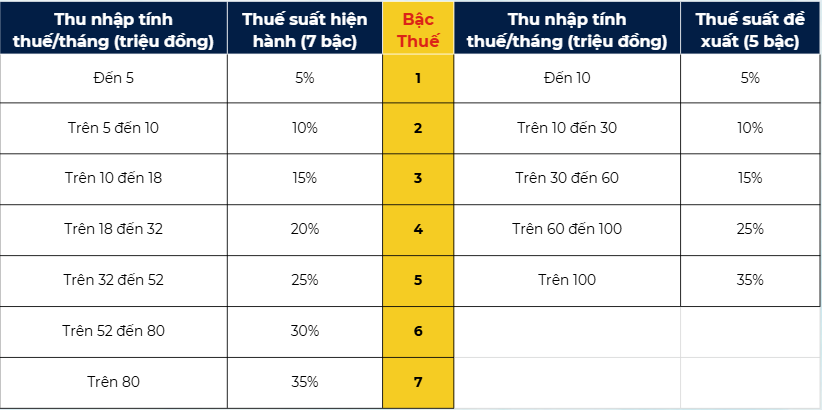
- Significance: The reduction clearly benefits those with taxable income from VND 10–60 million monthly, applying lower tax rates to portions of income compared to the current seven-bracket schedule. For example, an individual with taxable income of VND 35 million will pay 15% on the portion above VND 30 million, instead of the previous 20%. This positive shift eases middle-class burdens and strengthens tax system equity.
- Accounting implications: Accounting departments must prepare for a potential second tax calculation formula update in 2026 (after the exemption change) if the new schedule takes effect mid-year. This requires absolute precision in applying rates and calculating year-end tax settlements.
2. New 17% Tax Rate for Business Individuals
The Draft proposes a new approach for business individuals (business households, property lessors), replacing the current fixed-rate method:
- Profit-based taxation: Business individuals with revenue exceeding regulatory thresholds (expected VND 1 billion/year) will calculate tax on profit: PIT = Taxable Income x 17%, where Taxable Income = Revenue – Deductible Expenses. This method is fairer, as tax is owed only on actual income.
- Business household classification: Division into three groups (under VND 200 million exempt, VND 200 million–3 billion applying revenue ratios, over VND 3 billion applying profit tax) encourages transparency and large household conversion to enterprise status.
- Significance: This change increases fairness by taxing actual income rather than estimated revenue, but requires stricter bookkeeping. This creates significant demand for professional accounting services.
For accounting service providers, this is a major opportunity to expand consulting and tax filing support for individual and business household clients. Experts must master deductible expense regulations to advise clients optimally under the new law.
3. Additions and Clarifications on Taxable and Exempt Income
The Draft also clarifies and supplements income items to align with contemporary realities:
- Exemption for reasonable lump-sum employee expenses: Tax exemption for lump-sum amounts provided to employees (phone, business travel, office supplies) is proposed, provided an internal expenditure policy exists. This offers businesses flexibility in structuring welfare and optimizing employee taxes.
- Digital economy income inclusion: The Draft supplements regulations on digital platform income and new digital asset taxation, ensuring the Law comprehensively covers technological-era income sources.
- State budget salary exemptions: Proposed tax exemption for state-funded salaries in specific professions (police, military).
Clear definitions of exempt income help businesses minimize tax collection risks. HR and Accounting must collaborate closely to review internal policies, ensuring compliance with new requirements to benefit from tax incentives.
V. Required Actions for Businesses and Taxpayers
1. Updating Payroll Systems and Accounting Software
Technical compliance is the priority:
- Update core parameters: By Q4/2025, IT and Accounting must plan to change exemption parameters in payroll systems (ERP, Excel, accounting software) effective January 1, 2026;
- Tax schedule flexibility: The system must seamlessly switch between current seven-bracket and proposed five-bracket schedules within 2026 if the new schedule takes effect mid-year, requiring effective date parameter settings;
- Stress testing: Conduct trial payroll runs for various employee groups (low, medium, high income, with/without dependents) using different exemption levels and tax schedules to ensure 100% calculation accuracy before official implementation.
Businesses should avoid manual updates due to high error risk. Work with software vendors for automatic updates, as even minor errors compound into major year-end discrepancies.
2. Compliance and Internal Communication
- Specialized training: Organize in-depth training for Accounting, HR, and Finance teams on the new exemptions, potentially new tax schedules, and dependent documentation requirements;
- Transparent communication: Use internal channels to announce new exemption levels and net income impact. Transparency in dependent registration encourages employee compliance;
- Periodic review: Establish quarterly review processes for 2026 personal income tax calculations and dependent documentation, especially during any tax schedule transition, to detect and correct errors promptly.
Tax compliance is a primary business responsibility. A clear plan not only avoids penalties but reinforces company reputation with employees and government agencies.
The 2026 Personal Income Tax regulations mark a significant milestone. The increase in personal exemptions to VND 15.5 million and VND 6.2 million per dependent demonstrates strong government support for the middle class, boosting disposable income and economic consumption.
For businesses, proactive preparation—updating systems, training staff, ensuring strict dependent documentation compliance—ensures accurate implementation and stronger employee relations. Wacontre Accounting Services is committed to supporting your business in analyzing, advising on, and effectively implementing the 2026 regulations for full tax law compliance.
If you have questions, contact Wacontre via Hotline: (028) 3820 1213 or email [email protected] for prompt consultation and support. With our experienced team, Wacontre is ready to serve customers with enthusiasm and efficiency.
The proposal to reduce the progressive tax schedule aims to simplify the system, reduce calculation complexity, and make rates more reasonable for upper-middle-income earners:
- Significance: The reduction clearly benefits those with taxable income from VND 10–60 million monthly, applying lower tax rates to portions of income compared to the current seven-bracket schedule. For example, an individual with taxable income of VND 35 million will pay 15% on the portion above VND 30 million, instead of the previous 20%. This positive shift eases middle-class burdens and strengthens tax system equity.
- Accounting implications: Accounting departments must prepare for a potential second tax calculation formula update in 2026 (after the exemption change) if the new schedule takes effect mid-year. This requires absolute precision in applying rates and calculating year-end tax settlements.
2. New 17% Tax Rate for Business Individuals
The Draft proposes a new approach for business individuals (business households, property lessors), replacing the current fixed-rate method:
- Profit-based taxation: Business individuals with revenue exceeding regulatory thresholds (expected VND 1 billion/year) will calculate tax on profit: PIT = Taxable Income x 17%, where Taxable Income = Revenue – Deductible Expenses. This method is fairer, as tax is owed only on actual income.
- Business household classification: Division into three groups (under VND 200 million exempt, VND 200 million–3 billion applying revenue ratios, over VND 3 billion applying profit tax) encourages transparency and large household conversion to enterprise status.
- Significance: This change increases fairness by taxing actual income rather than estimated revenue, but requires stricter bookkeeping. This creates significant demand for professional accounting services.
For accounting service providers, this is a major opportunity to expand consulting and tax filing support for individual and business household clients. Experts must master deductible expense regulations to advise clients optimally under the new law.
3. Additions and Clarifications on Taxable and Exempt Income
The Draft also clarifies and supplements income items to align with contemporary realities:
- Exemption for reasonable lump-sum employee expenses: Tax exemption for lump-sum amounts provided to employees (phone, business travel, office supplies) is proposed, provided an internal expenditure policy exists. This offers businesses flexibility in structuring welfare and optimizing employee taxes.
- Digital economy income inclusion: The Draft supplements regulations on digital platform income and new digital asset taxation, ensuring the Law comprehensively covers technological-era income sources.
- State budget salary exemptions: Proposed tax exemption for state-funded salaries in specific professions (police, military).
Clear definitions of exempt income help businesses minimize tax collection risks. HR and Accounting must collaborate closely to review internal policies, ensuring compliance with new requirements to benefit from tax incentives.
V. Required Actions for Businesses and Taxpayers
1. Updating Payroll Systems and Accounting Software
Technical compliance is the priority:
- Update core parameters: By Q4/2025, IT and Accounting must plan to change exemption parameters in payroll systems (ERP, Excel, accounting software) effective January 1, 2026;
- Tax schedule flexibility: The system must seamlessly switch between current seven-bracket and proposed five-bracket schedules within 2026 if the new schedule takes effect mid-year, requiring effective date parameter settings;
- Stress testing: Conduct trial payroll runs for various employee groups (low, medium, high income, with/without dependents) using different exemption levels and tax schedules to ensure 100% calculation accuracy before official implementation.
Businesses should avoid manual updates due to high error risk. Work with software vendors for automatic updates, as even minor errors compound into major year-end discrepancies.
2. Compliance and Internal Communication
- Specialized training: Organize in-depth training for Accounting, HR, and Finance teams on the new exemptions, potentially new tax schedules, and dependent documentation requirements;
- Transparent communication: Use internal channels to announce new exemption levels and net income impact. Transparency in dependent registration encourages employee compliance;
- Periodic review: Establish quarterly review processes for 2026 personal income tax calculations and dependent documentation, especially during any tax schedule transition, to detect and correct errors promptly.
Tax compliance is a primary business responsibility. A clear plan not only avoids penalties but reinforces company reputation with employees and government agencies.
The 2026 Personal Income Tax regulations mark a significant milestone. The increase in personal exemptions to VND 15.5 million and VND 6.2 million per dependent demonstrates strong government support for the middle class, boosting disposable income and economic consumption.
For businesses, proactive preparation—updating systems, training staff, ensuring strict dependent documentation compliance—ensures accurate implementation and stronger employee relations. Wacontre Accounting Services is committed to supporting your business in analyzing, advising on, and effectively implementing the 2026 regulations for full tax law compliance.
If you have questions, contact Wacontre via Hotline: (028) 3820 1213 or email [email protected] for prompt consultation and support. With our experienced team, Wacontre is ready to serve customers with enthusiasm and efficiency.
1. Changes to the Progressive Tax Schedule (Seven to Five Brackets)
The proposal to reduce the progressive tax schedule aims to simplify the system, reduce calculation complexity, and make rates more reasonable for upper-middle-income earners:
- Significance: The reduction clearly benefits those with taxable income from VND 10–60 million monthly, applying lower tax rates to portions of income compared to the current seven-bracket schedule. For example, an individual with taxable income of VND 35 million will pay 15% on the portion above VND 30 million, instead of the previous 20%. This positive shift eases middle-class burdens and strengthens tax system equity.
- Accounting implications: Accounting departments must prepare for a potential second tax calculation formula update in 2026 (after the exemption change) if the new schedule takes effect mid-year. This requires absolute precision in applying rates and calculating year-end tax settlements.
2. New 17% Tax Rate for Business Individuals
The Draft proposes a new approach for business individuals (business households, property lessors), replacing the current fixed-rate method:
- Profit-based taxation: Business individuals with revenue exceeding regulatory thresholds (expected VND 1 billion/year) will calculate tax on profit: PIT = Taxable Income x 17%, where Taxable Income = Revenue – Deductible Expenses. This method is fairer, as tax is owed only on actual income.
- Business household classification: Division into three groups (under VND 200 million exempt, VND 200 million–3 billion applying revenue ratios, over VND 3 billion applying profit tax) encourages transparency and large household conversion to enterprise status.
- Significance: This change increases fairness by taxing actual income rather than estimated revenue, but requires stricter bookkeeping. This creates significant demand for professional accounting services.
For accounting service providers, this is a major opportunity to expand consulting and tax filing support for individual and business household clients. Experts must master deductible expense regulations to advise clients optimally under the new law.
3. Additions and Clarifications on Taxable and Exempt Income
The Draft also clarifies and supplements income items to align with contemporary realities:
- Exemption for reasonable lump-sum employee expenses: Tax exemption for lump-sum amounts provided to employees (phone, business travel, office supplies) is proposed, provided an internal expenditure policy exists. This offers businesses flexibility in structuring welfare and optimizing employee taxes.
- Digital economy income inclusion: The Draft supplements regulations on digital platform income and new digital asset taxation, ensuring the Law comprehensively covers technological-era income sources.
- State budget salary exemptions: Proposed tax exemption for state-funded salaries in specific professions (police, military).
Clear definitions of exempt income help businesses minimize tax collection risks. HR and Accounting must collaborate closely to review internal policies, ensuring compliance with new requirements to benefit from tax incentives.
V. Required Actions for Businesses and Taxpayers
1. Updating Payroll Systems and Accounting Software
Technical compliance is the priority:
- Update core parameters: By Q4/2025, IT and Accounting must plan to change exemption parameters in payroll systems (ERP, Excel, accounting software) effective January 1, 2026;
- Tax schedule flexibility: The system must seamlessly switch between current seven-bracket and proposed five-bracket schedules within 2026 if the new schedule takes effect mid-year, requiring effective date parameter settings;
- Stress testing: Conduct trial payroll runs for various employee groups (low, medium, high income, with/without dependents) using different exemption levels and tax schedules to ensure 100% calculation accuracy before official implementation.
Businesses should avoid manual updates due to high error risk. Work with software vendors for automatic updates, as even minor errors compound into major year-end discrepancies.
2. Compliance and Internal Communication
- Specialized training: Organize in-depth training for Accounting, HR, and Finance teams on the new exemptions, potentially new tax schedules, and dependent documentation requirements;
- Transparent communication: Use internal channels to announce new exemption levels and net income impact. Transparency in dependent registration encourages employee compliance;
- Periodic review: Establish quarterly review processes for 2026 personal income tax calculations and dependent documentation, especially during any tax schedule transition, to detect and correct errors promptly.
Tax compliance is a primary business responsibility. A clear plan not only avoids penalties but reinforces company reputation with employees and government agencies.
The 2026 Personal Income Tax regulations mark a significant milestone. The increase in personal exemptions to VND 15.5 million and VND 6.2 million per dependent demonstrates strong government support for the middle class, boosting disposable income and economic consumption.
For businesses, proactive preparation—updating systems, training staff, ensuring strict dependent documentation compliance—ensures accurate implementation and stronger employee relations. Wacontre Accounting Services is committed to supporting your business in analyzing, advising on, and effectively implementing the 2026 regulations for full tax law compliance.
If you have questions, contact Wacontre via Hotline: (028) 3820 1213 or email [email protected] for prompt consultation and support. With our experienced team, Wacontre is ready to serve customers with enthusiasm and efficiency.
Parallel to the exemption increase, the Draft Personal Income Tax Law (replacement) under National Assembly review contains systemic changes affecting tax calculation and administration.
1. Changes to the Progressive Tax Schedule (Seven to Five Brackets)
The proposal to reduce the progressive tax schedule aims to simplify the system, reduce calculation complexity, and make rates more reasonable for upper-middle-income earners:
- Significance: The reduction clearly benefits those with taxable income from VND 10–60 million monthly, applying lower tax rates to portions of income compared to the current seven-bracket schedule. For example, an individual with taxable income of VND 35 million will pay 15% on the portion above VND 30 million, instead of the previous 20%. This positive shift eases middle-class burdens and strengthens tax system equity.
- Accounting implications: Accounting departments must prepare for a potential second tax calculation formula update in 2026 (after the exemption change) if the new schedule takes effect mid-year. This requires absolute precision in applying rates and calculating year-end tax settlements.
2. New 17% Tax Rate for Business Individuals
The Draft proposes a new approach for business individuals (business households, property lessors), replacing the current fixed-rate method:
- Profit-based taxation: Business individuals with revenue exceeding regulatory thresholds (expected VND 1 billion/year) will calculate tax on profit: PIT = Taxable Income x 17%, where Taxable Income = Revenue – Deductible Expenses. This method is fairer, as tax is owed only on actual income.
- Business household classification: Division into three groups (under VND 200 million exempt, VND 200 million–3 billion applying revenue ratios, over VND 3 billion applying profit tax) encourages transparency and large household conversion to enterprise status.
- Significance: This change increases fairness by taxing actual income rather than estimated revenue, but requires stricter bookkeeping. This creates significant demand for professional accounting services.
For accounting service providers, this is a major opportunity to expand consulting and tax filing support for individual and business household clients. Experts must master deductible expense regulations to advise clients optimally under the new law.
3. Additions and Clarifications on Taxable and Exempt Income
The Draft also clarifies and supplements income items to align with contemporary realities:
- Exemption for reasonable lump-sum employee expenses: Tax exemption for lump-sum amounts provided to employees (phone, business travel, office supplies) is proposed, provided an internal expenditure policy exists. This offers businesses flexibility in structuring welfare and optimizing employee taxes.
- Digital economy income inclusion: The Draft supplements regulations on digital platform income and new digital asset taxation, ensuring the Law comprehensively covers technological-era income sources.
- State budget salary exemptions: Proposed tax exemption for state-funded salaries in specific professions (police, military).
Clear definitions of exempt income help businesses minimize tax collection risks. HR and Accounting must collaborate closely to review internal policies, ensuring compliance with new requirements to benefit from tax incentives.
V. Required Actions for Businesses and Taxpayers
1. Updating Payroll Systems and Accounting Software
Technical compliance is the priority:
- Update core parameters: By Q4/2025, IT and Accounting must plan to change exemption parameters in payroll systems (ERP, Excel, accounting software) effective January 1, 2026;
- Tax schedule flexibility: The system must seamlessly switch between current seven-bracket and proposed five-bracket schedules within 2026 if the new schedule takes effect mid-year, requiring effective date parameter settings;
- Stress testing: Conduct trial payroll runs for various employee groups (low, medium, high income, with/without dependents) using different exemption levels and tax schedules to ensure 100% calculation accuracy before official implementation.
Businesses should avoid manual updates due to high error risk. Work with software vendors for automatic updates, as even minor errors compound into major year-end discrepancies.
2. Compliance and Internal Communication
- Specialized training: Organize in-depth training for Accounting, HR, and Finance teams on the new exemptions, potentially new tax schedules, and dependent documentation requirements;
- Transparent communication: Use internal channels to announce new exemption levels and net income impact. Transparency in dependent registration encourages employee compliance;
- Periodic review: Establish quarterly review processes for 2026 personal income tax calculations and dependent documentation, especially during any tax schedule transition, to detect and correct errors promptly.
Tax compliance is a primary business responsibility. A clear plan not only avoids penalties but reinforces company reputation with employees and government agencies.
The 2026 Personal Income Tax regulations mark a significant milestone. The increase in personal exemptions to VND 15.5 million and VND 6.2 million per dependent demonstrates strong government support for the middle class, boosting disposable income and economic consumption.
For businesses, proactive preparation—updating systems, training staff, ensuring strict dependent documentation compliance—ensures accurate implementation and stronger employee relations. Wacontre Accounting Services is committed to supporting your business in analyzing, advising on, and effectively implementing the 2026 regulations for full tax law compliance.
If you have questions, contact Wacontre via Hotline: (028) 3820 1213 or email [email protected] for prompt consultation and support. With our experienced team, Wacontre is ready to serve customers with enthusiasm and efficiency.
IV. Key Points in the Draft Revised Personal Income Tax Law
Parallel to the exemption increase, the Draft Personal Income Tax Law (replacement) under National Assembly review contains systemic changes affecting tax calculation and administration.
1. Changes to the Progressive Tax Schedule (Seven to Five Brackets)
The proposal to reduce the progressive tax schedule aims to simplify the system, reduce calculation complexity, and make rates more reasonable for upper-middle-income earners:
- Significance: The reduction clearly benefits those with taxable income from VND 10–60 million monthly, applying lower tax rates to portions of income compared to the current seven-bracket schedule. For example, an individual with taxable income of VND 35 million will pay 15% on the portion above VND 30 million, instead of the previous 20%. This positive shift eases middle-class burdens and strengthens tax system equity.
- Accounting implications: Accounting departments must prepare for a potential second tax calculation formula update in 2026 (after the exemption change) if the new schedule takes effect mid-year. This requires absolute precision in applying rates and calculating year-end tax settlements.
2. New 17% Tax Rate for Business Individuals
The Draft proposes a new approach for business individuals (business households, property lessors), replacing the current fixed-rate method:
- Profit-based taxation: Business individuals with revenue exceeding regulatory thresholds (expected VND 1 billion/year) will calculate tax on profit: PIT = Taxable Income x 17%, where Taxable Income = Revenue – Deductible Expenses. This method is fairer, as tax is owed only on actual income.
- Business household classification: Division into three groups (under VND 200 million exempt, VND 200 million–3 billion applying revenue ratios, over VND 3 billion applying profit tax) encourages transparency and large household conversion to enterprise status.
- Significance: This change increases fairness by taxing actual income rather than estimated revenue, but requires stricter bookkeeping. This creates significant demand for professional accounting services.
For accounting service providers, this is a major opportunity to expand consulting and tax filing support for individual and business household clients. Experts must master deductible expense regulations to advise clients optimally under the new law.
3. Additions and Clarifications on Taxable and Exempt Income
The Draft also clarifies and supplements income items to align with contemporary realities:
- Exemption for reasonable lump-sum employee expenses: Tax exemption for lump-sum amounts provided to employees (phone, business travel, office supplies) is proposed, provided an internal expenditure policy exists. This offers businesses flexibility in structuring welfare and optimizing employee taxes.
- Digital economy income inclusion: The Draft supplements regulations on digital platform income and new digital asset taxation, ensuring the Law comprehensively covers technological-era income sources.
- State budget salary exemptions: Proposed tax exemption for state-funded salaries in specific professions (police, military).
Clear definitions of exempt income help businesses minimize tax collection risks. HR and Accounting must collaborate closely to review internal policies, ensuring compliance with new requirements to benefit from tax incentives.
V. Required Actions for Businesses and Taxpayers
1. Updating Payroll Systems and Accounting Software
Technical compliance is the priority:
- Update core parameters: By Q4/2025, IT and Accounting must plan to change exemption parameters in payroll systems (ERP, Excel, accounting software) effective January 1, 2026;
- Tax schedule flexibility: The system must seamlessly switch between current seven-bracket and proposed five-bracket schedules within 2026 if the new schedule takes effect mid-year, requiring effective date parameter settings;
- Stress testing: Conduct trial payroll runs for various employee groups (low, medium, high income, with/without dependents) using different exemption levels and tax schedules to ensure 100% calculation accuracy before official implementation.
Businesses should avoid manual updates due to high error risk. Work with software vendors for automatic updates, as even minor errors compound into major year-end discrepancies.
2. Compliance and Internal Communication
- Specialized training: Organize in-depth training for Accounting, HR, and Finance teams on the new exemptions, potentially new tax schedules, and dependent documentation requirements;
- Transparent communication: Use internal channels to announce new exemption levels and net income impact. Transparency in dependent registration encourages employee compliance;
- Periodic review: Establish quarterly review processes for 2026 personal income tax calculations and dependent documentation, especially during any tax schedule transition, to detect and correct errors promptly.
Tax compliance is a primary business responsibility. A clear plan not only avoids penalties but reinforces company reputation with employees and government agencies.
The 2026 Personal Income Tax regulations mark a significant milestone. The increase in personal exemptions to VND 15.5 million and VND 6.2 million per dependent demonstrates strong government support for the middle class, boosting disposable income and economic consumption.
For businesses, proactive preparation—updating systems, training staff, ensuring strict dependent documentation compliance—ensures accurate implementation and stronger employee relations. Wacontre Accounting Services is committed to supporting your business in analyzing, advising on, and effectively implementing the 2026 regulations for full tax law compliance.
If you have questions, contact Wacontre via Hotline: (028) 3820 1213 or email [email protected] for prompt consultation and support. With our experienced team, Wacontre is ready to serve customers with enthusiasm and efficiency.
For high-level experts and expats, the increased dependent exemption to VND 6.2 million per dependent monthly is particularly valuable, as they often have greater family financial burdens. This adjustment strengthens Vietnam’s compensation competitiveness for attracting international talent.
IV. Key Points in the Draft Revised Personal Income Tax Law
Parallel to the exemption increase, the Draft Personal Income Tax Law (replacement) under National Assembly review contains systemic changes affecting tax calculation and administration.
1. Changes to the Progressive Tax Schedule (Seven to Five Brackets)
The proposal to reduce the progressive tax schedule aims to simplify the system, reduce calculation complexity, and make rates more reasonable for upper-middle-income earners:
- Significance: The reduction clearly benefits those with taxable income from VND 10–60 million monthly, applying lower tax rates to portions of income compared to the current seven-bracket schedule. For example, an individual with taxable income of VND 35 million will pay 15% on the portion above VND 30 million, instead of the previous 20%. This positive shift eases middle-class burdens and strengthens tax system equity.
- Accounting implications: Accounting departments must prepare for a potential second tax calculation formula update in 2026 (after the exemption change) if the new schedule takes effect mid-year. This requires absolute precision in applying rates and calculating year-end tax settlements.
2. New 17% Tax Rate for Business Individuals
The Draft proposes a new approach for business individuals (business households, property lessors), replacing the current fixed-rate method:
- Profit-based taxation: Business individuals with revenue exceeding regulatory thresholds (expected VND 1 billion/year) will calculate tax on profit: PIT = Taxable Income x 17%, where Taxable Income = Revenue – Deductible Expenses. This method is fairer, as tax is owed only on actual income.
- Business household classification: Division into three groups (under VND 200 million exempt, VND 200 million–3 billion applying revenue ratios, over VND 3 billion applying profit tax) encourages transparency and large household conversion to enterprise status.
- Significance: This change increases fairness by taxing actual income rather than estimated revenue, but requires stricter bookkeeping. This creates significant demand for professional accounting services.
For accounting service providers, this is a major opportunity to expand consulting and tax filing support for individual and business household clients. Experts must master deductible expense regulations to advise clients optimally under the new law.
3. Additions and Clarifications on Taxable and Exempt Income
The Draft also clarifies and supplements income items to align with contemporary realities:
- Exemption for reasonable lump-sum employee expenses: Tax exemption for lump-sum amounts provided to employees (phone, business travel, office supplies) is proposed, provided an internal expenditure policy exists. This offers businesses flexibility in structuring welfare and optimizing employee taxes.
- Digital economy income inclusion: The Draft supplements regulations on digital platform income and new digital asset taxation, ensuring the Law comprehensively covers technological-era income sources.
- State budget salary exemptions: Proposed tax exemption for state-funded salaries in specific professions (police, military).
Clear definitions of exempt income help businesses minimize tax collection risks. HR and Accounting must collaborate closely to review internal policies, ensuring compliance with new requirements to benefit from tax incentives.
V. Required Actions for Businesses and Taxpayers
1. Updating Payroll Systems and Accounting Software
Technical compliance is the priority:
- Update core parameters: By Q4/2025, IT and Accounting must plan to change exemption parameters in payroll systems (ERP, Excel, accounting software) effective January 1, 2026;
- Tax schedule flexibility: The system must seamlessly switch between current seven-bracket and proposed five-bracket schedules within 2026 if the new schedule takes effect mid-year, requiring effective date parameter settings;
- Stress testing: Conduct trial payroll runs for various employee groups (low, medium, high income, with/without dependents) using different exemption levels and tax schedules to ensure 100% calculation accuracy before official implementation.
Businesses should avoid manual updates due to high error risk. Work with software vendors for automatic updates, as even minor errors compound into major year-end discrepancies.
2. Compliance and Internal Communication
- Specialized training: Organize in-depth training for Accounting, HR, and Finance teams on the new exemptions, potentially new tax schedules, and dependent documentation requirements;
- Transparent communication: Use internal channels to announce new exemption levels and net income impact. Transparency in dependent registration encourages employee compliance;
- Periodic review: Establish quarterly review processes for 2026 personal income tax calculations and dependent documentation, especially during any tax schedule transition, to detect and correct errors promptly.
Tax compliance is a primary business responsibility. A clear plan not only avoids penalties but reinforces company reputation with employees and government agencies.
The 2026 Personal Income Tax regulations mark a significant milestone. The increase in personal exemptions to VND 15.5 million and VND 6.2 million per dependent demonstrates strong government support for the middle class, boosting disposable income and economic consumption.
For businesses, proactive preparation—updating systems, training staff, ensuring strict dependent documentation compliance—ensures accurate implementation and stronger employee relations. Wacontre Accounting Services is committed to supporting your business in analyzing, advising on, and effectively implementing the 2026 regulations for full tax law compliance.
If you have questions, contact Wacontre via Hotline: (028) 3820 1213 or email [email protected] for prompt consultation and support. With our experienced team, Wacontre is ready to serve customers with enthusiasm and efficiency.
For high-level experts and expats, the increased dependent exemption to VND 6.2 million per dependent monthly is particularly valuable, as they often have greater family financial burdens. This adjustment strengthens Vietnam’s compensation competitiveness for attracting international talent.
IV. Key Points in the Draft Revised Personal Income Tax Law
Parallel to the exemption increase, the Draft Personal Income Tax Law (replacement) under National Assembly review contains systemic changes affecting tax calculation and administration.
1. Changes to the Progressive Tax Schedule (Seven to Five Brackets)
The proposal to reduce the progressive tax schedule aims to simplify the system, reduce calculation complexity, and make rates more reasonable for upper-middle-income earners:
- Significance: The reduction clearly benefits those with taxable income from VND 10–60 million monthly, applying lower tax rates to portions of income compared to the current seven-bracket schedule. For example, an individual with taxable income of VND 35 million will pay 15% on the portion above VND 30 million, instead of the previous 20%. This positive shift eases middle-class burdens and strengthens tax system equity.
- Accounting implications: Accounting departments must prepare for a potential second tax calculation formula update in 2026 (after the exemption change) if the new schedule takes effect mid-year. This requires absolute precision in applying rates and calculating year-end tax settlements.
2. New 17% Tax Rate for Business Individuals
The Draft proposes a new approach for business individuals (business households, property lessors), replacing the current fixed-rate method:
- Profit-based taxation: Business individuals with revenue exceeding regulatory thresholds (expected VND 1 billion/year) will calculate tax on profit: PIT = Taxable Income x 17%, where Taxable Income = Revenue – Deductible Expenses. This method is fairer, as tax is owed only on actual income.
- Business household classification: Division into three groups (under VND 200 million exempt, VND 200 million–3 billion applying revenue ratios, over VND 3 billion applying profit tax) encourages transparency and large household conversion to enterprise status.
- Significance: This change increases fairness by taxing actual income rather than estimated revenue, but requires stricter bookkeeping. This creates significant demand for professional accounting services.
For accounting service providers, this is a major opportunity to expand consulting and tax filing support for individual and business household clients. Experts must master deductible expense regulations to advise clients optimally under the new law.
3. Additions and Clarifications on Taxable and Exempt Income
The Draft also clarifies and supplements income items to align with contemporary realities:
- Exemption for reasonable lump-sum employee expenses: Tax exemption for lump-sum amounts provided to employees (phone, business travel, office supplies) is proposed, provided an internal expenditure policy exists. This offers businesses flexibility in structuring welfare and optimizing employee taxes.
- Digital economy income inclusion: The Draft supplements regulations on digital platform income and new digital asset taxation, ensuring the Law comprehensively covers technological-era income sources.
- State budget salary exemptions: Proposed tax exemption for state-funded salaries in specific professions (police, military).
Clear definitions of exempt income help businesses minimize tax collection risks. HR and Accounting must collaborate closely to review internal policies, ensuring compliance with new requirements to benefit from tax incentives.
V. Required Actions for Businesses and Taxpayers
1. Updating Payroll Systems and Accounting Software
Technical compliance is the priority:
- Update core parameters: By Q4/2025, IT and Accounting must plan to change exemption parameters in payroll systems (ERP, Excel, accounting software) effective January 1, 2026;
- Tax schedule flexibility: The system must seamlessly switch between current seven-bracket and proposed five-bracket schedules within 2026 if the new schedule takes effect mid-year, requiring effective date parameter settings;
- Stress testing: Conduct trial payroll runs for various employee groups (low, medium, high income, with/without dependents) using different exemption levels and tax schedules to ensure 100% calculation accuracy before official implementation.
Businesses should avoid manual updates due to high error risk. Work with software vendors for automatic updates, as even minor errors compound into major year-end discrepancies.
2. Compliance and Internal Communication
- Specialized training: Organize in-depth training for Accounting, HR, and Finance teams on the new exemptions, potentially new tax schedules, and dependent documentation requirements;
- Transparent communication: Use internal channels to announce new exemption levels and net income impact. Transparency in dependent registration encourages employee compliance;
- Periodic review: Establish quarterly review processes for 2026 personal income tax calculations and dependent documentation, especially during any tax schedule transition, to detect and correct errors promptly.
Tax compliance is a primary business responsibility. A clear plan not only avoids penalties but reinforces company reputation with employees and government agencies.
The 2026 Personal Income Tax regulations mark a significant milestone. The increase in personal exemptions to VND 15.5 million and VND 6.2 million per dependent demonstrates strong government support for the middle class, boosting disposable income and economic consumption.
For businesses, proactive preparation—updating systems, training staff, ensuring strict dependent documentation compliance—ensures accurate implementation and stronger employee relations. Wacontre Accounting Services is committed to supporting your business in analyzing, advising on, and effectively implementing the 2026 regulations for full tax law compliance.
If you have questions, contact Wacontre via Hotline: (028) 3820 1213 or email [email protected] for prompt consultation and support. With our experienced team, Wacontre is ready to serve customers with enthusiasm and efficiency.
For high-level experts and expats, the increased dependent exemption to VND 6.2 million per dependent monthly is particularly valuable, as they often have greater family financial burdens. This adjustment strengthens Vietnam’s compensation competitiveness for attracting international talent.
IV. Key Points in the Draft Revised Personal Income Tax Law
Parallel to the exemption increase, the Draft Personal Income Tax Law (replacement) under National Assembly review contains systemic changes affecting tax calculation and administration.
1. Changes to the Progressive Tax Schedule (Seven to Five Brackets)
The proposal to reduce the progressive tax schedule aims to simplify the system, reduce calculation complexity, and make rates more reasonable for upper-middle-income earners:
- Significance: The reduction clearly benefits those with taxable income from VND 10–60 million monthly, applying lower tax rates to portions of income compared to the current seven-bracket schedule. For example, an individual with taxable income of VND 35 million will pay 15% on the portion above VND 30 million, instead of the previous 20%. This positive shift eases middle-class burdens and strengthens tax system equity.
- Accounting implications: Accounting departments must prepare for a potential second tax calculation formula update in 2026 (after the exemption change) if the new schedule takes effect mid-year. This requires absolute precision in applying rates and calculating year-end tax settlements.
2. New 17% Tax Rate for Business Individuals
The Draft proposes a new approach for business individuals (business households, property lessors), replacing the current fixed-rate method:
- Profit-based taxation: Business individuals with revenue exceeding regulatory thresholds (expected VND 1 billion/year) will calculate tax on profit: PIT = Taxable Income x 17%, where Taxable Income = Revenue – Deductible Expenses. This method is fairer, as tax is owed only on actual income.
- Business household classification: Division into three groups (under VND 200 million exempt, VND 200 million–3 billion applying revenue ratios, over VND 3 billion applying profit tax) encourages transparency and large household conversion to enterprise status.
- Significance: This change increases fairness by taxing actual income rather than estimated revenue, but requires stricter bookkeeping. This creates significant demand for professional accounting services.
For accounting service providers, this is a major opportunity to expand consulting and tax filing support for individual and business household clients. Experts must master deductible expense regulations to advise clients optimally under the new law.
3. Additions and Clarifications on Taxable and Exempt Income
The Draft also clarifies and supplements income items to align with contemporary realities:
- Exemption for reasonable lump-sum employee expenses: Tax exemption for lump-sum amounts provided to employees (phone, business travel, office supplies) is proposed, provided an internal expenditure policy exists. This offers businesses flexibility in structuring welfare and optimizing employee taxes.
- Digital economy income inclusion: The Draft supplements regulations on digital platform income and new digital asset taxation, ensuring the Law comprehensively covers technological-era income sources.
- State budget salary exemptions: Proposed tax exemption for state-funded salaries in specific professions (police, military).
Clear definitions of exempt income help businesses minimize tax collection risks. HR and Accounting must collaborate closely to review internal policies, ensuring compliance with new requirements to benefit from tax incentives.
V. Required Actions for Businesses and Taxpayers
1. Updating Payroll Systems and Accounting Software
Technical compliance is the priority:
- Update core parameters: By Q4/2025, IT and Accounting must plan to change exemption parameters in payroll systems (ERP, Excel, accounting software) effective January 1, 2026;
- Tax schedule flexibility: The system must seamlessly switch between current seven-bracket and proposed five-bracket schedules within 2026 if the new schedule takes effect mid-year, requiring effective date parameter settings;
- Stress testing: Conduct trial payroll runs for various employee groups (low, medium, high income, with/without dependents) using different exemption levels and tax schedules to ensure 100% calculation accuracy before official implementation.
Businesses should avoid manual updates due to high error risk. Work with software vendors for automatic updates, as even minor errors compound into major year-end discrepancies.
2. Compliance and Internal Communication
- Specialized training: Organize in-depth training for Accounting, HR, and Finance teams on the new exemptions, potentially new tax schedules, and dependent documentation requirements;
- Transparent communication: Use internal channels to announce new exemption levels and net income impact. Transparency in dependent registration encourages employee compliance;
- Periodic review: Establish quarterly review processes for 2026 personal income tax calculations and dependent documentation, especially during any tax schedule transition, to detect and correct errors promptly.
Tax compliance is a primary business responsibility. A clear plan not only avoids penalties but reinforces company reputation with employees and government agencies.
The 2026 Personal Income Tax regulations mark a significant milestone. The increase in personal exemptions to VND 15.5 million and VND 6.2 million per dependent demonstrates strong government support for the middle class, boosting disposable income and economic consumption.
For businesses, proactive preparation—updating systems, training staff, ensuring strict dependent documentation compliance—ensures accurate implementation and stronger employee relations. Wacontre Accounting Services is committed to supporting your business in analyzing, advising on, and effectively implementing the 2026 regulations for full tax law compliance.
If you have questions, contact Wacontre via Hotline: (028) 3820 1213 or email [email protected] for prompt consultation and support. With our experienced team, Wacontre is ready to serve customers with enthusiasm and efficiency.
For high-level experts and expats, the increased dependent exemption to VND 6.2 million per dependent monthly is particularly valuable, as they often have greater family financial burdens. This adjustment strengthens Vietnam’s compensation competitiveness for attracting international talent.
IV. Key Points in the Draft Revised Personal Income Tax Law
Parallel to the exemption increase, the Draft Personal Income Tax Law (replacement) under National Assembly review contains systemic changes affecting tax calculation and administration.
1. Changes to the Progressive Tax Schedule (Seven to Five Brackets)
The proposal to reduce the progressive tax schedule aims to simplify the system, reduce calculation complexity, and make rates more reasonable for upper-middle-income earners:
- Significance: The reduction clearly benefits those with taxable income from VND 10–60 million monthly, applying lower tax rates to portions of income compared to the current seven-bracket schedule. For example, an individual with taxable income of VND 35 million will pay 15% on the portion above VND 30 million, instead of the previous 20%. This positive shift eases middle-class burdens and strengthens tax system equity.
- Accounting implications: Accounting departments must prepare for a potential second tax calculation formula update in 2026 (after the exemption change) if the new schedule takes effect mid-year. This requires absolute precision in applying rates and calculating year-end tax settlements.
2. New 17% Tax Rate for Business Individuals
The Draft proposes a new approach for business individuals (business households, property lessors), replacing the current fixed-rate method:
- Profit-based taxation: Business individuals with revenue exceeding regulatory thresholds (expected VND 1 billion/year) will calculate tax on profit: PIT = Taxable Income x 17%, where Taxable Income = Revenue – Deductible Expenses. This method is fairer, as tax is owed only on actual income.
- Business household classification: Division into three groups (under VND 200 million exempt, VND 200 million–3 billion applying revenue ratios, over VND 3 billion applying profit tax) encourages transparency and large household conversion to enterprise status.
- Significance: This change increases fairness by taxing actual income rather than estimated revenue, but requires stricter bookkeeping. This creates significant demand for professional accounting services.
For accounting service providers, this is a major opportunity to expand consulting and tax filing support for individual and business household clients. Experts must master deductible expense regulations to advise clients optimally under the new law.
3. Additions and Clarifications on Taxable and Exempt Income
The Draft also clarifies and supplements income items to align with contemporary realities:
- Exemption for reasonable lump-sum employee expenses: Tax exemption for lump-sum amounts provided to employees (phone, business travel, office supplies) is proposed, provided an internal expenditure policy exists. This offers businesses flexibility in structuring welfare and optimizing employee taxes.
- Digital economy income inclusion: The Draft supplements regulations on digital platform income and new digital asset taxation, ensuring the Law comprehensively covers technological-era income sources.
- State budget salary exemptions: Proposed tax exemption for state-funded salaries in specific professions (police, military).
Clear definitions of exempt income help businesses minimize tax collection risks. HR and Accounting must collaborate closely to review internal policies, ensuring compliance with new requirements to benefit from tax incentives.
V. Required Actions for Businesses and Taxpayers
1. Updating Payroll Systems and Accounting Software
Technical compliance is the priority:
- Update core parameters: By Q4/2025, IT and Accounting must plan to change exemption parameters in payroll systems (ERP, Excel, accounting software) effective January 1, 2026;
- Tax schedule flexibility: The system must seamlessly switch between current seven-bracket and proposed five-bracket schedules within 2026 if the new schedule takes effect mid-year, requiring effective date parameter settings;
- Stress testing: Conduct trial payroll runs for various employee groups (low, medium, high income, with/without dependents) using different exemption levels and tax schedules to ensure 100% calculation accuracy before official implementation.
Businesses should avoid manual updates due to high error risk. Work with software vendors for automatic updates, as even minor errors compound into major year-end discrepancies.
2. Compliance and Internal Communication
- Specialized training: Organize in-depth training for Accounting, HR, and Finance teams on the new exemptions, potentially new tax schedules, and dependent documentation requirements;
- Transparent communication: Use internal channels to announce new exemption levels and net income impact. Transparency in dependent registration encourages employee compliance;
- Periodic review: Establish quarterly review processes for 2026 personal income tax calculations and dependent documentation, especially during any tax schedule transition, to detect and correct errors promptly.
Tax compliance is a primary business responsibility. A clear plan not only avoids penalties but reinforces company reputation with employees and government agencies.
The 2026 Personal Income Tax regulations mark a significant milestone. The increase in personal exemptions to VND 15.5 million and VND 6.2 million per dependent demonstrates strong government support for the middle class, boosting disposable income and economic consumption.
For businesses, proactive preparation—updating systems, training staff, ensuring strict dependent documentation compliance—ensures accurate implementation and stronger employee relations. Wacontre Accounting Services is committed to supporting your business in analyzing, advising on, and effectively implementing the 2026 regulations for full tax law compliance.
If you have questions, contact Wacontre via Hotline: (028) 3820 1213 or email [email protected] for prompt consultation and support. With our experienced team, Wacontre is ready to serve customers with enthusiasm and efficiency.
- Improved living standards: Increased net income enables citizens to spend more on education, healthcare, and essentials, improving quality of life amid inflation;
- Stimulating consumption: When citizens retain more income, aggregate demand increases, driving production and service sector development—a crucial macroeconomic measure for growth;
- Enhanced employee satisfaction: Automatic receipt of higher net income by employees—without increased gross salary costs to companies—improves satisfaction and engagement.
For high-level experts and expats, the increased dependent exemption to VND 6.2 million per dependent monthly is particularly valuable, as they often have greater family financial burdens. This adjustment strengthens Vietnam’s compensation competitiveness for attracting international talent.
IV. Key Points in the Draft Revised Personal Income Tax Law
Parallel to the exemption increase, the Draft Personal Income Tax Law (replacement) under National Assembly review contains systemic changes affecting tax calculation and administration.
1. Changes to the Progressive Tax Schedule (Seven to Five Brackets)
The proposal to reduce the progressive tax schedule aims to simplify the system, reduce calculation complexity, and make rates more reasonable for upper-middle-income earners:
- Significance: The reduction clearly benefits those with taxable income from VND 10–60 million monthly, applying lower tax rates to portions of income compared to the current seven-bracket schedule. For example, an individual with taxable income of VND 35 million will pay 15% on the portion above VND 30 million, instead of the previous 20%. This positive shift eases middle-class burdens and strengthens tax system equity.
- Accounting implications: Accounting departments must prepare for a potential second tax calculation formula update in 2026 (after the exemption change) if the new schedule takes effect mid-year. This requires absolute precision in applying rates and calculating year-end tax settlements.
2. New 17% Tax Rate for Business Individuals
The Draft proposes a new approach for business individuals (business households, property lessors), replacing the current fixed-rate method:
- Profit-based taxation: Business individuals with revenue exceeding regulatory thresholds (expected VND 1 billion/year) will calculate tax on profit: PIT = Taxable Income x 17%, where Taxable Income = Revenue – Deductible Expenses. This method is fairer, as tax is owed only on actual income.
- Business household classification: Division into three groups (under VND 200 million exempt, VND 200 million–3 billion applying revenue ratios, over VND 3 billion applying profit tax) encourages transparency and large household conversion to enterprise status.
- Significance: This change increases fairness by taxing actual income rather than estimated revenue, but requires stricter bookkeeping. This creates significant demand for professional accounting services.
For accounting service providers, this is a major opportunity to expand consulting and tax filing support for individual and business household clients. Experts must master deductible expense regulations to advise clients optimally under the new law.
3. Additions and Clarifications on Taxable and Exempt Income
The Draft also clarifies and supplements income items to align with contemporary realities:
- Exemption for reasonable lump-sum employee expenses: Tax exemption for lump-sum amounts provided to employees (phone, business travel, office supplies) is proposed, provided an internal expenditure policy exists. This offers businesses flexibility in structuring welfare and optimizing employee taxes.
- Digital economy income inclusion: The Draft supplements regulations on digital platform income and new digital asset taxation, ensuring the Law comprehensively covers technological-era income sources.
- State budget salary exemptions: Proposed tax exemption for state-funded salaries in specific professions (police, military).
Clear definitions of exempt income help businesses minimize tax collection risks. HR and Accounting must collaborate closely to review internal policies, ensuring compliance with new requirements to benefit from tax incentives.
V. Required Actions for Businesses and Taxpayers
1. Updating Payroll Systems and Accounting Software
Technical compliance is the priority:
- Update core parameters: By Q4/2025, IT and Accounting must plan to change exemption parameters in payroll systems (ERP, Excel, accounting software) effective January 1, 2026;
- Tax schedule flexibility: The system must seamlessly switch between current seven-bracket and proposed five-bracket schedules within 2026 if the new schedule takes effect mid-year, requiring effective date parameter settings;
- Stress testing: Conduct trial payroll runs for various employee groups (low, medium, high income, with/without dependents) using different exemption levels and tax schedules to ensure 100% calculation accuracy before official implementation.
Businesses should avoid manual updates due to high error risk. Work with software vendors for automatic updates, as even minor errors compound into major year-end discrepancies.
2. Compliance and Internal Communication
- Specialized training: Organize in-depth training for Accounting, HR, and Finance teams on the new exemptions, potentially new tax schedules, and dependent documentation requirements;
- Transparent communication: Use internal channels to announce new exemption levels and net income impact. Transparency in dependent registration encourages employee compliance;
- Periodic review: Establish quarterly review processes for 2026 personal income tax calculations and dependent documentation, especially during any tax schedule transition, to detect and correct errors promptly.
Tax compliance is a primary business responsibility. A clear plan not only avoids penalties but reinforces company reputation with employees and government agencies.
The 2026 Personal Income Tax regulations mark a significant milestone. The increase in personal exemptions to VND 15.5 million and VND 6.2 million per dependent demonstrates strong government support for the middle class, boosting disposable income and economic consumption.
For businesses, proactive preparation—updating systems, training staff, ensuring strict dependent documentation compliance—ensures accurate implementation and stronger employee relations. Wacontre Accounting Services is committed to supporting your business in analyzing, advising on, and effectively implementing the 2026 regulations for full tax law compliance.
If you have questions, contact Wacontre via Hotline: (028) 3820 1213 or email [email protected] for prompt consultation and support. With our experienced team, Wacontre is ready to serve customers with enthusiasm and efficiency.
The greatest benefit of the 2026 regulations is the direct and substantial increase in worker disposable income:
- Improved living standards: Increased net income enables citizens to spend more on education, healthcare, and essentials, improving quality of life amid inflation;
- Stimulating consumption: When citizens retain more income, aggregate demand increases, driving production and service sector development—a crucial macroeconomic measure for growth;
- Enhanced employee satisfaction: Automatic receipt of higher net income by employees—without increased gross salary costs to companies—improves satisfaction and engagement.
For high-level experts and expats, the increased dependent exemption to VND 6.2 million per dependent monthly is particularly valuable, as they often have greater family financial burdens. This adjustment strengthens Vietnam’s compensation competitiveness for attracting international talent.
IV. Key Points in the Draft Revised Personal Income Tax Law
Parallel to the exemption increase, the Draft Personal Income Tax Law (replacement) under National Assembly review contains systemic changes affecting tax calculation and administration.
1. Changes to the Progressive Tax Schedule (Seven to Five Brackets)
The proposal to reduce the progressive tax schedule aims to simplify the system, reduce calculation complexity, and make rates more reasonable for upper-middle-income earners:
- Significance: The reduction clearly benefits those with taxable income from VND 10–60 million monthly, applying lower tax rates to portions of income compared to the current seven-bracket schedule. For example, an individual with taxable income of VND 35 million will pay 15% on the portion above VND 30 million, instead of the previous 20%. This positive shift eases middle-class burdens and strengthens tax system equity.
- Accounting implications: Accounting departments must prepare for a potential second tax calculation formula update in 2026 (after the exemption change) if the new schedule takes effect mid-year. This requires absolute precision in applying rates and calculating year-end tax settlements.
2. New 17% Tax Rate for Business Individuals
The Draft proposes a new approach for business individuals (business households, property lessors), replacing the current fixed-rate method:
- Profit-based taxation: Business individuals with revenue exceeding regulatory thresholds (expected VND 1 billion/year) will calculate tax on profit: PIT = Taxable Income x 17%, where Taxable Income = Revenue – Deductible Expenses. This method is fairer, as tax is owed only on actual income.
- Business household classification: Division into three groups (under VND 200 million exempt, VND 200 million–3 billion applying revenue ratios, over VND 3 billion applying profit tax) encourages transparency and large household conversion to enterprise status.
- Significance: This change increases fairness by taxing actual income rather than estimated revenue, but requires stricter bookkeeping. This creates significant demand for professional accounting services.
For accounting service providers, this is a major opportunity to expand consulting and tax filing support for individual and business household clients. Experts must master deductible expense regulations to advise clients optimally under the new law.
3. Additions and Clarifications on Taxable and Exempt Income
The Draft also clarifies and supplements income items to align with contemporary realities:
- Exemption for reasonable lump-sum employee expenses: Tax exemption for lump-sum amounts provided to employees (phone, business travel, office supplies) is proposed, provided an internal expenditure policy exists. This offers businesses flexibility in structuring welfare and optimizing employee taxes.
- Digital economy income inclusion: The Draft supplements regulations on digital platform income and new digital asset taxation, ensuring the Law comprehensively covers technological-era income sources.
- State budget salary exemptions: Proposed tax exemption for state-funded salaries in specific professions (police, military).
Clear definitions of exempt income help businesses minimize tax collection risks. HR and Accounting must collaborate closely to review internal policies, ensuring compliance with new requirements to benefit from tax incentives.
V. Required Actions for Businesses and Taxpayers
1. Updating Payroll Systems and Accounting Software
Technical compliance is the priority:
- Update core parameters: By Q4/2025, IT and Accounting must plan to change exemption parameters in payroll systems (ERP, Excel, accounting software) effective January 1, 2026;
- Tax schedule flexibility: The system must seamlessly switch between current seven-bracket and proposed five-bracket schedules within 2026 if the new schedule takes effect mid-year, requiring effective date parameter settings;
- Stress testing: Conduct trial payroll runs for various employee groups (low, medium, high income, with/without dependents) using different exemption levels and tax schedules to ensure 100% calculation accuracy before official implementation.
Businesses should avoid manual updates due to high error risk. Work with software vendors for automatic updates, as even minor errors compound into major year-end discrepancies.
2. Compliance and Internal Communication
- Specialized training: Organize in-depth training for Accounting, HR, and Finance teams on the new exemptions, potentially new tax schedules, and dependent documentation requirements;
- Transparent communication: Use internal channels to announce new exemption levels and net income impact. Transparency in dependent registration encourages employee compliance;
- Periodic review: Establish quarterly review processes for 2026 personal income tax calculations and dependent documentation, especially during any tax schedule transition, to detect and correct errors promptly.
Tax compliance is a primary business responsibility. A clear plan not only avoids penalties but reinforces company reputation with employees and government agencies.
The 2026 Personal Income Tax regulations mark a significant milestone. The increase in personal exemptions to VND 15.5 million and VND 6.2 million per dependent demonstrates strong government support for the middle class, boosting disposable income and economic consumption.
For businesses, proactive preparation—updating systems, training staff, ensuring strict dependent documentation compliance—ensures accurate implementation and stronger employee relations. Wacontre Accounting Services is committed to supporting your business in analyzing, advising on, and effectively implementing the 2026 regulations for full tax law compliance.
If you have questions, contact Wacontre via Hotline: (028) 3820 1213 or email [email protected] for prompt consultation and support. With our experienced team, Wacontre is ready to serve customers with enthusiasm and efficiency.
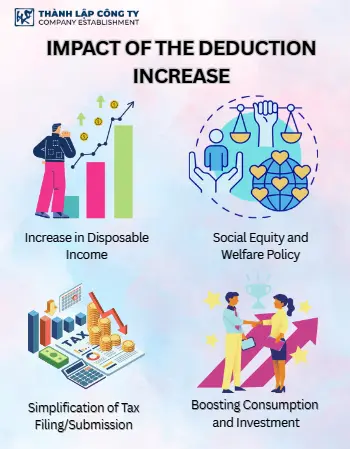
The greatest benefit of the 2026 regulations is the direct and substantial increase in worker disposable income:
- Improved living standards: Increased net income enables citizens to spend more on education, healthcare, and essentials, improving quality of life amid inflation;
- Stimulating consumption: When citizens retain more income, aggregate demand increases, driving production and service sector development—a crucial macroeconomic measure for growth;
- Enhanced employee satisfaction: Automatic receipt of higher net income by employees—without increased gross salary costs to companies—improves satisfaction and engagement.
For high-level experts and expats, the increased dependent exemption to VND 6.2 million per dependent monthly is particularly valuable, as they often have greater family financial burdens. This adjustment strengthens Vietnam’s compensation competitiveness for attracting international talent.
IV. Key Points in the Draft Revised Personal Income Tax Law
Parallel to the exemption increase, the Draft Personal Income Tax Law (replacement) under National Assembly review contains systemic changes affecting tax calculation and administration.
1. Changes to the Progressive Tax Schedule (Seven to Five Brackets)
The proposal to reduce the progressive tax schedule aims to simplify the system, reduce calculation complexity, and make rates more reasonable for upper-middle-income earners:
- Significance: The reduction clearly benefits those with taxable income from VND 10–60 million monthly, applying lower tax rates to portions of income compared to the current seven-bracket schedule. For example, an individual with taxable income of VND 35 million will pay 15% on the portion above VND 30 million, instead of the previous 20%. This positive shift eases middle-class burdens and strengthens tax system equity.
- Accounting implications: Accounting departments must prepare for a potential second tax calculation formula update in 2026 (after the exemption change) if the new schedule takes effect mid-year. This requires absolute precision in applying rates and calculating year-end tax settlements.
2. New 17% Tax Rate for Business Individuals
The Draft proposes a new approach for business individuals (business households, property lessors), replacing the current fixed-rate method:
- Profit-based taxation: Business individuals with revenue exceeding regulatory thresholds (expected VND 1 billion/year) will calculate tax on profit: PIT = Taxable Income x 17%, where Taxable Income = Revenue – Deductible Expenses. This method is fairer, as tax is owed only on actual income.
- Business household classification: Division into three groups (under VND 200 million exempt, VND 200 million–3 billion applying revenue ratios, over VND 3 billion applying profit tax) encourages transparency and large household conversion to enterprise status.
- Significance: This change increases fairness by taxing actual income rather than estimated revenue, but requires stricter bookkeeping. This creates significant demand for professional accounting services.
For accounting service providers, this is a major opportunity to expand consulting and tax filing support for individual and business household clients. Experts must master deductible expense regulations to advise clients optimally under the new law.
3. Additions and Clarifications on Taxable and Exempt Income
The Draft also clarifies and supplements income items to align with contemporary realities:
- Exemption for reasonable lump-sum employee expenses: Tax exemption for lump-sum amounts provided to employees (phone, business travel, office supplies) is proposed, provided an internal expenditure policy exists. This offers businesses flexibility in structuring welfare and optimizing employee taxes.
- Digital economy income inclusion: The Draft supplements regulations on digital platform income and new digital asset taxation, ensuring the Law comprehensively covers technological-era income sources.
- State budget salary exemptions: Proposed tax exemption for state-funded salaries in specific professions (police, military).
Clear definitions of exempt income help businesses minimize tax collection risks. HR and Accounting must collaborate closely to review internal policies, ensuring compliance with new requirements to benefit from tax incentives.
V. Required Actions for Businesses and Taxpayers
1. Updating Payroll Systems and Accounting Software
Technical compliance is the priority:
- Update core parameters: By Q4/2025, IT and Accounting must plan to change exemption parameters in payroll systems (ERP, Excel, accounting software) effective January 1, 2026;
- Tax schedule flexibility: The system must seamlessly switch between current seven-bracket and proposed five-bracket schedules within 2026 if the new schedule takes effect mid-year, requiring effective date parameter settings;
- Stress testing: Conduct trial payroll runs for various employee groups (low, medium, high income, with/without dependents) using different exemption levels and tax schedules to ensure 100% calculation accuracy before official implementation.
Businesses should avoid manual updates due to high error risk. Work with software vendors for automatic updates, as even minor errors compound into major year-end discrepancies.
2. Compliance and Internal Communication
- Specialized training: Organize in-depth training for Accounting, HR, and Finance teams on the new exemptions, potentially new tax schedules, and dependent documentation requirements;
- Transparent communication: Use internal channels to announce new exemption levels and net income impact. Transparency in dependent registration encourages employee compliance;
- Periodic review: Establish quarterly review processes for 2026 personal income tax calculations and dependent documentation, especially during any tax schedule transition, to detect and correct errors promptly.
Tax compliance is a primary business responsibility. A clear plan not only avoids penalties but reinforces company reputation with employees and government agencies.
The 2026 Personal Income Tax regulations mark a significant milestone. The increase in personal exemptions to VND 15.5 million and VND 6.2 million per dependent demonstrates strong government support for the middle class, boosting disposable income and economic consumption.
For businesses, proactive preparation—updating systems, training staff, ensuring strict dependent documentation compliance—ensures accurate implementation and stronger employee relations. Wacontre Accounting Services is committed to supporting your business in analyzing, advising on, and effectively implementing the 2026 regulations for full tax law compliance.
If you have questions, contact Wacontre via Hotline: (028) 3820 1213 or email [email protected] for prompt consultation and support. With our experienced team, Wacontre is ready to serve customers with enthusiasm and efficiency.
III. Disposable Income Benefits
The greatest benefit of the 2026 regulations is the direct and substantial increase in worker disposable income:
- Improved living standards: Increased net income enables citizens to spend more on education, healthcare, and essentials, improving quality of life amid inflation;
- Stimulating consumption: When citizens retain more income, aggregate demand increases, driving production and service sector development—a crucial macroeconomic measure for growth;
- Enhanced employee satisfaction: Automatic receipt of higher net income by employees—without increased gross salary costs to companies—improves satisfaction and engagement.
For high-level experts and expats, the increased dependent exemption to VND 6.2 million per dependent monthly is particularly valuable, as they often have greater family financial burdens. This adjustment strengthens Vietnam’s compensation competitiveness for attracting international talent.
IV. Key Points in the Draft Revised Personal Income Tax Law
Parallel to the exemption increase, the Draft Personal Income Tax Law (replacement) under National Assembly review contains systemic changes affecting tax calculation and administration.
1. Changes to the Progressive Tax Schedule (Seven to Five Brackets)
The proposal to reduce the progressive tax schedule aims to simplify the system, reduce calculation complexity, and make rates more reasonable for upper-middle-income earners:
- Significance: The reduction clearly benefits those with taxable income from VND 10–60 million monthly, applying lower tax rates to portions of income compared to the current seven-bracket schedule. For example, an individual with taxable income of VND 35 million will pay 15% on the portion above VND 30 million, instead of the previous 20%. This positive shift eases middle-class burdens and strengthens tax system equity.
- Accounting implications: Accounting departments must prepare for a potential second tax calculation formula update in 2026 (after the exemption change) if the new schedule takes effect mid-year. This requires absolute precision in applying rates and calculating year-end tax settlements.
2. New 17% Tax Rate for Business Individuals
The Draft proposes a new approach for business individuals (business households, property lessors), replacing the current fixed-rate method:
- Profit-based taxation: Business individuals with revenue exceeding regulatory thresholds (expected VND 1 billion/year) will calculate tax on profit: PIT = Taxable Income x 17%, where Taxable Income = Revenue – Deductible Expenses. This method is fairer, as tax is owed only on actual income.
- Business household classification: Division into three groups (under VND 200 million exempt, VND 200 million–3 billion applying revenue ratios, over VND 3 billion applying profit tax) encourages transparency and large household conversion to enterprise status.
- Significance: This change increases fairness by taxing actual income rather than estimated revenue, but requires stricter bookkeeping. This creates significant demand for professional accounting services.
For accounting service providers, this is a major opportunity to expand consulting and tax filing support for individual and business household clients. Experts must master deductible expense regulations to advise clients optimally under the new law.
3. Additions and Clarifications on Taxable and Exempt Income
The Draft also clarifies and supplements income items to align with contemporary realities:
- Exemption for reasonable lump-sum employee expenses: Tax exemption for lump-sum amounts provided to employees (phone, business travel, office supplies) is proposed, provided an internal expenditure policy exists. This offers businesses flexibility in structuring welfare and optimizing employee taxes.
- Digital economy income inclusion: The Draft supplements regulations on digital platform income and new digital asset taxation, ensuring the Law comprehensively covers technological-era income sources.
- State budget salary exemptions: Proposed tax exemption for state-funded salaries in specific professions (police, military).
Clear definitions of exempt income help businesses minimize tax collection risks. HR and Accounting must collaborate closely to review internal policies, ensuring compliance with new requirements to benefit from tax incentives.
V. Required Actions for Businesses and Taxpayers
1. Updating Payroll Systems and Accounting Software
Technical compliance is the priority:
- Update core parameters: By Q4/2025, IT and Accounting must plan to change exemption parameters in payroll systems (ERP, Excel, accounting software) effective January 1, 2026;
- Tax schedule flexibility: The system must seamlessly switch between current seven-bracket and proposed five-bracket schedules within 2026 if the new schedule takes effect mid-year, requiring effective date parameter settings;
- Stress testing: Conduct trial payroll runs for various employee groups (low, medium, high income, with/without dependents) using different exemption levels and tax schedules to ensure 100% calculation accuracy before official implementation.
Businesses should avoid manual updates due to high error risk. Work with software vendors for automatic updates, as even minor errors compound into major year-end discrepancies.
2. Compliance and Internal Communication
- Specialized training: Organize in-depth training for Accounting, HR, and Finance teams on the new exemptions, potentially new tax schedules, and dependent documentation requirements;
- Transparent communication: Use internal channels to announce new exemption levels and net income impact. Transparency in dependent registration encourages employee compliance;
- Periodic review: Establish quarterly review processes for 2026 personal income tax calculations and dependent documentation, especially during any tax schedule transition, to detect and correct errors promptly.
Tax compliance is a primary business responsibility. A clear plan not only avoids penalties but reinforces company reputation with employees and government agencies.
The 2026 Personal Income Tax regulations mark a significant milestone. The increase in personal exemptions to VND 15.5 million and VND 6.2 million per dependent demonstrates strong government support for the middle class, boosting disposable income and economic consumption.
For businesses, proactive preparation—updating systems, training staff, ensuring strict dependent documentation compliance—ensures accurate implementation and stronger employee relations. Wacontre Accounting Services is committed to supporting your business in analyzing, advising on, and effectively implementing the 2026 regulations for full tax law compliance.
If you have questions, contact Wacontre via Hotline: (028) 3820 1213 or email [email protected] for prompt consultation and support. With our experienced team, Wacontre is ready to serve customers with enthusiasm and efficiency.
Tax threshold calculation must be done precisely, including mandatory insurance contributions. Companies should proactively communicate this comparison table to employees to demonstrate benefits received. For high-income individuals who remain taxable in higher brackets, this increased exemption still results in fixed monthly tax savings, boosting after-tax income.
III. Disposable Income Benefits
The greatest benefit of the 2026 regulations is the direct and substantial increase in worker disposable income:
- Improved living standards: Increased net income enables citizens to spend more on education, healthcare, and essentials, improving quality of life amid inflation;
- Stimulating consumption: When citizens retain more income, aggregate demand increases, driving production and service sector development—a crucial macroeconomic measure for growth;
- Enhanced employee satisfaction: Automatic receipt of higher net income by employees—without increased gross salary costs to companies—improves satisfaction and engagement.
For high-level experts and expats, the increased dependent exemption to VND 6.2 million per dependent monthly is particularly valuable, as they often have greater family financial burdens. This adjustment strengthens Vietnam’s compensation competitiveness for attracting international talent.
IV. Key Points in the Draft Revised Personal Income Tax Law
Parallel to the exemption increase, the Draft Personal Income Tax Law (replacement) under National Assembly review contains systemic changes affecting tax calculation and administration.
1. Changes to the Progressive Tax Schedule (Seven to Five Brackets)
The proposal to reduce the progressive tax schedule aims to simplify the system, reduce calculation complexity, and make rates more reasonable for upper-middle-income earners:
- Significance: The reduction clearly benefits those with taxable income from VND 10–60 million monthly, applying lower tax rates to portions of income compared to the current seven-bracket schedule. For example, an individual with taxable income of VND 35 million will pay 15% on the portion above VND 30 million, instead of the previous 20%. This positive shift eases middle-class burdens and strengthens tax system equity.
- Accounting implications: Accounting departments must prepare for a potential second tax calculation formula update in 2026 (after the exemption change) if the new schedule takes effect mid-year. This requires absolute precision in applying rates and calculating year-end tax settlements.
2. New 17% Tax Rate for Business Individuals
The Draft proposes a new approach for business individuals (business households, property lessors), replacing the current fixed-rate method:
- Profit-based taxation: Business individuals with revenue exceeding regulatory thresholds (expected VND 1 billion/year) will calculate tax on profit: PIT = Taxable Income x 17%, where Taxable Income = Revenue – Deductible Expenses. This method is fairer, as tax is owed only on actual income.
- Business household classification: Division into three groups (under VND 200 million exempt, VND 200 million–3 billion applying revenue ratios, over VND 3 billion applying profit tax) encourages transparency and large household conversion to enterprise status.
- Significance: This change increases fairness by taxing actual income rather than estimated revenue, but requires stricter bookkeeping. This creates significant demand for professional accounting services.
For accounting service providers, this is a major opportunity to expand consulting and tax filing support for individual and business household clients. Experts must master deductible expense regulations to advise clients optimally under the new law.
3. Additions and Clarifications on Taxable and Exempt Income
The Draft also clarifies and supplements income items to align with contemporary realities:
- Exemption for reasonable lump-sum employee expenses: Tax exemption for lump-sum amounts provided to employees (phone, business travel, office supplies) is proposed, provided an internal expenditure policy exists. This offers businesses flexibility in structuring welfare and optimizing employee taxes.
- Digital economy income inclusion: The Draft supplements regulations on digital platform income and new digital asset taxation, ensuring the Law comprehensively covers technological-era income sources.
- State budget salary exemptions: Proposed tax exemption for state-funded salaries in specific professions (police, military).
Clear definitions of exempt income help businesses minimize tax collection risks. HR and Accounting must collaborate closely to review internal policies, ensuring compliance with new requirements to benefit from tax incentives.
V. Required Actions for Businesses and Taxpayers
1. Updating Payroll Systems and Accounting Software
Technical compliance is the priority:
- Update core parameters: By Q4/2025, IT and Accounting must plan to change exemption parameters in payroll systems (ERP, Excel, accounting software) effective January 1, 2026;
- Tax schedule flexibility: The system must seamlessly switch between current seven-bracket and proposed five-bracket schedules within 2026 if the new schedule takes effect mid-year, requiring effective date parameter settings;
- Stress testing: Conduct trial payroll runs for various employee groups (low, medium, high income, with/without dependents) using different exemption levels and tax schedules to ensure 100% calculation accuracy before official implementation.
Businesses should avoid manual updates due to high error risk. Work with software vendors for automatic updates, as even minor errors compound into major year-end discrepancies.
2. Compliance and Internal Communication
- Specialized training: Organize in-depth training for Accounting, HR, and Finance teams on the new exemptions, potentially new tax schedules, and dependent documentation requirements;
- Transparent communication: Use internal channels to announce new exemption levels and net income impact. Transparency in dependent registration encourages employee compliance;
- Periodic review: Establish quarterly review processes for 2026 personal income tax calculations and dependent documentation, especially during any tax schedule transition, to detect and correct errors promptly.
Tax compliance is a primary business responsibility. A clear plan not only avoids penalties but reinforces company reputation with employees and government agencies.
The 2026 Personal Income Tax regulations mark a significant milestone. The increase in personal exemptions to VND 15.5 million and VND 6.2 million per dependent demonstrates strong government support for the middle class, boosting disposable income and economic consumption.
For businesses, proactive preparation—updating systems, training staff, ensuring strict dependent documentation compliance—ensures accurate implementation and stronger employee relations. Wacontre Accounting Services is committed to supporting your business in analyzing, advising on, and effectively implementing the 2026 regulations for full tax law compliance.
If you have questions, contact Wacontre via Hotline: (028) 3820 1213 or email [email protected] for prompt consultation and support. With our experienced team, Wacontre is ready to serve customers with enthusiasm and efficiency.
Tax threshold calculation must be done precisely, including mandatory insurance contributions. Companies should proactively communicate this comparison table to employees to demonstrate benefits received. For high-income individuals who remain taxable in higher brackets, this increased exemption still results in fixed monthly tax savings, boosting after-tax income.
III. Disposable Income Benefits
The greatest benefit of the 2026 regulations is the direct and substantial increase in worker disposable income:
- Improved living standards: Increased net income enables citizens to spend more on education, healthcare, and essentials, improving quality of life amid inflation;
- Stimulating consumption: When citizens retain more income, aggregate demand increases, driving production and service sector development—a crucial macroeconomic measure for growth;
- Enhanced employee satisfaction: Automatic receipt of higher net income by employees—without increased gross salary costs to companies—improves satisfaction and engagement.
For high-level experts and expats, the increased dependent exemption to VND 6.2 million per dependent monthly is particularly valuable, as they often have greater family financial burdens. This adjustment strengthens Vietnam’s compensation competitiveness for attracting international talent.
IV. Key Points in the Draft Revised Personal Income Tax Law
Parallel to the exemption increase, the Draft Personal Income Tax Law (replacement) under National Assembly review contains systemic changes affecting tax calculation and administration.
1. Changes to the Progressive Tax Schedule (Seven to Five Brackets)
The proposal to reduce the progressive tax schedule aims to simplify the system, reduce calculation complexity, and make rates more reasonable for upper-middle-income earners:
- Significance: The reduction clearly benefits those with taxable income from VND 10–60 million monthly, applying lower tax rates to portions of income compared to the current seven-bracket schedule. For example, an individual with taxable income of VND 35 million will pay 15% on the portion above VND 30 million, instead of the previous 20%. This positive shift eases middle-class burdens and strengthens tax system equity.
- Accounting implications: Accounting departments must prepare for a potential second tax calculation formula update in 2026 (after the exemption change) if the new schedule takes effect mid-year. This requires absolute precision in applying rates and calculating year-end tax settlements.
2. New 17% Tax Rate for Business Individuals
The Draft proposes a new approach for business individuals (business households, property lessors), replacing the current fixed-rate method:
- Profit-based taxation: Business individuals with revenue exceeding regulatory thresholds (expected VND 1 billion/year) will calculate tax on profit: PIT = Taxable Income x 17%, where Taxable Income = Revenue – Deductible Expenses. This method is fairer, as tax is owed only on actual income.
- Business household classification: Division into three groups (under VND 200 million exempt, VND 200 million–3 billion applying revenue ratios, over VND 3 billion applying profit tax) encourages transparency and large household conversion to enterprise status.
- Significance: This change increases fairness by taxing actual income rather than estimated revenue, but requires stricter bookkeeping. This creates significant demand for professional accounting services.
For accounting service providers, this is a major opportunity to expand consulting and tax filing support for individual and business household clients. Experts must master deductible expense regulations to advise clients optimally under the new law.
3. Additions and Clarifications on Taxable and Exempt Income
The Draft also clarifies and supplements income items to align with contemporary realities:
- Exemption for reasonable lump-sum employee expenses: Tax exemption for lump-sum amounts provided to employees (phone, business travel, office supplies) is proposed, provided an internal expenditure policy exists. This offers businesses flexibility in structuring welfare and optimizing employee taxes.
- Digital economy income inclusion: The Draft supplements regulations on digital platform income and new digital asset taxation, ensuring the Law comprehensively covers technological-era income sources.
- State budget salary exemptions: Proposed tax exemption for state-funded salaries in specific professions (police, military).
Clear definitions of exempt income help businesses minimize tax collection risks. HR and Accounting must collaborate closely to review internal policies, ensuring compliance with new requirements to benefit from tax incentives.
V. Required Actions for Businesses and Taxpayers
1. Updating Payroll Systems and Accounting Software
Technical compliance is the priority:
- Update core parameters: By Q4/2025, IT and Accounting must plan to change exemption parameters in payroll systems (ERP, Excel, accounting software) effective January 1, 2026;
- Tax schedule flexibility: The system must seamlessly switch between current seven-bracket and proposed five-bracket schedules within 2026 if the new schedule takes effect mid-year, requiring effective date parameter settings;
- Stress testing: Conduct trial payroll runs for various employee groups (low, medium, high income, with/without dependents) using different exemption levels and tax schedules to ensure 100% calculation accuracy before official implementation.
Businesses should avoid manual updates due to high error risk. Work with software vendors for automatic updates, as even minor errors compound into major year-end discrepancies.
2. Compliance and Internal Communication
- Specialized training: Organize in-depth training for Accounting, HR, and Finance teams on the new exemptions, potentially new tax schedules, and dependent documentation requirements;
- Transparent communication: Use internal channels to announce new exemption levels and net income impact. Transparency in dependent registration encourages employee compliance;
- Periodic review: Establish quarterly review processes for 2026 personal income tax calculations and dependent documentation, especially during any tax schedule transition, to detect and correct errors promptly.
Tax compliance is a primary business responsibility. A clear plan not only avoids penalties but reinforces company reputation with employees and government agencies.
The 2026 Personal Income Tax regulations mark a significant milestone. The increase in personal exemptions to VND 15.5 million and VND 6.2 million per dependent demonstrates strong government support for the middle class, boosting disposable income and economic consumption.
For businesses, proactive preparation—updating systems, training staff, ensuring strict dependent documentation compliance—ensures accurate implementation and stronger employee relations. Wacontre Accounting Services is committed to supporting your business in analyzing, advising on, and effectively implementing the 2026 regulations for full tax law compliance.
If you have questions, contact Wacontre via Hotline: (028) 3820 1213 or email [email protected] for prompt consultation and support. With our experienced team, Wacontre is ready to serve customers with enthusiasm and efficiency.
Tax threshold calculation must be done precisely, including mandatory insurance contributions. Companies should proactively communicate this comparison table to employees to demonstrate benefits received. For high-income individuals who remain taxable in higher brackets, this increased exemption still results in fixed monthly tax savings, boosting after-tax income.
III. Disposable Income Benefits
The greatest benefit of the 2026 regulations is the direct and substantial increase in worker disposable income:
- Improved living standards: Increased net income enables citizens to spend more on education, healthcare, and essentials, improving quality of life amid inflation;
- Stimulating consumption: When citizens retain more income, aggregate demand increases, driving production and service sector development—a crucial macroeconomic measure for growth;
- Enhanced employee satisfaction: Automatic receipt of higher net income by employees—without increased gross salary costs to companies—improves satisfaction and engagement.
For high-level experts and expats, the increased dependent exemption to VND 6.2 million per dependent monthly is particularly valuable, as they often have greater family financial burdens. This adjustment strengthens Vietnam’s compensation competitiveness for attracting international talent.
IV. Key Points in the Draft Revised Personal Income Tax Law
Parallel to the exemption increase, the Draft Personal Income Tax Law (replacement) under National Assembly review contains systemic changes affecting tax calculation and administration.
1. Changes to the Progressive Tax Schedule (Seven to Five Brackets)
The proposal to reduce the progressive tax schedule aims to simplify the system, reduce calculation complexity, and make rates more reasonable for upper-middle-income earners:
- Significance: The reduction clearly benefits those with taxable income from VND 10–60 million monthly, applying lower tax rates to portions of income compared to the current seven-bracket schedule. For example, an individual with taxable income of VND 35 million will pay 15% on the portion above VND 30 million, instead of the previous 20%. This positive shift eases middle-class burdens and strengthens tax system equity.
- Accounting implications: Accounting departments must prepare for a potential second tax calculation formula update in 2026 (after the exemption change) if the new schedule takes effect mid-year. This requires absolute precision in applying rates and calculating year-end tax settlements.
2. New 17% Tax Rate for Business Individuals
The Draft proposes a new approach for business individuals (business households, property lessors), replacing the current fixed-rate method:
- Profit-based taxation: Business individuals with revenue exceeding regulatory thresholds (expected VND 1 billion/year) will calculate tax on profit: PIT = Taxable Income x 17%, where Taxable Income = Revenue – Deductible Expenses. This method is fairer, as tax is owed only on actual income.
- Business household classification: Division into three groups (under VND 200 million exempt, VND 200 million–3 billion applying revenue ratios, over VND 3 billion applying profit tax) encourages transparency and large household conversion to enterprise status.
- Significance: This change increases fairness by taxing actual income rather than estimated revenue, but requires stricter bookkeeping. This creates significant demand for professional accounting services.
For accounting service providers, this is a major opportunity to expand consulting and tax filing support for individual and business household clients. Experts must master deductible expense regulations to advise clients optimally under the new law.
3. Additions and Clarifications on Taxable and Exempt Income
The Draft also clarifies and supplements income items to align with contemporary realities:
- Exemption for reasonable lump-sum employee expenses: Tax exemption for lump-sum amounts provided to employees (phone, business travel, office supplies) is proposed, provided an internal expenditure policy exists. This offers businesses flexibility in structuring welfare and optimizing employee taxes.
- Digital economy income inclusion: The Draft supplements regulations on digital platform income and new digital asset taxation, ensuring the Law comprehensively covers technological-era income sources.
- State budget salary exemptions: Proposed tax exemption for state-funded salaries in specific professions (police, military).
Clear definitions of exempt income help businesses minimize tax collection risks. HR and Accounting must collaborate closely to review internal policies, ensuring compliance with new requirements to benefit from tax incentives.
V. Required Actions for Businesses and Taxpayers
1. Updating Payroll Systems and Accounting Software
Technical compliance is the priority:
- Update core parameters: By Q4/2025, IT and Accounting must plan to change exemption parameters in payroll systems (ERP, Excel, accounting software) effective January 1, 2026;
- Tax schedule flexibility: The system must seamlessly switch between current seven-bracket and proposed five-bracket schedules within 2026 if the new schedule takes effect mid-year, requiring effective date parameter settings;
- Stress testing: Conduct trial payroll runs for various employee groups (low, medium, high income, with/without dependents) using different exemption levels and tax schedules to ensure 100% calculation accuracy before official implementation.
Businesses should avoid manual updates due to high error risk. Work with software vendors for automatic updates, as even minor errors compound into major year-end discrepancies.
2. Compliance and Internal Communication
- Specialized training: Organize in-depth training for Accounting, HR, and Finance teams on the new exemptions, potentially new tax schedules, and dependent documentation requirements;
- Transparent communication: Use internal channels to announce new exemption levels and net income impact. Transparency in dependent registration encourages employee compliance;
- Periodic review: Establish quarterly review processes for 2026 personal income tax calculations and dependent documentation, especially during any tax schedule transition, to detect and correct errors promptly.
Tax compliance is a primary business responsibility. A clear plan not only avoids penalties but reinforces company reputation with employees and government agencies.
The 2026 Personal Income Tax regulations mark a significant milestone. The increase in personal exemptions to VND 15.5 million and VND 6.2 million per dependent demonstrates strong government support for the middle class, boosting disposable income and economic consumption.
For businesses, proactive preparation—updating systems, training staff, ensuring strict dependent documentation compliance—ensures accurate implementation and stronger employee relations. Wacontre Accounting Services is committed to supporting your business in analyzing, advising on, and effectively implementing the 2026 regulations for full tax law compliance.
If you have questions, contact Wacontre via Hotline: (028) 3820 1213 or email [email protected] for prompt consultation and support. With our experienced team, Wacontre is ready to serve customers with enthusiasm and efficiency.
- Clear impact: The exemption increase raises the tax threshold by nearly 41%. An individual with a gross income of approximately VND 20 million and one dependent, previously taxable, will not be required to pay tax from 2026 onward.
- Reducing first-bracket burden: The Ministry of Finance estimates this change will remove approximately 50% of those currently paying tax at the first bracket (5% rate) from taxable status. This significantly reduces administrative complexity and preserves critical spending income for citizens.
Tax threshold calculation must be done precisely, including mandatory insurance contributions. Companies should proactively communicate this comparison table to employees to demonstrate benefits received. For high-income individuals who remain taxable in higher brackets, this increased exemption still results in fixed monthly tax savings, boosting after-tax income.
III. Disposable Income Benefits
The greatest benefit of the 2026 regulations is the direct and substantial increase in worker disposable income:
- Improved living standards: Increased net income enables citizens to spend more on education, healthcare, and essentials, improving quality of life amid inflation;
- Stimulating consumption: When citizens retain more income, aggregate demand increases, driving production and service sector development—a crucial macroeconomic measure for growth;
- Enhanced employee satisfaction: Automatic receipt of higher net income by employees—without increased gross salary costs to companies—improves satisfaction and engagement.
For high-level experts and expats, the increased dependent exemption to VND 6.2 million per dependent monthly is particularly valuable, as they often have greater family financial burdens. This adjustment strengthens Vietnam’s compensation competitiveness for attracting international talent.
IV. Key Points in the Draft Revised Personal Income Tax Law
Parallel to the exemption increase, the Draft Personal Income Tax Law (replacement) under National Assembly review contains systemic changes affecting tax calculation and administration.
1. Changes to the Progressive Tax Schedule (Seven to Five Brackets)
The proposal to reduce the progressive tax schedule aims to simplify the system, reduce calculation complexity, and make rates more reasonable for upper-middle-income earners:
- Significance: The reduction clearly benefits those with taxable income from VND 10–60 million monthly, applying lower tax rates to portions of income compared to the current seven-bracket schedule. For example, an individual with taxable income of VND 35 million will pay 15% on the portion above VND 30 million, instead of the previous 20%. This positive shift eases middle-class burdens and strengthens tax system equity.
- Accounting implications: Accounting departments must prepare for a potential second tax calculation formula update in 2026 (after the exemption change) if the new schedule takes effect mid-year. This requires absolute precision in applying rates and calculating year-end tax settlements.
2. New 17% Tax Rate for Business Individuals
The Draft proposes a new approach for business individuals (business households, property lessors), replacing the current fixed-rate method:
- Profit-based taxation: Business individuals with revenue exceeding regulatory thresholds (expected VND 1 billion/year) will calculate tax on profit: PIT = Taxable Income x 17%, where Taxable Income = Revenue – Deductible Expenses. This method is fairer, as tax is owed only on actual income.
- Business household classification: Division into three groups (under VND 200 million exempt, VND 200 million–3 billion applying revenue ratios, over VND 3 billion applying profit tax) encourages transparency and large household conversion to enterprise status.
- Significance: This change increases fairness by taxing actual income rather than estimated revenue, but requires stricter bookkeeping. This creates significant demand for professional accounting services.
For accounting service providers, this is a major opportunity to expand consulting and tax filing support for individual and business household clients. Experts must master deductible expense regulations to advise clients optimally under the new law.
3. Additions and Clarifications on Taxable and Exempt Income
The Draft also clarifies and supplements income items to align with contemporary realities:
- Exemption for reasonable lump-sum employee expenses: Tax exemption for lump-sum amounts provided to employees (phone, business travel, office supplies) is proposed, provided an internal expenditure policy exists. This offers businesses flexibility in structuring welfare and optimizing employee taxes.
- Digital economy income inclusion: The Draft supplements regulations on digital platform income and new digital asset taxation, ensuring the Law comprehensively covers technological-era income sources.
- State budget salary exemptions: Proposed tax exemption for state-funded salaries in specific professions (police, military).
Clear definitions of exempt income help businesses minimize tax collection risks. HR and Accounting must collaborate closely to review internal policies, ensuring compliance with new requirements to benefit from tax incentives.
V. Required Actions for Businesses and Taxpayers
1. Updating Payroll Systems and Accounting Software
Technical compliance is the priority:
- Update core parameters: By Q4/2025, IT and Accounting must plan to change exemption parameters in payroll systems (ERP, Excel, accounting software) effective January 1, 2026;
- Tax schedule flexibility: The system must seamlessly switch between current seven-bracket and proposed five-bracket schedules within 2026 if the new schedule takes effect mid-year, requiring effective date parameter settings;
- Stress testing: Conduct trial payroll runs for various employee groups (low, medium, high income, with/without dependents) using different exemption levels and tax schedules to ensure 100% calculation accuracy before official implementation.
Businesses should avoid manual updates due to high error risk. Work with software vendors for automatic updates, as even minor errors compound into major year-end discrepancies.
2. Compliance and Internal Communication
- Specialized training: Organize in-depth training for Accounting, HR, and Finance teams on the new exemptions, potentially new tax schedules, and dependent documentation requirements;
- Transparent communication: Use internal channels to announce new exemption levels and net income impact. Transparency in dependent registration encourages employee compliance;
- Periodic review: Establish quarterly review processes for 2026 personal income tax calculations and dependent documentation, especially during any tax schedule transition, to detect and correct errors promptly.
Tax compliance is a primary business responsibility. A clear plan not only avoids penalties but reinforces company reputation with employees and government agencies.
The 2026 Personal Income Tax regulations mark a significant milestone. The increase in personal exemptions to VND 15.5 million and VND 6.2 million per dependent demonstrates strong government support for the middle class, boosting disposable income and economic consumption.
For businesses, proactive preparation—updating systems, training staff, ensuring strict dependent documentation compliance—ensures accurate implementation and stronger employee relations. Wacontre Accounting Services is committed to supporting your business in analyzing, advising on, and effectively implementing the 2026 regulations for full tax law compliance.
If you have questions, contact Wacontre via Hotline: (028) 3820 1213 or email [email protected] for prompt consultation and support. With our experienced team, Wacontre is ready to serve customers with enthusiasm and efficiency.
The approximate gross income threshold is calculated as: New exemption + mandatory insurance contributions (approximately 10.5% of gross income).
- Clear impact: The exemption increase raises the tax threshold by nearly 41%. An individual with a gross income of approximately VND 20 million and one dependent, previously taxable, will not be required to pay tax from 2026 onward.
- Reducing first-bracket burden: The Ministry of Finance estimates this change will remove approximately 50% of those currently paying tax at the first bracket (5% rate) from taxable status. This significantly reduces administrative complexity and preserves critical spending income for citizens.
Tax threshold calculation must be done precisely, including mandatory insurance contributions. Companies should proactively communicate this comparison table to employees to demonstrate benefits received. For high-income individuals who remain taxable in higher brackets, this increased exemption still results in fixed monthly tax savings, boosting after-tax income.
III. Disposable Income Benefits
The greatest benefit of the 2026 regulations is the direct and substantial increase in worker disposable income:
- Improved living standards: Increased net income enables citizens to spend more on education, healthcare, and essentials, improving quality of life amid inflation;
- Stimulating consumption: When citizens retain more income, aggregate demand increases, driving production and service sector development—a crucial macroeconomic measure for growth;
- Enhanced employee satisfaction: Automatic receipt of higher net income by employees—without increased gross salary costs to companies—improves satisfaction and engagement.
For high-level experts and expats, the increased dependent exemption to VND 6.2 million per dependent monthly is particularly valuable, as they often have greater family financial burdens. This adjustment strengthens Vietnam’s compensation competitiveness for attracting international talent.
IV. Key Points in the Draft Revised Personal Income Tax Law
Parallel to the exemption increase, the Draft Personal Income Tax Law (replacement) under National Assembly review contains systemic changes affecting tax calculation and administration.
1. Changes to the Progressive Tax Schedule (Seven to Five Brackets)
The proposal to reduce the progressive tax schedule aims to simplify the system, reduce calculation complexity, and make rates more reasonable for upper-middle-income earners:
- Significance: The reduction clearly benefits those with taxable income from VND 10–60 million monthly, applying lower tax rates to portions of income compared to the current seven-bracket schedule. For example, an individual with taxable income of VND 35 million will pay 15% on the portion above VND 30 million, instead of the previous 20%. This positive shift eases middle-class burdens and strengthens tax system equity.
- Accounting implications: Accounting departments must prepare for a potential second tax calculation formula update in 2026 (after the exemption change) if the new schedule takes effect mid-year. This requires absolute precision in applying rates and calculating year-end tax settlements.
2. New 17% Tax Rate for Business Individuals
The Draft proposes a new approach for business individuals (business households, property lessors), replacing the current fixed-rate method:
- Profit-based taxation: Business individuals with revenue exceeding regulatory thresholds (expected VND 1 billion/year) will calculate tax on profit: PIT = Taxable Income x 17%, where Taxable Income = Revenue – Deductible Expenses. This method is fairer, as tax is owed only on actual income.
- Business household classification: Division into three groups (under VND 200 million exempt, VND 200 million–3 billion applying revenue ratios, over VND 3 billion applying profit tax) encourages transparency and large household conversion to enterprise status.
- Significance: This change increases fairness by taxing actual income rather than estimated revenue, but requires stricter bookkeeping. This creates significant demand for professional accounting services.
For accounting service providers, this is a major opportunity to expand consulting and tax filing support for individual and business household clients. Experts must master deductible expense regulations to advise clients optimally under the new law.
3. Additions and Clarifications on Taxable and Exempt Income
The Draft also clarifies and supplements income items to align with contemporary realities:
- Exemption for reasonable lump-sum employee expenses: Tax exemption for lump-sum amounts provided to employees (phone, business travel, office supplies) is proposed, provided an internal expenditure policy exists. This offers businesses flexibility in structuring welfare and optimizing employee taxes.
- Digital economy income inclusion: The Draft supplements regulations on digital platform income and new digital asset taxation, ensuring the Law comprehensively covers technological-era income sources.
- State budget salary exemptions: Proposed tax exemption for state-funded salaries in specific professions (police, military).
Clear definitions of exempt income help businesses minimize tax collection risks. HR and Accounting must collaborate closely to review internal policies, ensuring compliance with new requirements to benefit from tax incentives.
V. Required Actions for Businesses and Taxpayers
1. Updating Payroll Systems and Accounting Software
Technical compliance is the priority:
- Update core parameters: By Q4/2025, IT and Accounting must plan to change exemption parameters in payroll systems (ERP, Excel, accounting software) effective January 1, 2026;
- Tax schedule flexibility: The system must seamlessly switch between current seven-bracket and proposed five-bracket schedules within 2026 if the new schedule takes effect mid-year, requiring effective date parameter settings;
- Stress testing: Conduct trial payroll runs for various employee groups (low, medium, high income, with/without dependents) using different exemption levels and tax schedules to ensure 100% calculation accuracy before official implementation.
Businesses should avoid manual updates due to high error risk. Work with software vendors for automatic updates, as even minor errors compound into major year-end discrepancies.
2. Compliance and Internal Communication
- Specialized training: Organize in-depth training for Accounting, HR, and Finance teams on the new exemptions, potentially new tax schedules, and dependent documentation requirements;
- Transparent communication: Use internal channels to announce new exemption levels and net income impact. Transparency in dependent registration encourages employee compliance;
- Periodic review: Establish quarterly review processes for 2026 personal income tax calculations and dependent documentation, especially during any tax schedule transition, to detect and correct errors promptly.
Tax compliance is a primary business responsibility. A clear plan not only avoids penalties but reinforces company reputation with employees and government agencies.
The 2026 Personal Income Tax regulations mark a significant milestone. The increase in personal exemptions to VND 15.5 million and VND 6.2 million per dependent demonstrates strong government support for the middle class, boosting disposable income and economic consumption.
For businesses, proactive preparation—updating systems, training staff, ensuring strict dependent documentation compliance—ensures accurate implementation and stronger employee relations. Wacontre Accounting Services is committed to supporting your business in analyzing, advising on, and effectively implementing the 2026 regulations for full tax law compliance.
If you have questions, contact Wacontre via Hotline: (028) 3820 1213 or email [email protected] for prompt consultation and support. With our experienced team, Wacontre is ready to serve customers with enthusiasm and efficiency.
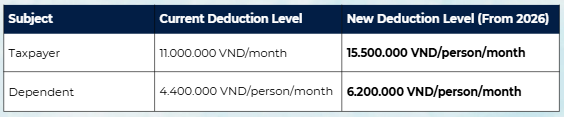
The approximate gross income threshold is calculated as: New exemption + mandatory insurance contributions (approximately 10.5% of gross income).
- Clear impact: The exemption increase raises the tax threshold by nearly 41%. An individual with a gross income of approximately VND 20 million and one dependent, previously taxable, will not be required to pay tax from 2026 onward.
- Reducing first-bracket burden: The Ministry of Finance estimates this change will remove approximately 50% of those currently paying tax at the first bracket (5% rate) from taxable status. This significantly reduces administrative complexity and preserves critical spending income for citizens.
Tax threshold calculation must be done precisely, including mandatory insurance contributions. Companies should proactively communicate this comparison table to employees to demonstrate benefits received. For high-income individuals who remain taxable in higher brackets, this increased exemption still results in fixed monthly tax savings, boosting after-tax income.
III. Disposable Income Benefits
The greatest benefit of the 2026 regulations is the direct and substantial increase in worker disposable income:
- Improved living standards: Increased net income enables citizens to spend more on education, healthcare, and essentials, improving quality of life amid inflation;
- Stimulating consumption: When citizens retain more income, aggregate demand increases, driving production and service sector development—a crucial macroeconomic measure for growth;
- Enhanced employee satisfaction: Automatic receipt of higher net income by employees—without increased gross salary costs to companies—improves satisfaction and engagement.
For high-level experts and expats, the increased dependent exemption to VND 6.2 million per dependent monthly is particularly valuable, as they often have greater family financial burdens. This adjustment strengthens Vietnam’s compensation competitiveness for attracting international talent.
IV. Key Points in the Draft Revised Personal Income Tax Law
Parallel to the exemption increase, the Draft Personal Income Tax Law (replacement) under National Assembly review contains systemic changes affecting tax calculation and administration.
1. Changes to the Progressive Tax Schedule (Seven to Five Brackets)
The proposal to reduce the progressive tax schedule aims to simplify the system, reduce calculation complexity, and make rates more reasonable for upper-middle-income earners:
- Significance: The reduction clearly benefits those with taxable income from VND 10–60 million monthly, applying lower tax rates to portions of income compared to the current seven-bracket schedule. For example, an individual with taxable income of VND 35 million will pay 15% on the portion above VND 30 million, instead of the previous 20%. This positive shift eases middle-class burdens and strengthens tax system equity.
- Accounting implications: Accounting departments must prepare for a potential second tax calculation formula update in 2026 (after the exemption change) if the new schedule takes effect mid-year. This requires absolute precision in applying rates and calculating year-end tax settlements.
2. New 17% Tax Rate for Business Individuals
The Draft proposes a new approach for business individuals (business households, property lessors), replacing the current fixed-rate method:
- Profit-based taxation: Business individuals with revenue exceeding regulatory thresholds (expected VND 1 billion/year) will calculate tax on profit: PIT = Taxable Income x 17%, where Taxable Income = Revenue – Deductible Expenses. This method is fairer, as tax is owed only on actual income.
- Business household classification: Division into three groups (under VND 200 million exempt, VND 200 million–3 billion applying revenue ratios, over VND 3 billion applying profit tax) encourages transparency and large household conversion to enterprise status.
- Significance: This change increases fairness by taxing actual income rather than estimated revenue, but requires stricter bookkeeping. This creates significant demand for professional accounting services.
For accounting service providers, this is a major opportunity to expand consulting and tax filing support for individual and business household clients. Experts must master deductible expense regulations to advise clients optimally under the new law.
3. Additions and Clarifications on Taxable and Exempt Income
The Draft also clarifies and supplements income items to align with contemporary realities:
- Exemption for reasonable lump-sum employee expenses: Tax exemption for lump-sum amounts provided to employees (phone, business travel, office supplies) is proposed, provided an internal expenditure policy exists. This offers businesses flexibility in structuring welfare and optimizing employee taxes.
- Digital economy income inclusion: The Draft supplements regulations on digital platform income and new digital asset taxation, ensuring the Law comprehensively covers technological-era income sources.
- State budget salary exemptions: Proposed tax exemption for state-funded salaries in specific professions (police, military).
Clear definitions of exempt income help businesses minimize tax collection risks. HR and Accounting must collaborate closely to review internal policies, ensuring compliance with new requirements to benefit from tax incentives.
V. Required Actions for Businesses and Taxpayers
1. Updating Payroll Systems and Accounting Software
Technical compliance is the priority:
- Update core parameters: By Q4/2025, IT and Accounting must plan to change exemption parameters in payroll systems (ERP, Excel, accounting software) effective January 1, 2026;
- Tax schedule flexibility: The system must seamlessly switch between current seven-bracket and proposed five-bracket schedules within 2026 if the new schedule takes effect mid-year, requiring effective date parameter settings;
- Stress testing: Conduct trial payroll runs for various employee groups (low, medium, high income, with/without dependents) using different exemption levels and tax schedules to ensure 100% calculation accuracy before official implementation.
Businesses should avoid manual updates due to high error risk. Work with software vendors for automatic updates, as even minor errors compound into major year-end discrepancies.
2. Compliance and Internal Communication
- Specialized training: Organize in-depth training for Accounting, HR, and Finance teams on the new exemptions, potentially new tax schedules, and dependent documentation requirements;
- Transparent communication: Use internal channels to announce new exemption levels and net income impact. Transparency in dependent registration encourages employee compliance;
- Periodic review: Establish quarterly review processes for 2026 personal income tax calculations and dependent documentation, especially during any tax schedule transition, to detect and correct errors promptly.
Tax compliance is a primary business responsibility. A clear plan not only avoids penalties but reinforces company reputation with employees and government agencies.
The 2026 Personal Income Tax regulations mark a significant milestone. The increase in personal exemptions to VND 15.5 million and VND 6.2 million per dependent demonstrates strong government support for the middle class, boosting disposable income and economic consumption.
For businesses, proactive preparation—updating systems, training staff, ensuring strict dependent documentation compliance—ensures accurate implementation and stronger employee relations. Wacontre Accounting Services is committed to supporting your business in analyzing, advising on, and effectively implementing the 2026 regulations for full tax law compliance.
If you have questions, contact Wacontre via Hotline: (028) 3820 1213 or email [email protected] for prompt consultation and support. With our experienced team, Wacontre is ready to serve customers with enthusiasm and efficiency.
The new exemption levels fundamentally change the taxable income threshold, enabling millions of workers to shift to non-taxable status:
The approximate gross income threshold is calculated as: New exemption + mandatory insurance contributions (approximately 10.5% of gross income).
- Clear impact: The exemption increase raises the tax threshold by nearly 41%. An individual with a gross income of approximately VND 20 million and one dependent, previously taxable, will not be required to pay tax from 2026 onward.
- Reducing first-bracket burden: The Ministry of Finance estimates this change will remove approximately 50% of those currently paying tax at the first bracket (5% rate) from taxable status. This significantly reduces administrative complexity and preserves critical spending income for citizens.
Tax threshold calculation must be done precisely, including mandatory insurance contributions. Companies should proactively communicate this comparison table to employees to demonstrate benefits received. For high-income individuals who remain taxable in higher brackets, this increased exemption still results in fixed monthly tax savings, boosting after-tax income.
III. Disposable Income Benefits
The greatest benefit of the 2026 regulations is the direct and substantial increase in worker disposable income:
- Improved living standards: Increased net income enables citizens to spend more on education, healthcare, and essentials, improving quality of life amid inflation;
- Stimulating consumption: When citizens retain more income, aggregate demand increases, driving production and service sector development—a crucial macroeconomic measure for growth;
- Enhanced employee satisfaction: Automatic receipt of higher net income by employees—without increased gross salary costs to companies—improves satisfaction and engagement.
For high-level experts and expats, the increased dependent exemption to VND 6.2 million per dependent monthly is particularly valuable, as they often have greater family financial burdens. This adjustment strengthens Vietnam’s compensation competitiveness for attracting international talent.
IV. Key Points in the Draft Revised Personal Income Tax Law
Parallel to the exemption increase, the Draft Personal Income Tax Law (replacement) under National Assembly review contains systemic changes affecting tax calculation and administration.
1. Changes to the Progressive Tax Schedule (Seven to Five Brackets)
The proposal to reduce the progressive tax schedule aims to simplify the system, reduce calculation complexity, and make rates more reasonable for upper-middle-income earners:
- Significance: The reduction clearly benefits those with taxable income from VND 10–60 million monthly, applying lower tax rates to portions of income compared to the current seven-bracket schedule. For example, an individual with taxable income of VND 35 million will pay 15% on the portion above VND 30 million, instead of the previous 20%. This positive shift eases middle-class burdens and strengthens tax system equity.
- Accounting implications: Accounting departments must prepare for a potential second tax calculation formula update in 2026 (after the exemption change) if the new schedule takes effect mid-year. This requires absolute precision in applying rates and calculating year-end tax settlements.
2. New 17% Tax Rate for Business Individuals
The Draft proposes a new approach for business individuals (business households, property lessors), replacing the current fixed-rate method:
- Profit-based taxation: Business individuals with revenue exceeding regulatory thresholds (expected VND 1 billion/year) will calculate tax on profit: PIT = Taxable Income x 17%, where Taxable Income = Revenue – Deductible Expenses. This method is fairer, as tax is owed only on actual income.
- Business household classification: Division into three groups (under VND 200 million exempt, VND 200 million–3 billion applying revenue ratios, over VND 3 billion applying profit tax) encourages transparency and large household conversion to enterprise status.
- Significance: This change increases fairness by taxing actual income rather than estimated revenue, but requires stricter bookkeeping. This creates significant demand for professional accounting services.
For accounting service providers, this is a major opportunity to expand consulting and tax filing support for individual and business household clients. Experts must master deductible expense regulations to advise clients optimally under the new law.
3. Additions and Clarifications on Taxable and Exempt Income
The Draft also clarifies and supplements income items to align with contemporary realities:
- Exemption for reasonable lump-sum employee expenses: Tax exemption for lump-sum amounts provided to employees (phone, business travel, office supplies) is proposed, provided an internal expenditure policy exists. This offers businesses flexibility in structuring welfare and optimizing employee taxes.
- Digital economy income inclusion: The Draft supplements regulations on digital platform income and new digital asset taxation, ensuring the Law comprehensively covers technological-era income sources.
- State budget salary exemptions: Proposed tax exemption for state-funded salaries in specific professions (police, military).
Clear definitions of exempt income help businesses minimize tax collection risks. HR and Accounting must collaborate closely to review internal policies, ensuring compliance with new requirements to benefit from tax incentives.
V. Required Actions for Businesses and Taxpayers
1. Updating Payroll Systems and Accounting Software
Technical compliance is the priority:
- Update core parameters: By Q4/2025, IT and Accounting must plan to change exemption parameters in payroll systems (ERP, Excel, accounting software) effective January 1, 2026;
- Tax schedule flexibility: The system must seamlessly switch between current seven-bracket and proposed five-bracket schedules within 2026 if the new schedule takes effect mid-year, requiring effective date parameter settings;
- Stress testing: Conduct trial payroll runs for various employee groups (low, medium, high income, with/without dependents) using different exemption levels and tax schedules to ensure 100% calculation accuracy before official implementation.
Businesses should avoid manual updates due to high error risk. Work with software vendors for automatic updates, as even minor errors compound into major year-end discrepancies.
2. Compliance and Internal Communication
- Specialized training: Organize in-depth training for Accounting, HR, and Finance teams on the new exemptions, potentially new tax schedules, and dependent documentation requirements;
- Transparent communication: Use internal channels to announce new exemption levels and net income impact. Transparency in dependent registration encourages employee compliance;
- Periodic review: Establish quarterly review processes for 2026 personal income tax calculations and dependent documentation, especially during any tax schedule transition, to detect and correct errors promptly.
Tax compliance is a primary business responsibility. A clear plan not only avoids penalties but reinforces company reputation with employees and government agencies.
The 2026 Personal Income Tax regulations mark a significant milestone. The increase in personal exemptions to VND 15.5 million and VND 6.2 million per dependent demonstrates strong government support for the middle class, boosting disposable income and economic consumption.
For businesses, proactive preparation—updating systems, training staff, ensuring strict dependent documentation compliance—ensures accurate implementation and stronger employee relations. Wacontre Accounting Services is committed to supporting your business in analyzing, advising on, and effectively implementing the 2026 regulations for full tax law compliance.
If you have questions, contact Wacontre via Hotline: (028) 3820 1213 or email [email protected] for prompt consultation and support. With our experienced team, Wacontre is ready to serve customers with enthusiasm and efficiency.
2. Impact on Tax Thresholds
The new exemption levels fundamentally change the taxable income threshold, enabling millions of workers to shift to non-taxable status:
The approximate gross income threshold is calculated as: New exemption + mandatory insurance contributions (approximately 10.5% of gross income).
- Clear impact: The exemption increase raises the tax threshold by nearly 41%. An individual with a gross income of approximately VND 20 million and one dependent, previously taxable, will not be required to pay tax from 2026 onward.
- Reducing first-bracket burden: The Ministry of Finance estimates this change will remove approximately 50% of those currently paying tax at the first bracket (5% rate) from taxable status. This significantly reduces administrative complexity and preserves critical spending income for citizens.
Tax threshold calculation must be done precisely, including mandatory insurance contributions. Companies should proactively communicate this comparison table to employees to demonstrate benefits received. For high-income individuals who remain taxable in higher brackets, this increased exemption still results in fixed monthly tax savings, boosting after-tax income.
III. Disposable Income Benefits
The greatest benefit of the 2026 regulations is the direct and substantial increase in worker disposable income:
- Improved living standards: Increased net income enables citizens to spend more on education, healthcare, and essentials, improving quality of life amid inflation;
- Stimulating consumption: When citizens retain more income, aggregate demand increases, driving production and service sector development—a crucial macroeconomic measure for growth;
- Enhanced employee satisfaction: Automatic receipt of higher net income by employees—without increased gross salary costs to companies—improves satisfaction and engagement.
For high-level experts and expats, the increased dependent exemption to VND 6.2 million per dependent monthly is particularly valuable, as they often have greater family financial burdens. This adjustment strengthens Vietnam’s compensation competitiveness for attracting international talent.
IV. Key Points in the Draft Revised Personal Income Tax Law
Parallel to the exemption increase, the Draft Personal Income Tax Law (replacement) under National Assembly review contains systemic changes affecting tax calculation and administration.
1. Changes to the Progressive Tax Schedule (Seven to Five Brackets)
The proposal to reduce the progressive tax schedule aims to simplify the system, reduce calculation complexity, and make rates more reasonable for upper-middle-income earners:
- Significance: The reduction clearly benefits those with taxable income from VND 10–60 million monthly, applying lower tax rates to portions of income compared to the current seven-bracket schedule. For example, an individual with taxable income of VND 35 million will pay 15% on the portion above VND 30 million, instead of the previous 20%. This positive shift eases middle-class burdens and strengthens tax system equity.
- Accounting implications: Accounting departments must prepare for a potential second tax calculation formula update in 2026 (after the exemption change) if the new schedule takes effect mid-year. This requires absolute precision in applying rates and calculating year-end tax settlements.
2. New 17% Tax Rate for Business Individuals
The Draft proposes a new approach for business individuals (business households, property lessors), replacing the current fixed-rate method:
- Profit-based taxation: Business individuals with revenue exceeding regulatory thresholds (expected VND 1 billion/year) will calculate tax on profit: PIT = Taxable Income x 17%, where Taxable Income = Revenue – Deductible Expenses. This method is fairer, as tax is owed only on actual income.
- Business household classification: Division into three groups (under VND 200 million exempt, VND 200 million–3 billion applying revenue ratios, over VND 3 billion applying profit tax) encourages transparency and large household conversion to enterprise status.
- Significance: This change increases fairness by taxing actual income rather than estimated revenue, but requires stricter bookkeeping. This creates significant demand for professional accounting services.
For accounting service providers, this is a major opportunity to expand consulting and tax filing support for individual and business household clients. Experts must master deductible expense regulations to advise clients optimally under the new law.
3. Additions and Clarifications on Taxable and Exempt Income
The Draft also clarifies and supplements income items to align with contemporary realities:
- Exemption for reasonable lump-sum employee expenses: Tax exemption for lump-sum amounts provided to employees (phone, business travel, office supplies) is proposed, provided an internal expenditure policy exists. This offers businesses flexibility in structuring welfare and optimizing employee taxes.
- Digital economy income inclusion: The Draft supplements regulations on digital platform income and new digital asset taxation, ensuring the Law comprehensively covers technological-era income sources.
- State budget salary exemptions: Proposed tax exemption for state-funded salaries in specific professions (police, military).
Clear definitions of exempt income help businesses minimize tax collection risks. HR and Accounting must collaborate closely to review internal policies, ensuring compliance with new requirements to benefit from tax incentives.
V. Required Actions for Businesses and Taxpayers
1. Updating Payroll Systems and Accounting Software
Technical compliance is the priority:
- Update core parameters: By Q4/2025, IT and Accounting must plan to change exemption parameters in payroll systems (ERP, Excel, accounting software) effective January 1, 2026;
- Tax schedule flexibility: The system must seamlessly switch between current seven-bracket and proposed five-bracket schedules within 2026 if the new schedule takes effect mid-year, requiring effective date parameter settings;
- Stress testing: Conduct trial payroll runs for various employee groups (low, medium, high income, with/without dependents) using different exemption levels and tax schedules to ensure 100% calculation accuracy before official implementation.
Businesses should avoid manual updates due to high error risk. Work with software vendors for automatic updates, as even minor errors compound into major year-end discrepancies.
2. Compliance and Internal Communication
- Specialized training: Organize in-depth training for Accounting, HR, and Finance teams on the new exemptions, potentially new tax schedules, and dependent documentation requirements;
- Transparent communication: Use internal channels to announce new exemption levels and net income impact. Transparency in dependent registration encourages employee compliance;
- Periodic review: Establish quarterly review processes for 2026 personal income tax calculations and dependent documentation, especially during any tax schedule transition, to detect and correct errors promptly.
Tax compliance is a primary business responsibility. A clear plan not only avoids penalties but reinforces company reputation with employees and government agencies.
The 2026 Personal Income Tax regulations mark a significant milestone. The increase in personal exemptions to VND 15.5 million and VND 6.2 million per dependent demonstrates strong government support for the middle class, boosting disposable income and economic consumption.
For businesses, proactive preparation—updating systems, training staff, ensuring strict dependent documentation compliance—ensures accurate implementation and stronger employee relations. Wacontre Accounting Services is committed to supporting your business in analyzing, advising on, and effectively implementing the 2026 regulations for full tax law compliance.
If you have questions, contact Wacontre via Hotline: (028) 3820 1213 or email [email protected] for prompt consultation and support. With our experienced team, Wacontre is ready to serve customers with enthusiasm and efficiency.
This change is one of the most timely and significant policy decisions in recent years, helping middle and upper-middle-income workers substantially reduce tax liabilities. For Foreign Direct Investment companies operating in Vietnam, this adjustment increases the competitiveness of net salary packages for experts with families, especially those with multiple dependents, compared to regional alternatives.
2. Impact on Tax Thresholds
The new exemption levels fundamentally change the taxable income threshold, enabling millions of workers to shift to non-taxable status:
The approximate gross income threshold is calculated as: New exemption + mandatory insurance contributions (approximately 10.5% of gross income).
- Clear impact: The exemption increase raises the tax threshold by nearly 41%. An individual with a gross income of approximately VND 20 million and one dependent, previously taxable, will not be required to pay tax from 2026 onward.
- Reducing first-bracket burden: The Ministry of Finance estimates this change will remove approximately 50% of those currently paying tax at the first bracket (5% rate) from taxable status. This significantly reduces administrative complexity and preserves critical spending income for citizens.
Tax threshold calculation must be done precisely, including mandatory insurance contributions. Companies should proactively communicate this comparison table to employees to demonstrate benefits received. For high-income individuals who remain taxable in higher brackets, this increased exemption still results in fixed monthly tax savings, boosting after-tax income.
III. Disposable Income Benefits
The greatest benefit of the 2026 regulations is the direct and substantial increase in worker disposable income:
- Improved living standards: Increased net income enables citizens to spend more on education, healthcare, and essentials, improving quality of life amid inflation;
- Stimulating consumption: When citizens retain more income, aggregate demand increases, driving production and service sector development—a crucial macroeconomic measure for growth;
- Enhanced employee satisfaction: Automatic receipt of higher net income by employees—without increased gross salary costs to companies—improves satisfaction and engagement.
For high-level experts and expats, the increased dependent exemption to VND 6.2 million per dependent monthly is particularly valuable, as they often have greater family financial burdens. This adjustment strengthens Vietnam’s compensation competitiveness for attracting international talent.
IV. Key Points in the Draft Revised Personal Income Tax Law
Parallel to the exemption increase, the Draft Personal Income Tax Law (replacement) under National Assembly review contains systemic changes affecting tax calculation and administration.
1. Changes to the Progressive Tax Schedule (Seven to Five Brackets)
The proposal to reduce the progressive tax schedule aims to simplify the system, reduce calculation complexity, and make rates more reasonable for upper-middle-income earners:
- Significance: The reduction clearly benefits those with taxable income from VND 10–60 million monthly, applying lower tax rates to portions of income compared to the current seven-bracket schedule. For example, an individual with taxable income of VND 35 million will pay 15% on the portion above VND 30 million, instead of the previous 20%. This positive shift eases middle-class burdens and strengthens tax system equity.
- Accounting implications: Accounting departments must prepare for a potential second tax calculation formula update in 2026 (after the exemption change) if the new schedule takes effect mid-year. This requires absolute precision in applying rates and calculating year-end tax settlements.
2. New 17% Tax Rate for Business Individuals
The Draft proposes a new approach for business individuals (business households, property lessors), replacing the current fixed-rate method:
- Profit-based taxation: Business individuals with revenue exceeding regulatory thresholds (expected VND 1 billion/year) will calculate tax on profit: PIT = Taxable Income x 17%, where Taxable Income = Revenue – Deductible Expenses. This method is fairer, as tax is owed only on actual income.
- Business household classification: Division into three groups (under VND 200 million exempt, VND 200 million–3 billion applying revenue ratios, over VND 3 billion applying profit tax) encourages transparency and large household conversion to enterprise status.
- Significance: This change increases fairness by taxing actual income rather than estimated revenue, but requires stricter bookkeeping. This creates significant demand for professional accounting services.
For accounting service providers, this is a major opportunity to expand consulting and tax filing support for individual and business household clients. Experts must master deductible expense regulations to advise clients optimally under the new law.
3. Additions and Clarifications on Taxable and Exempt Income
The Draft also clarifies and supplements income items to align with contemporary realities:
- Exemption for reasonable lump-sum employee expenses: Tax exemption for lump-sum amounts provided to employees (phone, business travel, office supplies) is proposed, provided an internal expenditure policy exists. This offers businesses flexibility in structuring welfare and optimizing employee taxes.
- Digital economy income inclusion: The Draft supplements regulations on digital platform income and new digital asset taxation, ensuring the Law comprehensively covers technological-era income sources.
- State budget salary exemptions: Proposed tax exemption for state-funded salaries in specific professions (police, military).
Clear definitions of exempt income help businesses minimize tax collection risks. HR and Accounting must collaborate closely to review internal policies, ensuring compliance with new requirements to benefit from tax incentives.
V. Required Actions for Businesses and Taxpayers
1. Updating Payroll Systems and Accounting Software
Technical compliance is the priority:
- Update core parameters: By Q4/2025, IT and Accounting must plan to change exemption parameters in payroll systems (ERP, Excel, accounting software) effective January 1, 2026;
- Tax schedule flexibility: The system must seamlessly switch between current seven-bracket and proposed five-bracket schedules within 2026 if the new schedule takes effect mid-year, requiring effective date parameter settings;
- Stress testing: Conduct trial payroll runs for various employee groups (low, medium, high income, with/without dependents) using different exemption levels and tax schedules to ensure 100% calculation accuracy before official implementation.
Businesses should avoid manual updates due to high error risk. Work with software vendors for automatic updates, as even minor errors compound into major year-end discrepancies.
2. Compliance and Internal Communication
- Specialized training: Organize in-depth training for Accounting, HR, and Finance teams on the new exemptions, potentially new tax schedules, and dependent documentation requirements;
- Transparent communication: Use internal channels to announce new exemption levels and net income impact. Transparency in dependent registration encourages employee compliance;
- Periodic review: Establish quarterly review processes for 2026 personal income tax calculations and dependent documentation, especially during any tax schedule transition, to detect and correct errors promptly.
Tax compliance is a primary business responsibility. A clear plan not only avoids penalties but reinforces company reputation with employees and government agencies.
The 2026 Personal Income Tax regulations mark a significant milestone. The increase in personal exemptions to VND 15.5 million and VND 6.2 million per dependent demonstrates strong government support for the middle class, boosting disposable income and economic consumption.
For businesses, proactive preparation—updating systems, training staff, ensuring strict dependent documentation compliance—ensures accurate implementation and stronger employee relations. Wacontre Accounting Services is committed to supporting your business in analyzing, advising on, and effectively implementing the 2026 regulations for full tax law compliance.
If you have questions, contact Wacontre via Hotline: (028) 3820 1213 or email [email protected] for prompt consultation and support. With our experienced team, Wacontre is ready to serve customers with enthusiasm and efficiency.
This change is one of the most timely and significant policy decisions in recent years, helping middle and upper-middle-income workers substantially reduce tax liabilities. For Foreign Direct Investment companies operating in Vietnam, this adjustment increases the competitiveness of net salary packages for experts with families, especially those with multiple dependents, compared to regional alternatives.
2. Impact on Tax Thresholds
The new exemption levels fundamentally change the taxable income threshold, enabling millions of workers to shift to non-taxable status:
The approximate gross income threshold is calculated as: New exemption + mandatory insurance contributions (approximately 10.5% of gross income).
- Clear impact: The exemption increase raises the tax threshold by nearly 41%. An individual with a gross income of approximately VND 20 million and one dependent, previously taxable, will not be required to pay tax from 2026 onward.
- Reducing first-bracket burden: The Ministry of Finance estimates this change will remove approximately 50% of those currently paying tax at the first bracket (5% rate) from taxable status. This significantly reduces administrative complexity and preserves critical spending income for citizens.
Tax threshold calculation must be done precisely, including mandatory insurance contributions. Companies should proactively communicate this comparison table to employees to demonstrate benefits received. For high-income individuals who remain taxable in higher brackets, this increased exemption still results in fixed monthly tax savings, boosting after-tax income.
III. Disposable Income Benefits
The greatest benefit of the 2026 regulations is the direct and substantial increase in worker disposable income:
- Improved living standards: Increased net income enables citizens to spend more on education, healthcare, and essentials, improving quality of life amid inflation;
- Stimulating consumption: When citizens retain more income, aggregate demand increases, driving production and service sector development—a crucial macroeconomic measure for growth;
- Enhanced employee satisfaction: Automatic receipt of higher net income by employees—without increased gross salary costs to companies—improves satisfaction and engagement.
For high-level experts and expats, the increased dependent exemption to VND 6.2 million per dependent monthly is particularly valuable, as they often have greater family financial burdens. This adjustment strengthens Vietnam’s compensation competitiveness for attracting international talent.
IV. Key Points in the Draft Revised Personal Income Tax Law
Parallel to the exemption increase, the Draft Personal Income Tax Law (replacement) under National Assembly review contains systemic changes affecting tax calculation and administration.
1. Changes to the Progressive Tax Schedule (Seven to Five Brackets)
The proposal to reduce the progressive tax schedule aims to simplify the system, reduce calculation complexity, and make rates more reasonable for upper-middle-income earners:
- Significance: The reduction clearly benefits those with taxable income from VND 10–60 million monthly, applying lower tax rates to portions of income compared to the current seven-bracket schedule. For example, an individual with taxable income of VND 35 million will pay 15% on the portion above VND 30 million, instead of the previous 20%. This positive shift eases middle-class burdens and strengthens tax system equity.
- Accounting implications: Accounting departments must prepare for a potential second tax calculation formula update in 2026 (after the exemption change) if the new schedule takes effect mid-year. This requires absolute precision in applying rates and calculating year-end tax settlements.
2. New 17% Tax Rate for Business Individuals
The Draft proposes a new approach for business individuals (business households, property lessors), replacing the current fixed-rate method:
- Profit-based taxation: Business individuals with revenue exceeding regulatory thresholds (expected VND 1 billion/year) will calculate tax on profit: PIT = Taxable Income x 17%, where Taxable Income = Revenue – Deductible Expenses. This method is fairer, as tax is owed only on actual income.
- Business household classification: Division into three groups (under VND 200 million exempt, VND 200 million–3 billion applying revenue ratios, over VND 3 billion applying profit tax) encourages transparency and large household conversion to enterprise status.
- Significance: This change increases fairness by taxing actual income rather than estimated revenue, but requires stricter bookkeeping. This creates significant demand for professional accounting services.
For accounting service providers, this is a major opportunity to expand consulting and tax filing support for individual and business household clients. Experts must master deductible expense regulations to advise clients optimally under the new law.
3. Additions and Clarifications on Taxable and Exempt Income
The Draft also clarifies and supplements income items to align with contemporary realities:
- Exemption for reasonable lump-sum employee expenses: Tax exemption for lump-sum amounts provided to employees (phone, business travel, office supplies) is proposed, provided an internal expenditure policy exists. This offers businesses flexibility in structuring welfare and optimizing employee taxes.
- Digital economy income inclusion: The Draft supplements regulations on digital platform income and new digital asset taxation, ensuring the Law comprehensively covers technological-era income sources.
- State budget salary exemptions: Proposed tax exemption for state-funded salaries in specific professions (police, military).
Clear definitions of exempt income help businesses minimize tax collection risks. HR and Accounting must collaborate closely to review internal policies, ensuring compliance with new requirements to benefit from tax incentives.
V. Required Actions for Businesses and Taxpayers
1. Updating Payroll Systems and Accounting Software
Technical compliance is the priority:
- Update core parameters: By Q4/2025, IT and Accounting must plan to change exemption parameters in payroll systems (ERP, Excel, accounting software) effective January 1, 2026;
- Tax schedule flexibility: The system must seamlessly switch between current seven-bracket and proposed five-bracket schedules within 2026 if the new schedule takes effect mid-year, requiring effective date parameter settings;
- Stress testing: Conduct trial payroll runs for various employee groups (low, medium, high income, with/without dependents) using different exemption levels and tax schedules to ensure 100% calculation accuracy before official implementation.
Businesses should avoid manual updates due to high error risk. Work with software vendors for automatic updates, as even minor errors compound into major year-end discrepancies.
2. Compliance and Internal Communication
- Specialized training: Organize in-depth training for Accounting, HR, and Finance teams on the new exemptions, potentially new tax schedules, and dependent documentation requirements;
- Transparent communication: Use internal channels to announce new exemption levels and net income impact. Transparency in dependent registration encourages employee compliance;
- Periodic review: Establish quarterly review processes for 2026 personal income tax calculations and dependent documentation, especially during any tax schedule transition, to detect and correct errors promptly.
Tax compliance is a primary business responsibility. A clear plan not only avoids penalties but reinforces company reputation with employees and government agencies.
The 2026 Personal Income Tax regulations mark a significant milestone. The increase in personal exemptions to VND 15.5 million and VND 6.2 million per dependent demonstrates strong government support for the middle class, boosting disposable income and economic consumption.
For businesses, proactive preparation—updating systems, training staff, ensuring strict dependent documentation compliance—ensures accurate implementation and stronger employee relations. Wacontre Accounting Services is committed to supporting your business in analyzing, advising on, and effectively implementing the 2026 regulations for full tax law compliance.
If you have questions, contact Wacontre via Hotline: (028) 3820 1213 or email [email protected] for prompt consultation and support. With our experienced team, Wacontre is ready to serve customers with enthusiasm and efficiency.
This change is one of the most timely and significant policy decisions in recent years, helping middle and upper-middle-income workers substantially reduce tax liabilities. For Foreign Direct Investment companies operating in Vietnam, this adjustment increases the competitiveness of net salary packages for experts with families, especially those with multiple dependents, compared to regional alternatives.
2. Impact on Tax Thresholds
The new exemption levels fundamentally change the taxable income threshold, enabling millions of workers to shift to non-taxable status:
The approximate gross income threshold is calculated as: New exemption + mandatory insurance contributions (approximately 10.5% of gross income).
- Clear impact: The exemption increase raises the tax threshold by nearly 41%. An individual with a gross income of approximately VND 20 million and one dependent, previously taxable, will not be required to pay tax from 2026 onward.
- Reducing first-bracket burden: The Ministry of Finance estimates this change will remove approximately 50% of those currently paying tax at the first bracket (5% rate) from taxable status. This significantly reduces administrative complexity and preserves critical spending income for citizens.
Tax threshold calculation must be done precisely, including mandatory insurance contributions. Companies should proactively communicate this comparison table to employees to demonstrate benefits received. For high-income individuals who remain taxable in higher brackets, this increased exemption still results in fixed monthly tax savings, boosting after-tax income.
III. Disposable Income Benefits
The greatest benefit of the 2026 regulations is the direct and substantial increase in worker disposable income:
- Improved living standards: Increased net income enables citizens to spend more on education, healthcare, and essentials, improving quality of life amid inflation;
- Stimulating consumption: When citizens retain more income, aggregate demand increases, driving production and service sector development—a crucial macroeconomic measure for growth;
- Enhanced employee satisfaction: Automatic receipt of higher net income by employees—without increased gross salary costs to companies—improves satisfaction and engagement.
For high-level experts and expats, the increased dependent exemption to VND 6.2 million per dependent monthly is particularly valuable, as they often have greater family financial burdens. This adjustment strengthens Vietnam’s compensation competitiveness for attracting international talent.
IV. Key Points in the Draft Revised Personal Income Tax Law
Parallel to the exemption increase, the Draft Personal Income Tax Law (replacement) under National Assembly review contains systemic changes affecting tax calculation and administration.
1. Changes to the Progressive Tax Schedule (Seven to Five Brackets)
The proposal to reduce the progressive tax schedule aims to simplify the system, reduce calculation complexity, and make rates more reasonable for upper-middle-income earners:
- Significance: The reduction clearly benefits those with taxable income from VND 10–60 million monthly, applying lower tax rates to portions of income compared to the current seven-bracket schedule. For example, an individual with taxable income of VND 35 million will pay 15% on the portion above VND 30 million, instead of the previous 20%. This positive shift eases middle-class burdens and strengthens tax system equity.
- Accounting implications: Accounting departments must prepare for a potential second tax calculation formula update in 2026 (after the exemption change) if the new schedule takes effect mid-year. This requires absolute precision in applying rates and calculating year-end tax settlements.
2. New 17% Tax Rate for Business Individuals
The Draft proposes a new approach for business individuals (business households, property lessors), replacing the current fixed-rate method:
- Profit-based taxation: Business individuals with revenue exceeding regulatory thresholds (expected VND 1 billion/year) will calculate tax on profit: PIT = Taxable Income x 17%, where Taxable Income = Revenue – Deductible Expenses. This method is fairer, as tax is owed only on actual income.
- Business household classification: Division into three groups (under VND 200 million exempt, VND 200 million–3 billion applying revenue ratios, over VND 3 billion applying profit tax) encourages transparency and large household conversion to enterprise status.
- Significance: This change increases fairness by taxing actual income rather than estimated revenue, but requires stricter bookkeeping. This creates significant demand for professional accounting services.
For accounting service providers, this is a major opportunity to expand consulting and tax filing support for individual and business household clients. Experts must master deductible expense regulations to advise clients optimally under the new law.
3. Additions and Clarifications on Taxable and Exempt Income
The Draft also clarifies and supplements income items to align with contemporary realities:
- Exemption for reasonable lump-sum employee expenses: Tax exemption for lump-sum amounts provided to employees (phone, business travel, office supplies) is proposed, provided an internal expenditure policy exists. This offers businesses flexibility in structuring welfare and optimizing employee taxes.
- Digital economy income inclusion: The Draft supplements regulations on digital platform income and new digital asset taxation, ensuring the Law comprehensively covers technological-era income sources.
- State budget salary exemptions: Proposed tax exemption for state-funded salaries in specific professions (police, military).
Clear definitions of exempt income help businesses minimize tax collection risks. HR and Accounting must collaborate closely to review internal policies, ensuring compliance with new requirements to benefit from tax incentives.
V. Required Actions for Businesses and Taxpayers
1. Updating Payroll Systems and Accounting Software
Technical compliance is the priority:
- Update core parameters: By Q4/2025, IT and Accounting must plan to change exemption parameters in payroll systems (ERP, Excel, accounting software) effective January 1, 2026;
- Tax schedule flexibility: The system must seamlessly switch between current seven-bracket and proposed five-bracket schedules within 2026 if the new schedule takes effect mid-year, requiring effective date parameter settings;
- Stress testing: Conduct trial payroll runs for various employee groups (low, medium, high income, with/without dependents) using different exemption levels and tax schedules to ensure 100% calculation accuracy before official implementation.
Businesses should avoid manual updates due to high error risk. Work with software vendors for automatic updates, as even minor errors compound into major year-end discrepancies.
2. Compliance and Internal Communication
- Specialized training: Organize in-depth training for Accounting, HR, and Finance teams on the new exemptions, potentially new tax schedules, and dependent documentation requirements;
- Transparent communication: Use internal channels to announce new exemption levels and net income impact. Transparency in dependent registration encourages employee compliance;
- Periodic review: Establish quarterly review processes for 2026 personal income tax calculations and dependent documentation, especially during any tax schedule transition, to detect and correct errors promptly.
Tax compliance is a primary business responsibility. A clear plan not only avoids penalties but reinforces company reputation with employees and government agencies.
The 2026 Personal Income Tax regulations mark a significant milestone. The increase in personal exemptions to VND 15.5 million and VND 6.2 million per dependent demonstrates strong government support for the middle class, boosting disposable income and economic consumption.
For businesses, proactive preparation—updating systems, training staff, ensuring strict dependent documentation compliance—ensures accurate implementation and stronger employee relations. Wacontre Accounting Services is committed to supporting your business in analyzing, advising on, and effectively implementing the 2026 regulations for full tax law compliance.
If you have questions, contact Wacontre via Hotline: (028) 3820 1213 or email [email protected] for prompt consultation and support. With our experienced team, Wacontre is ready to serve customers with enthusiasm and efficiency.
- Self-exemption: Official increase from VND 11 million/month to VND 15.5 million/month. This VND 4.5 million increase reflects GDP growth and per capita income gains during 2020–2025.
- Per-dependent exemption: Official increase from VND 4.4 million/month to VND 6.2 million/month. This adjustment supports families with dependents, aligning exemptions with actual living expenses.
This change is one of the most timely and significant policy decisions in recent years, helping middle and upper-middle-income workers substantially reduce tax liabilities. For Foreign Direct Investment companies operating in Vietnam, this adjustment increases the competitiveness of net salary packages for experts with families, especially those with multiple dependents, compared to regional alternatives.
2. Impact on Tax Thresholds
The new exemption levels fundamentally change the taxable income threshold, enabling millions of workers to shift to non-taxable status:
The approximate gross income threshold is calculated as: New exemption + mandatory insurance contributions (approximately 10.5% of gross income).
- Clear impact: The exemption increase raises the tax threshold by nearly 41%. An individual with a gross income of approximately VND 20 million and one dependent, previously taxable, will not be required to pay tax from 2026 onward.
- Reducing first-bracket burden: The Ministry of Finance estimates this change will remove approximately 50% of those currently paying tax at the first bracket (5% rate) from taxable status. This significantly reduces administrative complexity and preserves critical spending income for citizens.
Tax threshold calculation must be done precisely, including mandatory insurance contributions. Companies should proactively communicate this comparison table to employees to demonstrate benefits received. For high-income individuals who remain taxable in higher brackets, this increased exemption still results in fixed monthly tax savings, boosting after-tax income.
III. Disposable Income Benefits
The greatest benefit of the 2026 regulations is the direct and substantial increase in worker disposable income:
- Improved living standards: Increased net income enables citizens to spend more on education, healthcare, and essentials, improving quality of life amid inflation;
- Stimulating consumption: When citizens retain more income, aggregate demand increases, driving production and service sector development—a crucial macroeconomic measure for growth;
- Enhanced employee satisfaction: Automatic receipt of higher net income by employees—without increased gross salary costs to companies—improves satisfaction and engagement.
For high-level experts and expats, the increased dependent exemption to VND 6.2 million per dependent monthly is particularly valuable, as they often have greater family financial burdens. This adjustment strengthens Vietnam’s compensation competitiveness for attracting international talent.
IV. Key Points in the Draft Revised Personal Income Tax Law
Parallel to the exemption increase, the Draft Personal Income Tax Law (replacement) under National Assembly review contains systemic changes affecting tax calculation and administration.
1. Changes to the Progressive Tax Schedule (Seven to Five Brackets)
The proposal to reduce the progressive tax schedule aims to simplify the system, reduce calculation complexity, and make rates more reasonable for upper-middle-income earners:
- Significance: The reduction clearly benefits those with taxable income from VND 10–60 million monthly, applying lower tax rates to portions of income compared to the current seven-bracket schedule. For example, an individual with taxable income of VND 35 million will pay 15% on the portion above VND 30 million, instead of the previous 20%. This positive shift eases middle-class burdens and strengthens tax system equity.
- Accounting implications: Accounting departments must prepare for a potential second tax calculation formula update in 2026 (after the exemption change) if the new schedule takes effect mid-year. This requires absolute precision in applying rates and calculating year-end tax settlements.
2. New 17% Tax Rate for Business Individuals
The Draft proposes a new approach for business individuals (business households, property lessors), replacing the current fixed-rate method:
- Profit-based taxation: Business individuals with revenue exceeding regulatory thresholds (expected VND 1 billion/year) will calculate tax on profit: PIT = Taxable Income x 17%, where Taxable Income = Revenue – Deductible Expenses. This method is fairer, as tax is owed only on actual income.
- Business household classification: Division into three groups (under VND 200 million exempt, VND 200 million–3 billion applying revenue ratios, over VND 3 billion applying profit tax) encourages transparency and large household conversion to enterprise status.
- Significance: This change increases fairness by taxing actual income rather than estimated revenue, but requires stricter bookkeeping. This creates significant demand for professional accounting services.
For accounting service providers, this is a major opportunity to expand consulting and tax filing support for individual and business household clients. Experts must master deductible expense regulations to advise clients optimally under the new law.
3. Additions and Clarifications on Taxable and Exempt Income
The Draft also clarifies and supplements income items to align with contemporary realities:
- Exemption for reasonable lump-sum employee expenses: Tax exemption for lump-sum amounts provided to employees (phone, business travel, office supplies) is proposed, provided an internal expenditure policy exists. This offers businesses flexibility in structuring welfare and optimizing employee taxes.
- Digital economy income inclusion: The Draft supplements regulations on digital platform income and new digital asset taxation, ensuring the Law comprehensively covers technological-era income sources.
- State budget salary exemptions: Proposed tax exemption for state-funded salaries in specific professions (police, military).
Clear definitions of exempt income help businesses minimize tax collection risks. HR and Accounting must collaborate closely to review internal policies, ensuring compliance with new requirements to benefit from tax incentives.
V. Required Actions for Businesses and Taxpayers
1. Updating Payroll Systems and Accounting Software
Technical compliance is the priority:
- Update core parameters: By Q4/2025, IT and Accounting must plan to change exemption parameters in payroll systems (ERP, Excel, accounting software) effective January 1, 2026;
- Tax schedule flexibility: The system must seamlessly switch between current seven-bracket and proposed five-bracket schedules within 2026 if the new schedule takes effect mid-year, requiring effective date parameter settings;
- Stress testing: Conduct trial payroll runs for various employee groups (low, medium, high income, with/without dependents) using different exemption levels and tax schedules to ensure 100% calculation accuracy before official implementation.
Businesses should avoid manual updates due to high error risk. Work with software vendors for automatic updates, as even minor errors compound into major year-end discrepancies.
2. Compliance and Internal Communication
- Specialized training: Organize in-depth training for Accounting, HR, and Finance teams on the new exemptions, potentially new tax schedules, and dependent documentation requirements;
- Transparent communication: Use internal channels to announce new exemption levels and net income impact. Transparency in dependent registration encourages employee compliance;
- Periodic review: Establish quarterly review processes for 2026 personal income tax calculations and dependent documentation, especially during any tax schedule transition, to detect and correct errors promptly.
Tax compliance is a primary business responsibility. A clear plan not only avoids penalties but reinforces company reputation with employees and government agencies.
The 2026 Personal Income Tax regulations mark a significant milestone. The increase in personal exemptions to VND 15.5 million and VND 6.2 million per dependent demonstrates strong government support for the middle class, boosting disposable income and economic consumption.
For businesses, proactive preparation—updating systems, training staff, ensuring strict dependent documentation compliance—ensures accurate implementation and stronger employee relations. Wacontre Accounting Services is committed to supporting your business in analyzing, advising on, and effectively implementing the 2026 regulations for full tax law compliance.
If you have questions, contact Wacontre via Hotline: (028) 3820 1213 or email [email protected] for prompt consultation and support. With our experienced team, Wacontre is ready to serve customers with enthusiasm and efficiency.
On October 17, 2025, the National Assembly Standing Committee approved the Resolution adjusting exemptions based on the government’s highest option. The decision takes effect immediately, applying to the 2026 tax period:
- Self-exemption: Official increase from VND 11 million/month to VND 15.5 million/month. This VND 4.5 million increase reflects GDP growth and per capita income gains during 2020–2025.
- Per-dependent exemption: Official increase from VND 4.4 million/month to VND 6.2 million/month. This adjustment supports families with dependents, aligning exemptions with actual living expenses.
This change is one of the most timely and significant policy decisions in recent years, helping middle and upper-middle-income workers substantially reduce tax liabilities. For Foreign Direct Investment companies operating in Vietnam, this adjustment increases the competitiveness of net salary packages for experts with families, especially those with multiple dependents, compared to regional alternatives.
2. Impact on Tax Thresholds
The new exemption levels fundamentally change the taxable income threshold, enabling millions of workers to shift to non-taxable status:
The approximate gross income threshold is calculated as: New exemption + mandatory insurance contributions (approximately 10.5% of gross income).
- Clear impact: The exemption increase raises the tax threshold by nearly 41%. An individual with a gross income of approximately VND 20 million and one dependent, previously taxable, will not be required to pay tax from 2026 onward.
- Reducing first-bracket burden: The Ministry of Finance estimates this change will remove approximately 50% of those currently paying tax at the first bracket (5% rate) from taxable status. This significantly reduces administrative complexity and preserves critical spending income for citizens.
Tax threshold calculation must be done precisely, including mandatory insurance contributions. Companies should proactively communicate this comparison table to employees to demonstrate benefits received. For high-income individuals who remain taxable in higher brackets, this increased exemption still results in fixed monthly tax savings, boosting after-tax income.
III. Disposable Income Benefits
The greatest benefit of the 2026 regulations is the direct and substantial increase in worker disposable income:
- Improved living standards: Increased net income enables citizens to spend more on education, healthcare, and essentials, improving quality of life amid inflation;
- Stimulating consumption: When citizens retain more income, aggregate demand increases, driving production and service sector development—a crucial macroeconomic measure for growth;
- Enhanced employee satisfaction: Automatic receipt of higher net income by employees—without increased gross salary costs to companies—improves satisfaction and engagement.
For high-level experts and expats, the increased dependent exemption to VND 6.2 million per dependent monthly is particularly valuable, as they often have greater family financial burdens. This adjustment strengthens Vietnam’s compensation competitiveness for attracting international talent.
IV. Key Points in the Draft Revised Personal Income Tax Law
Parallel to the exemption increase, the Draft Personal Income Tax Law (replacement) under National Assembly review contains systemic changes affecting tax calculation and administration.
1. Changes to the Progressive Tax Schedule (Seven to Five Brackets)
The proposal to reduce the progressive tax schedule aims to simplify the system, reduce calculation complexity, and make rates more reasonable for upper-middle-income earners:
- Significance: The reduction clearly benefits those with taxable income from VND 10–60 million monthly, applying lower tax rates to portions of income compared to the current seven-bracket schedule. For example, an individual with taxable income of VND 35 million will pay 15% on the portion above VND 30 million, instead of the previous 20%. This positive shift eases middle-class burdens and strengthens tax system equity.
- Accounting implications: Accounting departments must prepare for a potential second tax calculation formula update in 2026 (after the exemption change) if the new schedule takes effect mid-year. This requires absolute precision in applying rates and calculating year-end tax settlements.
2. New 17% Tax Rate for Business Individuals
The Draft proposes a new approach for business individuals (business households, property lessors), replacing the current fixed-rate method:
- Profit-based taxation: Business individuals with revenue exceeding regulatory thresholds (expected VND 1 billion/year) will calculate tax on profit: PIT = Taxable Income x 17%, where Taxable Income = Revenue – Deductible Expenses. This method is fairer, as tax is owed only on actual income.
- Business household classification: Division into three groups (under VND 200 million exempt, VND 200 million–3 billion applying revenue ratios, over VND 3 billion applying profit tax) encourages transparency and large household conversion to enterprise status.
- Significance: This change increases fairness by taxing actual income rather than estimated revenue, but requires stricter bookkeeping. This creates significant demand for professional accounting services.
For accounting service providers, this is a major opportunity to expand consulting and tax filing support for individual and business household clients. Experts must master deductible expense regulations to advise clients optimally under the new law.
3. Additions and Clarifications on Taxable and Exempt Income
The Draft also clarifies and supplements income items to align with contemporary realities:
- Exemption for reasonable lump-sum employee expenses: Tax exemption for lump-sum amounts provided to employees (phone, business travel, office supplies) is proposed, provided an internal expenditure policy exists. This offers businesses flexibility in structuring welfare and optimizing employee taxes.
- Digital economy income inclusion: The Draft supplements regulations on digital platform income and new digital asset taxation, ensuring the Law comprehensively covers technological-era income sources.
- State budget salary exemptions: Proposed tax exemption for state-funded salaries in specific professions (police, military).
Clear definitions of exempt income help businesses minimize tax collection risks. HR and Accounting must collaborate closely to review internal policies, ensuring compliance with new requirements to benefit from tax incentives.
V. Required Actions for Businesses and Taxpayers
1. Updating Payroll Systems and Accounting Software
Technical compliance is the priority:
- Update core parameters: By Q4/2025, IT and Accounting must plan to change exemption parameters in payroll systems (ERP, Excel, accounting software) effective January 1, 2026;
- Tax schedule flexibility: The system must seamlessly switch between current seven-bracket and proposed five-bracket schedules within 2026 if the new schedule takes effect mid-year, requiring effective date parameter settings;
- Stress testing: Conduct trial payroll runs for various employee groups (low, medium, high income, with/without dependents) using different exemption levels and tax schedules to ensure 100% calculation accuracy before official implementation.
Businesses should avoid manual updates due to high error risk. Work with software vendors for automatic updates, as even minor errors compound into major year-end discrepancies.
2. Compliance and Internal Communication
- Specialized training: Organize in-depth training for Accounting, HR, and Finance teams on the new exemptions, potentially new tax schedules, and dependent documentation requirements;
- Transparent communication: Use internal channels to announce new exemption levels and net income impact. Transparency in dependent registration encourages employee compliance;
- Periodic review: Establish quarterly review processes for 2026 personal income tax calculations and dependent documentation, especially during any tax schedule transition, to detect and correct errors promptly.
Tax compliance is a primary business responsibility. A clear plan not only avoids penalties but reinforces company reputation with employees and government agencies.
The 2026 Personal Income Tax regulations mark a significant milestone. The increase in personal exemptions to VND 15.5 million and VND 6.2 million per dependent demonstrates strong government support for the middle class, boosting disposable income and economic consumption.
For businesses, proactive preparation—updating systems, training staff, ensuring strict dependent documentation compliance—ensures accurate implementation and stronger employee relations. Wacontre Accounting Services is committed to supporting your business in analyzing, advising on, and effectively implementing the 2026 regulations for full tax law compliance.
If you have questions, contact Wacontre via Hotline: (028) 3820 1213 or email [email protected] for prompt consultation and support. With our experienced team, Wacontre is ready to serve customers with enthusiasm and efficiency.
On October 17, 2025, the National Assembly Standing Committee approved the Resolution adjusting exemptions based on the government’s highest option. The decision takes effect immediately, applying to the 2026 tax period:
- Self-exemption: Official increase from VND 11 million/month to VND 15.5 million/month. This VND 4.5 million increase reflects GDP growth and per capita income gains during 2020–2025.
- Per-dependent exemption: Official increase from VND 4.4 million/month to VND 6.2 million/month. This adjustment supports families with dependents, aligning exemptions with actual living expenses.
This change is one of the most timely and significant policy decisions in recent years, helping middle and upper-middle-income workers substantially reduce tax liabilities. For Foreign Direct Investment companies operating in Vietnam, this adjustment increases the competitiveness of net salary packages for experts with families, especially those with multiple dependents, compared to regional alternatives.
2. Impact on Tax Thresholds
The new exemption levels fundamentally change the taxable income threshold, enabling millions of workers to shift to non-taxable status:
The approximate gross income threshold is calculated as: New exemption + mandatory insurance contributions (approximately 10.5% of gross income).
- Clear impact: The exemption increase raises the tax threshold by nearly 41%. An individual with a gross income of approximately VND 20 million and one dependent, previously taxable, will not be required to pay tax from 2026 onward.
- Reducing first-bracket burden: The Ministry of Finance estimates this change will remove approximately 50% of those currently paying tax at the first bracket (5% rate) from taxable status. This significantly reduces administrative complexity and preserves critical spending income for citizens.
Tax threshold calculation must be done precisely, including mandatory insurance contributions. Companies should proactively communicate this comparison table to employees to demonstrate benefits received. For high-income individuals who remain taxable in higher brackets, this increased exemption still results in fixed monthly tax savings, boosting after-tax income.
III. Disposable Income Benefits
The greatest benefit of the 2026 regulations is the direct and substantial increase in worker disposable income:
- Improved living standards: Increased net income enables citizens to spend more on education, healthcare, and essentials, improving quality of life amid inflation;
- Stimulating consumption: When citizens retain more income, aggregate demand increases, driving production and service sector development—a crucial macroeconomic measure for growth;
- Enhanced employee satisfaction: Automatic receipt of higher net income by employees—without increased gross salary costs to companies—improves satisfaction and engagement.
For high-level experts and expats, the increased dependent exemption to VND 6.2 million per dependent monthly is particularly valuable, as they often have greater family financial burdens. This adjustment strengthens Vietnam’s compensation competitiveness for attracting international talent.
IV. Key Points in the Draft Revised Personal Income Tax Law
Parallel to the exemption increase, the Draft Personal Income Tax Law (replacement) under National Assembly review contains systemic changes affecting tax calculation and administration.
1. Changes to the Progressive Tax Schedule (Seven to Five Brackets)
The proposal to reduce the progressive tax schedule aims to simplify the system, reduce calculation complexity, and make rates more reasonable for upper-middle-income earners:
- Significance: The reduction clearly benefits those with taxable income from VND 10–60 million monthly, applying lower tax rates to portions of income compared to the current seven-bracket schedule. For example, an individual with taxable income of VND 35 million will pay 15% on the portion above VND 30 million, instead of the previous 20%. This positive shift eases middle-class burdens and strengthens tax system equity.
- Accounting implications: Accounting departments must prepare for a potential second tax calculation formula update in 2026 (after the exemption change) if the new schedule takes effect mid-year. This requires absolute precision in applying rates and calculating year-end tax settlements.
2. New 17% Tax Rate for Business Individuals
The Draft proposes a new approach for business individuals (business households, property lessors), replacing the current fixed-rate method:
- Profit-based taxation: Business individuals with revenue exceeding regulatory thresholds (expected VND 1 billion/year) will calculate tax on profit: PIT = Taxable Income x 17%, where Taxable Income = Revenue – Deductible Expenses. This method is fairer, as tax is owed only on actual income.
- Business household classification: Division into three groups (under VND 200 million exempt, VND 200 million–3 billion applying revenue ratios, over VND 3 billion applying profit tax) encourages transparency and large household conversion to enterprise status.
- Significance: This change increases fairness by taxing actual income rather than estimated revenue, but requires stricter bookkeeping. This creates significant demand for professional accounting services.
For accounting service providers, this is a major opportunity to expand consulting and tax filing support for individual and business household clients. Experts must master deductible expense regulations to advise clients optimally under the new law.
3. Additions and Clarifications on Taxable and Exempt Income
The Draft also clarifies and supplements income items to align with contemporary realities:
- Exemption for reasonable lump-sum employee expenses: Tax exemption for lump-sum amounts provided to employees (phone, business travel, office supplies) is proposed, provided an internal expenditure policy exists. This offers businesses flexibility in structuring welfare and optimizing employee taxes.
- Digital economy income inclusion: The Draft supplements regulations on digital platform income and new digital asset taxation, ensuring the Law comprehensively covers technological-era income sources.
- State budget salary exemptions: Proposed tax exemption for state-funded salaries in specific professions (police, military).
Clear definitions of exempt income help businesses minimize tax collection risks. HR and Accounting must collaborate closely to review internal policies, ensuring compliance with new requirements to benefit from tax incentives.
V. Required Actions for Businesses and Taxpayers
1. Updating Payroll Systems and Accounting Software
Technical compliance is the priority:
- Update core parameters: By Q4/2025, IT and Accounting must plan to change exemption parameters in payroll systems (ERP, Excel, accounting software) effective January 1, 2026;
- Tax schedule flexibility: The system must seamlessly switch between current seven-bracket and proposed five-bracket schedules within 2026 if the new schedule takes effect mid-year, requiring effective date parameter settings;
- Stress testing: Conduct trial payroll runs for various employee groups (low, medium, high income, with/without dependents) using different exemption levels and tax schedules to ensure 100% calculation accuracy before official implementation.
Businesses should avoid manual updates due to high error risk. Work with software vendors for automatic updates, as even minor errors compound into major year-end discrepancies.
2. Compliance and Internal Communication
- Specialized training: Organize in-depth training for Accounting, HR, and Finance teams on the new exemptions, potentially new tax schedules, and dependent documentation requirements;
- Transparent communication: Use internal channels to announce new exemption levels and net income impact. Transparency in dependent registration encourages employee compliance;
- Periodic review: Establish quarterly review processes for 2026 personal income tax calculations and dependent documentation, especially during any tax schedule transition, to detect and correct errors promptly.
Tax compliance is a primary business responsibility. A clear plan not only avoids penalties but reinforces company reputation with employees and government agencies.
The 2026 Personal Income Tax regulations mark a significant milestone. The increase in personal exemptions to VND 15.5 million and VND 6.2 million per dependent demonstrates strong government support for the middle class, boosting disposable income and economic consumption.
For businesses, proactive preparation—updating systems, training staff, ensuring strict dependent documentation compliance—ensures accurate implementation and stronger employee relations. Wacontre Accounting Services is committed to supporting your business in analyzing, advising on, and effectively implementing the 2026 regulations for full tax law compliance.
If you have questions, contact Wacontre via Hotline: (028) 3820 1213 or email [email protected] for prompt consultation and support. With our experienced team, Wacontre is ready to serve customers with enthusiasm and efficiency.
II. Personal Exemption Increase – Effective from 2026 Tax Period
The personal exemption adjustment is the central focus of any personal income tax policy discussion. Based on macroeconomic analysis and public input, the National Assembly made a landmark decision officially confirming new exemption levels from 2026.
1. Official Exemption Levels
On October 17, 2025, the National Assembly Standing Committee approved the Resolution adjusting exemptions based on the government’s highest option. The decision takes effect immediately, applying to the 2026 tax period:
- Self-exemption: Official increase from VND 11 million/month to VND 15.5 million/month. This VND 4.5 million increase reflects GDP growth and per capita income gains during 2020–2025.
- Per-dependent exemption: Official increase from VND 4.4 million/month to VND 6.2 million/month. This adjustment supports families with dependents, aligning exemptions with actual living expenses.
This change is one of the most timely and significant policy decisions in recent years, helping middle and upper-middle-income workers substantially reduce tax liabilities. For Foreign Direct Investment companies operating in Vietnam, this adjustment increases the competitiveness of net salary packages for experts with families, especially those with multiple dependents, compared to regional alternatives.
2. Impact on Tax Thresholds
The new exemption levels fundamentally change the taxable income threshold, enabling millions of workers to shift to non-taxable status:
The approximate gross income threshold is calculated as: New exemption + mandatory insurance contributions (approximately 10.5% of gross income).
- Clear impact: The exemption increase raises the tax threshold by nearly 41%. An individual with a gross income of approximately VND 20 million and one dependent, previously taxable, will not be required to pay tax from 2026 onward.
- Reducing first-bracket burden: The Ministry of Finance estimates this change will remove approximately 50% of those currently paying tax at the first bracket (5% rate) from taxable status. This significantly reduces administrative complexity and preserves critical spending income for citizens.
Tax threshold calculation must be done precisely, including mandatory insurance contributions. Companies should proactively communicate this comparison table to employees to demonstrate benefits received. For high-income individuals who remain taxable in higher brackets, this increased exemption still results in fixed monthly tax savings, boosting after-tax income.
III. Disposable Income Benefits
The greatest benefit of the 2026 regulations is the direct and substantial increase in worker disposable income:
- Improved living standards: Increased net income enables citizens to spend more on education, healthcare, and essentials, improving quality of life amid inflation;
- Stimulating consumption: When citizens retain more income, aggregate demand increases, driving production and service sector development—a crucial macroeconomic measure for growth;
- Enhanced employee satisfaction: Automatic receipt of higher net income by employees—without increased gross salary costs to companies—improves satisfaction and engagement.
For high-level experts and expats, the increased dependent exemption to VND 6.2 million per dependent monthly is particularly valuable, as they often have greater family financial burdens. This adjustment strengthens Vietnam’s compensation competitiveness for attracting international talent.
IV. Key Points in the Draft Revised Personal Income Tax Law
Parallel to the exemption increase, the Draft Personal Income Tax Law (replacement) under National Assembly review contains systemic changes affecting tax calculation and administration.
1. Changes to the Progressive Tax Schedule (Seven to Five Brackets)
The proposal to reduce the progressive tax schedule aims to simplify the system, reduce calculation complexity, and make rates more reasonable for upper-middle-income earners:
- Significance: The reduction clearly benefits those with taxable income from VND 10–60 million monthly, applying lower tax rates to portions of income compared to the current seven-bracket schedule. For example, an individual with taxable income of VND 35 million will pay 15% on the portion above VND 30 million, instead of the previous 20%. This positive shift eases middle-class burdens and strengthens tax system equity.
- Accounting implications: Accounting departments must prepare for a potential second tax calculation formula update in 2026 (after the exemption change) if the new schedule takes effect mid-year. This requires absolute precision in applying rates and calculating year-end tax settlements.
2. New 17% Tax Rate for Business Individuals
The Draft proposes a new approach for business individuals (business households, property lessors), replacing the current fixed-rate method:
- Profit-based taxation: Business individuals with revenue exceeding regulatory thresholds (expected VND 1 billion/year) will calculate tax on profit: PIT = Taxable Income x 17%, where Taxable Income = Revenue – Deductible Expenses. This method is fairer, as tax is owed only on actual income.
- Business household classification: Division into three groups (under VND 200 million exempt, VND 200 million–3 billion applying revenue ratios, over VND 3 billion applying profit tax) encourages transparency and large household conversion to enterprise status.
- Significance: This change increases fairness by taxing actual income rather than estimated revenue, but requires stricter bookkeeping. This creates significant demand for professional accounting services.
For accounting service providers, this is a major opportunity to expand consulting and tax filing support for individual and business household clients. Experts must master deductible expense regulations to advise clients optimally under the new law.
3. Additions and Clarifications on Taxable and Exempt Income
The Draft also clarifies and supplements income items to align with contemporary realities:
- Exemption for reasonable lump-sum employee expenses: Tax exemption for lump-sum amounts provided to employees (phone, business travel, office supplies) is proposed, provided an internal expenditure policy exists. This offers businesses flexibility in structuring welfare and optimizing employee taxes.
- Digital economy income inclusion: The Draft supplements regulations on digital platform income and new digital asset taxation, ensuring the Law comprehensively covers technological-era income sources.
- State budget salary exemptions: Proposed tax exemption for state-funded salaries in specific professions (police, military).
Clear definitions of exempt income help businesses minimize tax collection risks. HR and Accounting must collaborate closely to review internal policies, ensuring compliance with new requirements to benefit from tax incentives.
V. Required Actions for Businesses and Taxpayers
1. Updating Payroll Systems and Accounting Software
Technical compliance is the priority:
- Update core parameters: By Q4/2025, IT and Accounting must plan to change exemption parameters in payroll systems (ERP, Excel, accounting software) effective January 1, 2026;
- Tax schedule flexibility: The system must seamlessly switch between current seven-bracket and proposed five-bracket schedules within 2026 if the new schedule takes effect mid-year, requiring effective date parameter settings;
- Stress testing: Conduct trial payroll runs for various employee groups (low, medium, high income, with/without dependents) using different exemption levels and tax schedules to ensure 100% calculation accuracy before official implementation.
Businesses should avoid manual updates due to high error risk. Work with software vendors for automatic updates, as even minor errors compound into major year-end discrepancies.
2. Compliance and Internal Communication
- Specialized training: Organize in-depth training for Accounting, HR, and Finance teams on the new exemptions, potentially new tax schedules, and dependent documentation requirements;
- Transparent communication: Use internal channels to announce new exemption levels and net income impact. Transparency in dependent registration encourages employee compliance;
- Periodic review: Establish quarterly review processes for 2026 personal income tax calculations and dependent documentation, especially during any tax schedule transition, to detect and correct errors promptly.
Tax compliance is a primary business responsibility. A clear plan not only avoids penalties but reinforces company reputation with employees and government agencies.
The 2026 Personal Income Tax regulations mark a significant milestone. The increase in personal exemptions to VND 15.5 million and VND 6.2 million per dependent demonstrates strong government support for the middle class, boosting disposable income and economic consumption.
For businesses, proactive preparation—updating systems, training staff, ensuring strict dependent documentation compliance—ensures accurate implementation and stronger employee relations. Wacontre Accounting Services is committed to supporting your business in analyzing, advising on, and effectively implementing the 2026 regulations for full tax law compliance.
If you have questions, contact Wacontre via Hotline: (028) 3820 1213 or email [email protected] for prompt consultation and support. With our experienced team, Wacontre is ready to serve customers with enthusiasm and efficiency.