
A comprehensive guide to Overtime (OT) calculation and Personal Income Tax (PIT) exemption rules in Vietnam (2026). Learn exactly which portion of overtime pay is tax-free.
Overtime work is a common way to boost income, but calculation methods and tax implications often confuse both employees and HR departments. Is all overtime pay taxable? Which portion is exempt? This article provides a comprehensive guide to 2026 OT calculation formulas and clarifies the PIT exemption regulations for overtime income to help you ensure compliance and optimize benefits.
Part 1: Regulations and Formulas for Overtime Calculation in 2026
To calculate tax correctly, we first must calculate the salary correctly. According to the Labor Code 2019 and current guiding documents, overtime pay is calculated based on the unit price of the salary or the actual salary paid for the job being done as follows:
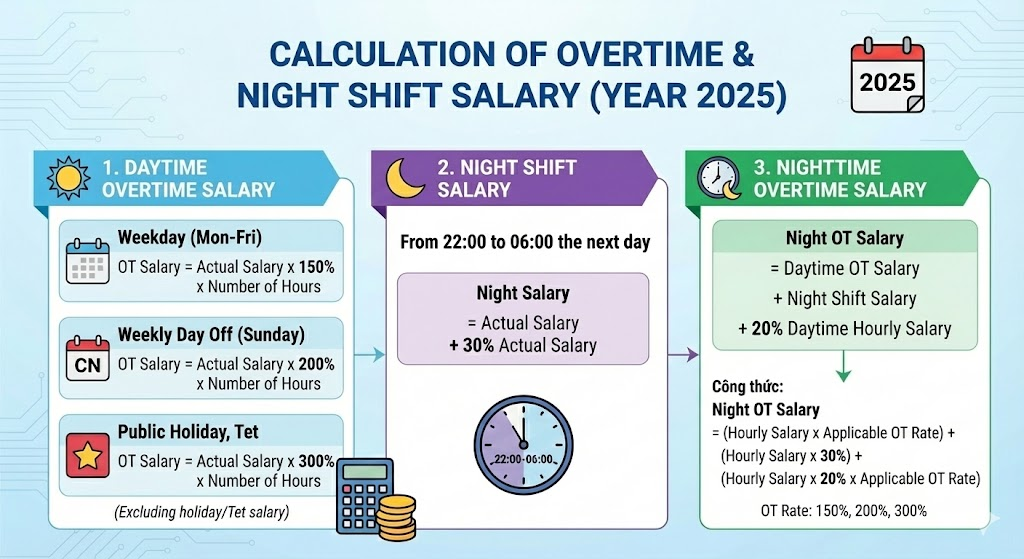
1. Formula for Daytime Overtime Pay
- On normal days: OT Pay = Actual Hourly Salary x 150% x Number of OT hours.
- On weekly rest days (usually Sunday): OT Pay = Actual Hourly Salary x 200% x Number of OT hours.
- On Public Holidays and paid leave days: OT Pay = Actual Hourly Salary x 300% x Number of OT hours. (Note: This 300% level does not include the salary for the Public Holiday or paid leave days for employees receiving daily wages).
2. Formula for Night Work Pay
Employees working at night (from 22:00 to 06:00 the next day) are paid at least an additional 30 percent of the salary calculated according to the salary unit price or actual salary paid for the job of a normal working day.
- Night Work Pay = Actual Hourly Salary + (Actual Hourly Salary x 30%).
3. Formula for Nighttime Overtime Pay
This is the most complex formula, applied when you work overtime during night hours.
- Nighttime OT Pay = [Daytime OT Pay] + [Night Work Pay] + [20% x Daytime Hourly Salary].
Specifically: Nighttime OT Pay = (Hourly Salary x Corresponding OT Rate) + (Hourly Salary x 30%) + (Hourly Salary x 20% x Corresponding OT Rate).
Where the Corresponding OT Rate is 150%, 200%, or 300%.
Part 2: New Regulations on PIT for Overtime Pay (Applicable from 2026)
This is the most critical change that employees and accountants need to note for the 2026 tax period.
1. Legal Basis
Based on Clause 9, Article 4 of the Law on Personal Income Tax 2025 and Clause 2, Article 29 (Transitional provisions applicable from the 2026 tax period), the list of Tax-Exempt Income includes: “Wages for night work, overtime work, and wages or remuneration paid for days off not taken according to the provisions of law.”
2. Breakthrough Change Compared to Old Regulations
- Before 2026: The old law stipulated tax exemption only for the “portion of wages or remuneration for night work, overtime work paid higher than wages for day work.” This meant the base salary (100%) was still taxable, and only the difference (50%, 100%, 200%) was exempt.
- From 2026: According to the wording of the PIT Law 2025, the phrase “paid higher than” has been removed. This implies that the entire income from overtime pay and night work wages will fall under the category of PIT exemption.

Part 3: Practical Calculation Example (Case Study)
To clearly see the benefits of the new regulation, let’s look at the following example:
Assumption: Mr. A has a normal hourly wage of 100,000 VND per hour. Mr. A works 01 hour of overtime on a normal day (150% rate). Total OT income Mr. A receives: 100,000 VND x 150% = 150,000 VND.
Tax Calculation Comparison:
- Under Old Regulations (Before 2026):
- Taxable PIT portion: 100,000 VND.
- Tax-exempt PIT portion: 50,000 VND.
- Under New Regulations (From 2026):
- Taxable PIT portion: 0 VND.
- Tax-exempt PIT portion: 150,000 VND (Fully Exempt).
The new regulation helps employees retain their full overtime income without PIT deductions.
Part 4: Required Documents for Tax Explanation in 2026
Since the tax exemption benefit is significant, tax authorities will strictly control this to avoid businesses “circumventing the law” by shifting official salaries to overtime salaries. Businesses need to prepare a full set of documents:
- Salary and Bonus Regulations or Collective Labor Agreement: Clearly specifying cases, conditions, and rates for overtime payment.
- Overtime Plan or Confirmation Form: Must reflect actual work arising that requires overtime, confirmed by management and the employee.
- Detailed Timesheet: Clearly separating administrative hours and overtime hours.
- Payroll Sheet: Separate the line “Overtime Income (Tax Exempt)” for finalization purposes.
- Electronic PIT Deduction Vouchers: Implementing the latest government regulations (mandatory implementation), when issuing vouchers to employees, this overtime amount must be accurately recorded in the “Tax-exempt income” item on the electronic voucher.
The change in the Law on Personal Income Tax 2025 (applicable to the 2026 tax period) is a major step forward, bringing direct and practical benefits to employees. With the regulation of total tax exemption for overtime and night work wages, the actual income (net income) of employees will increase significantly, creating great motivation to increase work productivity.
However, rights come with accountability. Businesses need to immediately update their payroll accounting software systems to clearly separate this income stream right from the beginning of the 2026 tax period. At the same time, the HR department needs to establish a strict overtime control process and maintain transparent records. This not only helps businesses optimize benefits for employees but also avoids legal risks during tax inspections regarding the abuse of policies to “disguise” base salaries as overtime pay for tax evasion purposes.
For any inquiries, contact Wacontre Accounting Services via Hotline: (028) 3820 1213 or email [email protected] for prompt assistance. With a team of experienced professionals, Wacontre is committed to providing dedicated and efficient service.

EDITORIAL INFORMATION
Wacontre Accounting & Tax Editorial Team
This article is maintained by the Wacontre editorial team. A named reviewer and review date are shown only after individual sign-off; this article does not yet have that sign-off.
Official references
Update history
- : Added editorial ownership, official references, and update history; no individual expert review is claimed.
- : Originally published.