
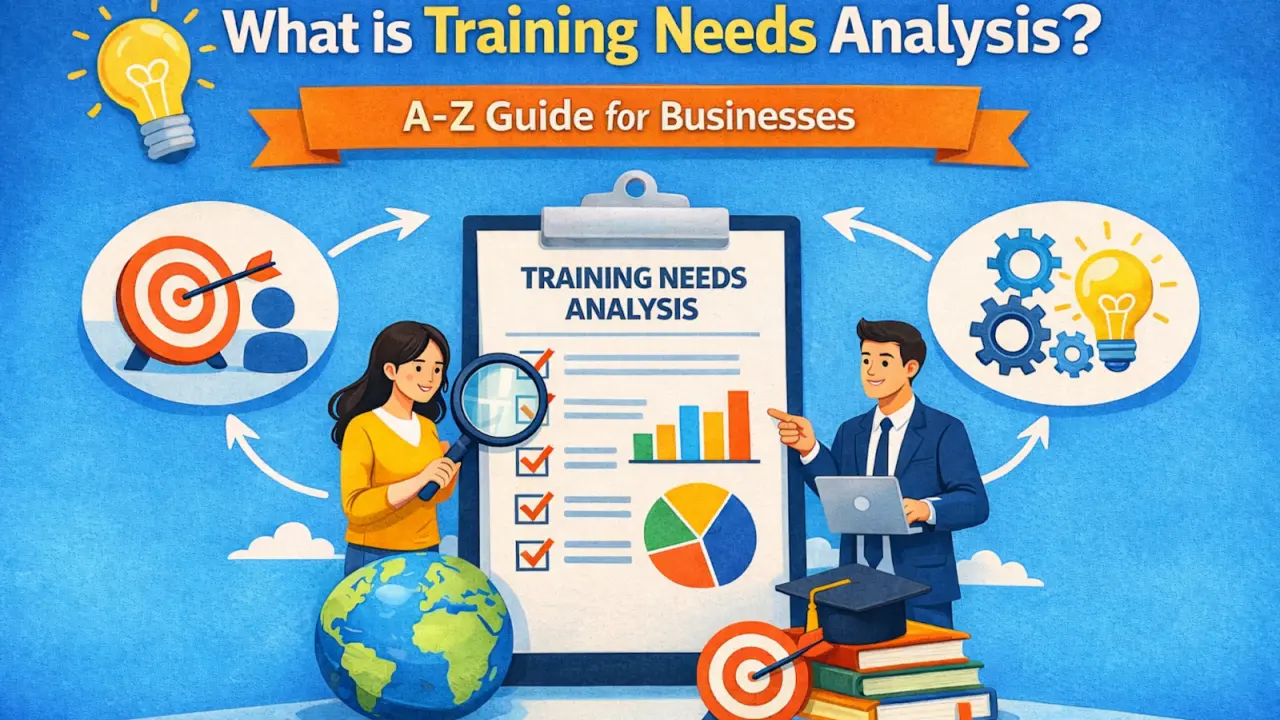
Conducting a Training Needs Analysis is vital for any successful learning and development strategy. We explore the TNA process and proven methods to identify training needs, ensuring your workforce is equipped for future challenges and optimizing training ROI.
What is Training Needs Analysis?
Training Needs Analysis (TNA) is a systematic process of data collection and analysis designed to identify the gap between the current competency of personnel and the standard requirements of the job or the strategic goals of the organization. Simply put, TNA helps answer the questions: “Who needs training? What skills do they need? And why do they need them right now?” This is not just about creating a list of courses employees want, but a diagnostic process for the “health” of the business’s skills.
The essence of Training Needs Analysis is finding the “Gap.” This gap lies between “Point A” (Current Status: Actual knowledge, skills, and attitude of employees) and “Point B” (Expectation: What employees need to do to achieve peak performance). Training is the solution to bridge that gap. Without this analysis, training activities are like a doctor prescribing medication without an examination—costly and failing to address the root cause.
A common mistake is equating TNA with surveying learning desires. Desires are what employees want, while training needs are what employees need to perform their jobs. Sometimes, performance issues do not stem from a lack of skills but from outdated workflows, poor support tools, or lack of motivation. A precise TNA process helps distinguish clearly between problems that need to be solved by training and those belonging to system management.
Why Do Businesses Need Training Needs Analysis?
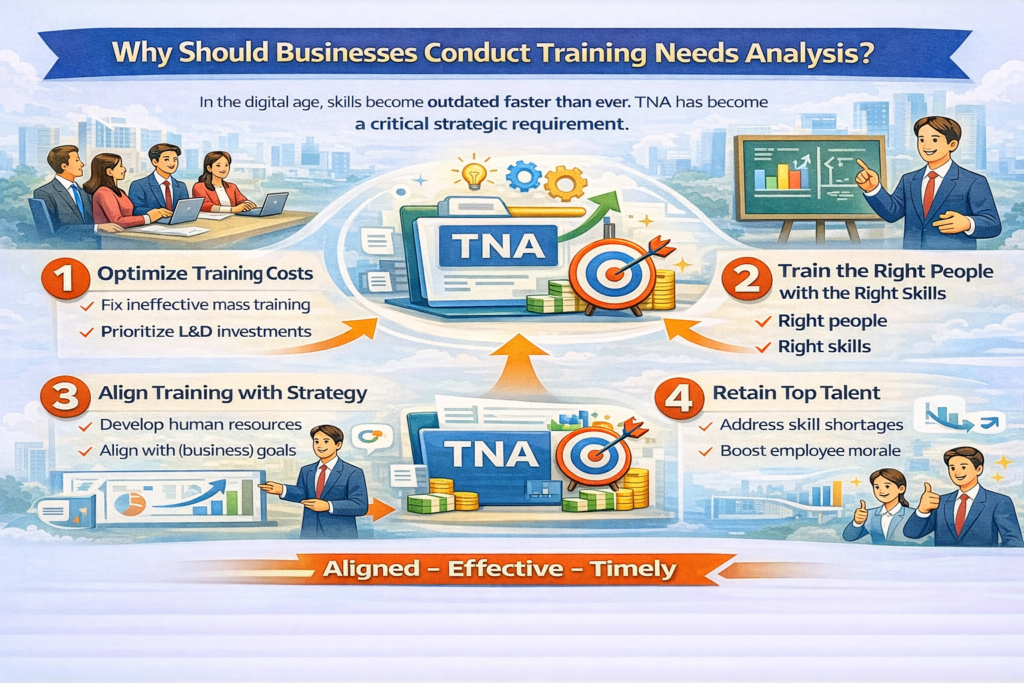
1. Optimize Training Investment and Maximize ROI
Corporate training budgets are always limited, while learning needs are infinite. Without Training Needs Analysis, businesses easily fall into the trap of “mass training,” where everyone studies, but few apply the knowledge effectively. TNA helps businesses pinpoint exactly which critical skills need investment priority. Instead of spreading resources across 10 ineffective courses, you can focus on 2-3 core programs that directly impact revenue and profit, thereby maximizing the Return on Investment (ROI) for training.
2. Train the Right Person, Right Job, at the Right Time
One reason training fails is misalignment between learning content and job reality. Some employees are sent to learn skills they have already mastered, wasting time and creating boredom. Conversely, personnel with severe skill shortages are not given proper attention. The TNA process helps map out a detailed competency framework, ensuring that every hour of training is dedicated to the right audience who needs it most, exactly when the project or job demands that skill.
3. Align Personnel Development with Business Strategy
Training must not be separated from business goals. For example, if the company’s strategy for the coming year is digital transformation, training needs must focus on tech skills, data mindset, and agile methodologies. If TNA is conducted methodically, the learning and development department becomes a strategic partner to leadership. It ensures that all people development activities contribute directly to realizing the organization’s vision, rather than being superficial activities.
4. Enhance Motivation and Improve Talent Retention
Employees today value personal development opportunities more than salary and bonuses alone. When businesses conduct thorough Training Needs Analysis, employees feel cared for and understand their career path. Being trained in areas where they lack confidence helps them feel more capable in their work, reduces pressure from incompetence, and increases engagement with the organization. This is an effective solution to reduce turnover in the competitive talent market.
Three Core Levels of Training Needs Analysis
To gain a comprehensive view, the McGhee and Thayer model (1961)—a standard in the HR industry—proposed three levels of analysis. Businesses need to perform all three levels synchronously to avoid missing any aspects.
1. Organizational Analysis
This is the most macro level, viewing the entire business as a system. At this step, managers need to answer: What is the upcoming business strategy? Is the corporate culture encouraging or hindering learning? What are the financial and time resources available for training? Organizational analysis helps determine if training is the right solution in the current context. For instance, if the business is in a phase of severe cost-cutting or organizational restructuring, implementing long-term training programs may not be feasible or a top priority.
2. Task or Job Analysis
This level focuses on the job itself, independent of the person holding the position. Human resources needs to rely on the Job Description (JD) and Competency Framework to determine: To excel in this position, what specific Knowledge, Skills, and Attitudes (KSA model) does the employee need? The TNA process at this level requires a detailed analysis of each task. For example, for a Sales Executive position, the necessary skill is not just general “communication,” but must be specified as “objection handling,” “closing skills,” and “CRM software usage.”
3. Individual Analysis
This is the micro level, examining each specific employee. We compare the actual competency of Employee A with the standard requirements of the position they hold (determined at Level 2). Data from Key Performance Indicators (KPIs), 360-degree reviews, or competency tests will be utilized thoroughly. Individual analysis helps answer: “Why is Employee A not meeting sales targets? Is it due to lack of closing skills or work attitude?” The results of this level will produce a specific list of who needs to learn what.
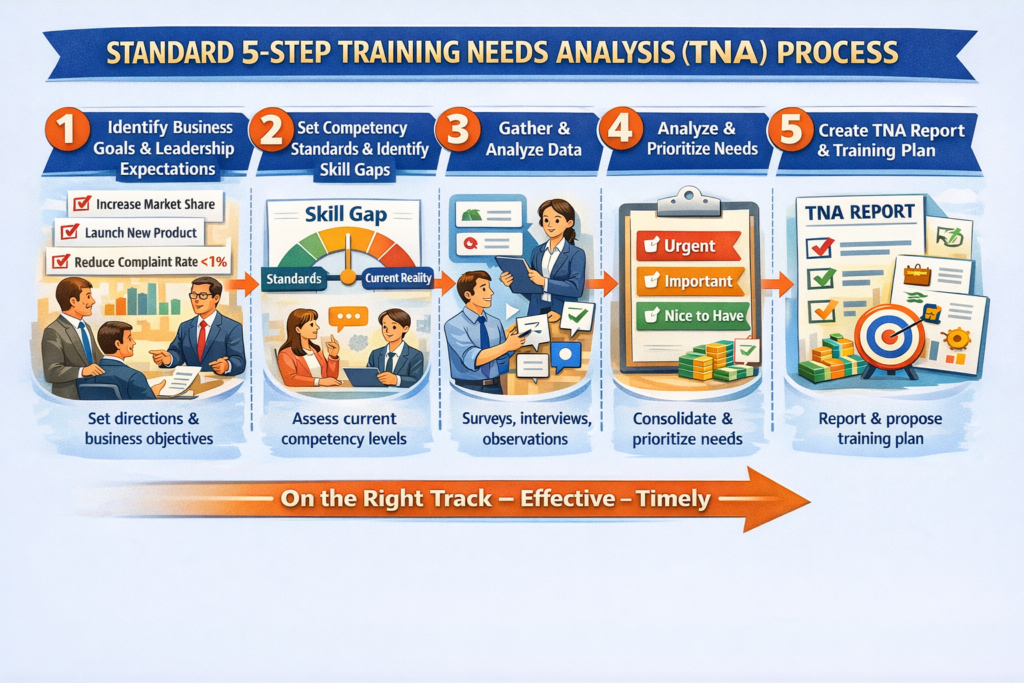
Standard 5-Step Training Needs Analysis Process
To implement TNA effectively, businesses need to follow a methodical process. Here are 5 standard steps applicable to most business models.
Step 1: Identify Business Goals and Management Expectations
Every training activity must start from the business’s destination. Human resources needs to sit down with leadership and department heads to grasp the direction. Is the goal this year to increase market share, launch new products, or improve customer service quality? For example, if the goal is to “Reduce customer complaint rate to below 1 percent,” potential training needs will revolve around problem-solving and customer service skills. This step helps orient the entire subsequent analysis process so it doesn’t go off track.
Step 2: Establish Competency Standards and Identify Skill Gaps
After having goals, you need to define the ideal state. What standards does a “perfect” employee for that position need to meet? Specify requirements regarding knowledge, soft skills, hard skills, and attitude. Then, compare this with the actual status of the workforce. The “Gap” between “Reality” and “Standard” is the preliminary training need. Note that not every gap needs to be filled by training; some can be solved by coaching or job rotation.
Step 3: Select Tools and Collect Data
This is the phase that consumes the most time and effort. You need to decide which method to identify training needs to use: surveys, interviews, observations, or competency tests? Each group of subjects should use a different method. For production workers, direct observation of operations is best. For management levels, in-depth interviews or 360-degree assessments work better. Data collection needs to be communicated skillfully so employees understand this is an activity to support their development, not to “fault-find” for criticisms or dismissal.
Step 4: Synthesize Data and Determine Priority Needs
After collecting a substantial amount of data, the human resources team’s task is to filter and analyze. Look for patterns. For example, if 80 percent of sales staff are weak in international negotiation skills, this is an urgent need at the group or department level. Needs should be categorized by priority: Urgent (affects survival or legal compliance immediately), Important (affects long-term goals), and Nice to have. You cannot satisfy all needs at once, so this priority ranking is the basis for budget allocation.
Step 5: Create TNA Report and Propose Specific Training Plan
The final step is to materialize analyses into a document. A professional TNA report needs to clearly present: What is the current problem? What are the causes? What is the proposed training solution (content, format, duration, audience)? Estimated costs and expected outcomes (KPIs after training). This report is the proposal to persuade leadership to approve the budget. Write the report based on decision-makers’ language: the language of benefits, costs, and investment efficiency.
Most Effective Methods to Identify Training Needs
There is no “master key” method. A skillful combination of the following qualitative and quantitative methods will yield the most accurate results.
1. Direct Observation at the Workplace
This method involves observing employees performing work in a real environment. The analyst will record behaviors, operations, and workflows to detect errors, redundant steps, or skill gaps.
- Pros: Data obtained is the most realistic and undistorted by the subjective opinion of the respondent. Very effective for technical and manual tasks.
- Cons: Consumes significant time and resources. The presence of an observer may make employees uncomfortable, leading to unnatural behavior.
2. Questionnaires and Surveys
This method uses pre-designed questionnaires to collect opinions from a large number of employees. Questions can revolve around difficulties they face, skills they feel are lacking, and learning desires.
- Pros: Collect large amounts of data in a short time, low cost, easy to compile statistics, and anonymous so employees are more honest.
- Cons: Data obtained is often shallow, depending on the honesty and self-awareness of employees. Poorly designed questionnaires will lead to biased results.
3. In-Depth Interviews or Focus Groups
Human resources conducts direct conversations with employees, direct managers, or industry experts. Interviews help dig deeper into issues that surveys cannot clarify.
- Pros: Understand the root cause of the problem, grasp thoughts, aspirations, and emotional nuances. Can detect hidden training needs that employees themselves have not realized.
- Cons: Very time-consuming, difficult to analyze qualitative data, and requires the interviewer to have excellent questioning and listening skills.
4. Analysis Based on Performance Appraisal
Using periodic KPI and OKR results to find poor indicators. If an employee consistently fails to meet customer satisfaction targets, it is a clear sign of a training need for service skills.
- Pros: Based on available quantitative data, directly linked to work results. Easy to identify who needs to improve what.
- Cons: Performance reviews only show “bad results” not always “causes.” Sometimes low indicators are due to objective factors (bad market) rather than lack of competence.
Common Mistakes When Implementing TNA and How to Fix Them
Although the process seems clear, actual TNA implementation in businesses still encounters many obstacles. Here are common “traps” to avoid.
1. Underestimating the Importance of Real Data Collection
Many training practitioners often “guess” needs instead of analyzing them. They rely on intuition or market trends (seeing competitors invest in AI training, they also make employees learn AI) without caring whether the business actually needs it. The result is creating “for fun” courses.
- Fix: Adhere to the “No data, no training” principle. Every training proposal must be proven by data from surveys, evaluations, or actual observations.
2. Applying a “One-Size-Fits-All” Method
Another mistake is using the same survey for office staff, factory workers, and sales teams. Each group has different job characteristics and cultures. Online forms may be good for office staff but impractical for workers who rarely use computers.
- Fix: Flexibly coordinate different tools. For management, conduct interviews. For technical staff, observe and test skills. Diversifying methods will bring a more accurate panoramic picture.
3. Lack of Participation and Commitment from Line Managers
The human resources or learning and development department cannot understand the deep expertise of every department (like IT, Engineering, Finance). If HR does TNA alone without consulting Line Managers, the results will be superficial and unrealistic. Later, Line Managers themselves will oppose sending employees to training because they think it is “unnecessary.”
- Fix: Turn Line Managers into allies. They are the ones who best understand what their employees lack. Involve them in the process of defining competency standards and evaluating employees.
Conclusion
Training Needs Analysis is not a magic wand that solves all business problems, but it is an indispensable map leading to success. A methodical, scientific TNA process will transform training activities from a “cost” into a “profitable investment.”
In a volatile economic context, businesses that clearly understand the strengths and weaknesses of their team’s capacity and have a timely nurturing strategy will hold a sustainable competitive advantage. Start the TNA process today, not with vague assumptions, but with real data and strategic vision. Don’t let your training budget go to waste; turn it into a lever for the organization’s exponential growth.
For any inquiries, contact Wacontre Accounting Services via Hotline: (028) 3820 1213 or email [email protected] for prompt assistance. With a team of experienced professionals, Wacontre is committed to providing dedicated and efficient service.