Developing Employee Problem-Solving Competency is vital for sustainable business growth. Effective staff training in problem-solving skills and solution-oriented thinking not only helps in resolving daily issues but also significantly contributes to improving work performance across the organization.
What is Developing Employee Problem-Solving Competency?
When discussing problem-solving, many often mistake it for simply fixing errors or troubleshooting immediate incidents. However, in modern human resource management, Developing Employee Problem-Solving Competency carries a much broader and deeper meaning. It is the process of equipping personnel with a comprehensive set of knowledge, skills, and attitudes necessary to confidently face complex, unprecedented situations.
This competency extends beyond “firefighting” when incidents occur; it begins with the ability to identify potential risks before they escalate. An employee with strong problem-solving capabilities knows how to gather data and analyze logic to find the root cause, rather than just treating surface symptoms. They possess critical thinking to evaluate situations and creative thinking to propose optimal solutions within available resources.
Furthermore, developing this competency means building a proactive mindset. Employees do not sit and wait for instructions from superiors whenever difficulties arise; instead, they proactively propose handling plans accompanied by specific risk analyses. This marks a shift from being a “follower” to a “partner” contributing directly to the organization’s growth. Thus, investing in staff training for this skill creates natural “antibodies” for the business against market fluctuations.
The Importance of Solution-Oriented Thinking in Modern Enterprises
In the digital era, while technology can replace humans in repetitive tasks, it cannot completely replace the human role in thinking and handling complex issues. Solution-oriented thinking becomes the “secret weapon” that helps businesses break through.
1. Improving Work Performance and Process Optimization
One of the clearest benefits when the workforce possesses good problem-solving skills is the ability to improve work performance across the entire system. In daily operations, bottlenecks or cumbersome processes often slow down progress. Employees lacking this skill often accept old, inefficient processes or waste time struggling with errors. Conversely, solution-oriented employees will ask, “Why do we do it this way?” and “How can we do it better?” They identify waste and proactively suggest improvements, making the corporate machine run smoother and faster.
2. Minimizing Risks and Operating Costs
Every small issue, if not resolved thoroughly, risks becoming a major crisis, causing heavy financial and reputational damage. For instance, a customer complaint, if ignored or handled clumsily, can escalate into a social media crisis. Employees equipped with problem-solving competencies will recognize the severity and handle it skillfully from the start. Additionally, root cause analysis prevents wasting budget on temporary, ineffective solutions, saving material costs, rework labor, and opportunity costs.
3. Fostering a Culture of Innovation and Employee Proactivity
An environment that encourages Developing Employee Problem-Solving Competency is one that nurtures innovation. Solving problems is essentially seeking new ways to overcome old barriers. When employees are empowered to solve challenges, they no longer fear change. This culture stimulates curiosity and learning. Employees feel trusted and valued, increasing Employee Engagement. They transition from passive workers to innovators, creating an agile organization ready to adapt.
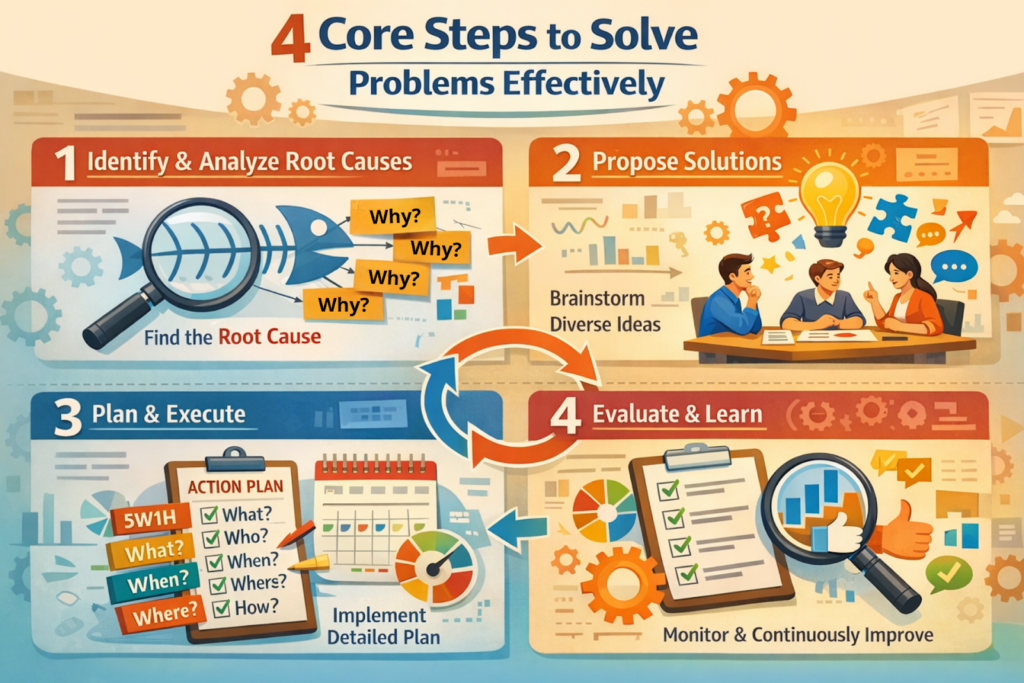
The Core 4-Step Process for Effective Problem Solving
To turn thinking into action, businesses need to guide employees through a scientific process.
1. Identify and Analyze the Root Cause
The first and most important step, accounting for 50 percent of success, is correctly identifying the problem. Many employees rush to solutions, leading to “wrong diagnosis, wrong prescription.” Training requires them to observe calmly and collect objective data. Tools like “5 Whys” or the Fishbone Diagram should be applied. Distinguishing between “symptoms” and “root causes” ensures resources are not wasted.
2. Creative Thinking and Solution Proposal
After understanding the cause, the next step is mobilizing intelligence to find solutions. This requires multi-dimensional thinking and creativity. Employees should not limit themselves to a single solution but list as many as possible (Divergent Thinking). Proposals should include preliminary assessments of pros, cons, and necessary resources.
3. Decision Making and Detailed Execution Planning
Having many solutions doesn’t mean all are suitable. Problem-solving competency is shown in the ability to make decisive decisions based on feasibility, budget, time, and impact. After selecting a solution, a detailed Action Plan (answering 5W1H: What, Who, Where, When, Why, How) is mandatory to ensure success during implementation.
4. Evaluation and Learning
The process concludes only after the Review step. Employees need to monitor metrics to see if the solution brought the expected results. If successful, standardize it. If it fails, analyze whether the error was in planning or execution. This “Kaizen” spirit—continuous improvement—helps employees accumulate professional experience.
Methods for Training Problem-Solving Skills
1. Applying Case Studies
Learning through real-life Case Studies is effective for honing thinking skills. The learning and development department can build a database of past company issues. In workshops, employees analyze situations, debate, and defend their solutions, creating a safe environment to “trial and error” before facing real risks.
2. Brainstorming and Mind Mapping
Brainstorming needs regular practice. Businesses should organize group meetings using visual tools like Mind Maps. The principle is “no judgment” to encourage ideas. Mind maps help employees see the big picture and connections between disparate data points, stimulating breakthrough ideas.
3. The Role of Coaching and Mentoring
While centralized training is necessary, one-on-one Coaching and Mentoring from direct managers sustains this competency. Managers should act as coaches, using open-ended questions (“What are our options?”) instead of giving immediate answers. This forms logical thinking grooves.
4. Encouraging Autonomy and Empowerment
Businesses need an Empowerment mechanism suitable for each employee’s capacity, allowing them to make decisions within their scope and accept controlled risks. This creates strong intrinsic motivation. They will treat company problems as their own.
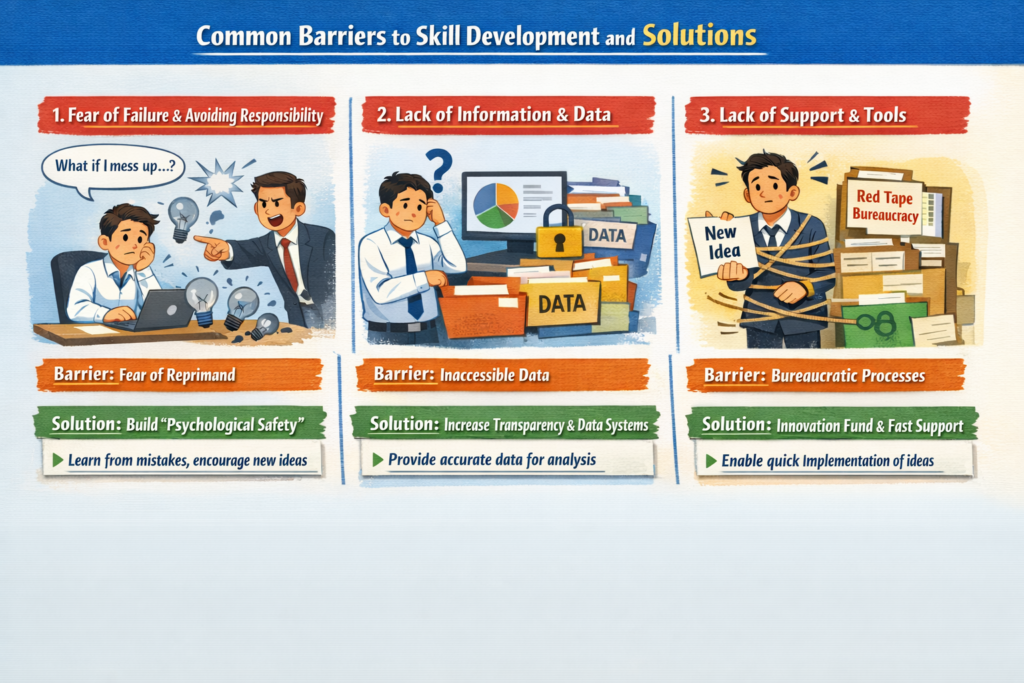
Common Barriers and How to Overcome Them
1. Fear of Failure and Responsibility
A common barrier is the mindset of “do more, mistake more,” leading to silence. To overcome this, leaders must build “Psychological Safety,” communicating that mistakes are part of development as long as lessons are learned.
2. Lack of Information or Data
Problems cannot be solved without accurate data. To avoid guessing based on intuition, businesses must invest in data management and train employees in Data Literacy to support decision-making.
3. Lack of Management Support
Bureaucracy or lack of tools can discourage employees. Management must commit practical resources, such as small Innovation Funds for testing ideas, and remove administrative barriers.
Conclusion
Developing Employee Problem-Solving Competency is a long-term journey requiring commitment. It is not just about organizing courses but reconstructing corporate culture where solution-oriented thinking is valued. A sharp, proactive workforce is the most valuable asset, helping businesses stand firm and reach out to the international market.
For any inquiries, contact Wacontre Accounting Services via Hotline: (028) 3820 1213 or email [email protected] for prompt assistance. With a team of experienced professionals, Wacontre is committed to providing dedicated and efficient service.