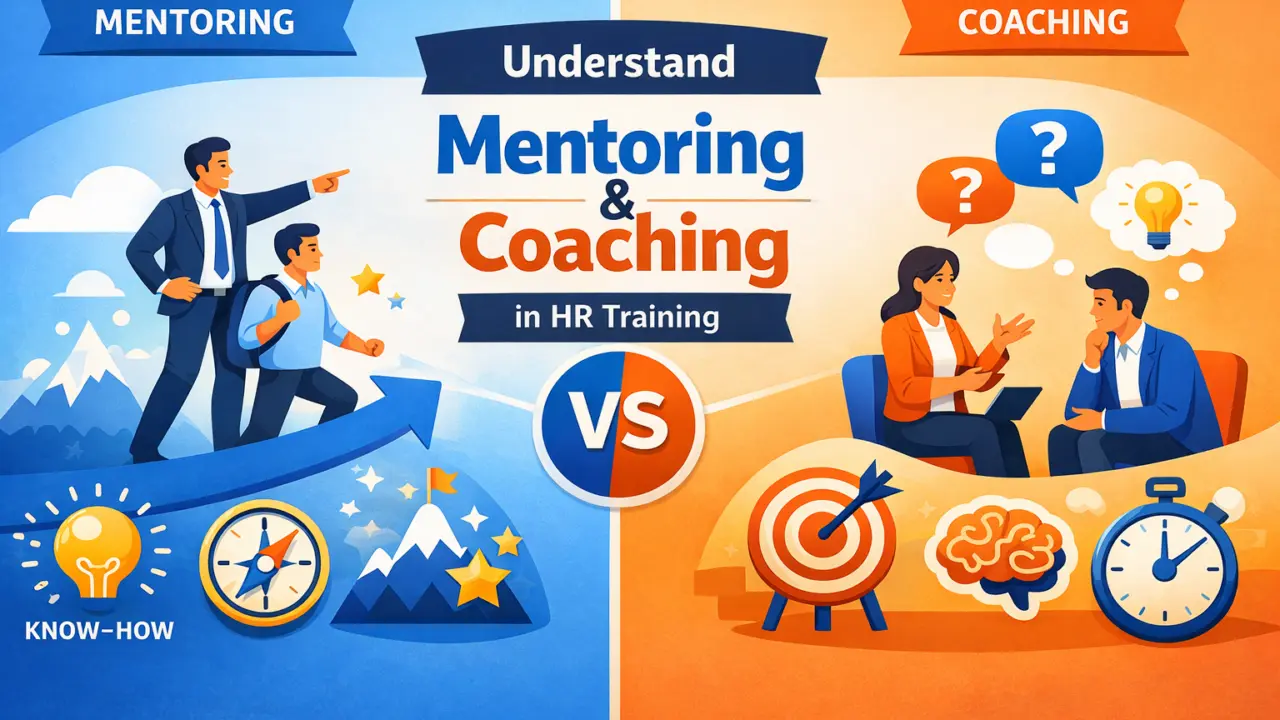
Do you know how to accurately distinguish Mentoring and Coaching? Understanding these concepts is critical for organizations aiming to build successful internal training programs. This article explores the key differences between a Mentor and Coach, helping you optimize your skill development strategies.
- What are Mentoring and Coaching? Definitions and Essence
- Why Must Businesses Distinguish Mentoring from Coaching?
- 5 Core Differences Between Mentoring and Coaching
- When Should Businesses Use Mentoring? When Coaching?
- Process for Building an Effective Internal Training Program
- Common Mistakes When Deploying Internal Training
- Conclusion
What are Mentoring and Coaching? Definitions and Essence
To successfully apply any method, the first and most critical step is to clearly understand its definition and core philosophy. Many managers still use these two terms interchangeably, but in reality, they represent two distinct poles in the spectrum of human capability development.
Mentoring is a strategic and long-term relationship, typically occurring between an experienced individual (Mentor) and a less experienced one (Mentee). The essence of Mentoring is “transmission” or “heritage.” The Mentor shares not only professional knowledge and hard skills but also life experiences, organizational culture, interpersonal conduct, and strategic thinking. The goal of Mentoring usually aims at the holistic development of the individual over the long term, helping the Mentee shape their career path and integrate deeply into the organization. In some cultures, Mentoring shares similarities with the “Master-Disciple” relationship, where trust and respect play key roles.
Coaching, conversely, is a collaborative process that stimulates thinking and creativity, aimed at optimizing the personal and professional potential of the trainee (Coachee). Unlike a Mentor who “gives advice,” a Coach is someone who “asks questions.” The essence of Coaching is based on the belief that every individual already possesses the answers and potential to solve their own problems. The Coach’s task is not to teach the job, but to use questioning techniques, deep listening, and feedback to help the Coachee achieve self-awareness, break through psychological barriers, and commit to action to achieve a specific short-term goal. Coaching focuses strongly on Performance and Action.
Why Must Businesses Distinguish Mentoring from Coaching?
Blurring the lines between these concepts is not just a semantic issue; it directly impacts budget, resources, and business results. Here are urgent reasons why businesses need to draw this line clearly.
1. Avoid Wasting Training Resources
A classic mistake learning and development departments often make is hiring an expensive professional Coach to train basic knowledge to new employees. New staff lack foundational knowledge; they need a guide (Mentor) to tell them what to do, not a Coach who constantly asks, “What do you think you should do?”. Conversely, for mid-level leaders who are experienced but stuck in innovation thinking, assigning a Mentor might cause stereotyping, whereas a professional Coach would help them unlock new thinking. Understanding the difference helps businesses allocate training budgets to the right people for the right tasks, avoiding wasted money on methods unsuitable for the personnel’s development stage.
2. Optimize Human Resource Development Paths
Every employee in an organization goes through different Career Lifecycle stages. In the early stages, they need Mentoring to integrate into the culture and learn vocational skills. When they become proficient and want to break through to management positions or improve a specific skill (like communication or leadership), they need Coaching. If a business cannot distinguish these forms, the employee’s promotion path becomes vague. A clear Individual Development Plan (IDP), combining Mentoring and Coaching rhythmically at each stage, acts as a magnet to attract and retain talent effectively, especially with Gen Z, who always crave self-development.
3. Solve the Right Employee Problems
Not all HR problems are solved by Training. Some employees have excellent skills but declining attitudes or lost motivation. In this case, Mentoring can help them rediscover work meaning through empathetic sharing, or Coaching can help them find the psychological knot hindering them. If applied incorrectly—for example, trying to “teach” skills (Mentoring) to someone with a motivation problem (who needs Coaching)—the result will be zero. Clear distinction helps managers “diagnose” and “prescribe” correctly for each HR “ailment,” thereby improving the overall team performance.
5 Core Differences Between Mentoring and Coaching
To visualize this better, we will dive into 5 detailed comparative aspects. These are the “backbone” for HR managers to design programs.
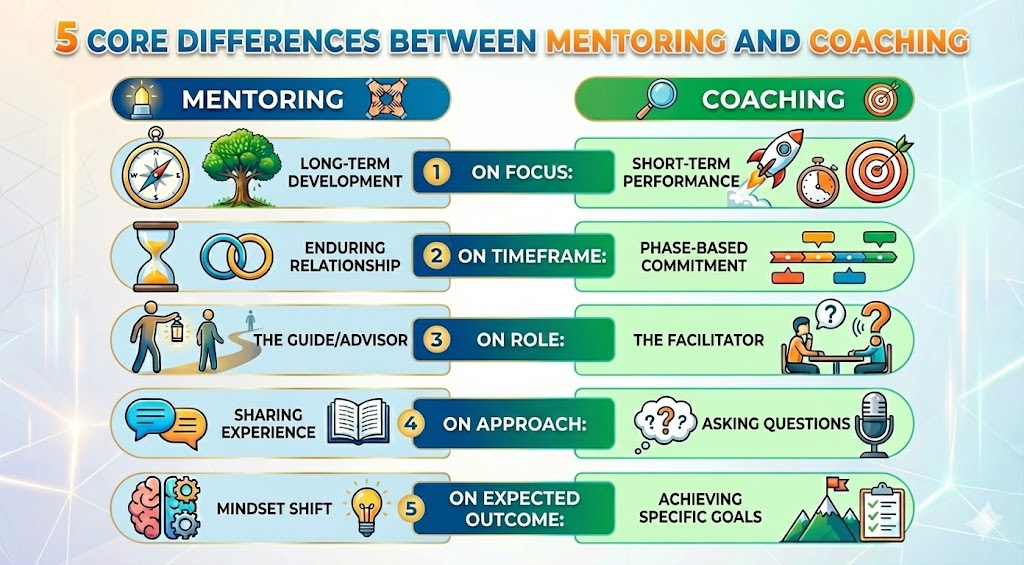
1. Goal: Long-term Development vs. Short-term Performance
The goal of Mentoring is always comprehensive and long-term. It aims at Holistic Development. A successful Mentoring program can last 6 months, a year, or even years, intended to help the Mentee mature, understand corporate culture, and prepare for further steps in their career. Meanwhile, Coaching focuses on specific goals and short-term performance. A Coaching contract usually defines a clear goal from the start (e.g., Improve public speaking skills in 3 months, or Enhance time management capabilities). Once the goal is met, the Coaching relationship usually ends or shifts to a new goal. Coaching is about “doing better now,” while Mentoring is about “becoming a better version in the future.”
2. Time: Enduring Relationship vs. Phase-based Commitment
The relationship in Mentoring is usually less formal and based on personal bonding. Meeting times can be flexible, depending on the Mentee’s needs and the Mentor’s availability. It resembles a professional friendship where trust is built over time. Conversely, Coaching has a very tight time structure. Coaching sessions are typically scheduled firmly (e.g., 1 hour every Friday), have a specific duration, and have clear start-end points. Time discipline in Coaching is much higher to ensure progress toward the committed goal.
3. Role: The Guide vs. The Facilitator
In Mentoring, the Mentor acts as “The Predecessor,” a living encyclopedia. They speak more (about 60-70 percent), give advice, and share their own lessons from failure so the Mentee can avoid them. The Mentor’s status is usually senior in tenure or rank. In Coaching, the Coach acts as “The Companion” or “The Mirror.” They speak less (only about 20-30 percent), mainly listening and asking questions. A Coach does not necessarily need to be an expert in the Coachee’s field (e.g., a Leadership Coach doesn’t need to know how to code to coach a technical director). The Coach’s role is equal to the Coachee, exploring solutions together.
4. Approach: Experience Sharing vs. Questioning
The method of Mentoring is “Directing” and “Advising.” A Mentor will say: “In this situation before, I did this… you should try it.” This is knowledge transfer from the outside in. The method of Coaching is “Non-directing” and “Asking.” A Coach will say: “In your opinion, what is the biggest barrier right now?” or “What options do you have to solve that problem?”. This evokes wisdom from the inside out. Coaching believes the best solution is the one the executor thinks of themselves, as they will have the highest commitment to executing it.
5. Expected Result: Mindset Shift vs. Specific Goal Achievement
The results of Mentoring are often hard to measure immediately with numbers. It manifests through changes in mindset, confidence, networking, and the level of engagement with the organization. The results of Coaching are usually tied to KPI indicators or specific observable behavioral changes. For example: After Coaching, a Sales staff increases sales by 20 percent, or a Manager reduces staff turnover to 5 percent. Measurability is a mandatory element in professional Coaching programs.
When Should Businesses Use Mentoring? When Coaching?
Choosing the tool depends entirely on the organization’s current “pain points” and goals.
1. Applying Mentoring: Succession Planning and Culture
Businesses should deploy Mentoring when implementing Succession Planning. Senior leaders will mentor high-potential talent to prepare for succession. Additionally, Mentoring is extremely effective during Onboarding for new employees, helping them quickly absorb corporate culture without feeling lost. Mentoring is also an excellent tool for Retention, as employees feel cared for and see a clear development path through the guidance of seniors.
2. Applying Coaching: Skill Improvement and Problem Solving
Businesses should use Coaching when needing to fix a specific skill gap or solve poor performance issues. For example, a department head with great expertise but poor communication causing internal disunity needs Coaching on communication skills and Emotional Intelligence (EQ). Coaching is also essential during crisis or Change Management phases, helping employees overcome fear and adapt to new ways of working. For leadership levels (Executive Coaching), this is a safe space for them to think strategically and relieve decision-making pressure.
3. Combining Mentoring and Coaching in Modern Business
The blended model is becoming popular and effective. A modern manager needs to wear both hats: sometimes a Mentor, sometimes a Coach. When a new employee joins and doesn’t know the job, the manager wears the Mentor hat to guide them. When the employee is seasoned but struggling with creativity, the manager switches to the Coach hat to ask evocative questions. The flexibility to switch between these two roles is the art of “Manager as a Coach” – a top HR management trend today.
Process for Building an Effective Internal Training Program
To turn theory into practice, businesses need a methodical 5-step process.
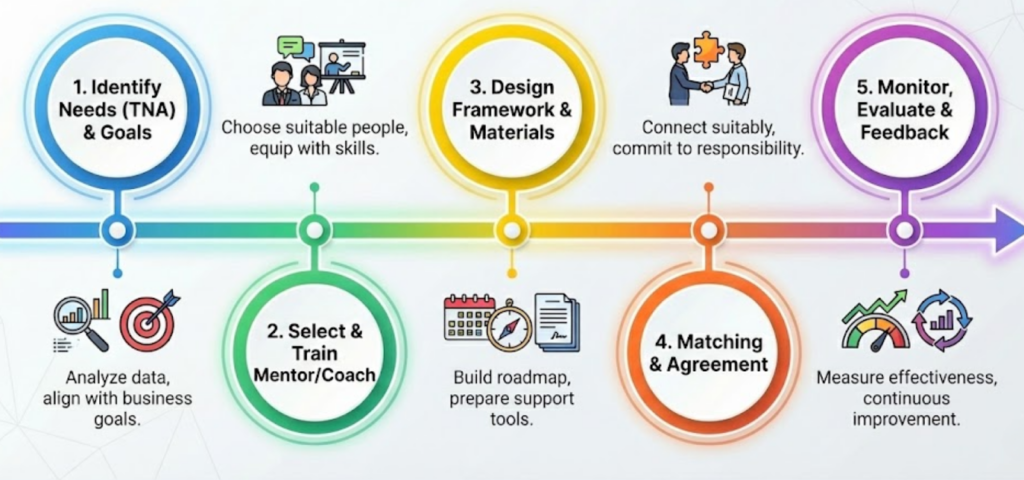
1. Training Needs Analysis and Organizational Goals
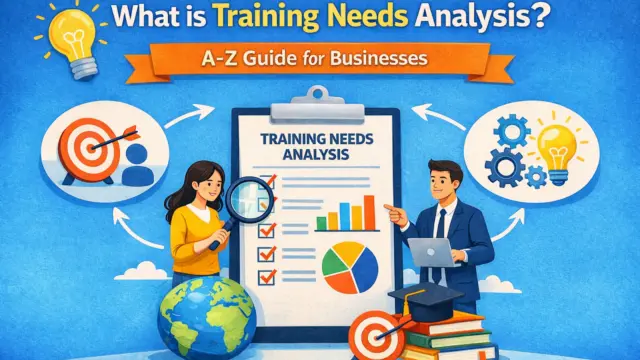
Don’t start by asking “What should we teach?”, ask “What problem is the business trying to solve?”. TNA needs to be done thoroughly through surveys, interviews, and performance data analysis. Clearly identify which group needs Mentoring (e.g., Management Trainees) and which needs Coaching (e.g., Middle Managers). The program’s goals must align with Business Goals.
2. Selection and Training of Internal Mentors and Coaches
This step decides the program quality. A Mentor doesn’t necessarily have to be the best expert, but must be someone capable of inspiring and willing to share. Internal Coaches need to be equipped with questioning and listening skills; ideally, they should attend basic Coaching skills training. Businesses need to organize “Train the Mentor” and “Train the Coach” sessions to unify methodology.
3. Design Framework and Support Materials
A spontaneous program will soon fade. A clear Framework is needed: How long does the program last? What is the meeting frequency? (e.g., once per month for Mentoring, bi-weekly for Coaching). Compile Guidelines, Templates for meeting notes, and suggested question sets for each stage. For Coaching, the GROW model (Goal – Reality – Options – Will) can be applied as a guideline for dialogues.
4. Matching and Agreement Setup
Success depends heavily on the “Chemistry” between the two parties. Matching shouldn’t just rely on HR assignment but should involve the participants’ preferences. “Speed Dating” sessions can be organized for Mentors and Mentees to get to know each other first. After matching, both parties need to sign a Mentoring or Coaching Agreement specifying confidentiality, working principles, schedule, and expectations.
5. Tracking, Evaluation, and Feedback
The program needs close monitoring by the learning and development department. Periodically (monthly or quarterly), feedback should be collected from both sides to adjust any inadequacies promptly. Effectiveness evaluation shouldn’t stop at satisfaction levels but needs to measure behavioral changes and impact on work results. Honor pairs that complete well to create motivation and a learning culture.
Common Mistakes When Deploying Internal Training
Even large corporations can stumble if they don’t pay attention to these traps.
1. Confusing Roles Between Mentor and Direct Manager
A common mistake is assuming the direct boss will be the Mentor. This creates a conflict of interest. Employees won’t dare share real difficulties or intentions to quit with the person holding their salary and KPI evaluation. Mentoring relationships require absolute Psychological Safety. Ideally, the Mentor should be a manager from another department or a higher level but not directly managing the Mentee (Skip-level).
2. Lack of Commitment from Leadership
If the program is just the HR department’s “baby” without Sponsorship from the Board of Directors, it will be seen as a mere movement and not prioritized. Managers will use “busy business” excuses to cancel sessions. Top leadership needs to communicate strongly about the importance of people development, and they themselves must be exemplary Mentors and Coaches.
3. Wrong Method for Wrong Audience
As analyzed, Coaching a brand-new employee is a mistake, but Mentoring a senior employee with “hand-holding” is equally harmful as it kills creativity and causes Micromanagement feelings. Rigidity in applying methods will lead to resistance from learners. Flexibility and Personalization based on the competence and attitude of specific personnel are required.
Conclusion
Distinguishing clearly between Mentoring and Coaching is not to separate them, but to combine them artistically and scientifically. While Mentoring builds cultural foundations and succession, Coaching activates motivation and performance breakthroughs. A business that knows how to use these two tools in parallel for its internal training program will possess a workforce not only skilled but also mentally strong, ready to conquer all market challenges. Start building a Mentoring and Coaching culture today; it is the most sustainable profitable investment for your business’s future.
For any inquiries, contact Wacontre Accounting Services via Hotline: (028) 3820 1213 or email [email protected] for prompt assistance. With a team of experienced professionals, Wacontre is committed to providing dedicated and efficient service.