Using the 70:20:10 model in Learning and Development is pivotal for successful training and development strategies. This approach blends on-the-job experience, social learning, and formal education to redefine how organizations nurture talent and achieve superior business results.
What is the 70:20:10 Model?
The 70:20:10 model is a framework in the field of learning and development, researched and developed in the 1980s by three researchers: Morgan McCall, Michael M. Lombardo, and Robert W. Eichinger at the Center for Creative Leadership. Their research was based on surveys of how successful managers learned and developed skills throughout their careers. The results revealed a surprising reality: the majority of effective working knowledge and skills do not come from formal classes, but from the process of experience and interaction in daily work.
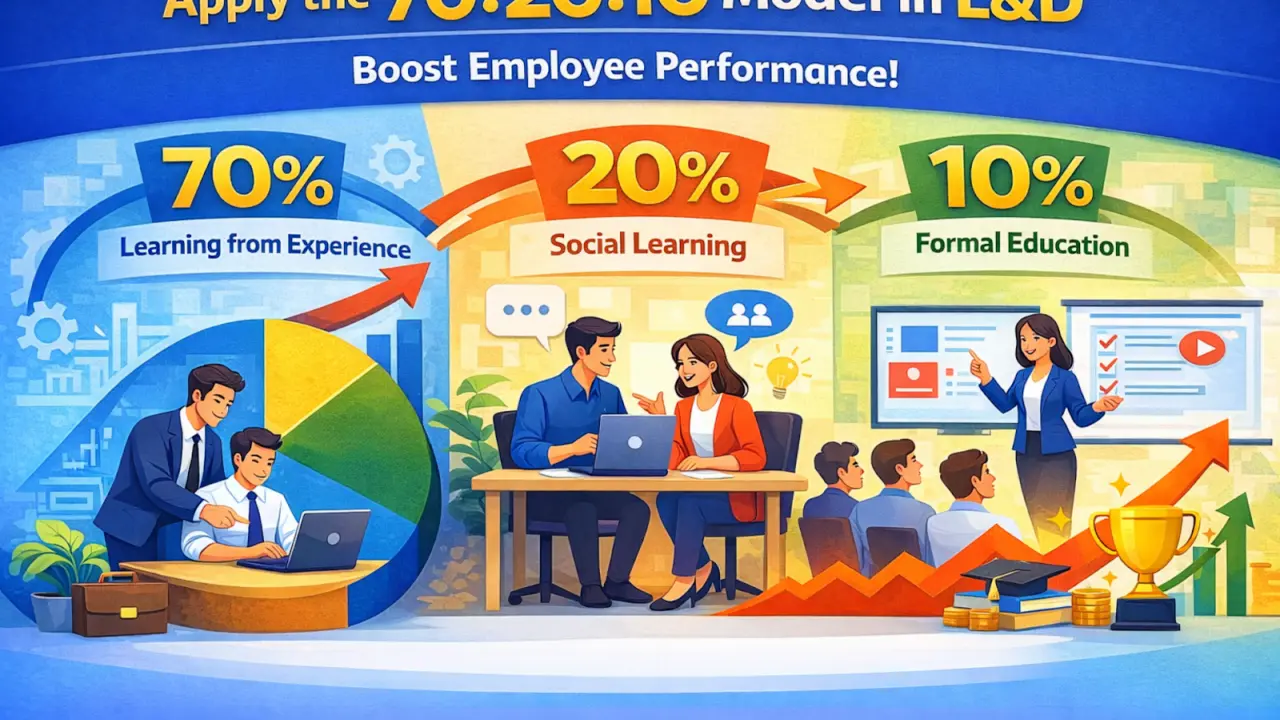
Specifically, the 70:20:10 figure represents the allocation ratio of different learning sources that an individual receives to develop competency:
- 70% from Experience (On-the-job training): Learning through challenging tasks, problem-solving, and direct practice at the workplace.
- 20% from Exposure (Social Learning): Learning through observing, listening, sharing, and receiving feedback from colleagues, superiors, or experts.
- 10% from Education (Formal Learning): Learning through formal training courses, books, seminars, or e-learning programs.
Understanding and using the 70:20:10 model in Learning and Development means that the business accepts a change in mindset: stop pouring the entire budget into 10% formal education and start investing resources to build an environment for the remaining 90% (experience and interaction). This is not about completely eliminating traditional classes, but placing them in the correct foundational position to support practical practice and social learning more effectively.
The Importance of Using the 70:20:10 Model in Learning and Development
Why is a Learning and Development strategy based on the 70:20:10 principle considered the optimal solution for modern enterprises? The answer lies in its ability to resolve bottlenecks that old training models face, while stimulating natural human development.
1. Overcoming Limitations of Traditional Training Methods
One of the biggest problems of traditional training is the “Forgetting Curve.” Studies have shown that without immediate review or application, learners forget about 50 percent of knowledge after just one hour and up to 70-80 percent after 24 hours. When businesses focus only on 10% formal learning without a mechanism for employees to apply (70%) or discuss (20%), the training budget is being wasted. Using the 70:20:10 model in Learning and Development radically fixes this issue by linking knowledge with action. When employees finish learning a theory and are immediately assigned a related project to practice, that knowledge transforms into long-term skills, helping them remember deeply and apply flexibly in the future.
2. Optimizing Business Budget and Resources
In a volatile economic context, cutting costs while ensuring efficiency is a top priority for every CEO. Off-site training courses often consume significant costs, including instructor fees, venue fees, travel costs, and especially opportunity costs when employees have to leave work to attend classes. By applying the 70:20:10 principle, businesses can shift focus to experiential learning right at the workplace (On-the-job training). This not only saves organizational costs but also turns work time into learning time, ensuring work continuity. Furthermore, leveraging internal knowledge through Mentoring or Coaching activities (belonging to the 20% group) is a way to exploit available resources without incurring additional outsourcing costs.
3. Enhancing Employee Proactivity and Engagement
The 70:20:10 model empowers employees to control their development rather than having it imposed by HR. Instead of passively waiting to be sent to school, employees are encouraged to seek learning opportunities through new projects or learning from colleagues. When employees feel trusted with challenging tasks (in the 70% part) and supported by mentors (in the 20% part), their Employee Engagement with the organization increases significantly. An environment that encourages improving employee capacity through real-world application will create a Continuous Learning Culture, where everyone is excited to share and progress together.
Analyzing the 3 Pillars of the 70:20:10 Principle
To successfully use the 70:20:10 model in Learning and Development, we need to analyze the operating mechanism of each pillar and how to deploy them in business reality.
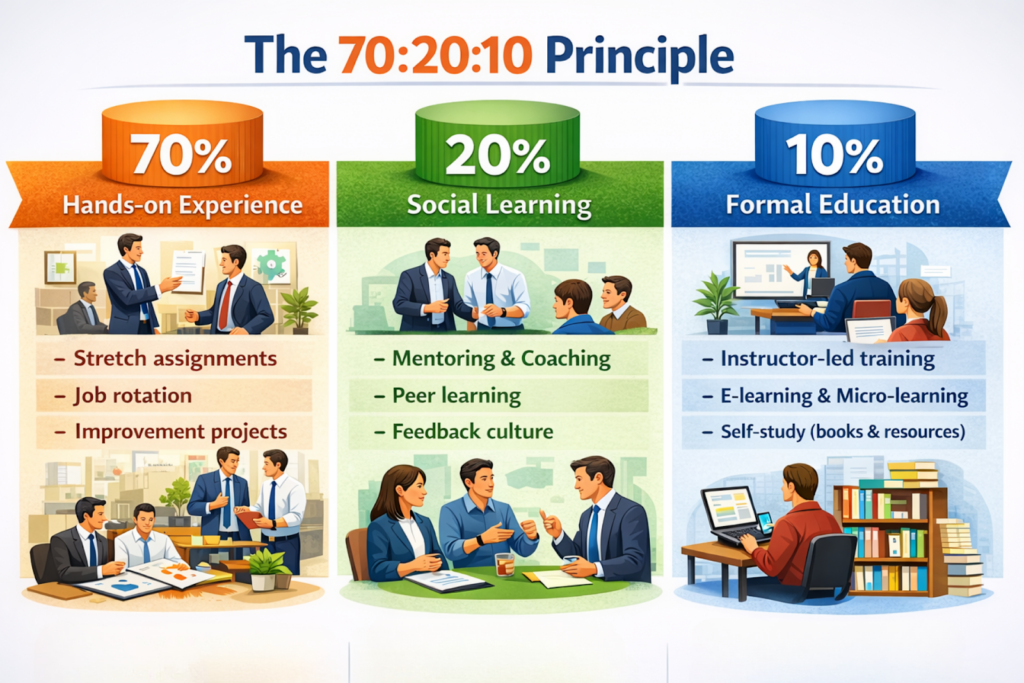
1. 70% from Experience (On-the-job training)
This is the most critical part, accounting for the largest proportion, and also the most difficult to implement systematically without a clear strategy. Learning from experience does not mean leaving employees to “sink or swim,” but rather a purposeful arrangement of tasks to stimulate development.
- Stretch Assignments: This is the best way for employees to step out of their comfort zone. Managers can assign employees projects outside their daily job descriptions or ask them to solve a tough problem the team is facing. For example, a marketing staff member could be tasked with leading a small campaign or participating in new market research. Sufficient pressure from reality will force the brain to think, find solutions, and thereby form new skills.
- Job Rotation: Allowing employees to try their hand at different departments for a short period helps them gain a multi-dimensional view of the business. A sales employee, when rotated to the customer care department, will deeply understand customer pain points after purchase, thereby adjusting their sales consultation approach more effectively. This is an extremely valuable form of experiential learning for training future management personnel.
- Participating in Improvement Projects: Encourage employees to propose and implement workflow improvement initiatives. When they build, operate, and take responsibility for the results of a new process themselves, they will learn project management skills, decision-making skills, and crisis handling skills most naturally.
2. 20% from Exposure (Social Learning)
The second pillar focuses on learning through relationships and interpersonal interaction. In the corporate environment, tacit knowledge—experiences, tips, trade secrets—usually does not lie in books but in the minds of veteran employees.
- Mentoring and Coaching Models: Building a Mentoring program where experienced employees guide new ones is the most effective way to transfer knowledge. Additionally, the Coaching skills of direct managers play a key role. Instead of giving answers immediately, managers should ask questions so employees can think of solutions themselves. Periodic one-on-one sessions should not just be for reporting work but should be time to review lessons learned, what went well, and what didn’t.
- Peer-to-Peer Learning: Create forums, internal sharing sessions (Lunch and Learn), or professional chat groups for employees to share knowledge. For example, after an employee returns from an external training course (belonging to 10%), they are responsible for organizing a session to share what they learned with the whole team (belonging to 20%). This helps the sharer reinforce knowledge while spreading value to the collective.
- Feedback Culture: 360-degree feedback is a powerful tool for this part. Employees need to receive feedback not only from bosses but also from colleagues and customers. Constructive comments given at the time the event occurs will help employees realize their blind spots and adjust behavior in a timely manner.
3. 10% from Education (Formal Learning)
Although accounting for only 10%, this is an indispensable knowledge foundation. Without basic theory, practice (70%) will become groping, lack direction, and easily lead to serious mistakes.
- Centralized Training Courses: This is where theoretical frameworks, standard procedures, or the latest industry updates are provided. For knowledge related to regulations, laws, or deep technical skills, formal training is mandatory.
- E-Learning and Micro-learning: The current trend is to break lessons into short modules (Micro-learning) so employees can learn anytime, anywhere. Learning Management Systems (LMS) act as digital knowledge repositories, storing documents and tutorial videos for employees to access whenever they need to look up information during practical work.
- Self-study through Books and Materials: Businesses should build bookshelves or digital libraries, encouraging employees to read and research on their own. This 10% acts as a “catalyst,” providing raw materials for employees to process during the remaining 90% of work and interaction.
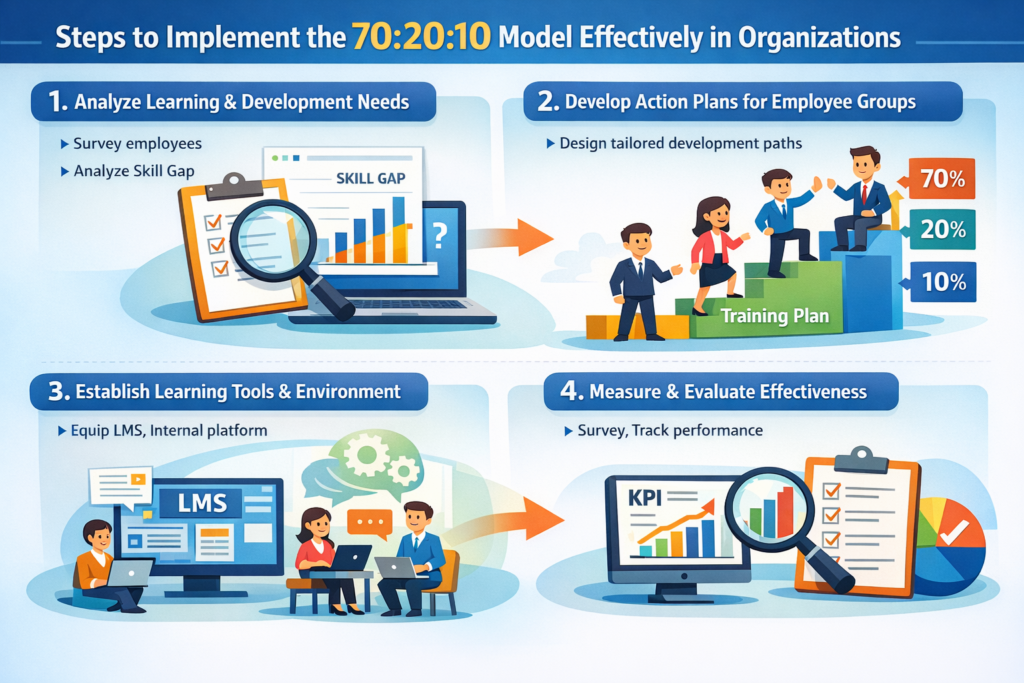
Steps to Effectively Implement the 70:20:10 Model in Business
Transitioning to the 70:20:10 model cannot happen overnight. To successfully use the 70:20:10 model in Learning and Development, businesses need a methodical and detailed roadmap.
1. Analyze Training and Development Needs
The first and most important step is to clearly identify the Skill Gap of the current workforce compared to the company’s business goals. The Learning and Development department needs to work closely with department heads to understand what skills employees are lacking: is it a lack of foundational knowledge (need to add to 10%), lack of mentoring (need to add to 20%), or lack of practice opportunities (need to add to 70%). This analysis avoids applying the wrong method to the wrong object.
2. Build Action Plans for Each Employee Group
After identifying needs, design separate development roadmaps. Do not apply a rigid formula to the entire company.
- For Talent Pool: Focus heavily on 70% with key projects and 20% with Mentoring by the Board of Directors.
- For Technical Specialists: May need to increase the 10% proportion to update new technologies, then apply immediately to real projects. The plan needs to specify: What project will they do? Who is the instructor? What supplementary course do they need? What is the output goal?
3. Establish Tools and Environment to Support Learning
For the model to operate smoothly, businesses need infrastructure support.
- Technology: Equip internal collaboration platforms (like MS Teams, Slack, Workplace) to promote Social Learning. Build an easy-to-use LMS on mobile devices.
- Policy: There needs to be a mechanism to recognize and reward employees who actively share knowledge or managers who perform the Coach role well. Without incentive policies, the 20% part (learning from colleagues) will be very difficult to occur naturally.
- Environment: Create an open workspace, encourage debate, and accept mistakes within allowable limits. If employees are afraid of being wrong, they will not dare to experiment in the 70% experience part.
4. Measure and Evaluate Effectiveness After Implementation
Do not just measure learning hours or the number of certificates (that is only measuring the 10% part). Measure behavior change and work results (Impact).
- Did employees apply new skills to solve problems?
- Did work productivity increase after the practice phase?
- Did the Retention Rate improve? Use pre- and post-training tests, combined with periodic Performance Reviews to get a comprehensive view. Assessment results will be input data to adjust strategies for the next cycle.
Important Notes for Success with This Learning and Development Strategy
Although the 70:20:10 model is superior, mechanical application can lead to failure. Here are vital notes for HR professionals.
1. Understand the Flexibility of Ratio Numbers
The 70:20:10 figure is only a symbolic reference ratio, not an immutable mathematical rule. Depending on the specific industry and corporate culture, this ratio can transform into 50:30:20 or 60:30:10. For example, in Healthcare or Aviation, where safety is paramount, the ratio of formal Education and simulation must certainly be higher before allowing employees to practice on real people or fly real planes. The important thing is to maintain the core spirit: learning must be linked to practice and social interaction.
2. The Indispensable Role of Direct Managers
The Learning and Development or HR department only acts as the system architect, while the executors who decide the success or failure of this model are the Line Managers. They are the ones assigning work (70%), mentoring and giving feedback (20%), and creating conditions for employees to go to school (10%). Therefore, before mass deployment, businesses need to train “Leader as a Teacher” skills for the middle management team.
3. Integrate Digital Technology into the Training Process
In the modern era, technology helps blur the boundaries between parts of the model. Virtual Reality (VR) and Augmented Reality (AR) can bring practical Experience right in a safe simulated environment. Enterprise social networks help social learning (Exposure) take place across borders. Artificial Intelligence (AI) can suggest personalized courses (Education) for each employee. Applying smart technology will make using the 70:20:10 model in Learning and Development smoother, more attractive, and easier to measure than ever.
Conclusion
In summary, using the 70:20:10 model in Learning and Development is not merely changing training methods, but a revolution in corporate learning culture. By harmoniously combining practical experience, social interaction, and formal education foundations, businesses can maximize the potential of their workforce. This is a long-term strategy helping to build an organization capable of self-learning, rapid adaptation, and sustainable development. Start this journey by re-evaluating current training programs and bravely empowering employees more in their own development process.
For any inquiries, contact Wacontre Accounting Services via Hotline: (028) 3820 1213 or email [email protected] for prompt assistance. With a team of experienced professionals, Wacontre is committed to providing dedicated and efficient service.