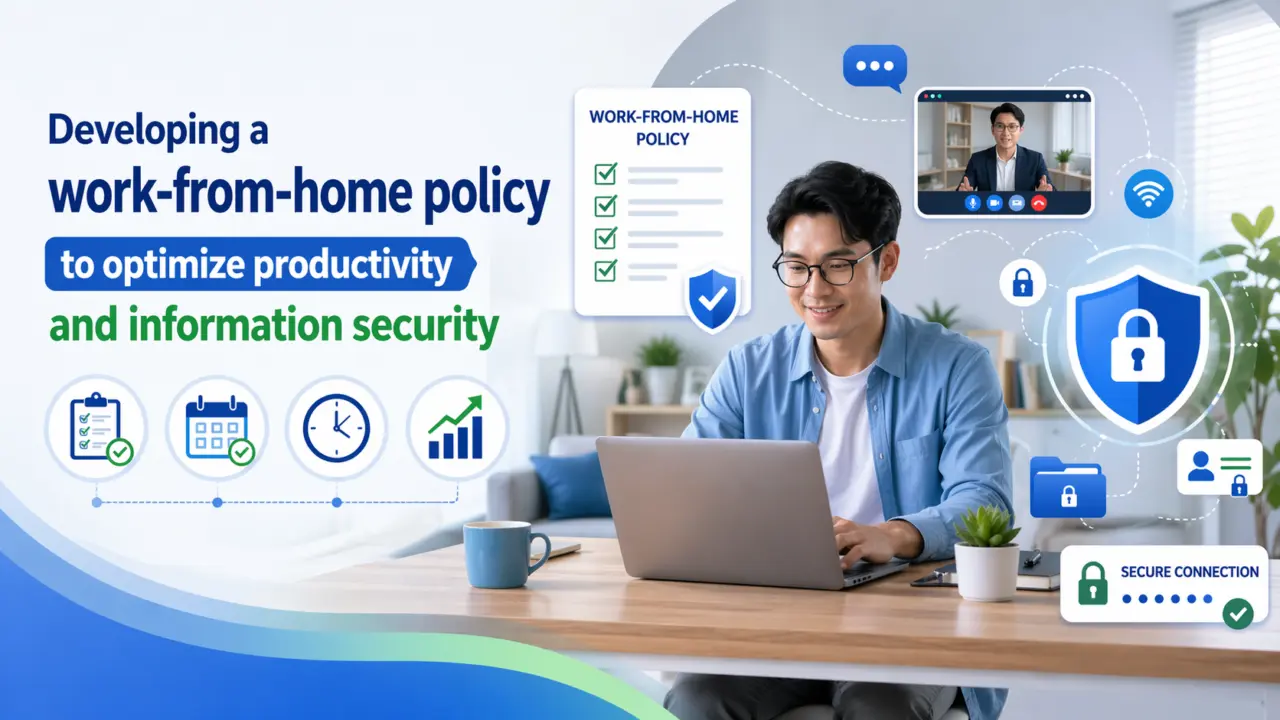
Building a work-from-home policy is essential for any 2026 HR solution. To effectively achieve remote productivity management and robust information security while working from home, companies must establish clear and flexible regulations.
- What Is the Development of a Work-from-Home Policy?
- The Importance of Establishing a Work-from-Home Policy in the Digital Era
- Core Components of a Remote Productivity Management Policy
- Information Security Strategies for Working from Home
- A 5-Step Process for Building a Professional Work-from-Home Policy
- HR Solution for 2026: Flexible Combination of Office and Home (Hybrid Work)
What Is the Development of a Work-from-Home Policy?
Developing a work-from-home policy is the process of establishing a formal system of rules, guidelines, and standards to govern employees’ work activities when they are not physically present at the office. This is not merely about allowing employees to take their laptops home, but rather a shift toward a modern approach to human resource management. Such a policy covers everything from time management, productivity benchmarks, and communication methods to technical measures aimed at protecting the company’s intellectual property.
In the context of Vietnam’s labor market rapidly shifting toward flexible working models, having a clear policy document helps eliminate ambiguity in responsibilities:
For employees: It clarifies what they need to do, who they report to, which tools they must use, and how to protect company data.
For managers: It provides a legal and administrative basis for fairly evaluating performance, avoiding both loss of control and excessive pressure on employees.
For organizations: It helps maintain operational stability regardless of external disruptions.
The Importance of Establishing a Work-from-Home Policy in the Digital Era
1. Ensuring Legal Compliance and Employee Rights
Clearly incorporating remote work terms into internal policies helps businesses strictly comply with the provisions of Vietnam’s Labor Code. When employees work from home, factors such as occupational accidents, working hours, break times, and insurance benefits often become more complex. A well-structured policy should clearly define:
- The recognized workspace boundaries
- Official working hours and rest periods
- The mechanism for recording incidents and providing compensation if problems occur during remote working hours
In addition, employees feel more secure when their rights are formally recognized in writing. The policy should clarify support for expenses such as internet and phone bills, as well as other benefits specific to the work-from-home model. This creates a transparent working environment where employee contributions are properly acknowledged regardless of geographic distance, thereby strengthening trust and dedication to the organization.
2. Optimizing Operating Costs for Businesses
Applying a well-designed remote work policy allows businesses to significantly reduce fixed costs. Instead of maintaining a large office space for 100% of employees, companies can switch to shared office models or reduce office size. Costs that can be optimized include:
- Office rent: Reduce unnecessary office space
- Utilities and internet: Lower on-site infrastructure costs
- Office supplies and equipment: Reduce purchasing and maintenance needs
The financial resources saved can be reinvested into management technology or high-quality workforce training. Moreover, a work-from-home policy can also help reduce employee turnover. When employees are given flexible working conditions, they are more likely to stay with the company long term, helping save billions of VND each year in recruitment and retraining costs.
3. Enhancing Employee Experience and Engagement
A flexible work environment is now one of the top factors attracting Gen Z and Millennial talent. When a business builds a professional policy, employees feel respected and empowered with greater autonomy. Work-life balance improves significantly:
- Less commuting time and stress in traffic-heavy urban areas
- Better mental health and greater personal satisfaction
- More opportunities for employees to care for their families without affecting work progress
However, engagement does not arise naturally when people work separately. The policy should include terms regarding online interaction, regular meetings, and digital culture-building activities. When employees feel they are still part of the team even while sitting in their living room, productivity naturally increases. This creates a positive cycle: happier employees, optimized performance, and sustainable business growth.
Core Components of a Remote Productivity Management Policy
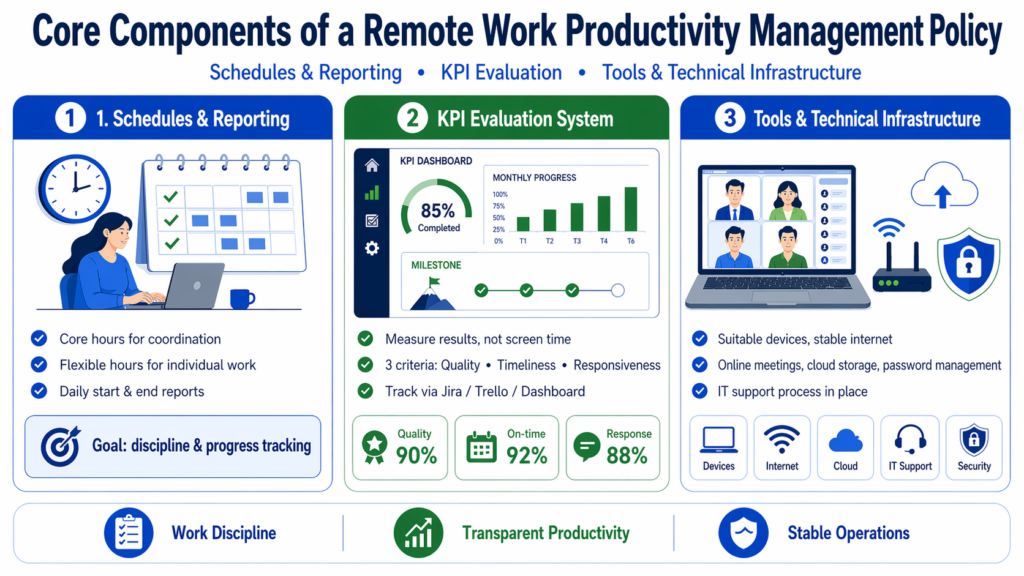
1. Regulations on Schedules and Reporting Methods
Time control is the biggest challenge when there is no direct supervision. The policy should clearly define the following timeframes:
- Core hours: The period during which all employees must be online for meetings and collaboration
- Flexible hours: The time employees can arrange themselves to complete individual tasks
Reporting methods should also be standardized to avoid information “slipping through the cracks.” Employees should be required to submit a brief report at the start of the day outlining their plan and another at the end of the day summarizing results through official channels such as Slack, Microsoft Teams, or project management software. This helps establish discipline and allows managers to monitor overall progress so they can provide timely support, instead of constantly calling to check in.
2. KPI Evaluation Standards for Remote Work
In a remote working environment, managing by deliverables is more important than managing by hours spent sitting at a desk. Businesses need to build a set of specific and measurable KPIs (Key Performance Indicators), such as:
- Product quality: Accuracy, creativity, and compliance with requirements
- Progress: Ability to complete work on time and meet deadlines
- Interaction: Responsiveness to messages and support for colleagues remotely
This evaluation system must be agreed upon in advance to ensure objectivity. Instead of worrying about whether employees are actually working, managers only need to look at progress boards on tools such as Jira or Trello. If important milestones are completed on time, that clearly shows employees are managing their time at home very effectively.
3. Necessary Support Tools and Technical Infrastructure
To maintain productivity, businesses are responsible for clearly defining the technical standards required for employees’ home setups:
- Hardware infrastructure: Suitable computers, high-speed and stable internet connections
- Software infrastructure: Online meeting software such as Zoom, cloud storage such as Google Drive, and password management tools
- Technical support: Procedures for contacting the IT department when software or hardware issues arise
The policy should also specify which hardware is provided by the company and which must be self-supplied by employees, along with remote maintenance policies. Proper training in using these tools not only speeds up work processing but also minimizes technical issues that can interrupt workflows, thereby optimizing the entire online operating process.
Information Security Strategies for Working from Home
1. Rules for Using VPNs and Personal Devices
The greatest security risks come from using home Wi-Fi without strong passwords or public networks. The policy should require:
- Use of a VPN (Virtual Private Network) when accessing internal systems
- Installation of licensed antivirus software on all work devices
- Prohibition of pirated software or access to websites with high malware risks
For personal devices (BYOD), businesses need to require a clear separation between personal accounts and work accounts. Encrypting hard drives and requiring strong device passwords should be mandatory to prevent information theft in case a device is lost or accessed by unauthorized individuals.
2. Procedures for Handling Remote Data Breach Incidents
No matter how well prepared a company is, risks still exist. The policy must include an emergency incident response scenario:
- Immediate reporting: Employees must notify the IT department as soon as they detect signs of intrusion
- Device isolation: Disconnect the device from the network to prevent malware from spreading to company systems
- Remote data wiping: Define IT’s authority to erase sensitive data from lost devices
The speed of response in the first few minutes determines up to 80% of the likelihood of saving the data. This process should also integrate multi-factor authentication (MFA) to ensure that only authorized individuals can access critical company data repositories.
3. Cybersecurity Awareness Training for Employees
The best security software is human awareness. Businesses should organize regular training sessions on:
- How to identify phishing emails and malicious links
- Rules for securing the workspace, such as not allowing family members to use company computers
- The habit of not saving important passwords in public web browsers
When employees clearly understand that a single careless act can result in billions of VND in damages, they are more likely to comply voluntarily. A culture of security should be integrated into daily activities and become part of employees’ professional ethics in the digital work environment.
A 5-Step Process for Building a Professional Work-from-Home Policy
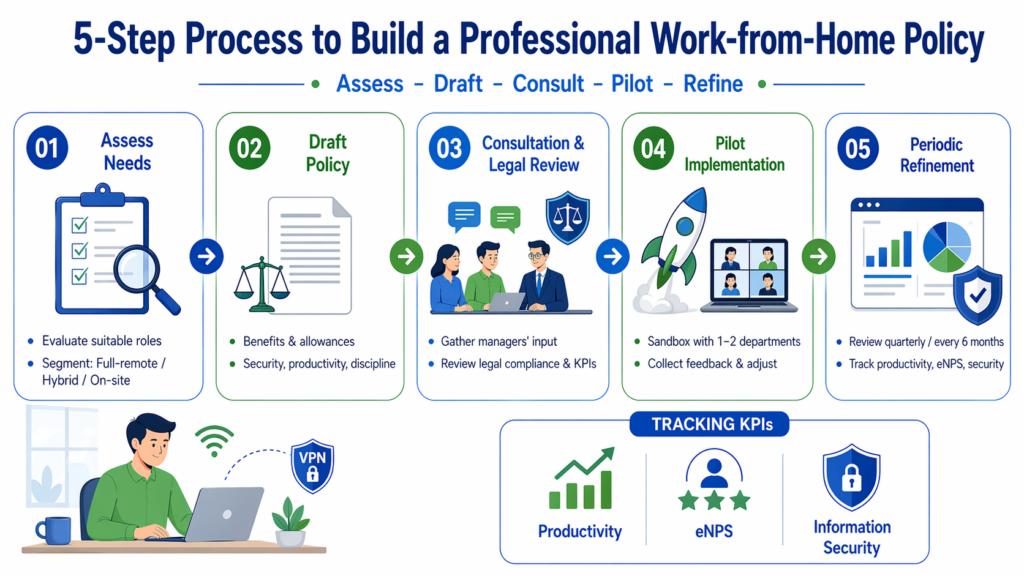
1. Survey Needs and Job-Specific Characteristics
This initial step serves as the foundation to ensure the policy is not imposed one-sidedly. Businesses should conduct a comprehensive survey through Google Forms or direct interviews with department heads to assess employee readiness and the technical infrastructure available in their homes.
The survey helps businesses classify employees into clear target groups:
- Full-remote group: Suitable for positions requiring little direct physical interaction, such as programmers, translators, or graphic designers. Policies for this group should focus deeply on output results and high-level data security.
- Hybrid group: The most common group in 2026, working flexibly between office and home, for example 3 days at the office and 2 days at home. Policies for this group need to clarify rules for switching workspaces and synchronizing data.
- On-site group: Positions that must be performed at the office, such as receptionists, hardware maintenance technicians, security staff, or janitors. For this group, the policy should clearly explain why remote work is not possible to ensure fairness and avoid internal comparison.
2. Draft Terms on Responsibilities and Authority
Once survey data has been collected, the HR department should work closely with Legal and Accounting to prepare a draft policy. This draft must balance “the stick” (responsibilities, discipline) and “the carrot” (rights, benefits, support).
The main contents to include are:
- Financial benefits: Clearly define allowances for internet costs, electricity, or depreciation of personal devices. Businesses should also specify reimbursement limits for necessary licensed software.
- Security and productivity responsibilities: Require mandatory VPN usage, commitment not to share work screens with family members, and maintenance of internal message response times within a specified period, for example no more than 15 minutes.
- Remote work discipline: Define specific disciplinary actions for unjustified absence during core hours or violations of information security rules that lead to serious consequences.
3. Consult Managers and the Legal Department
A policy that looks good on paper but is impractical in real-life management is useless. The draft should be sent to all department heads (HODs) so they can provide feedback on its compatibility with each department’s specific operating process.
This consultation process helps resolve potential issues:
- KPI practicality: Direct managers can determine whether remote measurement indicators are too strict or too loose for their employees
- Legal review: Lawyers or legal specialists can cross-check the terms with the current Vietnam Labor Code to ensure there is no overlap or violation of employee privacy at home
- Cultural alignment: Ensure the new regulations do not conflict with the company’s core values and communication culture
4. Issue and Pilot the Policy
Before company-wide implementation, businesses should carry out a “sandbox” pilot on a small scale, typically in 1–2 representative departments, for 1 to 2 months. This allows the company to observe how employees adapt in a real environment.
During this testing period, HR should focus on:
- Identifying bottlenecks: For example, VPN systems becoming overloaded when many people connect simultaneously, or end-of-day reporting processes being too cumbersome and time-consuming
- Collecting quick feedback: Organizing short weekly debriefing sessions to listen to the concerns of the pilot group
- Making timely adjustments: Revising wording or processes in the draft immediately before officially rolling it out to the entire company
5. Evaluate, Adjust, and Improve Periodically
A work-from-home policy should be treated as a “living entity” that can evolve with technological development and market changes. Businesses need to establish a periodic review mechanism, either quarterly or every six months.
Criteria for evaluating success include:
- Actual productivity indicators: Compare work output between office-based and remote work periods to clearly see the effectiveness of the policy
- Satisfaction level (eNPS): Survey whether employees feel happier and more engaged with the company after adopting a flexible work model
- Information security: Track the frequency of security incidents or data leaks to determine whether technical rules need to be tightened
HR Solution for 2026: Flexible Combination of Office and Home (Hybrid Work)
1. The Trend of Hybrid Work Models in Vietnam
By 2026, hybrid work has become the gold standard. Employees can choose office days for interaction and creativity, and home days for deep focus. This model requires policies to be highly flexible in order to support seamless transitions between the two environments.
2. The Role of Technology in Connecting Remote Teams
AI and VR technologies will help eliminate feelings of isolation. Using Employee Experience Platforms allows businesses to listen to employee feedback in real time and detect early signs of burnout so they can intervene promptly.
Building a work-from-home policy is not just about issuing a document, but about creating a work culture based on trust and responsibility. By optimizing productivity and tightening security, businesses can build a sustainable competitive advantage, attract talent, and be ready to break through in a fast-changing digital era.
To empower your business in overcoming HR management challenges and staying fully committed to your strategic goals, we provide specialized solutions:
- [RPO Services]: A comprehensive recruitment process outsourcing solution.
- [BPO Services]: Strategic outsourcing to streamline business processes and optimize operational costs.
For any inquiries, contact Wacontre Accounting Services via Hotline: (028) 3820 1213 or email [email protected] for prompt assistance. With a team of experienced professionals, Wacontre is committed to providing dedicated and efficient service. (For Japanese clients, please contact Hotline: (050) 5534 5505).