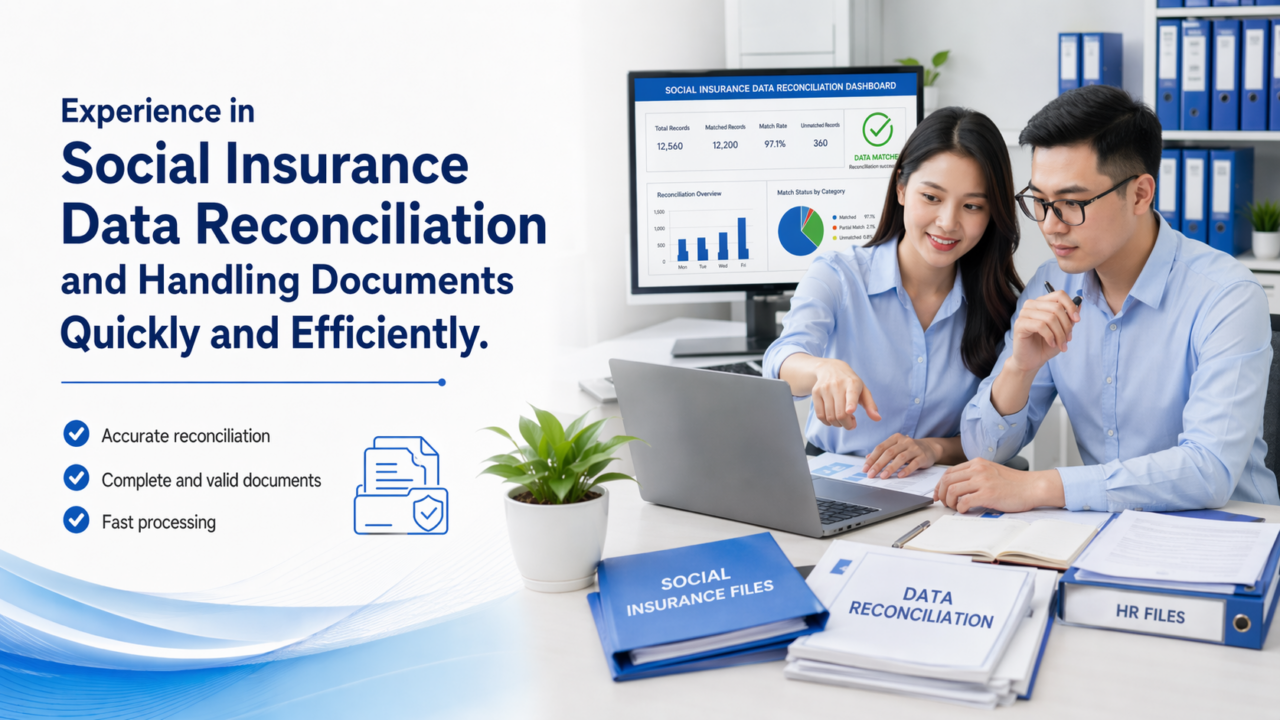
Mastering SI data reconciliation ensures financial accuracy. This guide explores ways to achieve swift benefits processing for sickness and maternity, optimizing HR workflows.
What is Social Insurance (SI) Data Reconciliation?
Social Insurance (SI) data reconciliation is more than just matching numbers on paper; it is a critical financial and legal risk management skill within an enterprise. It is the process of periodically verifying the consistency between internal payroll data, actual personnel records, and the management system of Vietnam Social Security (VSS). This reconciliation ensures that all contributions to the insurance fund are accurate—neither overpaid nor underpaid—and that employee benefits are continuously updated on the national system.
In practice, an experienced HR specialist views reconciliation as the “monthly heartbeat” of the HR department. Without this skill, businesses can easily fall into the trap of paying insurance for former employees (wasting budget) or underpaying for new hires (leading to late payment interest and affecting employees’ Health Insurance cards). Therefore, data reconciliation serves as the foundation for building a transparent, professional HR management system that strictly complies with labor laws.
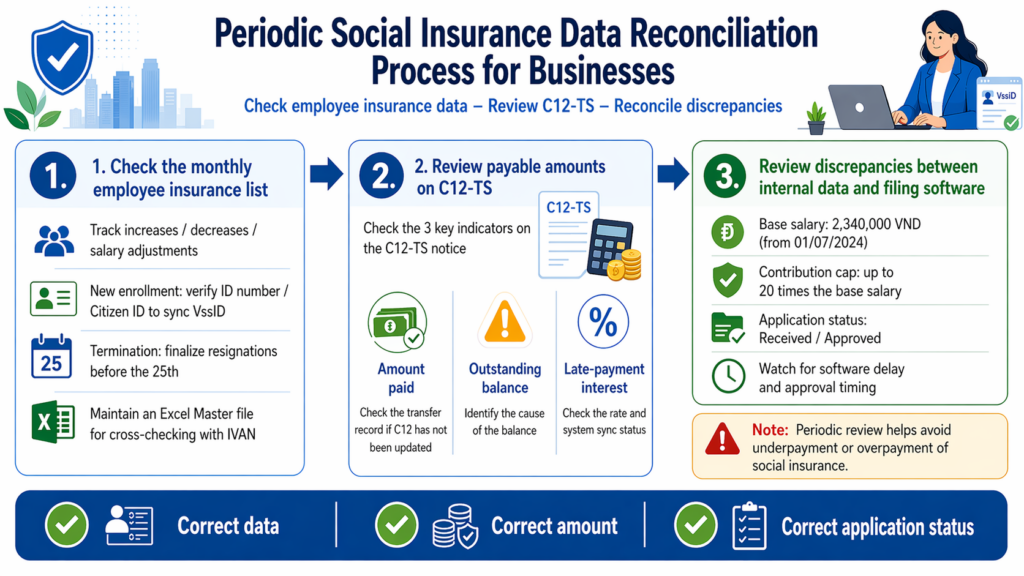
Periodic SI Data Reconciliation Process for Businesses
1. Monthly Review of the Social Insurance Contribution List
Personnel fluctuations are inevitable every month. To prevent reconciliation from becoming a burden, HR should maintain a real-time tracking sheet for changes (increases, decreases, or salary adjustments).
- Reporting Increases: It is essential to collect identification numbers from chip-based ID cards to synchronize data with the VssID application. An incorrect ID number can result in fragmented insurance records, making it difficult to merge books later.
- Reporting Decreases: This is the most error-prone stage. HR must coordinate with the production/operations department to finalize the resignation list before the 25th of each month. If a decrease is reported after the last day of the month, the enterprise must pay an additional month of Health Insurance (HI) even if the employee has already left.
- Pro Tip: Always maintain a Master Excel File containing the entire insurance history of employees to cross-check with data exported from electronic filing software (IVAN).
2. Reconciling Contributions via the SI Contribution Result Notice (Form C12-TS)
Form C12-TS is the financial “manifesto” between the enterprise and the social insurance agency. Upon receiving this form at the beginning of each month, reconciliation specialists should follow a 3-step rule:
| Reconciliation Metric | Discrepancy Handling | Expert Note |
| Paid Amount | If funds were transferred but not recorded on C12, verify the bank transfer order and contact the collection management department. | Always clearly state the unit code and payment content according to the prescribed syntax. |
| Outstanding Debt | Investigate which month the debt originated from—was it due to late reporting or retroactive salary adjustments? | Prolonged debt will eventually lead to the suspension of Health Insurance cards for all employees. |
| Late Payment Interest | Check the interest rate (usually based on the average investment return of the SI fund from the previous year). | If payment was on time but interest is still charged, it may be due to a synchronization delay between the bank and VSS. |
3. Reviewing Discrepancies Between Internal Data and Filing Software
With the new base salary of 2,340,000 VND (effective July 1, 2024) and the regional minimum wage under Decree 74/2024/ND-CP, reviewing contribution levels is mandatory.
- Checking Contribution Caps: Note that the maximum contribution for SI and HI is 20 times the base salary. New HR staff often overlook this when calculating for high-level executives, leading to unnecessary overpayments.
- Handling Software Latency: Sometimes you have completed the task in the software, but the data has not been approved by the insurance agency. You must check the status as “Received” or “Approved” on the Public Service Portal to ensure the file has actually been processed.
Secrets to Swift Sickness and Maternity Claims Processing
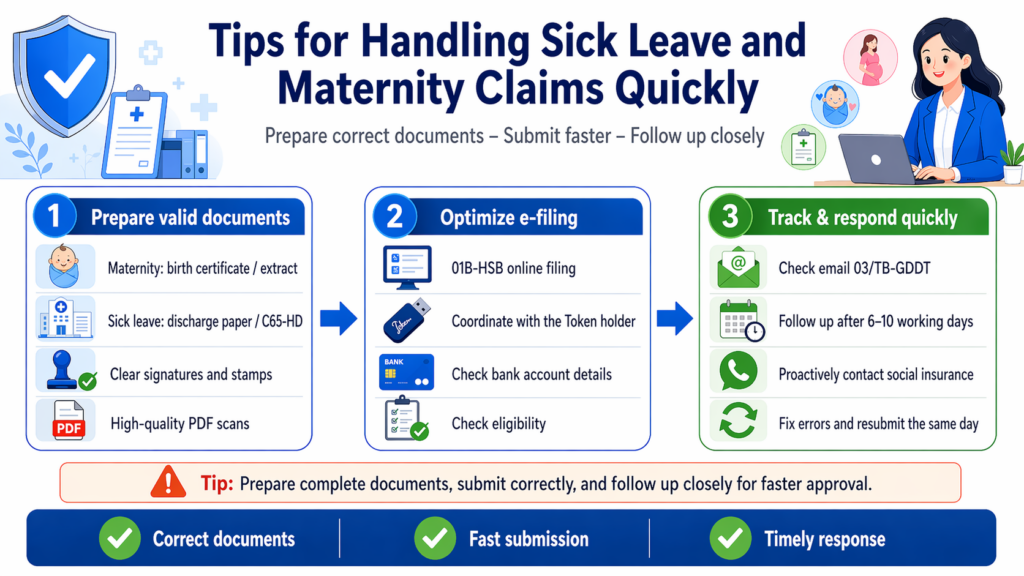
1. Preparing Valid Documentation per Latest Regulations
A “Rejection” is an HR nightmare as it wastes time and damages credibility with employees. For swift processing, require employees to submit documents immediately upon returning to work:
- For Maternity: A copy of the Birth Certificate or extract of birth registration is required. In cases of stillbirth or pathological abortion, a hospital discharge paper or SI Leave Certificate is necessary.
- For Sickness: Hospital discharge papers (inpatient) or SI Leave Certificate (Form C65-HD) for outpatient treatment. Note: The doctor’s signature and hospital stamp must be clear, without any erasures or corrections.
- Quick Tip: Scan all documents into high-quality PDF files to attach to the filing software, helping insurance officers review online files more easily.
2. Optimizing Electronic Filing and Digital Signatures
Currently, claims for sickness and maternity (Form 01B-HSB) are processed entirely online. To accelerate progress, businesses should:
- Specific Authorization: The digital signature (Token) holder must coordinate smoothly with the document preparer to avoid delays when the holder is away.
- Bank Account Details: Always verify the accuracy of the employee’s bank account number and branch. VSS now prioritizes direct payment to individual accounts to increase transparency and speed.
- Eligibility Check: Before submitting, verify if the maternity employee has contributed for at least 6 months within the 12 months prior to childbirth.
3. Tracking and Responding to VSS Notifications
The “submit and forget” approach causes files to hang for months. A professional HR will:
- Periodic Email Checks: The insurance agency will send notification Form 03/TB-GDĐT regarding the acceptance or rejection of the file.
- Proactive Contact: If no payment or notification is received after 6-10 working days, call the Benefits Department of the local SI agency.
- Immediate Correction: If a file is rejected due to missing information, supplement and resubmit it within the same day.
Common Real-World Scenarios in Data Reconciliation
1. Identification Mismatch Between ID Cards and SI Data
Synchronizing the national population database with SI codes is now mandatory. However, many employees using old ID cards face “Information Mismatch” errors on VssID.
- Consequence: Employees cannot use HI cards for medical treatment or claim maternity benefits.
- Solution: HR must guide employees through the information change procedure (Form TK1-TS) to update their latest chip-based ID card in the system.
2. Employees with Multiple SI Books
This is extremely common in Vietnam when workers move between multiple companies without declaring their old SI code.
- Consequence: When reconciling total contribution time for benefits, the system will show insufficient time because data is scattered across multiple books.
- Solution: HR must check the contribution history on the portal and guide the employee through the book merging process.
3. Interest Discrepancy Due to Banking Synchronization Issues
If a company transfers funds on the 30th but the SI agency receives it on the 5th of the following month (due to weekends), the system may automatically charge late interest.
- Consequence: The business is flagged for “Insurance Debt” and incurs unnecessary costs.
- Solution: HR must archive the Bank Transfer Order to work with the collection officer and request an interest waiver due to transaction latency.
HR Outsourcing Solutions for Process Optimization
HR Outsourcing has evolved from a trend into a strategic solution for businesses to optimize operations, especially in the complex SI sector.
1. Access to Automated and Precise Reconciliation Technology
Professional HR service providers invest in ERP/HRIS systems that connect directly with the VSS portal.
- Automated Reconciliation: Instead of manual checks, the software automatically scans for discrepancies between payroll and Form C12-TS, issuing instant alerts.
- Security & Archiving: Data is digitized and stored systematically, making the retrieval of records from 5-10 years ago simple and instantaneous.
2. Ensuring Continuity and Mitigating Internal Turnover Risks
If an internal SI specialist resigns unexpectedly, the reconciliation and claims process is often disrupted.
- Stable Service: With outsourcing, businesses no longer worry about recruiting or retraining SI staff. The provider guarantees continuity and assumes full legal responsibility for the records.
- Strategic Consulting: Beyond paperwork, outsourcing units advise on optimized salary scales and allowances to ensure employee benefits while remaining compliant with statutory contribution levels, saving significant budget for the business owner.
Mastering SI data reconciliation and claims processing requires a blend of disciplined data management and keen policy awareness. A rigorous reconciliation process not only protects employee rights but also helps businesses optimize costs and operate smoothly. In the era of digital transformation, mastering electronic insurance filing tools is the key to elevating the HR department’s status within the enterprise.
To empower your business in overcoming HR management challenges and staying fully committed to your strategic goals, we provide specialized solutions:
- [RPO Services]: A comprehensive recruitment process outsourcing solution.
- [BPO Services]: Strategic outsourcing to streamline business processes and optimize operational costs.
For any inquiries, contact Wacontre Accounting Services via Hotline: (028) 3820 1213 or email [email protected] for prompt assistance. With a team of experienced professionals, Wacontre is committed to providing dedicated and efficient service. (For Japanese clients, please contact Hotline: (050) 5534 5505).