
Streamlining your Personal Income Tax finalization is now a reality in 2026. We provide a comprehensive 2024-2026 PIT finalization guide, covering digital how to calculate personal income tax and the automated PIT refund process for employees via government apps.
What is Personal Income Tax (PIT) Finalization?
Personal Income Tax (PIT) finalization is the process by which employees or income-paying organizations re-determine the actual tax liability for a calendar year. This is a crucial step to reconcile the tax amount temporarily withheld monthly or quarterly against the actual tax incurred based on total annual income and legal deductions.
In the context of 2026, tax finalization is no longer synonymous with thick stacks of paper. Vietnam’s electronic tax system is now fully synchronized with the national population database, making the determination of tax obligations transparent and efficient. For individuals, this is a vital right to claim refunds for overpaid taxes or offset liabilities in the next period, ensuring financial fairness for every citizen.
Targets and Deadlines for 2026 PIT Finalization
The year 2026 marks a turning point as 100% of tax finalization dossiers for resident individuals are processed electronically. Identifying the correct filing category helps employees avoid unnecessary legal complications and optimizes administrative processing time.
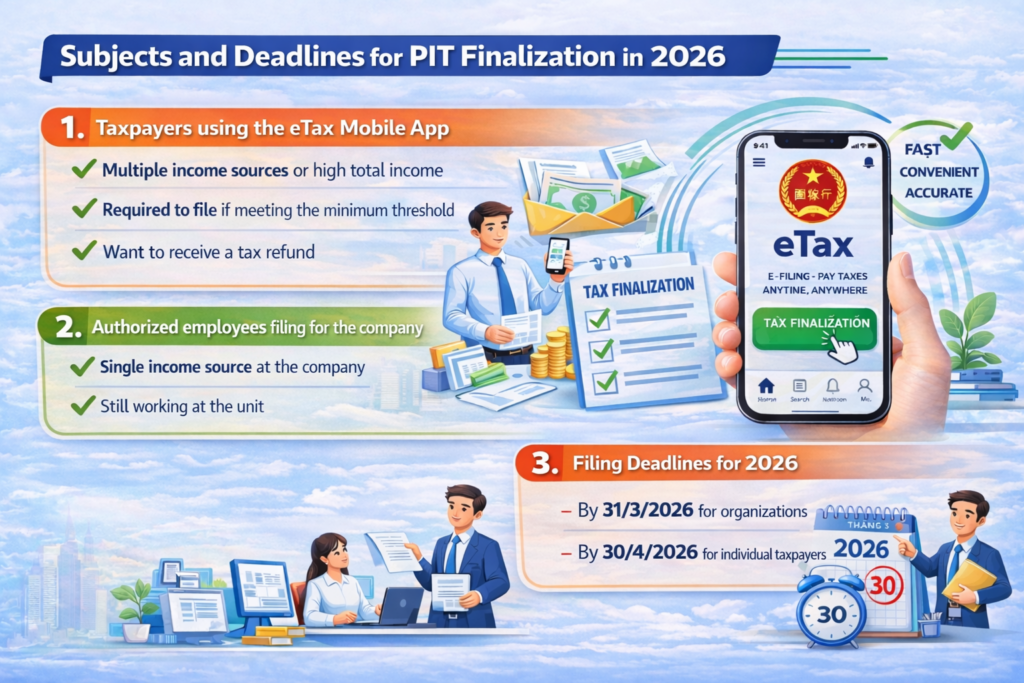
1. Who must self-finalize via the eTax Mobile App?
Individuals with income from multiple sources or significant irregular income typically fall into the category of self-finalization. Under 2026 regulations, if your total additional tax payable exceeds the minimum threshold or if you wish to claim a refund for overpayment, you are required to log into the eTax Mobile system to file your return.
Self-finalization also applies to employees who resigned from their previous company but have not signed a contract with a new entity by the end of the year. The tax authority’s data system automatically aggregates cash flows from different paying tax codes, allowing you to manage your entire income within a single interface on your smartphone.
2. Cases eligible for authorizing the employer to finalize on your behalf
Employees who have only one source of income from wages or salaries at a single paying entity and are still working there at the time of finalization may authorize the employer to act on their behalf. This is an optimal solution for office workers with stable income, reducing the burden of personal procedures as the company’s accounting department will aggregate and submit the dossiers.
However, please note that authorization is only valid if you sign an authorization document (usually a digital signature on the company’s HR management software). If you have outside income such as online business, property rentals, or royalties reaching the taxable threshold, you cannot authorize the company and must perform self-finalization to ensure the accuracy of your total global income.
3. Important 2026 tax filing deadlines to remember
For income-paying organizations, the deadline for submitting tax finalization dossiers is typically the last day of the 3rd month from the end of the calendar year. This means businesses must complete their reporting obligations to the tax authorities before March 31, 2026, to avoid administrative penalties for late filing.
For individuals filing directly, the tax authority provides more flexibility with a deadline extending to the last day of the 4th month from the end of the calendar year (April 30, 2026). Mastering this timeline is critical, as after this point, the system will automatically record late filings and incur interest on unpaid tax amounts, which may negatively impact your personal tax credit score.
Step-by-Step Guide for High-Speed Online PIT Finalization
Digital transformation in tax management has brought significant convenience. Now, with just a smartphone and an internet connection, employees can complete their tax obligations in less than 15 minutes without visiting a tax office in person.
1. Preparing electronic tax withholding certificates and tax transaction accounts
Before starting, you need to request your HR department to provide electronic PIT withholding certificates. In 2026, paper certificates have been completely abolished and replaced by files with authenticated QR codes from the tax authority. You should store these files in a document folder on your phone for easy uploading.
Additionally, possessing an electronic tax transaction account authenticated via Level 2 digital identity (VNeID) is a prerequisite. If you do not have an account, register immediately on the eTax Mobile app by scanning your face and chip-embedded ID card. This ensures absolute security and prevents fraudsters from impersonating you to claim your tax refund.
2. Five-step filing process on eTax Mobile or the Public Service Portal
The process begins by logging in and selecting “Tax Finalization.” The system will automatically populate income data reported by paying entities during the year; you simply need to verify the accuracy against your certificates. The next step is to update family circumstance deductions, including information for dependents who have been registered with their own tax codes.
Once the information is complete, click “Calculate Tax,” and the system will automatically apply the progressive tax rates to provide an exact figure. If the result shows an overpayment, enter your official bank account details to receive a refund. Finally, digitally sign the dossier and click “Submit Return.” A confirmation message from the General Department of Taxation will be sent to your phone immediately, marking a successful submission.
3. How to look up tax overpayments and execute online refund orders
One of the most outstanding features of the 2026 eTax app is the real-time tax obligation lookup function. Under the “Dossier Lookup” section, you can track the status of your return from “Received” and “Processing” to “Accepted.” If the result indicates an overpaid tax amount, you can issue a “Request for Refund of State Budget Revenue” directly on the app.
Tax refunds will be transferred directly to your registered bank account within 5-10 working days after approval. This transparency in the cash flow roadmap gives employees peace of mind and minimizes cumbersome inquiries with tax officials, demonstrating the Government’s effort in citizen-centric administrative reform.
Latest PIT Calculation Methods and Deductions
Understanding how tax is calculated not only helps you manage personal finances better but also ensures you do not miss any legal deductions. The 2026 tax brackets have been flexibly adjusted to reflect the actual cost of living in major urban areas.
1. Family circumstance and dependent deductions for 2026
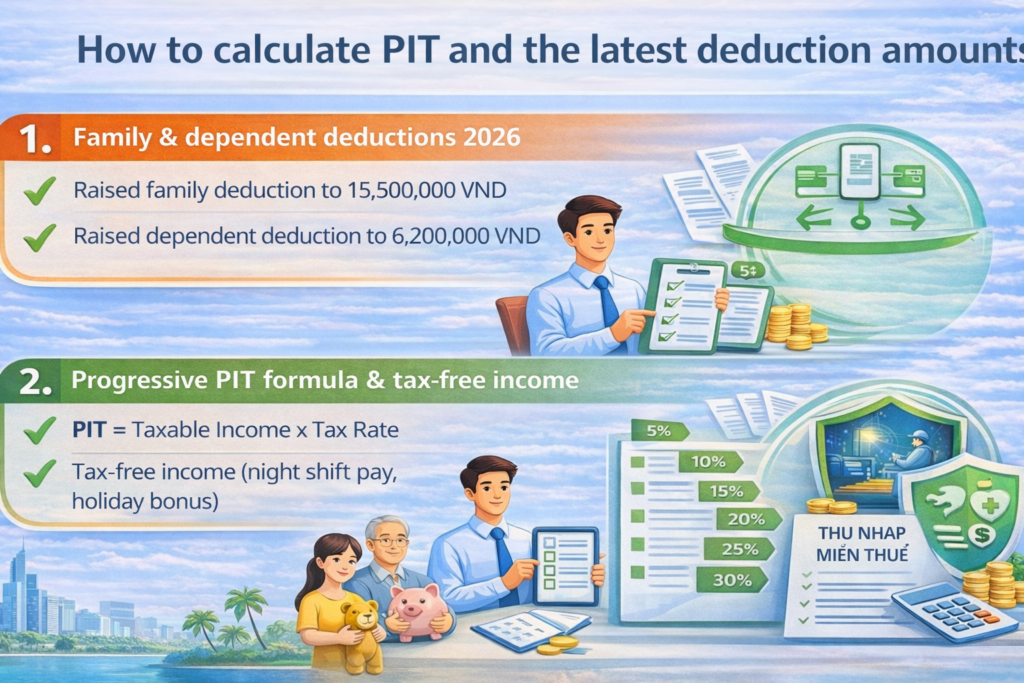
Deductions for the taxpayer and their dependents in 2026 have been updated to reflect fluctuations in the Consumer Price Index (CPI). Dependent registration is now fully automated through integration with the National Population Database, reducing the need to submit documents like residency books or birth certificate copies.
Employees should review their list of dependents before the finalization period. Cases such as children who have reached working age and have income, or parents with pensions exceeding the regulated limit, will no longer qualify as dependents. Updating accurate information will help you avoid tax arrears and penalties due to incorrect declaration of deduction subjects.
2. Progressive tax formula and tax-exempt income
PIT from wages and salaries is calculated using a partially progressive method, meaning higher income is subject to higher tax rates. The basic formula is: PIT = Taxable Income × Tax Rate. Taxable income is equal to total income minus compulsory insurance, family deductions, and certified charitable or humanitarian contributions.
Furthermore, employees need to be aware of tax-exempt income, such as pay for night shifts or overtime (the portion paid higher than normal day rates), or hazardous/dangerous allowances as per regulations. Accurately separating these amounts significantly reduces the tax payable, protecting the actual income you have worked hard to earn.
Common Errors and Notes for App-Based Finalization
While the online process is convenient, lack of caution during data entry can still lead to avoidable errors, delaying dossier approval.
1. Handling errors in tax codes or dependent information
One of the most common errors is entering the wrong personal tax code or the tax code of the income-paying entity. This prevents the system from syncing data, resulting in a “Dossier does not exist” error. In this case, double-check the information on your withholding certificate and use the QR scan function on the app to auto-fill information instead of typing manually.
Regarding dependent information, many often forget to update the start or end dates for deductions. The 2026 system is very strict regarding duplication; if a dependent is registered for two different taxpayers simultaneously, the dossier will be suspended. Ensure clear agreement within the family before declaring on the app.
2. How to check dossier approval status from the tax authority
After successfully submitting the return, frequently checking notifications on the eTax app is essential. The tax authority will send notifications of acceptance or requests for explanation/supplementary information through the system. Many employees have a habit of “submit and forget,” leading to ignorance of technical rejections until the deadline has passed.
If the dossier status shows “Adjustment Required,” you can submit a replacement or supplementary return directly on the app without deleting the old dossier. The system will retain correct information and only require you to fix the errors. This two-way interaction makes the process transparent and minimizes cumulative errors.
3. Legal risks and penalties for late PIT finalization
Late submission of tax finalization dossiers not only results in the loss of refund rights but also leads to strict financial sanctions. According to 2026 legal regulations, fines for late filing can reach tens of millions of VND depending on the duration of the delay. Furthermore, tax debt may lead to temporary exit bans under new regulations on tax debt management for individuals.
To avoid this risk, employees should form a habit of early finalization starting in March. Do not wait until the final days of April, as traffic to the eTax Mobile system may spike, leading to local network congestion. An early submission not only helps you receive your refund faster but also builds a “clean” tax compliance record, supporting future financial transactions or visa applications.
Conclusion
2026 PIT finalization is no longer a burden for employees, thanks to the powerful support of technology. Proactively gaining knowledge, mastering the eTax Mobile app, and adhering to deadlines are the best ways to protect your personal financial interests. We hope this detailed guide enables you to perform your tax finalization confidently, quickly, and accurately, contributing to a transparent and modern tax management system in Vietnam.
To empower your business in overcoming HR management challenges and staying fully committed to your strategic goals, we provide specialized solutions:
- [RPO Services]: A comprehensive recruitment process outsourcing solution.
- [BPO Services]: Strategic outsourcing to streamline business processes and optimize operational costs.
For any inquiries, contact Wacontre Accounting Services via Hotline: (028) 3820 1213 or email [email protected] for prompt assistance. With a team of experienced professionals, Wacontre is committed to providing dedicated and efficient service. (For Japanese clients, please contact Hotline: (050) 5534 5505).