
Understanding the 13th-month salary and Tet bonus calculation alongside HR legal regulations is vital for businesses to ensure labor compliance and employee satisfaction.
What is the 13th-month salary and Tet bonus?
In Vietnam’s labor culture, the terms “13th-month salary” and “Tet bonus” are often used interchangeably, sometimes leading to confusion. In practice, the 13th-month salary is understood as a bonus paid by enterprises at year-end, typically based on the average annual salary or the most recent monthly salary.
This is a vital welfare policy that helps businesses attract and retain talent, providing employees with a sense of security after a year of dedication. Paying this amount strengthens the bond between employees and the organization.
The Tet bonus, specifically for the Lunar New Year, carries a deeper spiritual and symbolic meaning. This bonus is not merely a financial figure; it is a recognition of labor achievements and a token of gratitude from management to the collective staff.
Depending on business results and individual performance, each company offers different bonus levels in cash or in kind. Operationally, establishing a clear definition in the internal regulations helps HR communicate effectively and resolve employee inquiries.
Legal Regulations on Bonuses and 13th-Month Salary
1. Legal Nature under the Labor Code
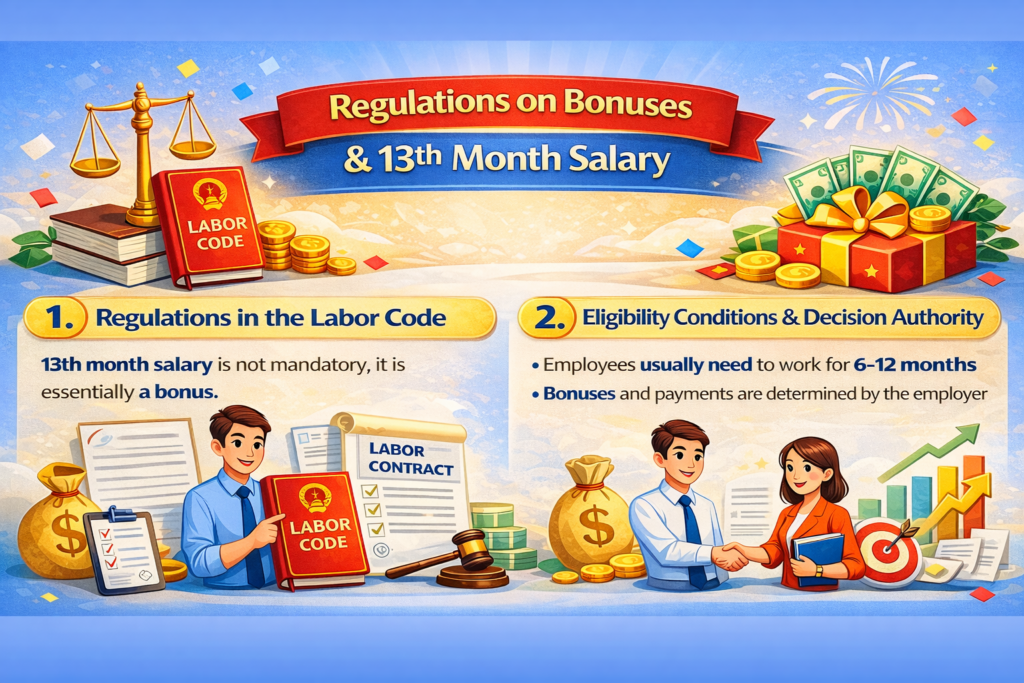
According to Article 104 of the current Labor Code, the term “13th-month salary” does not appear in legal texts. In reality, it is classified under the “Bonus” category. The law stipulates that bonuses are based on the enterprise’s business results and the employee’s work completion level.
Therefore, paying a 13th-month salary is not a mandatory obligation for all businesses unless otherwise agreed upon. If the Employment Contract or Collective Labor Agreement specifies the payment of a 13th-month salary, the enterprise is legally bound to fulfill this commitment.
Failure to pay after making a commitment can lead to serious legal risks and labor disputes. Conversely, if company regulations do not provide for it and the business is operating at a loss, the employer has the right not to pay after consulting with the grassroots labor representative organization.
2. Eligibility Criteria and Decision-Making Authority
To receive a bonus, employees usually must meet specific criteria such as: length of service (usually 6-12 months or more), no disciplinary violations, and meeting KPIs. Some companies stipulate that employees must be currently employed at the time of the bonus announcement to be eligible.
Transparency in setting bonus conditions is vital for maintaining motivation. HR experts recommend that businesses quantify criteria in detail and announce them publicly at the beginning of the fiscal year so that employees have clear goals to strive for.
The final decision on the bonus amount rests entirely with the employer. However, this right must be exercised through the issuance of a “Bonus Regulation” posted publicly at the workplace. Consultation with the Trade Union is mandatory to ensure democracy and objectivity.
Standard Formulas for 13th-Month Salary and Tet Bonus
1. Calculation for Employees with 12 Months of Service
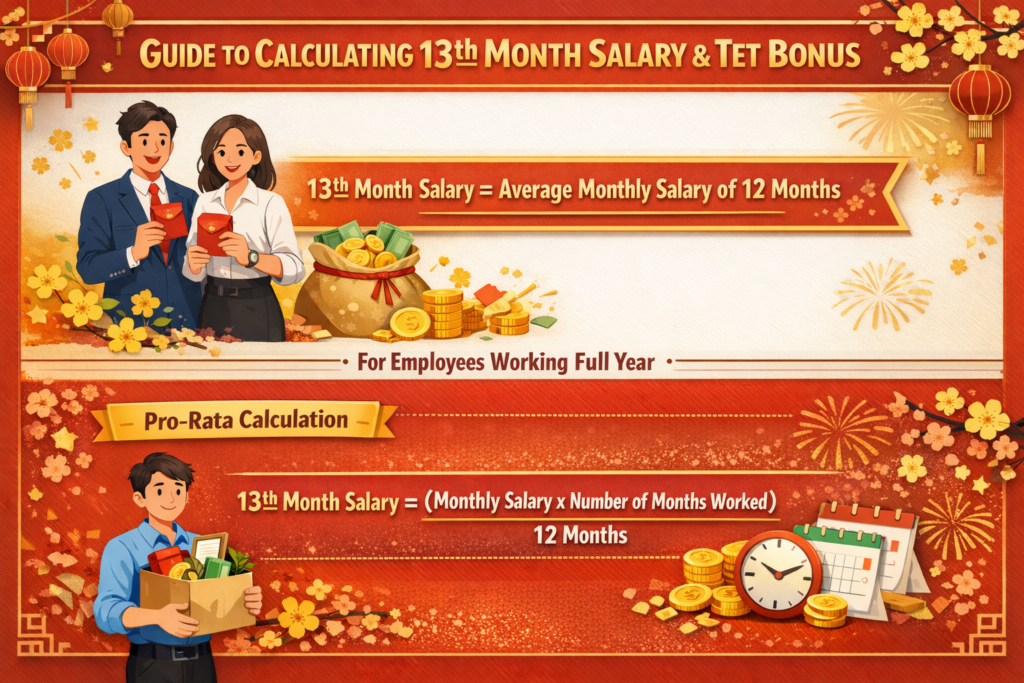
Most enterprises apply a bonus level equal to one month’s actual salary or the average salary of the 12 working months. Some units choose the salary used for Social Insurance contributions as the basis, depending on welfare policies and financial capacity.
If the average salary is applied, the formula is:

This method accurately reflects the employee’s contribution throughout the year, especially for those who received salary adjustments mid-year.
2. Pro-rata Calculation for Partial Year Service
For employees who joined or resigned before the end of the year, businesses apply a pro-rata calculation based on the actual working time. This is a fair method, ensuring “pay for what you contribute.”
The specific formula:

HR should clearly define how to round partial working days in the internal regulations. This helps avoid unnecessary disputes over a few working days when calculating the final figure on the payslip.
Tax and Insurance Obligations for Bonuses
1. Personal Income Tax (PIT)
Tet bonuses and 13th-month salaries are subject to PIT as income from salaries and wages. The timing for tax calculation is the actual time of payment. If a company pays the bonus in January, this amount will be added to the January income to calculate tax under the progressive tax scale.
Since bonus amounts are often significant, the total income can easily push employees into higher tax brackets. HR should provide simulation tables or specific explanations regarding the deducted tax amount. Transparency helps reduce disappointment when the “Net” amount received is lower than expected.
2. Are Social Insurance contributions required for bonuses?
According to the guidelines for implementing the Social Insurance Law, bonuses (including the 13th-month salary) are not part of the basis for compulsory Social Insurance contributions. The monthly salary for insurance contributions usually includes only the basic salary and fixed allowances paid regularly each month.
This regulation helps businesses reduce the burden of insurance costs on large bonus funds. However, the bonus must still be fully accounted for as a deductible expense for Corporate Income Tax (CIT) purposes, provided it is specifically stipulated in the labor agreement documents.
Essential Notes for HR and Business Owners
1. Optimal Timing for Announcement and Payment
Businesses should announce the expected bonus level at least one month before Tet. This provides employees with peace of mind and allows them to plan their finances. Delays often cause anxiety, reduced productivity, and sometimes a wave of resignations just before the holiday.
The ideal time for actual payment is 1 to 2 weeks before the Lunar New Year. Some units pay in two installments (before and after Tet) to retain staff. However, this format must be skillfully negotiated to avoid making employees feel coerced or uncomfortable.
2. Building Transparent Regulations to Prevent Disputes
Disputes often revolve around “who is eligible and who is not.” Businesses need strict regulations: “Must an employee work until the very last day of the year to receive the bonus?” Clear wording in documents serves as the strongest legal shield when complaints arise.
Furthermore, direct dialogue about the business situation is crucial. When management shares sincerely, employees are more likely to be understanding even if the bonus is not as high as expected. A transparent regulation is the foundation for building long-term loyalty.
Conclusion
Developing and implementing year-end bonus policies is a blend of legal knowledge and the art of human management. A fair, compliant, and transparent policy not only ensures legal safety but also serves as a powerful tool to boost morale and retain talent. Investing systematically in the bonus calculation process is the smartest investment for a business’s sustainable development: its human resources.
To empower your business in overcoming HR management challenges and staying fully committed to your strategic goals, we provide specialized solutions:
- [RPO Services]: A comprehensive recruitment process outsourcing solution.
- [BPO Services]: Strategic outsourcing to streamline business processes and optimize operational costs.
For any inquiries, contact Wacontre Accounting Services via Hotline: (028) 3820 1213 or email [email protected] for prompt assistance. With a team of experienced professionals, Wacontre is committed to providing dedicated and efficient service. (For Japanese clients, please contact Hotline: (050) 5534 5505).