


Understanding how to explain Gross – Net salary to candidates is vital for HR. Let’s distinguish Gross and Net to ensure transparency and trust during contract negotiations.
- What Does Explaining Gross – Net Salary to Candidates Entail?
- Distinguishing Between Gross and Net Salary
- Common Misunderstandings Among Candidates When Signing Contracts
- The Art of Advising Candidates on Gross – Net Salary
- Why Should Businesses Prioritize Gross Salary Negotiations?
- Key Considerations When Drafting Salary Clauses
What Does Explaining Gross – Net Salary to Candidates Entail?
In the Vietnamese recruitment landscape, explaining Gross and Net salaries is more than just providing a figure; it is a process of ensuring transparency regarding an employee’s rights and obligations. Mastering this explanation is a critical communication skill that helps candidates distinguish between the total cost incurred by the employer and the actual take-home pay received each month after statutory insurance and tax deductions.
For HR professionals, this requires a profound understanding of the Labor Code, the Law on Social Insurance, and Personal Income Tax (PIT) regulations. A proper explanation ensures that candidates feel respected and confident in the company’s professionalism, and most importantly, it eliminates unrealistic expectations that could lead to disputes after the employment contract is signed.
Distinguishing Between Gross and Net Salary
Misinterpreting these two concepts is the root cause of most misunderstandings between employers and employees. To consult effectively, HR must break down each layer of meaning.
1. Gross Salary: Total Income Before Taxes and Insurance
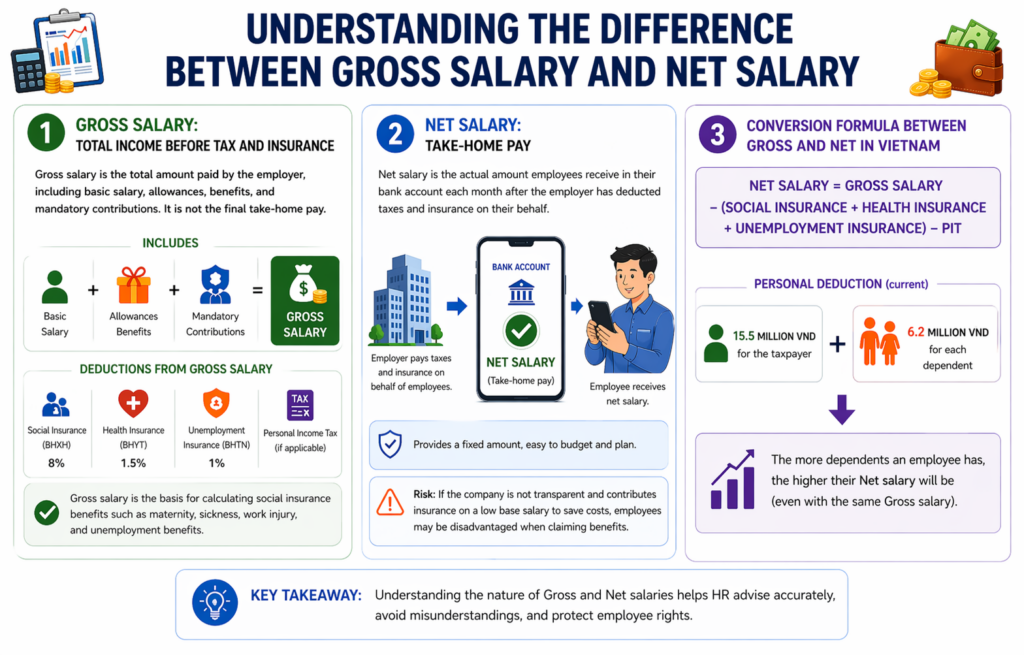
Gross salary is the total compensation an employer pays to an employee, including basic salary, allowances, subsidies, and mandatory contributions. When negotiating a Gross salary, candidates must understand that this is not the final amount they take home. From this figure, the employee will contribute a portion to Social Insurance (8%), Health Insurance (1.5%), Unemployment Insurance (1%), and Personal Income Tax (if applicable).
Gross salary is often preferred by businesses because it clearly reflects total personnel costs and facilitates budget management. For employees, Gross salary offers a significant advantage when calculating social security benefits such as maternity leave, sick leave, occupational accidents, or unemployment benefits, as these rates are typically based on the salary used for insurance contributions (which usually aligns closely with the Gross salary).
2. Net Salary: Actual Take-Home Pay
Net salary is the “actual cash” an employee receives in their bank account every month after the employer has fulfilled tax and insurance obligations on their behalf. In other words, the company commits to a fixed amount that the candidate will receive, regardless of fluctuations in insurance contribution levels or personal income tax.
While Net salary provides a sense of security and ease of budgeting for candidates, it carries inherent risks if the business is not transparent. There are cases where companies pay a Net salary but contribute to insurance based on the minimum basic salary to save costs, leaving employees disadvantaged when claiming social insurance benefits.
3. Conversion Formula Between Gross and Net in Vietnam
To provide professional consultation, HR must master the formula:

Converting from Net to Gross is equally vital, as most tax finalization returns and HR management software operate on a Gross salary basis.
When advising, HR should explain that the family circumstance deduction (currently 15.5 million VND for the individual and 6.2 million VND for each dependent) plays a decisive role in whether their Net salary is high or low. A candidate with multiple dependents will have a higher Net salary than a single candidate, even if both share the same Gross salary.
Common Misunderstandings Among Candidates When Signing Contracts
A lack of information or a superficial understanding of legal regulations often leads candidates into frustrating situations after their first month’s pay.
1. Confusion Regarding Social Insurance (SI) Responsibilities
Many candidates, especially fresh graduates or manual laborers, often assume that Gross salary is the amount they “must” receive in full and that the company must pay for insurance separately. When they receive their payslip and see a 10.5% deduction for insurance funds, they often feel as though they are “losing money.”
HR’s duty is to clarify that this 10.5% is a legal obligation of the employee, and the business also contributes an additional 21.5% of that salary fund into these funds. This is a shared responsibility to ensure long-term social security for the employee.
2. Fluctuations in Net Salary Due to Changes in Family Deductions
A common misunderstanding with Gross salary contracts is that candidates fail to anticipate how changes in personal status affect take-home pay. For example, if an employee gets married and has a child, they register additional dependents. At this point, PIT decreases, leading to an increase in Net salary even though the Gross salary remains unchanged.
Conversely, if a dependent no longer qualifies for the deduction, PIT increases and Net salary decreases. Without a clear initial explanation from HR, employees may question why the company is “cutting” their pay.
3. Misaligned Expectations Regarding Bonuses and Allowances
Upon receiving a “one-month salary” bonus notice, candidates often default to assuming it is based on Gross salary. However, depending on company policy, this bonus may be calculated on the basic salary (usually lower than Gross) or Net salary. If the contract does not explicitly state “13th-month salary based on Gross salary,” disappointment during bonus season is inevitable.
Similarly, allowances such as fuel or telephone stipends are usually non-insurable items. Candidates need to understand which components fall under the Gross salary for insurance purposes and which are external allowances to have a holistic view of their Total Package.
The Art of Advising Candidates on Gross – Net Salary
The skill of explaining is not just about stating the law; it is about communicating in a way that makes the candidate feel they are “gaining” rather than “losing.”
1. Using Calculation Simulations for Transparency
Do not rely solely on verbal explanations. A professional HR specialist always has an Excel file or an online salary calculator ready to simulate figures for the candidate instantly. When they see exactly where the money goes—how much to the pension fund, health care, and state taxes—it fosters absolute transparency.
Presenting a detailed calculation sheet helps eliminate the feeling of “being deducted” and replaces it with the feeling of “investing” in the future. This also demonstrates the preparation and credibility of the HR department and the enterprise as a whole.
2. Emphasizing Benefits of Higher Social Insurance Contributions
This is the most critical “touchpoint.” HR should emphasize that by contributing to insurance based on a high Gross salary, the employee receives maximum benefits for maternity or sick leave. For instance, maternity benefit is equivalent to 6 months of the average salary on which SI was paid. A high Gross contribution leads to much higher payouts compared to contributing at the regional minimum wage.
Paint a long-term picture of retirement pensions and unemployment benefits. Senior candidates are particularly sensitive to this, as they understand the value of accurate and full insurance contributions based on total income.
3. Handling Tough Questions on Personal Income Tax (PIT)
Candidates often ask: “Why is my tax so high?” or “Is there a way for the company to bypass tax?”. At this moment, HR must tactfully affirm the company’s commitment to legal compliance. Explain that PIT is a national obligation and that paying full tax is a testament to the candidate’s high income and professional status.
Furthermore, advise them on how to optimize tax legally by preparing full documentation for family circumstance deductions (elderly parents, children, or persons unable to work). Assisting candidates in legal tax optimization is a significant “plus” for the HR brand.
Why Should Businesses Prioritize Gross Salary Negotiations?
Implementing a Gross salary model brings stability and sustainability to the entire HR management system.
1. Optimizing Personnel Cost Management
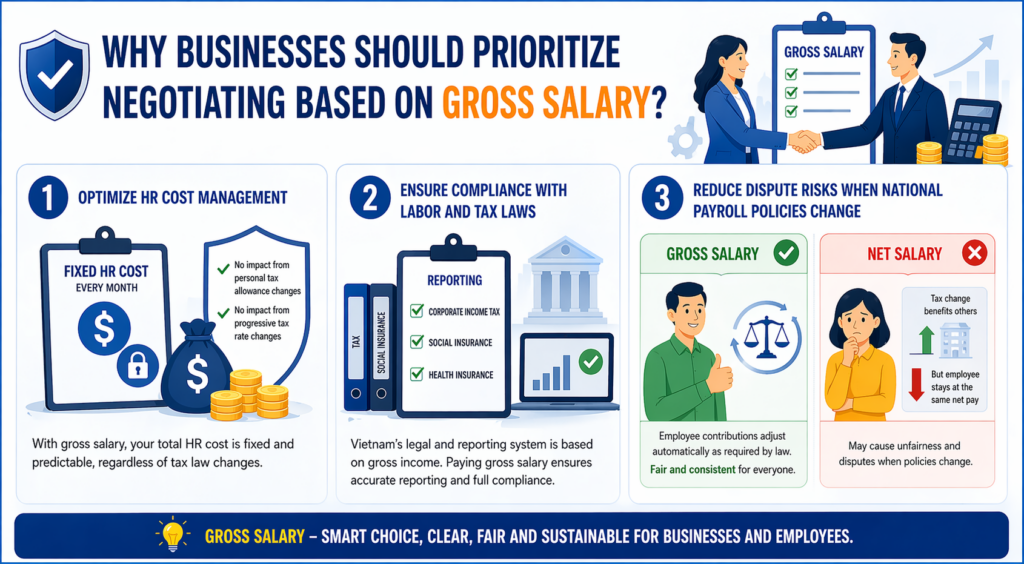
With a Gross salary agreement, personnel costs are fixed. The business knows exactly how much it must spend on that employee each month, regardless of whether the state changes family deductions or progressive tax brackets. In a Net salary arrangement, the business does not benefit when tax laws change in favor of the employee, but if taxes increase, the business must bear the extra cost to maintain the committed Net level.
2. Ensuring Compliance with Labor and Tax Laws
The Vietnamese legal system is built on a Gross salary foundation. Tax and insurance reports require data from total income. Paying Gross salaries helps the accounting and HR departments execute these reports accurately, minimizing errors during periodic tax or social insurance audits.
3. Mitigating Dispute Risks During Policy Changes
If national policies regarding the base salary or insurance contribution rates change, Gross salary earners naturally adjust their contributions according to the law. This creates fairness: as the law changes, all citizens comply equally. In contrast, Net salary employees may feel unfairness if they see peers at other companies receiving a take-home pay raise due to tax changes while their Net remains stagnant because the company “retained” the tax savings.
Key Considerations When Drafting Salary Clauses
The labor contract is the highest legal document; therefore, all Gross-Net agreements must be concretized in writing.
1. Clearly Define Insurance and Tax Responsibilities
In the contract, avoid vague terms like “Salary is 20 million.” HR should specify: “The monthly Gross Salary is 20,000,000 VND. The Employee is responsible for statutory insurance contributions and PIT in accordance with current regulations.” This protects the employer from future inquiries regarding why the received amount is lower than the contract figure.
2. Clauses Regarding Changes in Family Deductions
To avoid complications, the contract or appendix should include a clause stating: “The actual Net salary received may vary depending on the number of dependents the employee successfully registers with the tax authorities.” This places the responsibility of providing information on the employee and helps them understand that they proactively influence a portion of their take-home pay.
3. Commitments on Actual Pay in Net Salary Cases
If a business still chooses to pay a Net salary, clearly note: “The Company commits to a take-home pay after tax of … VND. The Company is responsible for paying all SI, HI, UI, and PIT based on the agreed salary.” Specifically, clarify the insurance contribution level (whether it is based on the Net salary or the minimum wage) to prevent future litigation regarding diminished insurance benefits.
Explaining Gross – Net salary to candidates is a communication art that requires a blend of technical expertise and tact. When HR performs this role well, the business not only recruits talent but also builds a foundation for labor relations based on transparency and mutual respect. Remember, a successful employment contract does not start with the highest number, but with the clearest understanding of those numbers.
To empower your business in overcoming HR management challenges and staying fully committed to your strategic goals, we provide specialized solutions:
- [RPO Services]: A comprehensive recruitment process outsourcing solution.
- [BPO Services]: Strategic outsourcing to streamline business processes and optimize operational costs.
For any inquiries, contact Wacontre Accounting Services via Hotline: (028) 3820 1213 or email [email protected] for prompt assistance. With a team of experienced professionals, Wacontre is committed to providing dedicated and efficient service. (For Japanese clients, please contact Hotline: (050) 5534 5505).