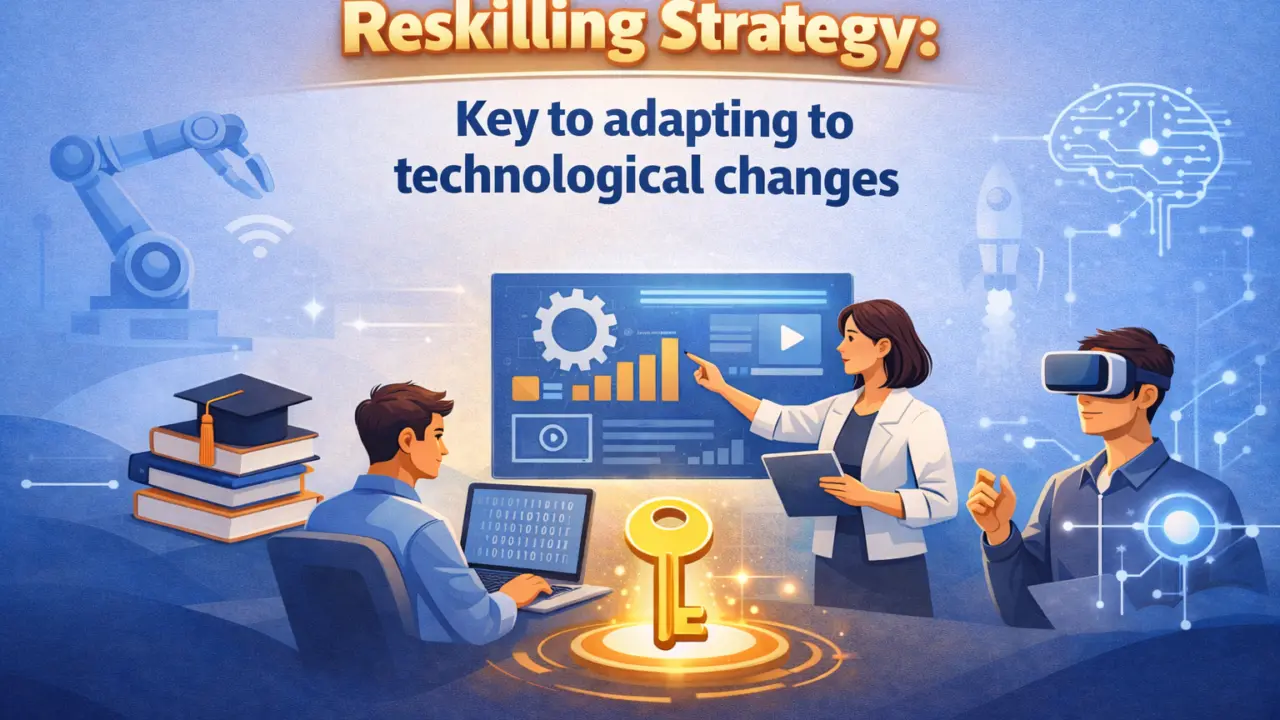
In the digital age, a robust reskilling strategy is essential for teams to adapt to technological changes, enhance upskilling, and maximize the potential of HR 4.0.
What is a Reskilling Strategy?
A Reskilling Strategy is far more than just opening skill-based classes; it is a systematic management process aimed at restructuring an organization’s core competencies. In the digital age, this strategy focuses on equipping employees with entirely new skill sets, fundamentally different in nature from their existing ones, to prepare them for new roles or to adapt to positions completely transformed by technology. In Vietnam, as Industry 4.0 permeates every factory and office, reskilling has become a strategic “lifeline” for the workforce in the face of the automation wave.
It is essential to distinguish between Reskilling and Upskilling. While upskilling helps an editor learn to use AI tools to write faster, reskilling might involve training that same editor to become a Content Data Analyst. This shift requires a long-term vision from leadership and a methodical execution roadmap—it cannot be achieved overnight. For Vietnamese enterprises, this strategy serves as a critical bridge to close the Digital Skill Gap compared to regional peers, creating a solid foundation for sustainable development.
A sound strategy must be based on market forecasting for the next 3–5 years. Businesses should not only train for technical tools but also focus on building an Agile mindset and a Self-learning culture. When employees realize that lifelong learning is a survival factor in the labor market, they will participate proactively with a growth-oriented spirit. This is an investment in intangible assets that yields the greatest tangible value for the longevity of the organization.
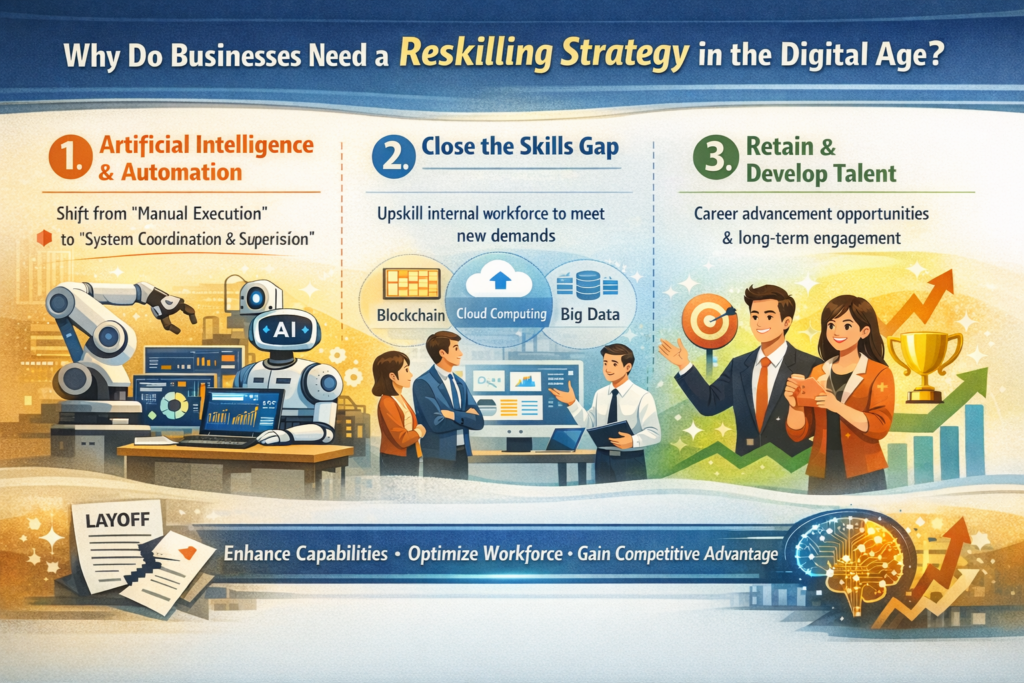
Why Do Businesses Need a Reskilling Strategy in the Digital Age?
1. The Explosion of Artificial Intelligence (AI) and Automation
Artificial Intelligence is redefining labor productivity by replacing repetitive tasks and processing large-scale data. Without a timely reskilling strategy, businesses will face labor surpluses in traditional stages, leading to the burden of severance costs and the loss of institutional knowledge. Reskilling allows employees to transition from “manual execution” to “coordinating and monitoring intelligent systems.” The combination of existing professional experience and AI mastery creates a synergistic power, helping businesses optimize profit margins and significantly increase competitive advantage.
2. Closing the Skill Gap in the Vietnamese Labor Market
The Vietnamese labor market faces a paradox: unemployment rates in some sectors remain high, yet technology and modern manufacturing firms are constantly “thirsty” for high-quality human resources (such as Blockchain, Cloud Computing, and Big Data specialists). The misalignment between traditional education and practical needs makes hiring “ready-to-work” personnel extremely costly and risky. Instead of entering a wage war to lure external talent, reskilling the internal workforce is a smarter approach. It helps businesses retain employees who already understand the company culture while bồi đắp (cultivating) new skills to fill current competency gaps.
3. Enhancing Talent Retention and Loyalty
For Gen Z and Millennials, opportunities for training and advancement are often more important than the starting salary. A transparent and methodical reskilling strategy is a testament to a business’s commitment to long-term investment in an employee’s career future. This creates an invisible psychological bond, helping employees feel respected and secure in their contributions despite rapid technological shifts. Reskilling, therefore, is not just a specialized HR task but also a powerful Employer Branding strategy, attracting candidates with a progressive spirit to the organization.
Effective Implementation Process for a Reskilling Strategy
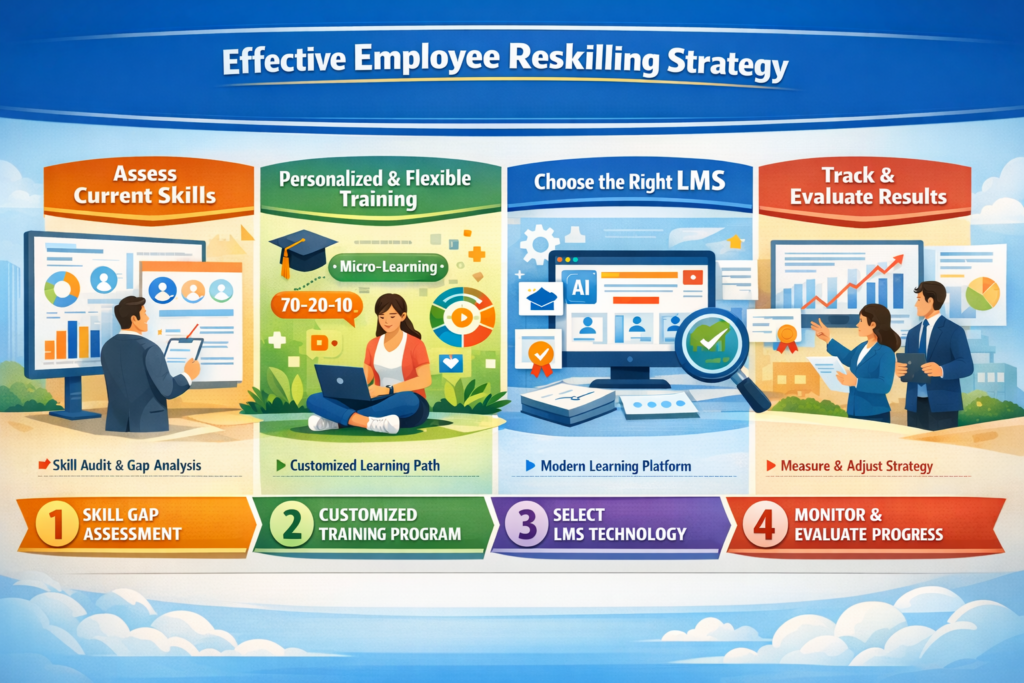
1. Assessing the Current Skill Gap
Every successful strategy begins with understanding the internal state. Businesses need to conduct an objective Skill Audit to identify current competencies versus the target competency map. Utilizing standardized assessments combined with HR data analytics tools helps leaders see the competency bottlenecks hindering the organization. From there, HR can accurately categorize personnel: those who need complete reskilling and those who only need upskilling, prioritizing resources for key positions capable of creating breakthroughs in business performance.
2. Designing Personalized and Flexible Training Programs
The “one-size-fits-all” training approach is completely obsolete. Modern strategies require a Personalized Learning Path based on the background and learning speed of each individual. Businesses should apply Micro-learning—breaking knowledge into 5–10 minute modules—to allow employees to learn flexibly on mobile devices without interrupting professional work. In particular, the 70-20-10 model must be strictly implemented: 70% learning from practical project experience, 20% from peer mentoring, and only 10% from theoretical courses, ensuring technology knowledge is absorbed naturally and sustainably.
3. Choosing a Learning Management System (LMS)
A Learning Management System (LMS) is the indispensable digital infrastructure for large-scale reskilling. A modern LMS is not just a document storage site; it must integrate AI to track learning behavior, thereby suggesting courses tailored to the “knowledge gaps” of each employee in real-time. In Vietnam, transitioning to cloud-based LMS platforms helps businesses save operational costs while creating a vibrant online interaction environment where employees can discuss, take tests, and receive certificates instantly, promoting a spirit of self-directed learning.
4. Monitoring, Evaluating, and Adjusting the Roadmap
Training is not an event, but a continuous cycle. After each stage, HR needs to measure the ROI (Return on Investment) through specific criteria: how much work performance has increased, how error rates have decreased, and the confidence level of employees when using new technology. Feedback from employees is live data for businesses to adjust training content to better fit the reality of production and business. A flexible reskilling strategy is one always ready to update the curriculum as soon as a new technology emerges or when the company’s business orientation shifts to adapt to the market.
Challenges in Implementing Skill Transformation for Employees
1. Psychological Barriers and Resistance to Change
Humans are naturally hesitant to step out of their comfort zones. For long-term employees, having to relearn abstract technological concepts from scratch can cause fear, anxiety about incompetence, or loss of status. Businesses need to perform skillful internal communication so that employees understand reskilling is an “insurance policy” for their careers, not a test for termination. Building an inclusive learning culture, where the effort to learn is celebrated over immediate results, will help the team be more confident in conquering new technological heights.
2. Investment Costs and Financial Resource Optimization
Building a methodical training roadmap requires a significant budget for software licenses, hiring experts, and the opportunity cost when employees pause production to learn. For Vietnamese SMEs, this is a difficult financial puzzle. However, compared to the cost of new recruitment and the time for new personnel to integrate, reskilling still brings higher economic efficiency in the long run. To optimize, businesses can leverage high-quality international Open Courseware (MOOCs) or seek training support packages from industry associations and government incentive policies.
3. Ensuring Practical Application After Training
A common mistake is providing too much pure theory, causing employees to fall into the “forgetting curve” immediately after the course. Businesses need to create sandboxes (safe testing environments) or directly assign small projects using the new skills right away. Tight coordination between the L&D (Learning & Development) department and production heads is the key to ensuring that knowledge does not stay on paper but turns into direct economic value. Training must go hand-in-hand with practice to consolidate the trust of both leadership and employees in the reskilling strategy.
Reskilling Trends in Vietnam for 2026
1. Data-driven Learning
By 2026, training will no longer be based on manager intuition. Data from HR management systems will point out exactly the skill gaps of each individual. Machine learning algorithms will forecast which skills will become “trends” in the future, helping Vietnamese businesses proactively prepare resources before the market becomes too scarce. Hyper-personalization of learning through data will shorten training time and maximize absorption efficiency.
2. Prioritizing Soft Skills Combined with Tech Skills
No matter how smart AI becomes, unique human skills such as critical thinking, creativity, and Emotional Intelligence (EQ) remain irreplaceable. Reskilling trends in 2026 will focus on the intersection of “High-tech” and “High-touch.” Employees will not only learn how to operate machines but also how to collaborate effectively between humans and machines, how to make decisions based on AI suggestions, and how to maintain professional ethics in a complex digital environment.
3. The Role of HR Outsourcing Services
Instead of building everything from scratch, many businesses will choose to partner with professional HR partners to implement the full reskilling process. These units provide international-standard LMS systems, networks of practical experts, and curricula always updated according to global trends. Outsourcing not only saves time and infrastructure investment but also ensures the quality of the output personnel meets international standards, allowing businesses to focus resources on core business activities.
A reskilling strategy is no longer a formal choice but has become a vital requirement for survival and breakthroughs. For Vietnamese enterprises, this is a golden opportunity to transform from a low-cost labor model to an intellectual and technology-intensive one. By persistently investing in people and building methodical learning roadmaps, businesses not only protect their most valuable resources but also create a solid launchpad for extraordinary growth in the future digital economy. Reskilling is the strongest commitment to the sustainable development of both businesses and the entire Vietnamese labor community.
To empower your business in overcoming HR management challenges and staying fully committed to your strategic goals, we provide specialized solutions:
- [RPO Services]: A comprehensive recruitment process outsourcing solution.
- [BPO Services]: Strategic outsourcing to streamline business processes and optimize operational costs.
For any inquiries, contact Wacontre Accounting Services via Hotline: (028) 3820 1213 or email [email protected] for prompt assistance. With a team of experienced professionals, Wacontre is committed to providing dedicated and efficient service. (For Japanese clients, please contact Hotline: (050) 5534 5505).