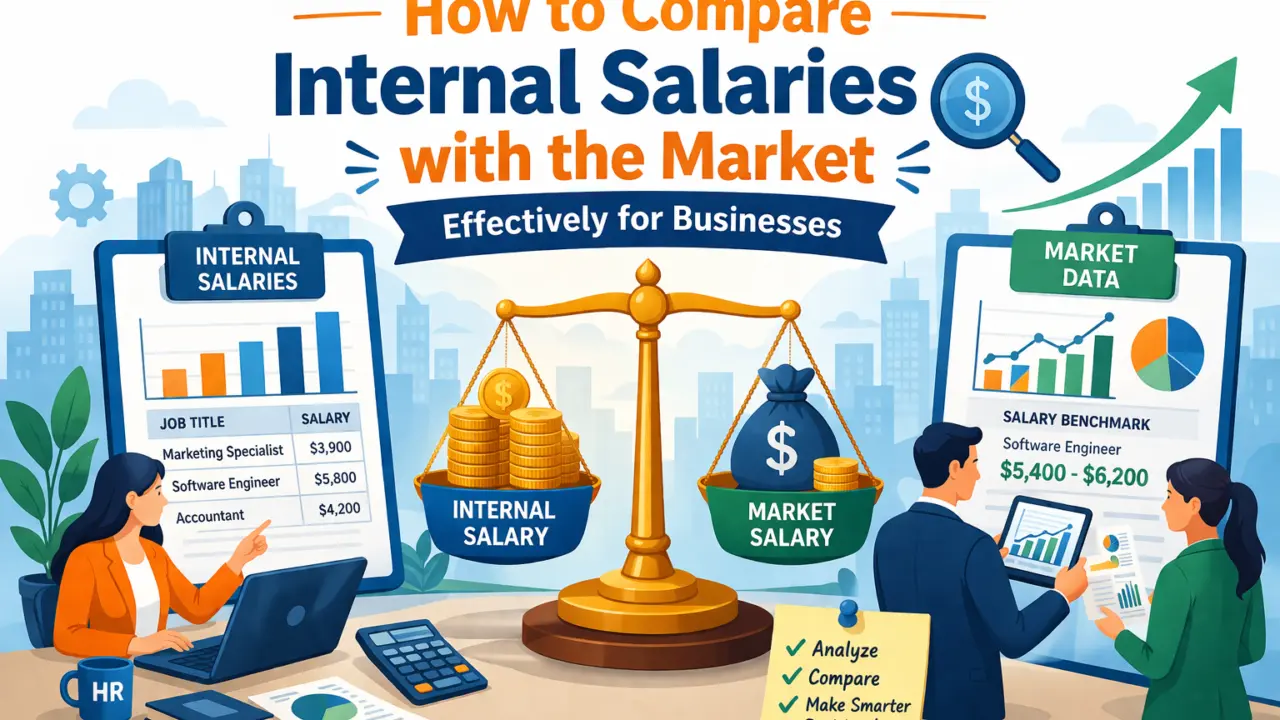
To prevent brain drain, comparing internal salaries with market rates is vital. This guide shows how to use market surveys to optimize HR compensation and talent retention.
Comparing internal salaries with market rates is not merely a way to check what competitors are paying; it is also an important HR management strategy that helps businesses retain top talent, strengthen hiring competitiveness, and optimize costs.
What is internal salary benchmarking against the market?
Internal salary benchmarking against the market is the process of collecting and analyzing compensation data on what other companies in the same industry or region are paying for equivalent roles. The goal is not only to find out how much competitors pay, but also to ensure external equity and properly position the company’s compensation policy in the labor market.
This process usually includes comparing internal salary ranges with data from professional salary survey reports. Based on that, a business can determine which strategy it wants to follow: leading the market to attract top talent, or staying around the market average while compensating with benefits, work environment, or development opportunities.
An important point is that benchmarking should not focus only on base salary. Companies need to look at the entire total compensation package, including base pay, bonuses, allowances, and non-financial benefits. If managers look only at base salary, they may misjudge the true competitiveness of the compensation policy.
The importance of salary benchmarking for Vietnamese businesses
1. Preventing brain drain
Vietnam’s labor market has been experiencing strong workforce movement, especially in industries such as IT, Finance, and Marketing. When employees realize that their salaries are significantly below the market average for the same workload, loyalty can quickly be replaced by dissatisfaction and the intention to leave.
Regular salary reviews help businesses identify “hot spots” in their compensation system before employees submit resignation letters. This allows HR teams to make timely adjustments to retain key contributors instead of reacting too late. A fair and competitive pay policy is always a crucial foundation for maintaining employee trust.
2. Strengthening recruitment competitiveness
Recruitment today is highly competitive. Talented candidates usually understand their market value very well. If a company’s job offer is below the market average and does not come with clear compensating advantages, the candidate is likely to reject it.
With accurate benchmark data, recruiters can negotiate confidently based on real numbers. This not only improves the ability to close candidates but also builds the image of a professional, transparent company that respects the value of labor. Recruitment competitiveness is not necessarily about paying the highest salary, but about paying fairly and appropriately.
3. Optimizing HR operating costs
Paying too little is not the only issue; paying too much without a clear basis is also a financial risk. Without salary benchmarking, a company may be overspending on positions for which the labor market offers an abundant supply at a lower cost.
Analyzing market data helps businesses build more scientific salary ranges and allocate their budget more intelligently. Managers can determine which roles need salary increases to retain talent and which roles can remain unchanged to protect profit margins. The ultimate goal is to balance talent retention with financial health.
Steps to benchmark internal salaries accurately against the market
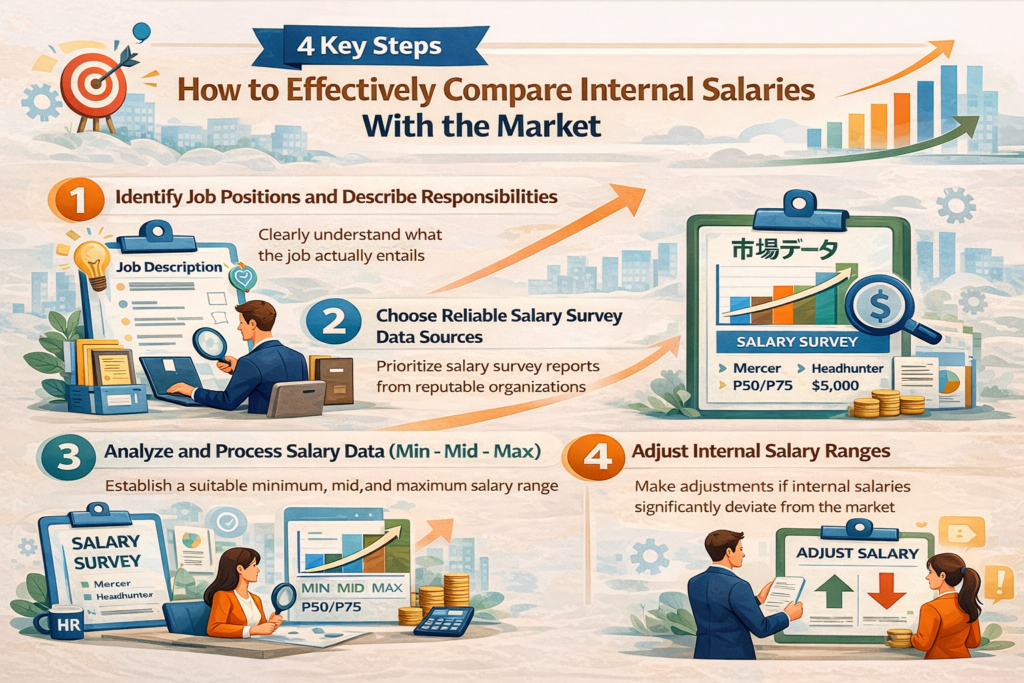
1. Define the role and job responsibilities (Job Matching)
The first step is not to look for salary figures, but to clearly understand what the job actually involves. Many companies make the mistake of comparing roles based only on job titles, even though the same title at different companies may vary greatly in responsibility, authority, and impact.
Therefore, HR should compare roles based on job descriptions, job level, and core competency requirements. Only when roles are placed on the same footing in terms of responsibility and job value does the comparison become truly meaningful.
2. Choose reliable salary survey data sources
To achieve objective results, businesses should not rely solely on job postings online or word-of-mouth information. Instead, they should prioritize salary survey reports from reputable sources such as Mercer, Talentnet, or major headhunting firms. These sources typically provide verified data collected from many companies in the same industry.
In addition, businesses may refer to data from large recruitment platforms or conduct closed-group surveys with companies in the same sector. Regardless of the source, good data should meet three criteria: broad enough, deep enough, and current enough.
3. Analyze and process salary data (Min – Mid – Max)
Once the data is collected, the next step is to analyze it and apply it to the internal pay system. Market data is often presented in percentiles such as P50 or P75. A business needs to determine where it wants to position itself in the market in order to choose an appropriate midpoint for its salary range.
From the midpoint, HR can build minimum, midpoint, and maximum salary ranges for each job grade. This approach creates room for salary increases based on tenure and performance while maintaining a stable compensation structure. At the same time, outlier values should be removed to ensure a fairer salary reference framework.
4. Adjust internal salary ranges based on the analysis
After benchmarking, businesses will identify groups being paid below the market or above the current market level. For employees paid below market, there should be an immediate or phased adjustment plan to reduce the risk of turnover.
For employees whose salaries are already above market, companies should avoid sudden salary cuts because they can trigger negative reactions. Instead, they may pause base salary increases and shift toward performance-based bonuses or advancement opportunities tied to greater responsibilities. Communication around salary adjustments should also be transparent and tactful so employees feel respected.
Mistakes to avoid when conducting salary benchmarking
1. Focusing only on base salary and ignoring total compensation
This is a very common mistake. Base salary is only one part of the compensation picture. Many companies may offer a modest base salary but provide large bonuses, strong insurance coverage, financial support, or other valuable benefits.
Therefore, HR should evaluate both Total Cash Compensation and Total Rewards, including financial and non-financial benefits. In many cases, factors such as flexible working arrangements, a positive environment, or learning opportunities are the real reasons employees stay long term.
2. Making mismatched comparisons across very different industries
Each industry has its own characteristics, pressures, and profit margins, so its ability to pay is also different. Comparing salaries for similar roles across industries with fundamentally different conditions can produce misleading data.
Businesses need to identify the exact labor market in which they are directly competing. If they choose the wrong comparison group, their compensation strategy can easily become misaligned and ineffective.
3. Failing to update data regularly as the market changes
A salary benchmark may be useful today but become outdated very quickly. In Vietnam, the labor market changes rapidly due to inflation, regional minimum wage adjustments, and the entry of new companies.
For that reason, businesses should review salaries at least once a year, or sooner when major changes occur. Continuous updates help organizations stay proactive instead of reacting only when turnover begins to rise.
Talent retention strategies beyond salary
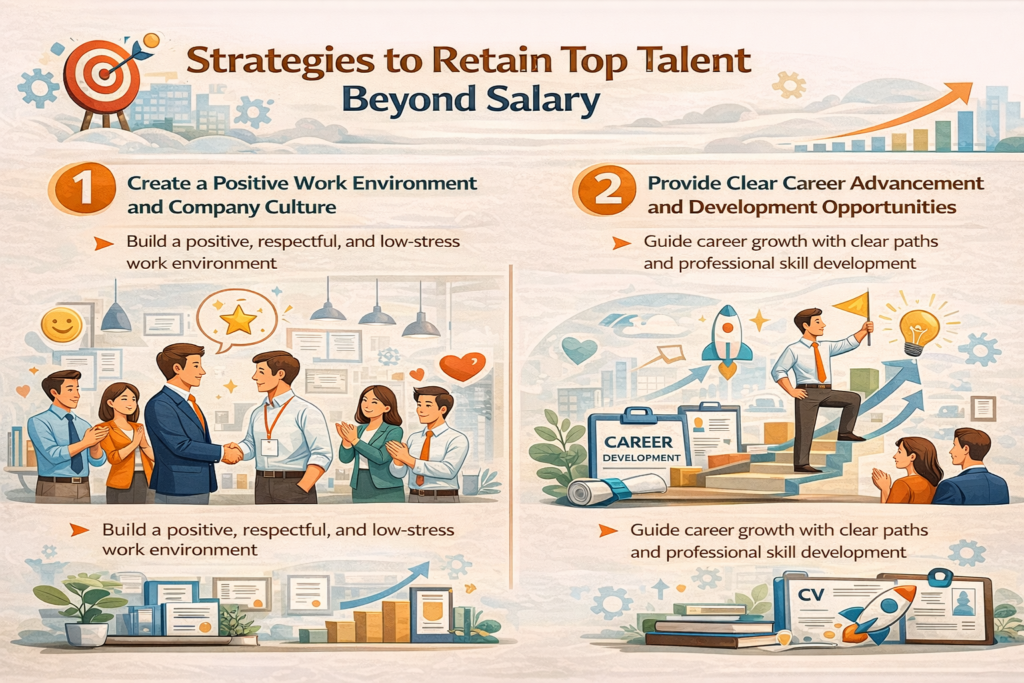
1. Building a strong work environment and company culture
Salary is important, but it is not everything. Many talented employees are willing to leave a higher-paying job for a healthier environment with less toxicity and more respect. Company culture is what creates long-term commitment once pay has already reached a competitive level.
Culture is not defined by slogans on the wall, but by how leaders treat employees every day. Timely recognition, a listening mindset, and meaningful team connection can create tremendous retention value without necessarily requiring large costs.
2. Clear career paths and development opportunities
A major cause of brain drain is that employees do not see a future in their current company. That is why businesses need to create clear career paths so employees understand what they need to do to move to higher positions and receive better compensation.
At the same time, investing in professional and soft skills training is also a valuable form of compensation. When companies help employees grow, employees are more likely to stay because they feel that their personal development is tied to the growth of the organization.
Conclusion
Comparing internal salaries with market rates is an ongoing process that requires serious investment in data, budget, and management thinking. Businesses that know how to use data to build fair and competitive compensation policies will gain a major advantage in the race to retain talent.
However, compensation is only a necessary condition. A positive work environment, a suitable culture, and clear development opportunities are the sufficient conditions for reducing brain drain in a sustainable way. Businesses should begin reviewing their salary systems now to protect their most important asset: people.
To empower your business in overcoming HR management challenges and staying fully committed to your strategic goals, we provide specialized solutions:
- [RPO Services]: A comprehensive recruitment process outsourcing solution.
- [BPO Services]: Strategic outsourcing to streamline business processes and optimize operational costs.
For any inquiries, contact Wacontre Accounting Services via Hotline: (028) 3820 1213 or email [email protected] for prompt assistance. With a team of experienced professionals, Wacontre is committed to providing dedicated and efficient service. (For Japanese clients, please contact Hotline: (050) 5534 5505).