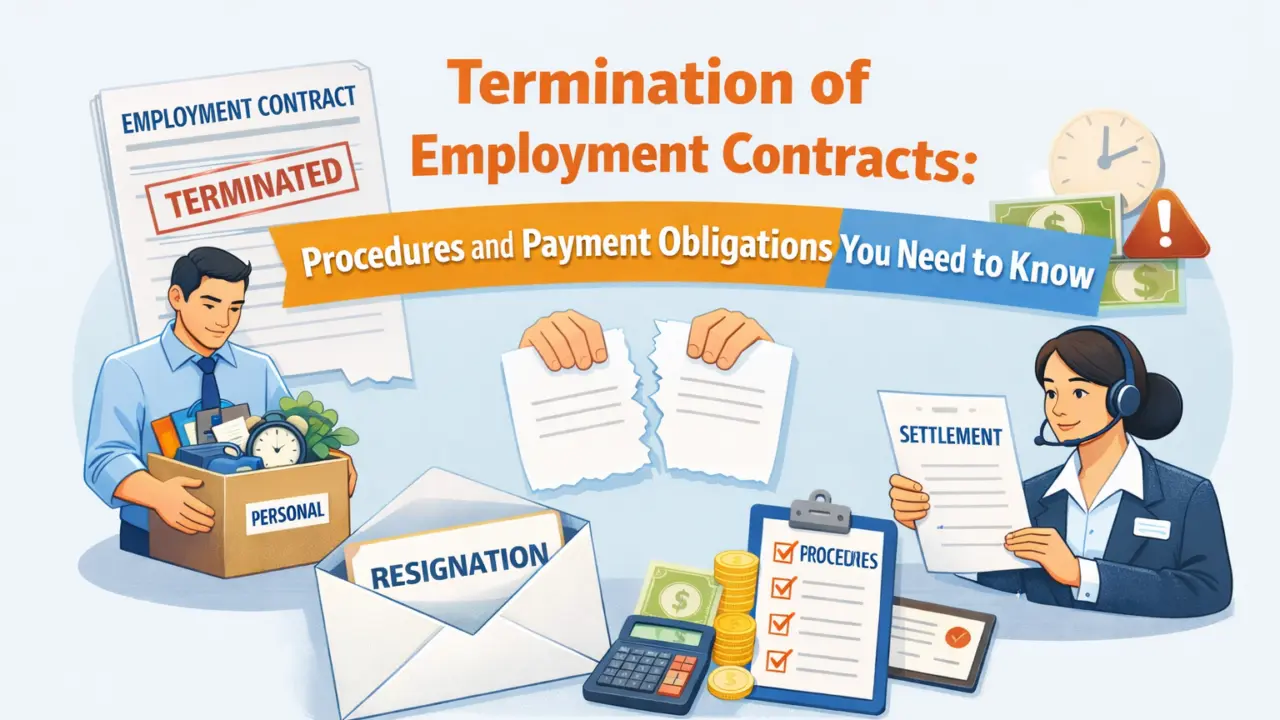
Understanding the procedures and payment obligations for employees when terminating a labor contract is essential for compliance. We cover severance pay and wage settlement regulations under Vietnam’s Labor Code to protect your business.
What are the Procedures and Payment Obligations for Employee Termination?
In human resource management, terminating a labor contract is not merely about ending a working relationship; it is a complex legal process. Procedures and payment obligations for employees upon labor contract termination encompass all administrative steps, documentation, and financial settlements that a business must follow under Vietnam’s 2019 Labor Code. Ensuring these steps are completed properly guarantees that employees receive their full entitlements for their period of service, while simultaneously helping the business mitigate unnecessary legal risks.
Understanding these concepts provides both employers and employees with transparency regarding their rights and duties. Payment obligations typically include wages, allowances such as severance pay or job-loss allowance, and compensation (if applicable). Administrative procedures include prior notice, issuing termination decisions, and finalizing social insurance obligations. Thorough preparation by the HR department ensures a smooth and professional transition.
Documentation and Standard Procedures for Termination
To ensure the termination process complies with regulations, businesses must adhere to a strict workflow from notification to document completion. Any error in these steps can lead to prolonged labor disputes and damage the employer’s reputation.
1. Advance Notice According to Statutory Timelines
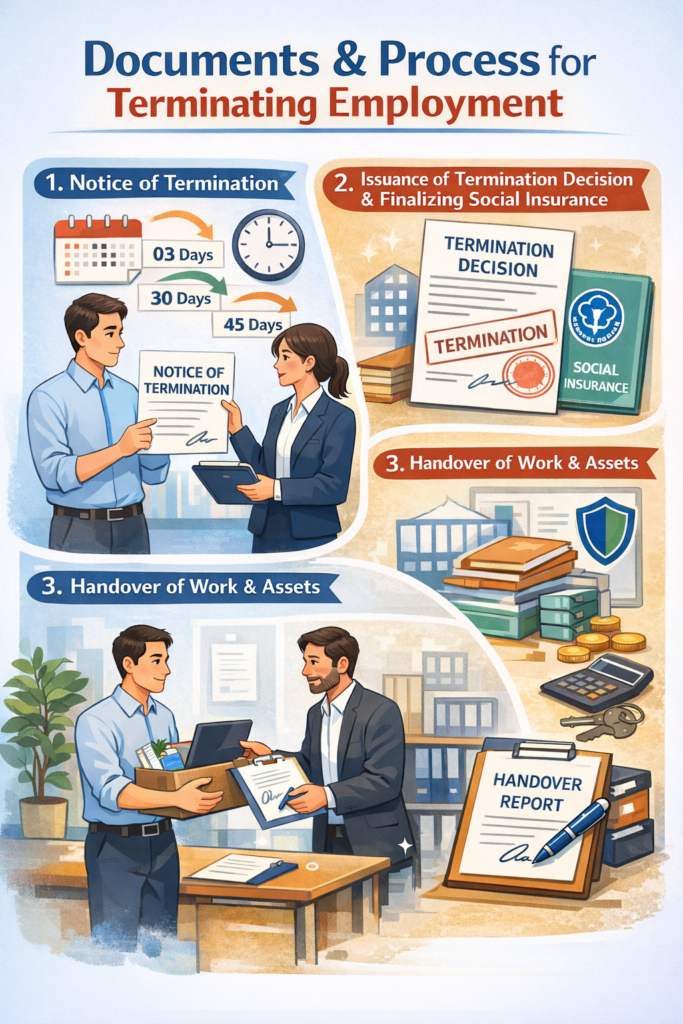
One of the most critical points in the current Labor Code is the notice period. Depending on the type of labor contract (fixed-term or indefinite-term), the employer or employee must notify the other party within a specific timeframe. Typically, this ranges from 3 working days for special cases to 30 or 45 days for long-term contracts. Compliance with the notice period is not only a legal obligation but also demonstrates mutual respect, allowing the business sufficient time to find a replacement and stabilize operations.
2. Issuing Termination Decisions and Finalizing Social Insurance
Once the notice period expires, the business must officially issue a Decision on Labor Contract Termination. This document serves as vital legal documentation for the employee to perform subsequent procedures, such as registering for unemployment insurance. Simultaneously, the employer is responsible for cooperating with the Social Insurance agency to close the social insurance book and return all relevant original documents held by the company. This process should be executed promptly as employees have a limited window (usually 3 months) to apply for unemployment benefits.
3. Completion of Property and Work Handover
Before leaving their position, employees are responsible for handing over all assets, tools, equipment, and related documents/data to their successor or direct manager. Businesses should prepare a handover record signed by all parties to avoid future claims. Full handover is a prerequisite for the accounting department to finalize the last payments. Clarity in this stage maintains a professional working environment and protects the company’s intellectual property.
Detailed Financial Obligations of the Employer
When a labor contract ends, the financial aspect is always the most sensitive issue. Businesses need to calculate payments accurately to ensure fairness and legal compliance.
1. Payment of Outstanding Wages and Allowances
The business is responsible for paying full wages for the actual days worked by the employee up to the date of termination. In addition to base salary, allowances such as responsibility allowance, regional allowance, or committed bonuses must be settled. These payments are usually made via bank transfer or cash as previously agreed. A detailed payslip showing income and deductions (Personal Income Tax, Social Insurance) should be provided for the employee to review before payment.
2. Calculation and Conditions for Severance Pay
Severance pay is a sum paid to employees who have worked continuously for 12 months or more when the contract is terminated legally. Each year of service entitles the employee to half a month’s salary. However, the period used to calculate severance pay is the total actual working time minus the period covered by unemployment insurance. The wage used for calculation is the average salary of the 6 consecutive months preceding the termination.
3. Distinguishing Severance Pay and Job-loss Allowance
Many businesses and employees confuse these two types of allowances. Job-loss allowance applies in cases of structural or technological changes, or for economic reasons leading to layoffs. Unlike severance pay, the job-loss allowance is 1 month’s salary for each year of work, with a minimum of 2 months’ salary. Identifying the correct reason for termination is key to applying the right allowance and avoiding financial discrepancies or complaints.
4. Compensation for Unused Annual Leave
According to regulations, employees who have not taken or fully used their annual leave upon termination are entitled to cash payment for those days. This is a direct benefit that businesses sometimes overlook. The amount is calculated based on the average salary of the preceding months. Businesses should proactively review attendance records and leave logs to accurately calculate this payment for the employee before their departure.
Deadlines and Post-termination Responsibilities
Timing is a key factor in fulfilling obligations after contract termination. The law clearly defines milestones to protect employees, who are often in a weaker bargaining position.
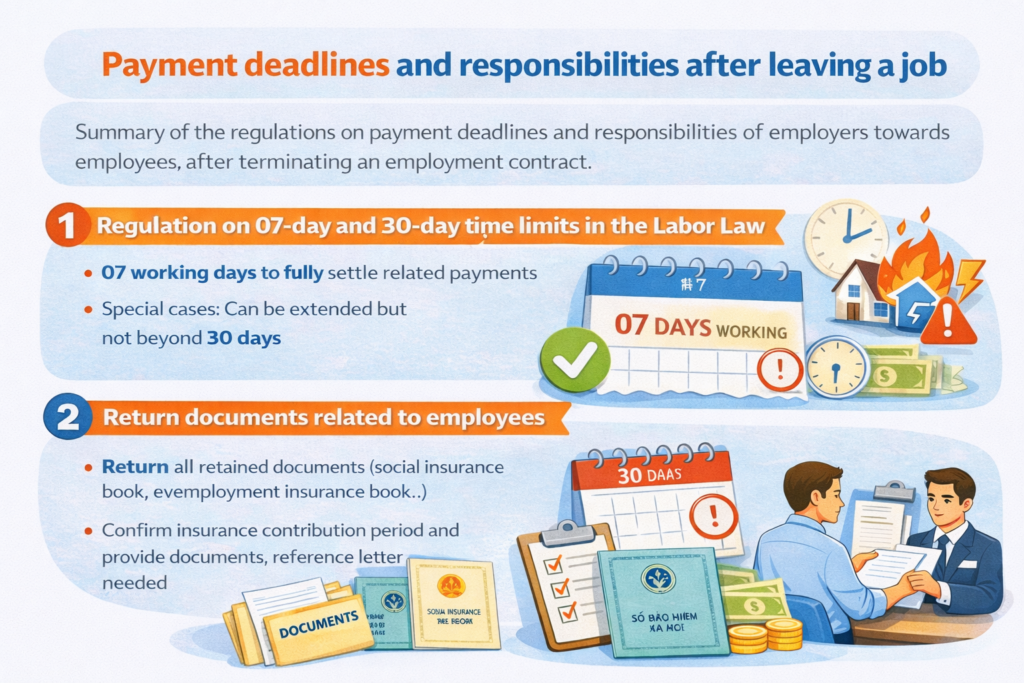
1. The 7-day and 30-day Rules
Within 7 working days from the date of termination, both parties are responsible for settling all payments related to each other’s interests. In special cases such as business dissolution, natural disasters, or fires, this period may be extended but must not exceed 30 days. Adhering to this deadline is a testament to corporate professionalism. Delays may lead to complaints filed with local labor authorities.
2. Responsibility to Return Documents to Employees
Beyond monetary obligations, businesses must complete the certification of social and unemployment insurance contributions and return these along with other original documents. Additionally, providing work experience certificates or recommendation letters upon request helps the employee’s future job search and builds a professional employer brand image.
Conclusion
Fulfilling all procedures and payment obligations for employees upon labor contract termination is not just about legal compliance but is a core part of corporate culture. A professional, transparent, and ethical process allows businesses to end employment relationships on good terms, building a solid reputation in the marketplace.
For inquiries, contact Wacontre Accounting Services via Hotline: (028) 3820 1213 or email [email protected] for prompt assistance. With a team of experienced professionals, Wacontre is committed to providing dedicated and efficient service. (For Japanese clients, please contact Hotline: (050) 5534 5505).