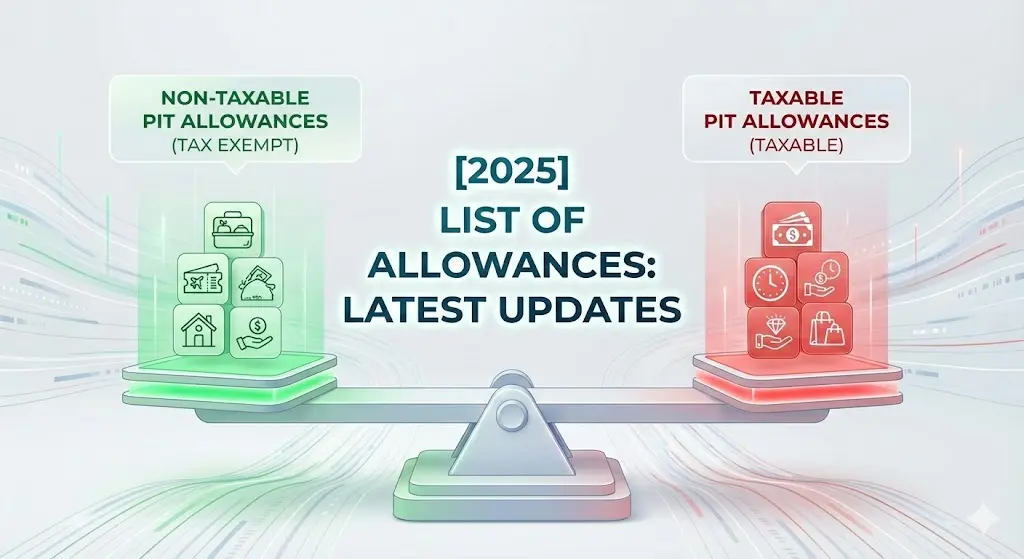
A comprehensive guide to taxable and non-taxable allowances for Personal Income Tax (PIT) in Vietnam for 2025. Learn how to properly handle lunch, telephone, attire, and transportation allowances. Distinguishing between taxable and non-taxable allowances is a common challenge for HR and accounting professionals. Which allowances are exempt, and what are the caps? This article provides a detailed checklist and latest regulations to ensure compliance and optimize tax efficiency.
Taxable and Non-Taxable Allowances for Personal Income Tax: 2025 Update
Determining which allowances are taxable and which are exempt for PIT is challenging for accountants and employees. Lunch allowances, gasoline, telephone—which ones are tax-free, which are taxable, and what are the limits? This guide provides a detailed summary table and latest legal regulations for 2025 to help businesses comply with the law and optimize employee compensation.
General Principle for Salary and Wage Taxation
According to Vietnam’s Personal Income Tax Law and Circular 111/2013/TT-BTC (amended by Circular 92/2015/TT-BTC), taxable income from salaries includes all employee income from employers: salaries, wages, and allowances/subsidies, except those specifically exempted by law.
Key Principle: All money paid by a business to an employee is taxable, EXCEPT for those specifically designated by law as exempt or excluded from taxable income.
Group 1: Non-Taxable (Exempt) Allowances
These allowances reduce employee tax obligations. Businesses should maximize these while strictly following prescribed limits.
1. Lunch and Mid-Shift Meal Allowance
Tax treatment depends on payment form:
- In-Kind (Meals or Meal Coupons): 100% PIT exempt, no limit on expenditure.
- Cash Payment: Tax-exempt up to 730,000 VND per person per month. Any excess is taxable.
- Example: A company provides 1,000,000 VND monthly lunch allowance. 730,000 VND is tax-exempt; 270,000 VND is added to taxable income.
2. Telephone, Stationery, and Per Diem Allowances
Per regulations, flat-rate expenditures for stationery, per diem, and telephone are deductible for PIT calculations if the flat rate complies with the business’s established regulations.
- Condition: The flat rate must be clearly specified in the company’s Financial Regulations or Salary and Bonus Regulations.
- Note: If actual costs are reimbursed with invoices in the company’s name, they are not considered employee income and are naturally not subject to PIT.
3. Attire and Uniform Allowance
Like lunch, treatment depends on payment form:
- In-Kind (Uniforms or Protective Clothing): 100% tax-exempt.
- Cash Payment: Tax-exempt up to 5,000,000 VND per person per year. Amounts exceeding 5 million VND are taxable.
- Example: In 2025, the company pays 6,000,000 VND in cash for attire. 5,000,000 VND is tax-exempt; 1,000,000 VND is taxable.
4. Overtime and Night Work Income
The portion of salary or wages paid above standard rates for night or overtime work is exempt from PIT.
- Calculation: Exempt amount = (Overtime wage) – (Normal hourly wage).
- Example: Normal work: 50,000 VND/hour. Overtime (150%): 75,000 VND/hour.
- Exempt amount = 75,000 – 50,000 = 25,000 VND/hour.
- The standard 50,000 VND remains subject to tax.
5. Other Specific Allowances
Industry-specific and state-regulated allowances, including:
- Toxic and hazardous allowances.
- Attraction and regional allowances.
- One-time relocation allowances.
- Occupational accident and disease allowances.

Group 2: Taxable Allowances
These are allowances often mistakenly considered exempt but are actually taxable according to tax authority regulations.
1. Commuting and Fixed Monthly Gasoline Allowance
It is important to distinguish two concepts:
- Business Travel Per Diem (Tax Exempt): Gasoline reimbursement for business-related travel (client meetings, provincial trips).
- Fixed Monthly Commuting Allowance (Taxable): Support for employee travel between home and workplace. This is salary/wage in nature and MUST be subject to PIT.
- Note: Some local tax authorities may grant exemption if clearly designated as a “flat-rate travel expense” for positions requiring frequent travel (Sales, delivery). Consult your local tax authority.
2. Housing Allowance (Rent Paid by Employer)
This allowance uses a unique tax calculation. Rent paid by the employer on behalf of the employee is included in taxable income at the actual amount but capped at 15% of total taxable income (excluding rent).
- Calculation Method:
- Step 1: Calculate total taxable income excluding housing.
- Step 2: Compare 15% of that total with actual rent paid. Use the lower amount for tax purposes.
- Example: Salary 20 million VND; company pays 5 million VND rent.
- 15% of 20 million = 3 million VND.
- Compare: 3 million < 5 million. Only 3 million VND is included in taxable income. (Employee receives 2 million VND tax-free).
3. Responsibility, Position, and Seniority Allowances
All allowances related to job titles and positions—responsibility allowances, position allowances, seniority allowances—are salary/wage income and are fully subject to PIT.
4. Bonuses, Holiday Gifts, and Other Cash Support
- Productivity bonuses, sales commissions, 13th-month salary.
- Tet holiday money, birthday allowances, wedding gifts (except welfare-fund payments complying with specific regulations—these may be exempt if modest and from welfare funds, but many businesses tax them when paid through payroll to be safe).

Essential Conditions for Valid Tax Exemption
To prevent disallowance and tax arrears from tax authorities regarding exempt allowances, businesses must meet two critical conditions:
1. Written Regulations
Allowances, expenditure limits, and eligibility must be clearly stated in:
- Labor Contract.
- Collective Labor Agreement.
- Company Financial Regulations.
2. Complete Documentation
- For flat-rate allowances (telephone, business travel, lunch): Regulations and signed receipt lists are required.
- For actual reimbursements (uniforms, meal provision): Valid invoices and supporting vouchers are required.
2025 Common Allowances Quick Reference
Quick lookup for the most common allowances:
- Lunch (Cash): Exempt up to 730,000 VND/month.
- Lunch (In-Kind): 100% Exempt.
- Attire (Cash): Exempt up to 5,000,000 VND/year.
- Telephone (Flat Rate): Tax Exempt (per company regulations).
- Overtime Portion: Exempt for amount exceeding normal hourly wage.
- Commuting Gasoline (Fixed): Taxable.
- Housing (Employer-Paid Rent): Taxable (capped at 15% of income).
- Position/Responsibility Allowance: Taxable.
- Hazardous Work Allowance: Tax Exempt.
Designing a strategic payroll structure that maximizes non-taxable allowances (lunch, attire, telephone) is a legal and effective way to increase actual employee income without increasing employer costs. This guide has provided a comprehensive overview of 2025 allowance regulations to ensure accurate payroll accounting.
For inquiries, contact Wacontre Accounting Services at Hotline: (028) 3820 1213 or email [email protected] for prompt assistance. Wacontre’s team of experienced professionals provides dedicated and efficient service. (Japanese clients, contact Hotline: (050) 5534 5505).