
Linking Compensation to Performance: Applying OKRs and KPIs in Salary Policy is critical for transparency. Learn how to apply OKRs in compensation and KPIs in compensation to build a robust performance-based salary policy using the 3P compensation model.
What Is Linking Compensation to Performance With OKRs and KPIs?
This represents a fundamental shift in management mindset: from Time-based Pay (measuring hours worked) to Value-based Pay (rewarding results delivered).
More than a calculation method, a performance-based salary policy transforms organizational culture:
- Fixed Pay: Provides financial security and basic living standards.
- Variable Pay: Varies based on KPI achievement or OKR commitment.
Win-Win Model Benefits:
- For Employees: Clear income potential visibility. Greater effort yields greater rewards.
- For Employers: Converts payroll from fixed expense into profitable investment. Salary increases align with efficiency improvements.
Important Note: This is not about cutting base salary in favor of commission. A sound policy must first ensure financial stability before incentivizing performance through KPIs and OKRs.
The Foundation: The 3P Compensation Model
To effectively apply KPIs in compensation, you need a solid framework. The 3P Compensation Model provides this foundation.
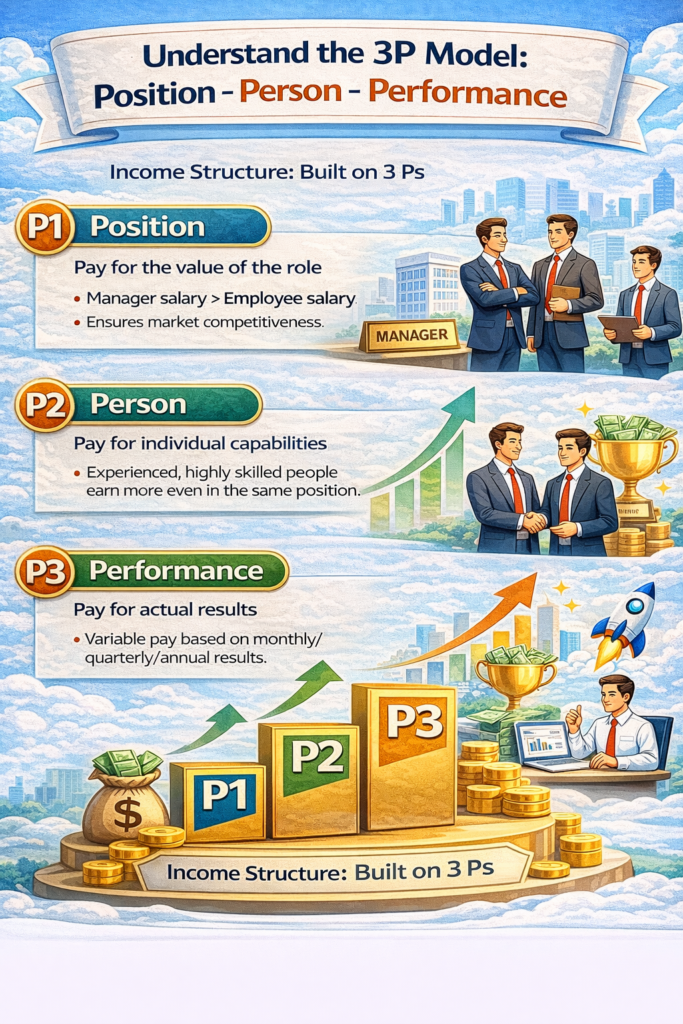
1. Understanding 3P: Position, Person, Performance
Income consists of three components:
- P1 – Position: Pay for job title value (e.g., manager salary exceeds staff salary). Ensures market competitiveness.
- P2 – Person: Pay for individual competency. Employees with greater experience or skills receive higher P2 pay, even in identical positions.
- P3 – Performance: The focus of this article. Variable pay based on actual results (monthly, quarterly, or yearly).
Without P3, organizations risk cultivating complacency where employees simply “show up” waiting for payday.
2. The Role of P3 in Ensuring Fairness
P3 acts as an impartial arbiter:
- Eliminates bias from personal relationships or seniority-based entitlements.
- Fairly addresses the question: “How much did your contribution achieve versus the target this period?”
With P3, payroll becomes a performance report. Employees understand their compensation and recognize what they must accomplish to earn more.
3. Why Shift to Performance-Based Pay?
- Attracting Emerging Talent: Today’s workforce values challenges and wants compensation reflecting current ability, not tenure.
- Business Agility: Revenue up means P3 up (employees benefit). Revenue down means P3 down (company expenses decrease). This self-regulating mechanism improves resilience.
Strategy for Applying KPIs in Compensation (Key Performance Indicators)
KPIs measure operational stability and efficiency. Applying KPIs in compensation works best for Sales and Operations departments.
1. Converting KPI Percentage Into Actual Income
Two common methods calculate incentives:
- Linear Method:
- Achieve 80% KPI = Receive 80% incentive.
- Achieve 110% KPI = Receive 110% incentive.
- Advantages: Simple and transparent.
- Step Method:
- Below 80% KPI: 0% incentive (Penalizes underperformance).
- 100% to 120%: Receive 120% incentive.
- Above 120%: Receive 150% incentive.
- Advantages: Creates strong motivation to exceed threshold targets.
2. Setting KPI Weighting
Not all activities have equal importance. Use weighting to direct employee focus:
- Financial/Core Results: 50-70% (e.g., Revenue, Production Volume).
- Process/Administrative Indicators: 20-30% (e.g., Reports, Training Completion).
This communicates clearly: “The company rewards most heavily for the most critical results.”
3. Risks of Overrelying on KPIs
- Narrow Focus: Employees focus exclusively on assigned KPIs, reluctant to help colleagues.
- Gaming Metrics: Sacrificing long-term value (e.g., pressuring clients) to hit short-term numbers.
- Solution: Balance KPIs with qualitative assessments of conduct and cultural contribution.
The Art of Applying OKRs in Compensation (Objectives and Key Results)
Applying OKRs in compensation is more complex because OKRs pursue Innovation rather than predictable execution.
1. Core Difference: OKR Versus KPI
- KPI: Targets Commitment. Achieving 100% is the expectation.
- OKR: Targets Ambition. Achieving 60-70% of a bold goal constitutes excellent performance.
Applying KPI payment formulas to OKRs (reducing pay for missing 100% completion) stifles innovation. Employees adopt “safe” low targets rather than pursuing ambitious goals.
2. Golden Rule: Do Not Link OKRs Directly to Monthly Salary
Never use OKR completion percentage to calculate monthly compensation. Instead, link indirectly:
- Use OKRs as input for Salary Reviews (every 6 months).
- Assess based on: “How ambitious was the goal?”, “How thoughtful was the problem-solving effort?”, “What tangible Impact resulted?”
3. Using OKRs for Spot Bonuses and Career Advancement
- Spot Bonus: When teams achieve a significant Key Result (e.g., product launch ahead of schedule), provide immediate recognition and reward.
- Career Advancement: Consistent high-quality OKR delivery is concrete evidence for identifying future leaders.
Implementation Roadmap
For successful implementation without disruption, follow this roadmap:
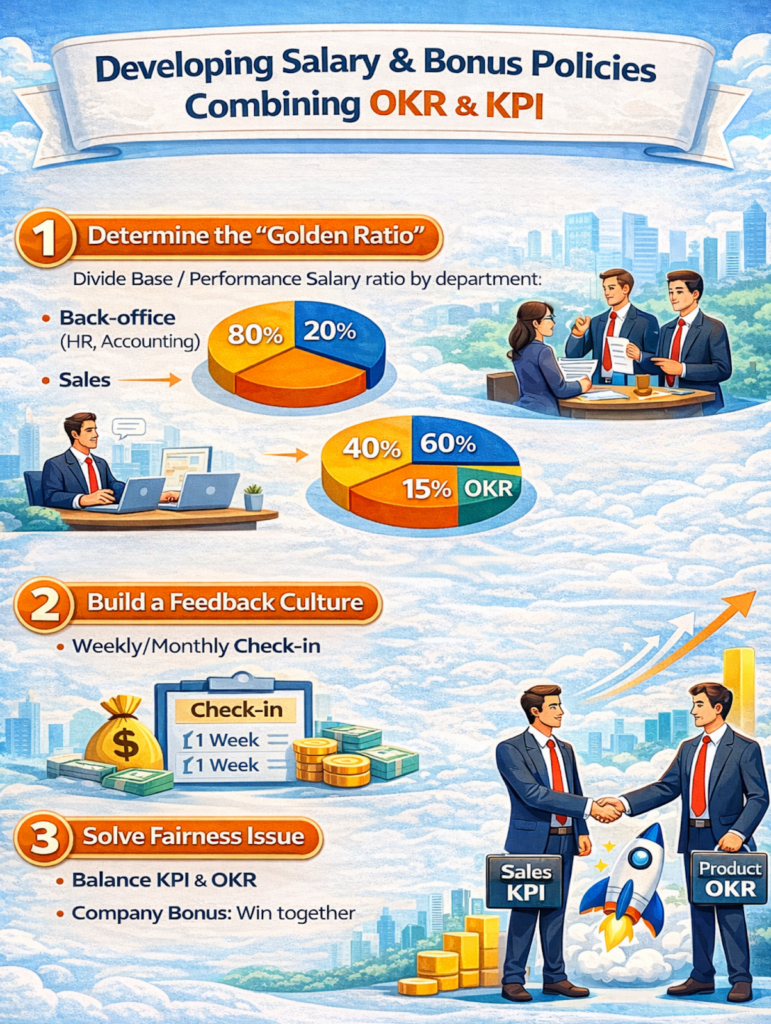
1. Determine the “Golden Ratio” (Compensation Structure)
Split Fixed Pay and Performance Pay by department:
- Back-Office (HR, Finance): 80% Fixed – 20% Performance (Requires stability).
- Sales: 40% Fixed – 60% Performance (Requires drive and accountability).
- Creative/Technical: 70% Fixed – 15% Core KPI – 15% OKR Project Bonus.
2. Build a Feedback Culture
Do not wait until year-end for performance discussion. Establish regular Check-ins (weekly or monthly):
- Apply the CFRs Model (Conversation – Feedback – Recognition).
- Timely recognition has greater impact than large, delayed bonuses.
3. Solving the Fairness Challenge
How can you prevent tension between Sales teams (KPI-based) and Product teams (OKR-based)?
- Parity: Total annual compensation at the same level must be equivalent if both perform excellently.
- Company Performance Bonus: When the company succeeds, everyone shares rewards. This breaks down department silos and aligns everyone toward common success.
Conclusion
Linking Compensation to Performance is a transformational initiative, not a quick adjustment.
Success requires:
- A strong 3P Foundation.
- The rigor of KPIs for operational excellence.
- The visionary approach of OKRs for strategic growth.
Companies across Vietnam can build high-performing teams by converting compensation into meaningful recognition and earned rewards.
For questions or support, contact Wacontre Accounting Services at (028) 3820 1213 or [email protected]. Our experienced professionals deliver comprehensive, efficient service. (Japanese-speaking clients: (050) 5534 5505)