

In a competitive landscape, conducting an effective salary survey is a critical step. It helps businesses define market position, optimize compensation strategy, and perform accurate salary benchmarking to ensure successful talent retention.
- What Is an Effective Salary Survey?
- The Importance of Defining Market Position Through Compensation
- Conclusion
- Conclusion
- Conclusion
- Mistakes to Avoid When Benchmarking and Positioning
- Conclusion
- Mistakes to Avoid When Benchmarking and Positioning
- Conclusion
- Mistakes to Avoid When Benchmarking and Positioning
- Conclusion
- Mistakes to Avoid When Benchmarking and Positioning
- Conclusion
- Mistakes to Avoid When Benchmarking and Positioning
- Conclusion
- Mistakes to Avoid When Benchmarking and Positioning
- Conclusion
- Mistakes to Avoid When Benchmarking and Positioning
- Conclusion
- 5-Step Process for Conducting an Effective Salary Survey
- Mistakes to Avoid When Benchmarking and Positioning
- Conclusion
- 5-Step Process for Conducting an Effective Salary Survey
- Mistakes to Avoid When Benchmarking and Positioning
- Conclusion
- 5-Step Process for Conducting an Effective Salary Survey
- Mistakes to Avoid When Benchmarking and Positioning
- Conclusion
- Common Market Salary Positioning Strategies
- 5-Step Process for Conducting an Effective Salary Survey
- Mistakes to Avoid When Benchmarking and Positioning
- Conclusion
- Common Market Salary Positioning Strategies
- 5-Step Process for Conducting an Effective Salary Survey
- Mistakes to Avoid When Benchmarking and Positioning
- Conclusion
What Is an Effective Salary Survey?
In modern human resource management, an effective salary survey is more than collecting competitor salary figures or industry averages. It is a strategic process involving gathering, analyzing, and comparing data on salaries, bonuses, and benefits (Total Rewards) for comparable positions in the labor market. Its core purpose is providing leadership with transparent, accurate, and comprehensive understanding of organizational competitive position relative to competitors.
Especially in Vietnam, where the labor market fluctuates due to multinational corporation entry and tech startup growth, determining salaries by “intuition” is outdated. Businesses require quantitative reports for scientific compensation decisions as the foundation for building Compensation and Benefits (C&B) systems that are internally fair and externally competitive.
The Importance of Defining Market Position Through Compensation
Defining market position through salary surveys is not expense—it is strategic investment delivering high Return on Investment through talent quality. Here is why this activity is increasingly critical.
Conclusion
Conducting an effective salary survey is challenging but mandatory for businesses pursuing sustainable growth. It enables accurate market position definition and serves as a compass for talent management decisions.
By understanding competitive standing, organizations build smart compensation strategies: competitive enough to attract top talent, fair enough to retain talent, and efficient enough to optimize costs. In the data era, organizations with accurate labor market information will win the competition for their most valuable resource—people.
For questions or support, contact Wacontre Accounting Services at (028) 3820 1213 or [email protected]. Our experienced professionals deliver comprehensive, efficient service. (Japanese-speaking clients: (050) 5534 5505)
3. Using Outdated or Mismatched Data
Markets change rapidly with inflation. Using 2-3 year old data is risky. Additionally, referencing companies with vastly different revenue scales distorts information. Organizations should seek Peer Group data from similar revenue, headcount, and industry sources.
Conclusion
Conducting an effective salary survey is challenging but mandatory for businesses pursuing sustainable growth. It enables accurate market position definition and serves as a compass for talent management decisions.
By understanding competitive standing, organizations build smart compensation strategies: competitive enough to attract top talent, fair enough to retain talent, and efficient enough to optimize costs. In the data era, organizations with accurate labor market information will win the competition for their most valuable resource—people.
For questions or support, contact Wacontre Accounting Services at (028) 3820 1213 or [email protected]. Our experienced professionals deliver comprehensive, efficient service. (Japanese-speaking clients: (050) 5534 5505)
2. Focusing Only on Base Salary While Ignoring Total Rewards
Examining only monthly gross salary is short-sighted. A company might pay lower monthly base but include year-end bonuses of 3-6 months plus allowances. Without analyzing Annual Total Cash and Total Rewards, competitive position assessment becomes distorted.
3. Using Outdated or Mismatched Data
Markets change rapidly with inflation. Using 2-3 year old data is risky. Additionally, referencing companies with vastly different revenue scales distorts information. Organizations should seek Peer Group data from similar revenue, headcount, and industry sources.
Conclusion
Conducting an effective salary survey is challenging but mandatory for businesses pursuing sustainable growth. It enables accurate market position definition and serves as a compass for talent management decisions.
By understanding competitive standing, organizations build smart compensation strategies: competitive enough to attract top talent, fair enough to retain talent, and efficient enough to optimize costs. In the data era, organizations with accurate labor market information will win the competition for their most valuable resource—people.
For questions or support, contact Wacontre Accounting Services at (028) 3820 1213 or [email protected]. Our experienced professionals deliver comprehensive, efficient service. (Japanese-speaking clients: (050) 5534 5505)
Mistakes to Avoid When Benchmarking and Positioning
1. Inaccurate Job Matching Comparisons
The most frequent error is comparing salaries based solely on titles. One must carefully review Job Description elements including responsibilities, experience requirements, and authority scope to find at least 70-80% similarity before comparing.
2. Focusing Only on Base Salary While Ignoring Total Rewards
Examining only monthly gross salary is short-sighted. A company might pay lower monthly base but include year-end bonuses of 3-6 months plus allowances. Without analyzing Annual Total Cash and Total Rewards, competitive position assessment becomes distorted.
3. Using Outdated or Mismatched Data
Markets change rapidly with inflation. Using 2-3 year old data is risky. Additionally, referencing companies with vastly different revenue scales distorts information. Organizations should seek Peer Group data from similar revenue, headcount, and industry sources.
Conclusion
Conducting an effective salary survey is challenging but mandatory for businesses pursuing sustainable growth. It enables accurate market position definition and serves as a compass for talent management decisions.
By understanding competitive standing, organizations build smart compensation strategies: competitive enough to attract top talent, fair enough to retain talent, and efficient enough to optimize costs. In the data era, organizations with accurate labor market information will win the competition for their most valuable resource—people.
For questions or support, contact Wacontre Accounting Services at (028) 3820 1213 or [email protected]. Our experienced professionals deliver comprehensive, efficient service. (Japanese-speaking clients: (050) 5534 5505)
Mistakes to Avoid When Benchmarking and Positioning
1. Inaccurate Job Matching Comparisons
The most frequent error is comparing salaries based solely on titles. One must carefully review Job Description elements including responsibilities, experience requirements, and authority scope to find at least 70-80% similarity before comparing.
2. Focusing Only on Base Salary While Ignoring Total Rewards
Examining only monthly gross salary is short-sighted. A company might pay lower monthly base but include year-end bonuses of 3-6 months plus allowances. Without analyzing Annual Total Cash and Total Rewards, competitive position assessment becomes distorted.
3. Using Outdated or Mismatched Data
Markets change rapidly with inflation. Using 2-3 year old data is risky. Additionally, referencing companies with vastly different revenue scales distorts information. Organizations should seek Peer Group data from similar revenue, headcount, and industry sources.
Conclusion
Conducting an effective salary survey is challenging but mandatory for businesses pursuing sustainable growth. It enables accurate market position definition and serves as a compass for talent management decisions.
By understanding competitive standing, organizations build smart compensation strategies: competitive enough to attract top talent, fair enough to retain talent, and efficient enough to optimize costs. In the data era, organizations with accurate labor market information will win the competition for their most valuable resource—people.
For questions or support, contact Wacontre Accounting Services at (028) 3820 1213 or [email protected]. Our experienced professionals deliver comprehensive, efficient service. (Japanese-speaking clients: (050) 5534 5505)
5. Adjust Salary Structure and Benefits Accordingly
Finally, translate data into action. Based on analysis and selected positioning strategy, adjust Salary Ranges. If current salaries fall below target zones, implement adjustment increases. If salaries exceed ceilings (Red-circle rates), consider base pay freezes and shift to performance bonuses. Reviewing benefit packages (remote work options, family insurance) is equally important.
Mistakes to Avoid When Benchmarking and Positioning
1. Inaccurate Job Matching Comparisons
The most frequent error is comparing salaries based solely on titles. One must carefully review Job Description elements including responsibilities, experience requirements, and authority scope to find at least 70-80% similarity before comparing.
2. Focusing Only on Base Salary While Ignoring Total Rewards
Examining only monthly gross salary is short-sighted. A company might pay lower monthly base but include year-end bonuses of 3-6 months plus allowances. Without analyzing Annual Total Cash and Total Rewards, competitive position assessment becomes distorted.
3. Using Outdated or Mismatched Data
Markets change rapidly with inflation. Using 2-3 year old data is risky. Additionally, referencing companies with vastly different revenue scales distorts information. Organizations should seek Peer Group data from similar revenue, headcount, and industry sources.
Conclusion
Conducting an effective salary survey is challenging but mandatory for businesses pursuing sustainable growth. It enables accurate market position definition and serves as a compass for talent management decisions.
By understanding competitive standing, organizations build smart compensation strategies: competitive enough to attract top talent, fair enough to retain talent, and efficient enough to optimize costs. In the data era, organizations with accurate labor market information will win the competition for their most valuable resource—people.
For questions or support, contact Wacontre Accounting Services at (028) 3820 1213 or [email protected]. Our experienced professionals deliver comprehensive, efficient service. (Japanese-speaking clients: (050) 5534 5505)
4. Data Analysis and Gap Identification
Compensation and Benefits departments analyze data to identify “gaps” between current internal salary and market benchmarks (P25, P50, P75). Analysis must extend beyond Base Salary to Total Cash and Total Rewards. This reveals true strengths and weaknesses in income structure.
5. Adjust Salary Structure and Benefits Accordingly
Finally, translate data into action. Based on analysis and selected positioning strategy, adjust Salary Ranges. If current salaries fall below target zones, implement adjustment increases. If salaries exceed ceilings (Red-circle rates), consider base pay freezes and shift to performance bonuses. Reviewing benefit packages (remote work options, family insurance) is equally important.
Mistakes to Avoid When Benchmarking and Positioning
1. Inaccurate Job Matching Comparisons
The most frequent error is comparing salaries based solely on titles. One must carefully review Job Description elements including responsibilities, experience requirements, and authority scope to find at least 70-80% similarity before comparing.
2. Focusing Only on Base Salary While Ignoring Total Rewards
Examining only monthly gross salary is short-sighted. A company might pay lower monthly base but include year-end bonuses of 3-6 months plus allowances. Without analyzing Annual Total Cash and Total Rewards, competitive position assessment becomes distorted.
3. Using Outdated or Mismatched Data
Markets change rapidly with inflation. Using 2-3 year old data is risky. Additionally, referencing companies with vastly different revenue scales distorts information. Organizations should seek Peer Group data from similar revenue, headcount, and industry sources.
Conclusion
Conducting an effective salary survey is challenging but mandatory for businesses pursuing sustainable growth. It enables accurate market position definition and serves as a compass for talent management decisions.
By understanding competitive standing, organizations build smart compensation strategies: competitive enough to attract top talent, fair enough to retain talent, and efficient enough to optimize costs. In the data era, organizations with accurate labor market information will win the competition for their most valuable resource—people.
For questions or support, contact Wacontre Accounting Services at (028) 3820 1213 or [email protected]. Our experienced professionals deliver comprehensive, efficient service. (Japanese-speaking clients: (050) 5534 5505)
3. Data Collection and Screening From Reliable Sources
Data sources include purchased reports from professional HR consulting firms (Mercer, compensation surveys, recruiting specialists) or reliable recruitment platforms. In Vietnam, purchasing annual reports is the most reliable method for large enterprises. Collected data must be screened to remove outliers ensuring sample representativeness.
4. Data Analysis and Gap Identification
Compensation and Benefits departments analyze data to identify “gaps” between current internal salary and market benchmarks (P25, P50, P75). Analysis must extend beyond Base Salary to Total Cash and Total Rewards. This reveals true strengths and weaknesses in income structure.
5. Adjust Salary Structure and Benefits Accordingly
Finally, translate data into action. Based on analysis and selected positioning strategy, adjust Salary Ranges. If current salaries fall below target zones, implement adjustment increases. If salaries exceed ceilings (Red-circle rates), consider base pay freezes and shift to performance bonuses. Reviewing benefit packages (remote work options, family insurance) is equally important.
Mistakes to Avoid When Benchmarking and Positioning
1. Inaccurate Job Matching Comparisons
The most frequent error is comparing salaries based solely on titles. One must carefully review Job Description elements including responsibilities, experience requirements, and authority scope to find at least 70-80% similarity before comparing.
2. Focusing Only on Base Salary While Ignoring Total Rewards
Examining only monthly gross salary is short-sighted. A company might pay lower monthly base but include year-end bonuses of 3-6 months plus allowances. Without analyzing Annual Total Cash and Total Rewards, competitive position assessment becomes distorted.
3. Using Outdated or Mismatched Data
Markets change rapidly with inflation. Using 2-3 year old data is risky. Additionally, referencing companies with vastly different revenue scales distorts information. Organizations should seek Peer Group data from similar revenue, headcount, and industry sources.
Conclusion
Conducting an effective salary survey is challenging but mandatory for businesses pursuing sustainable growth. It enables accurate market position definition and serves as a compass for talent management decisions.
By understanding competitive standing, organizations build smart compensation strategies: competitive enough to attract top talent, fair enough to retain talent, and efficient enough to optimize costs. In the data era, organizations with accurate labor market information will win the competition for their most valuable resource—people.
For questions or support, contact Wacontre Accounting Services at (028) 3820 1213 or [email protected]. Our experienced professionals deliver comprehensive, efficient service. (Japanese-speaking clients: (050) 5534 5505)
2. Select Benchmark Jobs for Comparison
Not all titles are comparable. A “Sales Manager” at a 10-person company differs significantly from one at a 10,000-person corporation. Organizations must select “Benchmark Jobs”—positions that are common, have stable content, and appear frequently across companies. The golden rule: “Compare jobs, not titles.”
3. Data Collection and Screening From Reliable Sources
Data sources include purchased reports from professional HR consulting firms (Mercer, compensation surveys, recruiting specialists) or reliable recruitment platforms. In Vietnam, purchasing annual reports is the most reliable method for large enterprises. Collected data must be screened to remove outliers ensuring sample representativeness.
4. Data Analysis and Gap Identification
Compensation and Benefits departments analyze data to identify “gaps” between current internal salary and market benchmarks (P25, P50, P75). Analysis must extend beyond Base Salary to Total Cash and Total Rewards. This reveals true strengths and weaknesses in income structure.
5. Adjust Salary Structure and Benefits Accordingly
Finally, translate data into action. Based on analysis and selected positioning strategy, adjust Salary Ranges. If current salaries fall below target zones, implement adjustment increases. If salaries exceed ceilings (Red-circle rates), consider base pay freezes and shift to performance bonuses. Reviewing benefit packages (remote work options, family insurance) is equally important.
Mistakes to Avoid When Benchmarking and Positioning
1. Inaccurate Job Matching Comparisons
The most frequent error is comparing salaries based solely on titles. One must carefully review Job Description elements including responsibilities, experience requirements, and authority scope to find at least 70-80% similarity before comparing.
2. Focusing Only on Base Salary While Ignoring Total Rewards
Examining only monthly gross salary is short-sighted. A company might pay lower monthly base but include year-end bonuses of 3-6 months plus allowances. Without analyzing Annual Total Cash and Total Rewards, competitive position assessment becomes distorted.
3. Using Outdated or Mismatched Data
Markets change rapidly with inflation. Using 2-3 year old data is risky. Additionally, referencing companies with vastly different revenue scales distorts information. Organizations should seek Peer Group data from similar revenue, headcount, and industry sources.
Conclusion
Conducting an effective salary survey is challenging but mandatory for businesses pursuing sustainable growth. It enables accurate market position definition and serves as a compass for talent management decisions.
By understanding competitive standing, organizations build smart compensation strategies: competitive enough to attract top talent, fair enough to retain talent, and efficient enough to optimize costs. In the data era, organizations with accurate labor market information will win the competition for their most valuable resource—people.
For questions or support, contact Wacontre Accounting Services at (028) 3820 1213 or [email protected]. Our experienced professionals deliver comprehensive, efficient service. (Japanese-speaking clients: (050) 5534 5505)
1. Define Objectives and Scope
First, answer: “Why conduct this survey?” Is it for building new salary scales, annual reviews, or new department setup? Objectives determine scope: With whom do we compare? (Competitors in the same industry, size, or geography?). For example, a manufacturing firm in an industrial zone should not compare worker salaries with service companies in central business districts.
2. Select Benchmark Jobs for Comparison
Not all titles are comparable. A “Sales Manager” at a 10-person company differs significantly from one at a 10,000-person corporation. Organizations must select “Benchmark Jobs”—positions that are common, have stable content, and appear frequently across companies. The golden rule: “Compare jobs, not titles.”
3. Data Collection and Screening From Reliable Sources
Data sources include purchased reports from professional HR consulting firms (Mercer, compensation surveys, recruiting specialists) or reliable recruitment platforms. In Vietnam, purchasing annual reports is the most reliable method for large enterprises. Collected data must be screened to remove outliers ensuring sample representativeness.
4. Data Analysis and Gap Identification
Compensation and Benefits departments analyze data to identify “gaps” between current internal salary and market benchmarks (P25, P50, P75). Analysis must extend beyond Base Salary to Total Cash and Total Rewards. This reveals true strengths and weaknesses in income structure.
5. Adjust Salary Structure and Benefits Accordingly
Finally, translate data into action. Based on analysis and selected positioning strategy, adjust Salary Ranges. If current salaries fall below target zones, implement adjustment increases. If salaries exceed ceilings (Red-circle rates), consider base pay freezes and shift to performance bonuses. Reviewing benefit packages (remote work options, family insurance) is equally important.
Mistakes to Avoid When Benchmarking and Positioning
1. Inaccurate Job Matching Comparisons
The most frequent error is comparing salaries based solely on titles. One must carefully review Job Description elements including responsibilities, experience requirements, and authority scope to find at least 70-80% similarity before comparing.
2. Focusing Only on Base Salary While Ignoring Total Rewards
Examining only monthly gross salary is short-sighted. A company might pay lower monthly base but include year-end bonuses of 3-6 months plus allowances. Without analyzing Annual Total Cash and Total Rewards, competitive position assessment becomes distorted.
3. Using Outdated or Mismatched Data
Markets change rapidly with inflation. Using 2-3 year old data is risky. Additionally, referencing companies with vastly different revenue scales distorts information. Organizations should seek Peer Group data from similar revenue, headcount, and industry sources.
Conclusion
Conducting an effective salary survey is challenging but mandatory for businesses pursuing sustainable growth. It enables accurate market position definition and serves as a compass for talent management decisions.
By understanding competitive standing, organizations build smart compensation strategies: competitive enough to attract top talent, fair enough to retain talent, and efficient enough to optimize costs. In the data era, organizations with accurate labor market information will win the competition for their most valuable resource—people.
For questions or support, contact Wacontre Accounting Services at (028) 3820 1213 or [email protected]. Our experienced professionals deliver comprehensive, efficient service. (Japanese-speaking clients: (050) 5534 5505)
3. “Lead the Market” Strategy
This strategy positions organizations in the highest compensation tier (P75, P90, or above). Typically used by Multinational Corporations (MNCs), Big Tech firms, or fast-growth businesses requiring senior talent acquisition. These organizations pay premium salaries to recruit top performers from competitors.
Benefits include rapid talent acquisition and high retention rates. However, risks are substantial: fixed cost pressure is extreme. Without rigorous hiring, the organization risks high-salary, low-performance employees.
5-Step Process for Conducting an Effective Salary Survey
1. Define Objectives and Scope
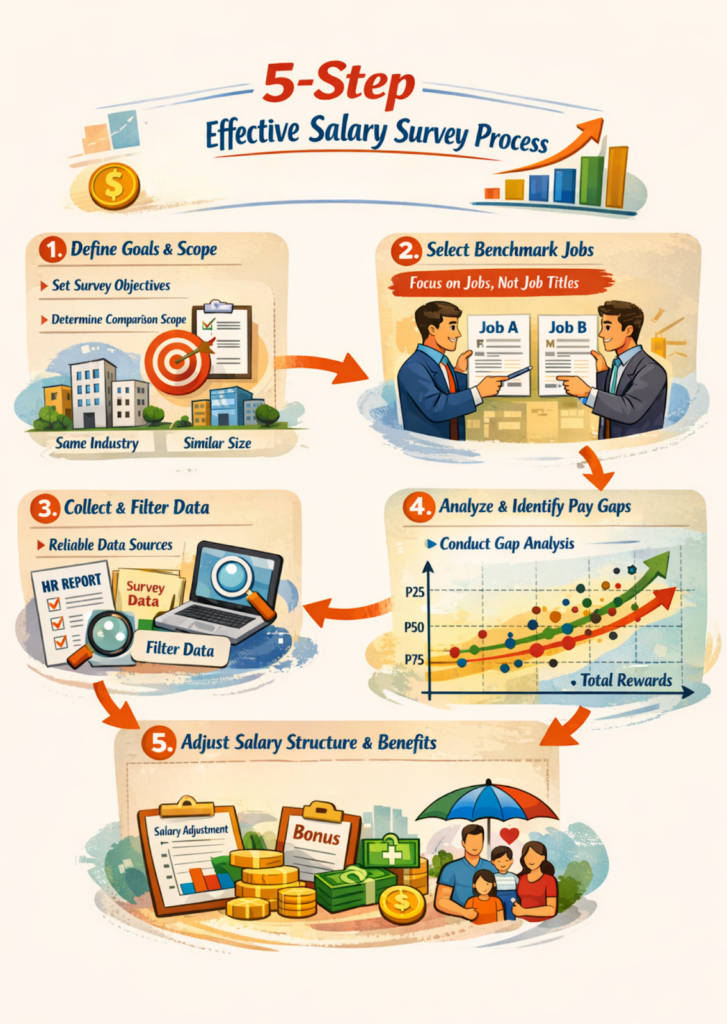
First, answer: “Why conduct this survey?” Is it for building new salary scales, annual reviews, or new department setup? Objectives determine scope: With whom do we compare? (Competitors in the same industry, size, or geography?). For example, a manufacturing firm in an industrial zone should not compare worker salaries with service companies in central business districts.
2. Select Benchmark Jobs for Comparison
Not all titles are comparable. A “Sales Manager” at a 10-person company differs significantly from one at a 10,000-person corporation. Organizations must select “Benchmark Jobs”—positions that are common, have stable content, and appear frequently across companies. The golden rule: “Compare jobs, not titles.”
3. Data Collection and Screening From Reliable Sources
Data sources include purchased reports from professional HR consulting firms (Mercer, compensation surveys, recruiting specialists) or reliable recruitment platforms. In Vietnam, purchasing annual reports is the most reliable method for large enterprises. Collected data must be screened to remove outliers ensuring sample representativeness.
4. Data Analysis and Gap Identification
Compensation and Benefits departments analyze data to identify “gaps” between current internal salary and market benchmarks (P25, P50, P75). Analysis must extend beyond Base Salary to Total Cash and Total Rewards. This reveals true strengths and weaknesses in income structure.
5. Adjust Salary Structure and Benefits Accordingly
Finally, translate data into action. Based on analysis and selected positioning strategy, adjust Salary Ranges. If current salaries fall below target zones, implement adjustment increases. If salaries exceed ceilings (Red-circle rates), consider base pay freezes and shift to performance bonuses. Reviewing benefit packages (remote work options, family insurance) is equally important.
Mistakes to Avoid When Benchmarking and Positioning
1. Inaccurate Job Matching Comparisons
The most frequent error is comparing salaries based solely on titles. One must carefully review Job Description elements including responsibilities, experience requirements, and authority scope to find at least 70-80% similarity before comparing.
2. Focusing Only on Base Salary While Ignoring Total Rewards
Examining only monthly gross salary is short-sighted. A company might pay lower monthly base but include year-end bonuses of 3-6 months plus allowances. Without analyzing Annual Total Cash and Total Rewards, competitive position assessment becomes distorted.
3. Using Outdated or Mismatched Data
Markets change rapidly with inflation. Using 2-3 year old data is risky. Additionally, referencing companies with vastly different revenue scales distorts information. Organizations should seek Peer Group data from similar revenue, headcount, and industry sources.
Conclusion
Conducting an effective salary survey is challenging but mandatory for businesses pursuing sustainable growth. It enables accurate market position definition and serves as a compass for talent management decisions.
By understanding competitive standing, organizations build smart compensation strategies: competitive enough to attract top talent, fair enough to retain talent, and efficient enough to optimize costs. In the data era, organizations with accurate labor market information will win the competition for their most valuable resource—people.
For questions or support, contact Wacontre Accounting Services at (028) 3820 1213 or [email protected]. Our experienced professionals deliver comprehensive, efficient service. (Japanese-speaking clients: (050) 5534 5505)
2. “Match the Market” Strategy
This most common strategy is adopted by majority of medium and large Vietnam enterprises. Organizations position salaries equivalent to market average (approximately P50). The objective is stability: preventing employee loss from inadequate pay while controlling operating cost pressure.
With “Match the Market,” competitive differentiation shifts from base salary to other elements like enhanced benefits (premium health insurance, travel, allowances), transparent promotion paths, and employer branding. This approach suits established companies requiring workforce stability for core operations.
3. “Lead the Market” Strategy
This strategy positions organizations in the highest compensation tier (P75, P90, or above). Typically used by Multinational Corporations (MNCs), Big Tech firms, or fast-growth businesses requiring senior talent acquisition. These organizations pay premium salaries to recruit top performers from competitors.
Benefits include rapid talent acquisition and high retention rates. However, risks are substantial: fixed cost pressure is extreme. Without rigorous hiring, the organization risks high-salary, low-performance employees.
5-Step Process for Conducting an Effective Salary Survey
1. Define Objectives and Scope
First, answer: “Why conduct this survey?” Is it for building new salary scales, annual reviews, or new department setup? Objectives determine scope: With whom do we compare? (Competitors in the same industry, size, or geography?). For example, a manufacturing firm in an industrial zone should not compare worker salaries with service companies in central business districts.
2. Select Benchmark Jobs for Comparison
Not all titles are comparable. A “Sales Manager” at a 10-person company differs significantly from one at a 10,000-person corporation. Organizations must select “Benchmark Jobs”—positions that are common, have stable content, and appear frequently across companies. The golden rule: “Compare jobs, not titles.”
3. Data Collection and Screening From Reliable Sources
Data sources include purchased reports from professional HR consulting firms (Mercer, compensation surveys, recruiting specialists) or reliable recruitment platforms. In Vietnam, purchasing annual reports is the most reliable method for large enterprises. Collected data must be screened to remove outliers ensuring sample representativeness.
4. Data Analysis and Gap Identification
Compensation and Benefits departments analyze data to identify “gaps” between current internal salary and market benchmarks (P25, P50, P75). Analysis must extend beyond Base Salary to Total Cash and Total Rewards. This reveals true strengths and weaknesses in income structure.
5. Adjust Salary Structure and Benefits Accordingly
Finally, translate data into action. Based on analysis and selected positioning strategy, adjust Salary Ranges. If current salaries fall below target zones, implement adjustment increases. If salaries exceed ceilings (Red-circle rates), consider base pay freezes and shift to performance bonuses. Reviewing benefit packages (remote work options, family insurance) is equally important.
Mistakes to Avoid When Benchmarking and Positioning
1. Inaccurate Job Matching Comparisons
The most frequent error is comparing salaries based solely on titles. One must carefully review Job Description elements including responsibilities, experience requirements, and authority scope to find at least 70-80% similarity before comparing.
2. Focusing Only on Base Salary While Ignoring Total Rewards
Examining only monthly gross salary is short-sighted. A company might pay lower monthly base but include year-end bonuses of 3-6 months plus allowances. Without analyzing Annual Total Cash and Total Rewards, competitive position assessment becomes distorted.
3. Using Outdated or Mismatched Data
Markets change rapidly with inflation. Using 2-3 year old data is risky. Additionally, referencing companies with vastly different revenue scales distorts information. Organizations should seek Peer Group data from similar revenue, headcount, and industry sources.
Conclusion
Conducting an effective salary survey is challenging but mandatory for businesses pursuing sustainable growth. It enables accurate market position definition and serves as a compass for talent management decisions.
By understanding competitive standing, organizations build smart compensation strategies: competitive enough to attract top talent, fair enough to retain talent, and efficient enough to optimize costs. In the data era, organizations with accurate labor market information will win the competition for their most valuable resource—people.
For questions or support, contact Wacontre Accounting Services at (028) 3820 1213 or [email protected]. Our experienced professionals deliver comprehensive, efficient service. (Japanese-speaking clients: (050) 5534 5505)
1. “Lag the Market” Strategy
This strategy positions salaries below market average (typically at P25 or lower). Often chosen by small businesses, early-stage startups (Pre-seed, Seed stage), or organizations with limited financial resources. However, this does not mean accepting lower-quality personnel.
To compensate for lower salaries, these organizations leverage other “Total Rewards” components, such as Employee Stock Ownership Plans (ESOP) with breakthrough growth potential, highly flexible work arrangements, or rapid learning opportunities. This strategy attracts personnel with entrepreneurial mindset willing to trade current income for future value.
2. “Match the Market” Strategy
This most common strategy is adopted by majority of medium and large Vietnam enterprises. Organizations position salaries equivalent to market average (approximately P50). The objective is stability: preventing employee loss from inadequate pay while controlling operating cost pressure.
With “Match the Market,” competitive differentiation shifts from base salary to other elements like enhanced benefits (premium health insurance, travel, allowances), transparent promotion paths, and employer branding. This approach suits established companies requiring workforce stability for core operations.
3. “Lead the Market” Strategy
This strategy positions organizations in the highest compensation tier (P75, P90, or above). Typically used by Multinational Corporations (MNCs), Big Tech firms, or fast-growth businesses requiring senior talent acquisition. These organizations pay premium salaries to recruit top performers from competitors.
Benefits include rapid talent acquisition and high retention rates. However, risks are substantial: fixed cost pressure is extreme. Without rigorous hiring, the organization risks high-salary, low-performance employees.
5-Step Process for Conducting an Effective Salary Survey
1. Define Objectives and Scope
First, answer: “Why conduct this survey?” Is it for building new salary scales, annual reviews, or new department setup? Objectives determine scope: With whom do we compare? (Competitors in the same industry, size, or geography?). For example, a manufacturing firm in an industrial zone should not compare worker salaries with service companies in central business districts.
2. Select Benchmark Jobs for Comparison
Not all titles are comparable. A “Sales Manager” at a 10-person company differs significantly from one at a 10,000-person corporation. Organizations must select “Benchmark Jobs”—positions that are common, have stable content, and appear frequently across companies. The golden rule: “Compare jobs, not titles.”
3. Data Collection and Screening From Reliable Sources
Data sources include purchased reports from professional HR consulting firms (Mercer, compensation surveys, recruiting specialists) or reliable recruitment platforms. In Vietnam, purchasing annual reports is the most reliable method for large enterprises. Collected data must be screened to remove outliers ensuring sample representativeness.
4. Data Analysis and Gap Identification
Compensation and Benefits departments analyze data to identify “gaps” between current internal salary and market benchmarks (P25, P50, P75). Analysis must extend beyond Base Salary to Total Cash and Total Rewards. This reveals true strengths and weaknesses in income structure.
5. Adjust Salary Structure and Benefits Accordingly
Finally, translate data into action. Based on analysis and selected positioning strategy, adjust Salary Ranges. If current salaries fall below target zones, implement adjustment increases. If salaries exceed ceilings (Red-circle rates), consider base pay freezes and shift to performance bonuses. Reviewing benefit packages (remote work options, family insurance) is equally important.
Mistakes to Avoid When Benchmarking and Positioning
1. Inaccurate Job Matching Comparisons
The most frequent error is comparing salaries based solely on titles. One must carefully review Job Description elements including responsibilities, experience requirements, and authority scope to find at least 70-80% similarity before comparing.
2. Focusing Only on Base Salary While Ignoring Total Rewards
Examining only monthly gross salary is short-sighted. A company might pay lower monthly base but include year-end bonuses of 3-6 months plus allowances. Without analyzing Annual Total Cash and Total Rewards, competitive position assessment becomes distorted.
3. Using Outdated or Mismatched Data
Markets change rapidly with inflation. Using 2-3 year old data is risky. Additionally, referencing companies with vastly different revenue scales distorts information. Organizations should seek Peer Group data from similar revenue, headcount, and industry sources.
Conclusion
Conducting an effective salary survey is challenging but mandatory for businesses pursuing sustainable growth. It enables accurate market position definition and serves as a compass for talent management decisions.
By understanding competitive standing, organizations build smart compensation strategies: competitive enough to attract top talent, fair enough to retain talent, and efficient enough to optimize costs. In the data era, organizations with accurate labor market information will win the competition for their most valuable resource—people.
For questions or support, contact Wacontre Accounting Services at (028) 3820 1213 or [email protected]. Our experienced professionals deliver comprehensive, efficient service. (Japanese-speaking clients: (050) 5534 5505)
3. Optimizing HR Budgets and Cost Control
Personnel costs typically constitute 30% to 70% of total operating expenses. Budgeting requires absolute precision. Without salary benchmarking data, annual increases often reflect intuition or pressure, creating inefficient spending.
An effective salary survey provides necessary parameters for Chief Human Resources Officers (CHRO) and Chief Financial Officers (CFO) to plan jointly. Businesses identify which positions require talent investment (scarce, high-demand roles) and which have abundant supply suitable for maintenance levels. Data-driven allocation optimizes cash flow while maintaining operational continuity.
Common Market Salary Positioning Strategies
After obtaining survey results, businesses choose a “position.” No single strategy fits all organizations; selection depends on financial strength, development stage, and organizational culture.

1. “Lag the Market” Strategy
This strategy positions salaries below market average (typically at P25 or lower). Often chosen by small businesses, early-stage startups (Pre-seed, Seed stage), or organizations with limited financial resources. However, this does not mean accepting lower-quality personnel.
To compensate for lower salaries, these organizations leverage other “Total Rewards” components, such as Employee Stock Ownership Plans (ESOP) with breakthrough growth potential, highly flexible work arrangements, or rapid learning opportunities. This strategy attracts personnel with entrepreneurial mindset willing to trade current income for future value.
2. “Match the Market” Strategy
This most common strategy is adopted by majority of medium and large Vietnam enterprises. Organizations position salaries equivalent to market average (approximately P50). The objective is stability: preventing employee loss from inadequate pay while controlling operating cost pressure.
With “Match the Market,” competitive differentiation shifts from base salary to other elements like enhanced benefits (premium health insurance, travel, allowances), transparent promotion paths, and employer branding. This approach suits established companies requiring workforce stability for core operations.
3. “Lead the Market” Strategy
This strategy positions organizations in the highest compensation tier (P75, P90, or above). Typically used by Multinational Corporations (MNCs), Big Tech firms, or fast-growth businesses requiring senior talent acquisition. These organizations pay premium salaries to recruit top performers from competitors.
Benefits include rapid talent acquisition and high retention rates. However, risks are substantial: fixed cost pressure is extreme. Without rigorous hiring, the organization risks high-salary, low-performance employees.
5-Step Process for Conducting an Effective Salary Survey
1. Define Objectives and Scope
First, answer: “Why conduct this survey?” Is it for building new salary scales, annual reviews, or new department setup? Objectives determine scope: With whom do we compare? (Competitors in the same industry, size, or geography?). For example, a manufacturing firm in an industrial zone should not compare worker salaries with service companies in central business districts.
2. Select Benchmark Jobs for Comparison
Not all titles are comparable. A “Sales Manager” at a 10-person company differs significantly from one at a 10,000-person corporation. Organizations must select “Benchmark Jobs”—positions that are common, have stable content, and appear frequently across companies. The golden rule: “Compare jobs, not titles.”
3. Data Collection and Screening From Reliable Sources
Data sources include purchased reports from professional HR consulting firms (Mercer, compensation surveys, recruiting specialists) or reliable recruitment platforms. In Vietnam, purchasing annual reports is the most reliable method for large enterprises. Collected data must be screened to remove outliers ensuring sample representativeness.
4. Data Analysis and Gap Identification
Compensation and Benefits departments analyze data to identify “gaps” between current internal salary and market benchmarks (P25, P50, P75). Analysis must extend beyond Base Salary to Total Cash and Total Rewards. This reveals true strengths and weaknesses in income structure.
5. Adjust Salary Structure and Benefits Accordingly
Finally, translate data into action. Based on analysis and selected positioning strategy, adjust Salary Ranges. If current salaries fall below target zones, implement adjustment increases. If salaries exceed ceilings (Red-circle rates), consider base pay freezes and shift to performance bonuses. Reviewing benefit packages (remote work options, family insurance) is equally important.
Mistakes to Avoid When Benchmarking and Positioning
1. Inaccurate Job Matching Comparisons
The most frequent error is comparing salaries based solely on titles. One must carefully review Job Description elements including responsibilities, experience requirements, and authority scope to find at least 70-80% similarity before comparing.
2. Focusing Only on Base Salary While Ignoring Total Rewards
Examining only monthly gross salary is short-sighted. A company might pay lower monthly base but include year-end bonuses of 3-6 months plus allowances. Without analyzing Annual Total Cash and Total Rewards, competitive position assessment becomes distorted.
3. Using Outdated or Mismatched Data
Markets change rapidly with inflation. Using 2-3 year old data is risky. Additionally, referencing companies with vastly different revenue scales distorts information. Organizations should seek Peer Group data from similar revenue, headcount, and industry sources.
Conclusion
Conducting an effective salary survey is challenging but mandatory for businesses pursuing sustainable growth. It enables accurate market position definition and serves as a compass for talent management decisions.
By understanding competitive standing, organizations build smart compensation strategies: competitive enough to attract top talent, fair enough to retain talent, and efficient enough to optimize costs. In the data era, organizations with accurate labor market information will win the competition for their most valuable resource—people.
For questions or support, contact Wacontre Accounting Services at (028) 3820 1213 or [email protected]. Our experienced professionals deliver comprehensive, efficient service. (Japanese-speaking clients: (050) 5534 5505)
1. Evaluating Business Competitiveness
Business competitiveness depends not just on products or technology, but fundamentally on people operating those systems. By conducting an effective salary survey, businesses clearly see competitive standing in the “talent war.” If salary levels significantly underperform market median for key positions, attracting top candidates becomes difficult regardless of employer brand strength.
Conversely, paying significantly above market without corresponding performance expectations erodes profits. Survey data enables businesses to “understand themselves and the market,” allowing intelligent offer adjustments for new hires.
2. Foundation for Talent Retention Strategies
A leading reason employees leave organizations is perceived unfair or below-market compensation. When employees recognize they could earn 20-30% more with the same effort elsewhere, loyalty becomes fragile. A compensation strategy based on accurate data is the most powerful talent retention tool.
By proactively adjusting salaries periodically based on market shifts and inflation, businesses signal: “We recognize your worth and commit to competitive pay.” This prevents “brain drain”—a critical challenge in fast-moving sectors like IT, Marketing, or Finance.
3. Optimizing HR Budgets and Cost Control
Personnel costs typically constitute 30% to 70% of total operating expenses. Budgeting requires absolute precision. Without salary benchmarking data, annual increases often reflect intuition or pressure, creating inefficient spending.
An effective salary survey provides necessary parameters for Chief Human Resources Officers (CHRO) and Chief Financial Officers (CFO) to plan jointly. Businesses identify which positions require talent investment (scarce, high-demand roles) and which have abundant supply suitable for maintenance levels. Data-driven allocation optimizes cash flow while maintaining operational continuity.
Common Market Salary Positioning Strategies
After obtaining survey results, businesses choose a “position.” No single strategy fits all organizations; selection depends on financial strength, development stage, and organizational culture.
1. “Lag the Market” Strategy
This strategy positions salaries below market average (typically at P25 or lower). Often chosen by small businesses, early-stage startups (Pre-seed, Seed stage), or organizations with limited financial resources. However, this does not mean accepting lower-quality personnel.
To compensate for lower salaries, these organizations leverage other “Total Rewards” components, such as Employee Stock Ownership Plans (ESOP) with breakthrough growth potential, highly flexible work arrangements, or rapid learning opportunities. This strategy attracts personnel with entrepreneurial mindset willing to trade current income for future value.
2. “Match the Market” Strategy
This most common strategy is adopted by majority of medium and large Vietnam enterprises. Organizations position salaries equivalent to market average (approximately P50). The objective is stability: preventing employee loss from inadequate pay while controlling operating cost pressure.
With “Match the Market,” competitive differentiation shifts from base salary to other elements like enhanced benefits (premium health insurance, travel, allowances), transparent promotion paths, and employer branding. This approach suits established companies requiring workforce stability for core operations.
3. “Lead the Market” Strategy
This strategy positions organizations in the highest compensation tier (P75, P90, or above). Typically used by Multinational Corporations (MNCs), Big Tech firms, or fast-growth businesses requiring senior talent acquisition. These organizations pay premium salaries to recruit top performers from competitors.
Benefits include rapid talent acquisition and high retention rates. However, risks are substantial: fixed cost pressure is extreme. Without rigorous hiring, the organization risks high-salary, low-performance employees.
5-Step Process for Conducting an Effective Salary Survey
1. Define Objectives and Scope
First, answer: “Why conduct this survey?” Is it for building new salary scales, annual reviews, or new department setup? Objectives determine scope: With whom do we compare? (Competitors in the same industry, size, or geography?). For example, a manufacturing firm in an industrial zone should not compare worker salaries with service companies in central business districts.
2. Select Benchmark Jobs for Comparison
Not all titles are comparable. A “Sales Manager” at a 10-person company differs significantly from one at a 10,000-person corporation. Organizations must select “Benchmark Jobs”—positions that are common, have stable content, and appear frequently across companies. The golden rule: “Compare jobs, not titles.”
3. Data Collection and Screening From Reliable Sources
Data sources include purchased reports from professional HR consulting firms (Mercer, compensation surveys, recruiting specialists) or reliable recruitment platforms. In Vietnam, purchasing annual reports is the most reliable method for large enterprises. Collected data must be screened to remove outliers ensuring sample representativeness.
4. Data Analysis and Gap Identification
Compensation and Benefits departments analyze data to identify “gaps” between current internal salary and market benchmarks (P25, P50, P75). Analysis must extend beyond Base Salary to Total Cash and Total Rewards. This reveals true strengths and weaknesses in income structure.
5. Adjust Salary Structure and Benefits Accordingly
Finally, translate data into action. Based on analysis and selected positioning strategy, adjust Salary Ranges. If current salaries fall below target zones, implement adjustment increases. If salaries exceed ceilings (Red-circle rates), consider base pay freezes and shift to performance bonuses. Reviewing benefit packages (remote work options, family insurance) is equally important.
Mistakes to Avoid When Benchmarking and Positioning
1. Inaccurate Job Matching Comparisons
The most frequent error is comparing salaries based solely on titles. One must carefully review Job Description elements including responsibilities, experience requirements, and authority scope to find at least 70-80% similarity before comparing.
2. Focusing Only on Base Salary While Ignoring Total Rewards
Examining only monthly gross salary is short-sighted. A company might pay lower monthly base but include year-end bonuses of 3-6 months plus allowances. Without analyzing Annual Total Cash and Total Rewards, competitive position assessment becomes distorted.
3. Using Outdated or Mismatched Data
Markets change rapidly with inflation. Using 2-3 year old data is risky. Additionally, referencing companies with vastly different revenue scales distorts information. Organizations should seek Peer Group data from similar revenue, headcount, and industry sources.
Conclusion
Conducting an effective salary survey is challenging but mandatory for businesses pursuing sustainable growth. It enables accurate market position definition and serves as a compass for talent management decisions.
By understanding competitive standing, organizations build smart compensation strategies: competitive enough to attract top talent, fair enough to retain talent, and efficient enough to optimize costs. In the data era, organizations with accurate labor market information will win the competition for their most valuable resource—people.
For questions or support, contact Wacontre Accounting Services at (028) 3820 1213 or [email protected]. Our experienced professionals deliver comprehensive, efficient service. (Japanese-speaking clients: (050) 5534 5505)