

Key updates on Decree 320/2025/NĐ-CP: Invoices exceeding 5 million VND require non-cash payment for deductibility, new foreign enterprise tax rules, and electronics manufacturing incentives effective January 1, 2026.
2025 brings significant changes to Vietnam’s tax policy with Decree 320/2025/NĐ-CP and Circular 33/2025/TT-BKHCN. Most importantly, deductible expenses now require non-cash payment documentation for invoices of 5 million VND or more. Additionally, regulations for foreign enterprises and incentives for electronics manufacturing undergo substantial revisions that accountants must understand immediately.
- 1. Updated Taxpayer Definitions
- 2. Expanded Subjects Paying Tax on Behalf
- 3. New Taxable Income Categories
- Key Takeaways for Businesses
- Key Takeaways for Businesses
- Key Takeaways for Businesses
- Key Takeaways for Businesses
- Key Takeaways for Businesses
- Key Takeaways for Businesses
- Key Takeaways for Businesses
- Key Takeaways for Businesses
- Key Takeaways for Businesses
- Key Takeaways for Businesses
- Key Takeaways for Businesses
- Key Takeaways for Businesses
- Key Takeaways for Businesses
- Key Takeaways for Businesses
- Key Takeaways for Businesses
- Key Takeaways for Businesses
- Key Takeaways for Businesses
- Key Takeaways for Businesses
- 6. Electronics Manufacturing CIT Incentive Criteria
- Key Takeaways for Businesses
- 6. Electronics Manufacturing CIT Incentive Criteria
- Key Takeaways for Businesses
- 6. Electronics Manufacturing CIT Incentive Criteria
- Key Takeaways for Businesses
- 6. Electronics Manufacturing CIT Incentive Criteria
- Key Takeaways for Businesses
- 5. Non-Cash Payment Requirement for Expense Deductibility
- 6. Electronics Manufacturing CIT Incentive Criteria
- Key Takeaways for Businesses
- 5. Non-Cash Payment Requirement for Expense Deductibility
- 6. Electronics Manufacturing CIT Incentive Criteria
- Key Takeaways for Businesses
- 5. Non-Cash Payment Requirement for Expense Deductibility
- 6. Electronics Manufacturing CIT Incentive Criteria
- Key Takeaways for Businesses
- 4. Expanded Tax-Exempt Income Categories
- 5. Non-Cash Payment Requirement for Expense Deductibility
- 6. Electronics Manufacturing CIT Incentive Criteria
- Key Takeaways for Businesses
- 4. Expanded Tax-Exempt Income Categories
- 5. Non-Cash Payment Requirement for Expense Deductibility
- 6. Electronics Manufacturing CIT Incentive Criteria
- Key Takeaways for Businesses
1. Updated Taxpayer Definitions
Article 2, Clause 1 of Decree 320/2025/NĐ-CP clarifies that enterprises established under foreign law are Corporate Income Tax (CIT) taxpayers in Vietnam. The decree specifies four categories:
- Foreign enterprises with Vietnam permanent establishment: Pay tax on Vietnam-sourced income and outside-Vietnam income related to their permanent establishment.
- Foreign enterprises with permanent establishment (unrelated income): Pay tax on Vietnam-sourced income not related to permanent establishment activities.
- Foreign enterprises with permanent establishment (e-commerce): Pay tax on Vietnam-sourced income from goods and services supplied via e-commerce or digital platforms.
- Foreign enterprises without Vietnam permanent establishment: Pay tax on Vietnam-sourced income.
2. Expanded Subjects Paying Tax on Behalf
Article 2, Clause 2 of the decree expands entities responsible for paying tax on behalf, including:
- Vietnamese entities: Conducting e-commerce, managing digital platforms, or receiving capital transfers from foreign enterprises.
- Securities Investment Fund Management Companies: Paying tax on behalf of investors for dividends and income from real estate investment fund transfers or leases.
- Vietnamese enterprises receiving foreign capital: When the transferee is a foreign organization or individual.
3. New Taxable Income Categories
Capital Transfer Income: Article 3, Clause 3, Point a excludes certain items from taxable capital transfer income:
- Revenue directly related to stock issuance, stock dividends, treasury share sales, and repurchased shares.
- Other revenues directly related to changes in owner’s equity.
Business Cooperation Contract (BCC) Income: Article 3, Clause 2, Point p now includes BCC income as taxable. Revenue is determined based on distribution method:
- By sales revenue: Revenue distributed per contract to each party.
- By product: Product revenue distributed per contract.
- By pre-tax profit: One party designated as representative for invoicing and pre-tax CIT profit distribution.
- By after-tax profit: One party designated as representative for invoicing and CIT payment on behalf of other parties.
Decree 320/2025/NĐ-CP and Circular 33/2025/TT-BKHCN establish a more rigorous tax framework adapted to the digital economy and e-commerce landscape. The most critical impact is the non-cash payment threshold reduction to 5 million VND (previously 20 million VND). Businesses must immediately review payment processes and spending policies to maintain expense deductibility. High-tech and electronics manufacturers should carefully evaluate the four new CIT incentive criteria to maximize benefits starting in 2026.
For guidance on compliance and tax strategy under these new regulations, contact Wacontre Accounting Services at Hotline: (028) 3820 1213 or email [email protected]. Our experienced team helps Vietnam company formation and tax compliance. (Japanese clients: Hotline (050) 5534 5505.)
Key Takeaways for Businesses
Decree 320/2025/NĐ-CP and Circular 33/2025/TT-BKHCN establish a more rigorous tax framework adapted to the digital economy and e-commerce landscape. The most critical impact is the non-cash payment threshold reduction to 5 million VND (previously 20 million VND). Businesses must immediately review payment processes and spending policies to maintain expense deductibility. High-tech and electronics manufacturers should carefully evaluate the four new CIT incentive criteria to maximize benefits starting in 2026.
For guidance on compliance and tax strategy under these new regulations, contact Wacontre Accounting Services at Hotline: (028) 3820 1213 or email [email protected]. Our experienced team helps Vietnam company formation and tax compliance. (Japanese clients: Hotline (050) 5534 5505.)
Key Takeaways for Businesses
Decree 320/2025/NĐ-CP and Circular 33/2025/TT-BKHCN establish a more rigorous tax framework adapted to the digital economy and e-commerce landscape. The most critical impact is the non-cash payment threshold reduction to 5 million VND (previously 20 million VND). Businesses must immediately review payment processes and spending policies to maintain expense deductibility. High-tech and electronics manufacturers should carefully evaluate the four new CIT incentive criteria to maximize benefits starting in 2026.
For guidance on compliance and tax strategy under these new regulations, contact Wacontre Accounting Services at Hotline: (028) 3820 1213 or email [email protected]. Our experienced team helps Vietnam company formation and tax compliance. (Japanese clients: Hotline (050) 5534 5505.)
Key Takeaways for Businesses
Decree 320/2025/NĐ-CP and Circular 33/2025/TT-BKHCN establish a more rigorous tax framework adapted to the digital economy and e-commerce landscape. The most critical impact is the non-cash payment threshold reduction to 5 million VND (previously 20 million VND). Businesses must immediately review payment processes and spending policies to maintain expense deductibility. High-tech and electronics manufacturers should carefully evaluate the four new CIT incentive criteria to maximize benefits starting in 2026.
For guidance on compliance and tax strategy under these new regulations, contact Wacontre Accounting Services at Hotline: (028) 3820 1213 or email [email protected]. Our experienced team helps Vietnam company formation and tax compliance. (Japanese clients: Hotline (050) 5534 5505.)
- Domestic supplier participation: Minimum 30% of suppliers for assembly, materials, components, and services are Vietnamese enterprises.
- Technology transfer: Transfer technology to at least 1 Vietnamese organization or enterprise within 5 years from Investment Registration Certificate or Investment Policy Approval date, complying with technology transfer regulations.
Key Takeaways for Businesses
Decree 320/2025/NĐ-CP and Circular 33/2025/TT-BKHCN establish a more rigorous tax framework adapted to the digital economy and e-commerce landscape. The most critical impact is the non-cash payment threshold reduction to 5 million VND (previously 20 million VND). Businesses must immediately review payment processes and spending policies to maintain expense deductibility. High-tech and electronics manufacturers should carefully evaluate the four new CIT incentive criteria to maximize benefits starting in 2026.
For guidance on compliance and tax strategy under these new regulations, contact Wacontre Accounting Services at Hotline: (028) 3820 1213 or email [email protected]. Our experienced team helps Vietnam company formation and tax compliance. (Japanese clients: Hotline (050) 5534 5505.)
4. Domestic Supply Chain and Technology Transfer Criteria
- Domestic supplier participation: Minimum 30% of suppliers for assembly, materials, components, and services are Vietnamese enterprises.
- Technology transfer: Transfer technology to at least 1 Vietnamese organization or enterprise within 5 years from Investment Registration Certificate or Investment Policy Approval date, complying with technology transfer regulations.
Key Takeaways for Businesses
Decree 320/2025/NĐ-CP and Circular 33/2025/TT-BKHCN establish a more rigorous tax framework adapted to the digital economy and e-commerce landscape. The most critical impact is the non-cash payment threshold reduction to 5 million VND (previously 20 million VND). Businesses must immediately review payment processes and spending policies to maintain expense deductibility. High-tech and electronics manufacturers should carefully evaluate the four new CIT incentive criteria to maximize benefits starting in 2026.
For guidance on compliance and tax strategy under these new regulations, contact Wacontre Accounting Services at Hotline: (028) 3820 1213 or email [email protected]. Our experienced team helps Vietnam company formation and tax compliance. (Japanese clients: Hotline (050) 5534 5505.)
4. Domestic Supply Chain and Technology Transfer Criteria
- Domestic supplier participation: Minimum 30% of suppliers for assembly, materials, components, and services are Vietnamese enterprises.
- Technology transfer: Transfer technology to at least 1 Vietnamese organization or enterprise within 5 years from Investment Registration Certificate or Investment Policy Approval date, complying with technology transfer regulations.
Key Takeaways for Businesses
Decree 320/2025/NĐ-CP and Circular 33/2025/TT-BKHCN establish a more rigorous tax framework adapted to the digital economy and e-commerce landscape. The most critical impact is the non-cash payment threshold reduction to 5 million VND (previously 20 million VND). Businesses must immediately review payment processes and spending policies to maintain expense deductibility. High-tech and electronics manufacturers should carefully evaluate the four new CIT incentive criteria to maximize benefits starting in 2026.
For guidance on compliance and tax strategy under these new regulations, contact Wacontre Accounting Services at Hotline: (028) 3820 1213 or email [email protected]. Our experienced team helps Vietnam company formation and tax compliance. (Japanese clients: Hotline (050) 5534 5505.)
4. Domestic Supply Chain and Technology Transfer Criteria
- Domestic supplier participation: Minimum 30% of suppliers for assembly, materials, components, and services are Vietnamese enterprises.
- Technology transfer: Transfer technology to at least 1 Vietnamese organization or enterprise within 5 years from Investment Registration Certificate or Investment Policy Approval date, complying with technology transfer regulations.
Key Takeaways for Businesses
Decree 320/2025/NĐ-CP and Circular 33/2025/TT-BKHCN establish a more rigorous tax framework adapted to the digital economy and e-commerce landscape. The most critical impact is the non-cash payment threshold reduction to 5 million VND (previously 20 million VND). Businesses must immediately review payment processes and spending policies to maintain expense deductibility. High-tech and electronics manufacturers should carefully evaluate the four new CIT incentive criteria to maximize benefits starting in 2026.
For guidance on compliance and tax strategy under these new regulations, contact Wacontre Accounting Services at Hotline: (028) 3820 1213 or email [email protected]. Our experienced team helps Vietnam company formation and tax compliance. (Japanese clients: Hotline (050) 5534 5505.)
- Electronic equipment products have designs (including specifications, architecture, detailed design, schematics, circuit layout, and technical documents) owned by the enterprise.
- Ownership established through self-design, hiring others to design, or purchasing designs.
4. Domestic Supply Chain and Technology Transfer Criteria
- Domestic supplier participation: Minimum 30% of suppliers for assembly, materials, components, and services are Vietnamese enterprises.
- Technology transfer: Transfer technology to at least 1 Vietnamese organization or enterprise within 5 years from Investment Registration Certificate or Investment Policy Approval date, complying with technology transfer regulations.
Key Takeaways for Businesses
Decree 320/2025/NĐ-CP and Circular 33/2025/TT-BKHCN establish a more rigorous tax framework adapted to the digital economy and e-commerce landscape. The most critical impact is the non-cash payment threshold reduction to 5 million VND (previously 20 million VND). Businesses must immediately review payment processes and spending policies to maintain expense deductibility. High-tech and electronics manufacturers should carefully evaluate the four new CIT incentive criteria to maximize benefits starting in 2026.
For guidance on compliance and tax strategy under these new regulations, contact Wacontre Accounting Services at Hotline: (028) 3820 1213 or email [email protected]. Our experienced team helps Vietnam company formation and tax compliance. (Japanese clients: Hotline (050) 5534 5505.)
3. Product Design Ownership Criteria
- Electronic equipment products have designs (including specifications, architecture, detailed design, schematics, circuit layout, and technical documents) owned by the enterprise.
- Ownership established through self-design, hiring others to design, or purchasing designs.
4. Domestic Supply Chain and Technology Transfer Criteria
- Domestic supplier participation: Minimum 30% of suppliers for assembly, materials, components, and services are Vietnamese enterprises.
- Technology transfer: Transfer technology to at least 1 Vietnamese organization or enterprise within 5 years from Investment Registration Certificate or Investment Policy Approval date, complying with technology transfer regulations.
Key Takeaways for Businesses
Decree 320/2025/NĐ-CP and Circular 33/2025/TT-BKHCN establish a more rigorous tax framework adapted to the digital economy and e-commerce landscape. The most critical impact is the non-cash payment threshold reduction to 5 million VND (previously 20 million VND). Businesses must immediately review payment processes and spending policies to maintain expense deductibility. High-tech and electronics manufacturers should carefully evaluate the four new CIT incentive criteria to maximize benefits starting in 2026.
For guidance on compliance and tax strategy under these new regulations, contact Wacontre Accounting Services at Hotline: (028) 3820 1213 or email [email protected]. Our experienced team helps Vietnam company formation and tax compliance. (Japanese clients: Hotline (050) 5534 5505.)
3. Product Design Ownership Criteria
- Electronic equipment products have designs (including specifications, architecture, detailed design, schematics, circuit layout, and technical documents) owned by the enterprise.
- Ownership established through self-design, hiring others to design, or purchasing designs.
4. Domestic Supply Chain and Technology Transfer Criteria
- Domestic supplier participation: Minimum 30% of suppliers for assembly, materials, components, and services are Vietnamese enterprises.
- Technology transfer: Transfer technology to at least 1 Vietnamese organization or enterprise within 5 years from Investment Registration Certificate or Investment Policy Approval date, complying with technology transfer regulations.
Key Takeaways for Businesses
Decree 320/2025/NĐ-CP and Circular 33/2025/TT-BKHCN establish a more rigorous tax framework adapted to the digital economy and e-commerce landscape. The most critical impact is the non-cash payment threshold reduction to 5 million VND (previously 20 million VND). Businesses must immediately review payment processes and spending policies to maintain expense deductibility. High-tech and electronics manufacturers should carefully evaluate the four new CIT incentive criteria to maximize benefits starting in 2026.
For guidance on compliance and tax strategy under these new regulations, contact Wacontre Accounting Services at Hotline: (028) 3820 1213 or email [email protected]. Our experienced team helps Vietnam company formation and tax compliance. (Japanese clients: Hotline (050) 5534 5505.)
3. Product Design Ownership Criteria
- Electronic equipment products have designs (including specifications, architecture, detailed design, schematics, circuit layout, and technical documents) owned by the enterprise.
- Ownership established through self-design, hiring others to design, or purchasing designs.
4. Domestic Supply Chain and Technology Transfer Criteria
- Domestic supplier participation: Minimum 30% of suppliers for assembly, materials, components, and services are Vietnamese enterprises.
- Technology transfer: Transfer technology to at least 1 Vietnamese organization or enterprise within 5 years from Investment Registration Certificate or Investment Policy Approval date, complying with technology transfer regulations.
Key Takeaways for Businesses
Decree 320/2025/NĐ-CP and Circular 33/2025/TT-BKHCN establish a more rigorous tax framework adapted to the digital economy and e-commerce landscape. The most critical impact is the non-cash payment threshold reduction to 5 million VND (previously 20 million VND). Businesses must immediately review payment processes and spending policies to maintain expense deductibility. High-tech and electronics manufacturers should carefully evaluate the four new CIT incentive criteria to maximize benefits starting in 2026.
For guidance on compliance and tax strategy under these new regulations, contact Wacontre Accounting Services at Hotline: (028) 3820 1213 or email [email protected]. Our experienced team helps Vietnam company formation and tax compliance. (Japanese clients: Hotline (050) 5534 5505.)
3. Product Design Ownership Criteria
- Electronic equipment products have designs (including specifications, architecture, detailed design, schematics, circuit layout, and technical documents) owned by the enterprise.
- Ownership established through self-design, hiring others to design, or purchasing designs.
4. Domestic Supply Chain and Technology Transfer Criteria
- Domestic supplier participation: Minimum 30% of suppliers for assembly, materials, components, and services are Vietnamese enterprises.
- Technology transfer: Transfer technology to at least 1 Vietnamese organization or enterprise within 5 years from Investment Registration Certificate or Investment Policy Approval date, complying with technology transfer regulations.
Key Takeaways for Businesses
Decree 320/2025/NĐ-CP and Circular 33/2025/TT-BKHCN establish a more rigorous tax framework adapted to the digital economy and e-commerce landscape. The most critical impact is the non-cash payment threshold reduction to 5 million VND (previously 20 million VND). Businesses must immediately review payment processes and spending policies to maintain expense deductibility. High-tech and electronics manufacturers should carefully evaluate the four new CIT incentive criteria to maximize benefits starting in 2026.
For guidance on compliance and tax strategy under these new regulations, contact Wacontre Accounting Services at Hotline: (028) 3820 1213 or email [email protected]. Our experienced team helps Vietnam company formation and tax compliance. (Japanese clients: Hotline (050) 5534 5505.)
- For regular enterprises: Maintain a research and development department with minimum 10 university-educated personnel, at least 50% Vietnamese citizens.
- For SMEs: Minimum 3 university-educated personnel performing research, at least 50% Vietnamese citizens.
- R&D spending: Minimum 2% of average net revenue over 3 consecutive fiscal years, or 200 billion VND per year for 3 consecutive years. For newer enterprises, calculate over actual operation period (minimum 1 full fiscal year).
3. Product Design Ownership Criteria
- Electronic equipment products have designs (including specifications, architecture, detailed design, schematics, circuit layout, and technical documents) owned by the enterprise.
- Ownership established through self-design, hiring others to design, or purchasing designs.
4. Domestic Supply Chain and Technology Transfer Criteria
- Domestic supplier participation: Minimum 30% of suppliers for assembly, materials, components, and services are Vietnamese enterprises.
- Technology transfer: Transfer technology to at least 1 Vietnamese organization or enterprise within 5 years from Investment Registration Certificate or Investment Policy Approval date, complying with technology transfer regulations.
Key Takeaways for Businesses
Decree 320/2025/NĐ-CP and Circular 33/2025/TT-BKHCN establish a more rigorous tax framework adapted to the digital economy and e-commerce landscape. The most critical impact is the non-cash payment threshold reduction to 5 million VND (previously 20 million VND). Businesses must immediately review payment processes and spending policies to maintain expense deductibility. High-tech and electronics manufacturers should carefully evaluate the four new CIT incentive criteria to maximize benefits starting in 2026.
For guidance on compliance and tax strategy under these new regulations, contact Wacontre Accounting Services at Hotline: (028) 3820 1213 or email [email protected]. Our experienced team helps Vietnam company formation and tax compliance. (Japanese clients: Hotline (050) 5534 5505.)
2. Research, Development, and Innovation Criteria
- For regular enterprises: Maintain a research and development department with minimum 10 university-educated personnel, at least 50% Vietnamese citizens.
- For SMEs: Minimum 3 university-educated personnel performing research, at least 50% Vietnamese citizens.
- R&D spending: Minimum 2% of average net revenue over 3 consecutive fiscal years, or 200 billion VND per year for 3 consecutive years. For newer enterprises, calculate over actual operation period (minimum 1 full fiscal year).
3. Product Design Ownership Criteria
- Electronic equipment products have designs (including specifications, architecture, detailed design, schematics, circuit layout, and technical documents) owned by the enterprise.
- Ownership established through self-design, hiring others to design, or purchasing designs.
4. Domestic Supply Chain and Technology Transfer Criteria
- Domestic supplier participation: Minimum 30% of suppliers for assembly, materials, components, and services are Vietnamese enterprises.
- Technology transfer: Transfer technology to at least 1 Vietnamese organization or enterprise within 5 years from Investment Registration Certificate or Investment Policy Approval date, complying with technology transfer regulations.
Key Takeaways for Businesses
Decree 320/2025/NĐ-CP and Circular 33/2025/TT-BKHCN establish a more rigorous tax framework adapted to the digital economy and e-commerce landscape. The most critical impact is the non-cash payment threshold reduction to 5 million VND (previously 20 million VND). Businesses must immediately review payment processes and spending policies to maintain expense deductibility. High-tech and electronics manufacturers should carefully evaluate the four new CIT incentive criteria to maximize benefits starting in 2026.
For guidance on compliance and tax strategy under these new regulations, contact Wacontre Accounting Services at Hotline: (028) 3820 1213 or email [email protected]. Our experienced team helps Vietnam company formation and tax compliance. (Japanese clients: Hotline (050) 5534 5505.)
2. Research, Development, and Innovation Criteria
- For regular enterprises: Maintain a research and development department with minimum 10 university-educated personnel, at least 50% Vietnamese citizens.
- For SMEs: Minimum 3 university-educated personnel performing research, at least 50% Vietnamese citizens.
- R&D spending: Minimum 2% of average net revenue over 3 consecutive fiscal years, or 200 billion VND per year for 3 consecutive years. For newer enterprises, calculate over actual operation period (minimum 1 full fiscal year).
3. Product Design Ownership Criteria
- Electronic equipment products have designs (including specifications, architecture, detailed design, schematics, circuit layout, and technical documents) owned by the enterprise.
- Ownership established through self-design, hiring others to design, or purchasing designs.
4. Domestic Supply Chain and Technology Transfer Criteria
- Domestic supplier participation: Minimum 30% of suppliers for assembly, materials, components, and services are Vietnamese enterprises.
- Technology transfer: Transfer technology to at least 1 Vietnamese organization or enterprise within 5 years from Investment Registration Certificate or Investment Policy Approval date, complying with technology transfer regulations.
Key Takeaways for Businesses
Decree 320/2025/NĐ-CP and Circular 33/2025/TT-BKHCN establish a more rigorous tax framework adapted to the digital economy and e-commerce landscape. The most critical impact is the non-cash payment threshold reduction to 5 million VND (previously 20 million VND). Businesses must immediately review payment processes and spending policies to maintain expense deductibility. High-tech and electronics manufacturers should carefully evaluate the four new CIT incentive criteria to maximize benefits starting in 2026.
For guidance on compliance and tax strategy under these new regulations, contact Wacontre Accounting Services at Hotline: (028) 3820 1213 or email [email protected]. Our experienced team helps Vietnam company formation and tax compliance. (Japanese clients: Hotline (050) 5534 5505.)
- Use semiconductor chips with designs owned by Vietnamese organizations, enterprises, or individuals (through self-design, hiring others to design, or purchasing designs).
- Use semiconductor chips manufactured or packaged/tested in Vietnam.
2. Research, Development, and Innovation Criteria
- For regular enterprises: Maintain a research and development department with minimum 10 university-educated personnel, at least 50% Vietnamese citizens.
- For SMEs: Minimum 3 university-educated personnel performing research, at least 50% Vietnamese citizens.
- R&D spending: Minimum 2% of average net revenue over 3 consecutive fiscal years, or 200 billion VND per year for 3 consecutive years. For newer enterprises, calculate over actual operation period (minimum 1 full fiscal year).
3. Product Design Ownership Criteria
- Electronic equipment products have designs (including specifications, architecture, detailed design, schematics, circuit layout, and technical documents) owned by the enterprise.
- Ownership established through self-design, hiring others to design, or purchasing designs.
4. Domestic Supply Chain and Technology Transfer Criteria
- Domestic supplier participation: Minimum 30% of suppliers for assembly, materials, components, and services are Vietnamese enterprises.
- Technology transfer: Transfer technology to at least 1 Vietnamese organization or enterprise within 5 years from Investment Registration Certificate or Investment Policy Approval date, complying with technology transfer regulations.
Key Takeaways for Businesses
Decree 320/2025/NĐ-CP and Circular 33/2025/TT-BKHCN establish a more rigorous tax framework adapted to the digital economy and e-commerce landscape. The most critical impact is the non-cash payment threshold reduction to 5 million VND (previously 20 million VND). Businesses must immediately review payment processes and spending policies to maintain expense deductibility. High-tech and electronics manufacturers should carefully evaluate the four new CIT incentive criteria to maximize benefits starting in 2026.
For guidance on compliance and tax strategy under these new regulations, contact Wacontre Accounting Services at Hotline: (028) 3820 1213 or email [email protected]. Our experienced team helps Vietnam company formation and tax compliance. (Japanese clients: Hotline (050) 5534 5505.)
1. Semiconductor Chip Usage Criteria
- Use semiconductor chips with designs owned by Vietnamese organizations, enterprises, or individuals (through self-design, hiring others to design, or purchasing designs).
- Use semiconductor chips manufactured or packaged/tested in Vietnam.
2. Research, Development, and Innovation Criteria
- For regular enterprises: Maintain a research and development department with minimum 10 university-educated personnel, at least 50% Vietnamese citizens.
- For SMEs: Minimum 3 university-educated personnel performing research, at least 50% Vietnamese citizens.
- R&D spending: Minimum 2% of average net revenue over 3 consecutive fiscal years, or 200 billion VND per year for 3 consecutive years. For newer enterprises, calculate over actual operation period (minimum 1 full fiscal year).
3. Product Design Ownership Criteria
- Electronic equipment products have designs (including specifications, architecture, detailed design, schematics, circuit layout, and technical documents) owned by the enterprise.
- Ownership established through self-design, hiring others to design, or purchasing designs.
4. Domestic Supply Chain and Technology Transfer Criteria
- Domestic supplier participation: Minimum 30% of suppliers for assembly, materials, components, and services are Vietnamese enterprises.
- Technology transfer: Transfer technology to at least 1 Vietnamese organization or enterprise within 5 years from Investment Registration Certificate or Investment Policy Approval date, complying with technology transfer regulations.
Key Takeaways for Businesses
Decree 320/2025/NĐ-CP and Circular 33/2025/TT-BKHCN establish a more rigorous tax framework adapted to the digital economy and e-commerce landscape. The most critical impact is the non-cash payment threshold reduction to 5 million VND (previously 20 million VND). Businesses must immediately review payment processes and spending policies to maintain expense deductibility. High-tech and electronics manufacturers should carefully evaluate the four new CIT incentive criteria to maximize benefits starting in 2026.
For guidance on compliance and tax strategy under these new regulations, contact Wacontre Accounting Services at Hotline: (028) 3820 1213 or email [email protected]. Our experienced team helps Vietnam company formation and tax compliance. (Japanese clients: Hotline (050) 5534 5505.)
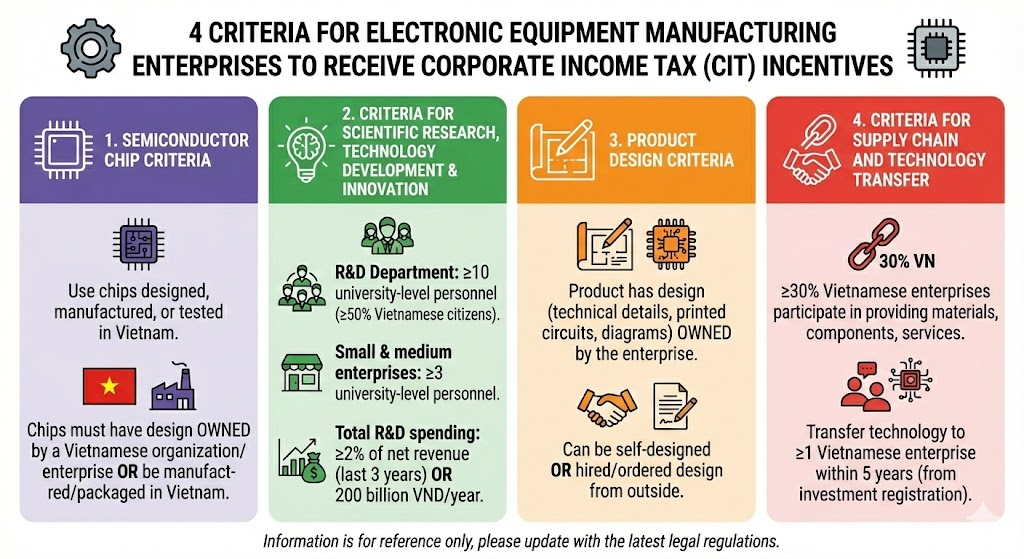
Circular 33/2025/TT-BKHCN (effective January 1, 2026) specifies four criteria for electronics manufacturing enterprises to qualify for CIT incentives. Enterprises must meet one or more:
1. Semiconductor Chip Usage Criteria
- Use semiconductor chips with designs owned by Vietnamese organizations, enterprises, or individuals (through self-design, hiring others to design, or purchasing designs).
- Use semiconductor chips manufactured or packaged/tested in Vietnam.
2. Research, Development, and Innovation Criteria
- For regular enterprises: Maintain a research and development department with minimum 10 university-educated personnel, at least 50% Vietnamese citizens.
- For SMEs: Minimum 3 university-educated personnel performing research, at least 50% Vietnamese citizens.
- R&D spending: Minimum 2% of average net revenue over 3 consecutive fiscal years, or 200 billion VND per year for 3 consecutive years. For newer enterprises, calculate over actual operation period (minimum 1 full fiscal year).
3. Product Design Ownership Criteria
- Electronic equipment products have designs (including specifications, architecture, detailed design, schematics, circuit layout, and technical documents) owned by the enterprise.
- Ownership established through self-design, hiring others to design, or purchasing designs.
4. Domestic Supply Chain and Technology Transfer Criteria
- Domestic supplier participation: Minimum 30% of suppliers for assembly, materials, components, and services are Vietnamese enterprises.
- Technology transfer: Transfer technology to at least 1 Vietnamese organization or enterprise within 5 years from Investment Registration Certificate or Investment Policy Approval date, complying with technology transfer regulations.
Key Takeaways for Businesses
Decree 320/2025/NĐ-CP and Circular 33/2025/TT-BKHCN establish a more rigorous tax framework adapted to the digital economy and e-commerce landscape. The most critical impact is the non-cash payment threshold reduction to 5 million VND (previously 20 million VND). Businesses must immediately review payment processes and spending policies to maintain expense deductibility. High-tech and electronics manufacturers should carefully evaluate the four new CIT incentive criteria to maximize benefits starting in 2026.
For guidance on compliance and tax strategy under these new regulations, contact Wacontre Accounting Services at Hotline: (028) 3820 1213 or email [email protected]. Our experienced team helps Vietnam company formation and tax compliance. (Japanese clients: Hotline (050) 5534 5505.)
6. Electronics Manufacturing CIT Incentive Criteria
Circular 33/2025/TT-BKHCN (effective January 1, 2026) specifies four criteria for electronics manufacturing enterprises to qualify for CIT incentives. Enterprises must meet one or more:
1. Semiconductor Chip Usage Criteria
- Use semiconductor chips with designs owned by Vietnamese organizations, enterprises, or individuals (through self-design, hiring others to design, or purchasing designs).
- Use semiconductor chips manufactured or packaged/tested in Vietnam.
2. Research, Development, and Innovation Criteria
- For regular enterprises: Maintain a research and development department with minimum 10 university-educated personnel, at least 50% Vietnamese citizens.
- For SMEs: Minimum 3 university-educated personnel performing research, at least 50% Vietnamese citizens.
- R&D spending: Minimum 2% of average net revenue over 3 consecutive fiscal years, or 200 billion VND per year for 3 consecutive years. For newer enterprises, calculate over actual operation period (minimum 1 full fiscal year).
3. Product Design Ownership Criteria
- Electronic equipment products have designs (including specifications, architecture, detailed design, schematics, circuit layout, and technical documents) owned by the enterprise.
- Ownership established through self-design, hiring others to design, or purchasing designs.
4. Domestic Supply Chain and Technology Transfer Criteria
- Domestic supplier participation: Minimum 30% of suppliers for assembly, materials, components, and services are Vietnamese enterprises.
- Technology transfer: Transfer technology to at least 1 Vietnamese organization or enterprise within 5 years from Investment Registration Certificate or Investment Policy Approval date, complying with technology transfer regulations.
Key Takeaways for Businesses
Decree 320/2025/NĐ-CP and Circular 33/2025/TT-BKHCN establish a more rigorous tax framework adapted to the digital economy and e-commerce landscape. The most critical impact is the non-cash payment threshold reduction to 5 million VND (previously 20 million VND). Businesses must immediately review payment processes and spending policies to maintain expense deductibility. High-tech and electronics manufacturers should carefully evaluate the four new CIT incentive criteria to maximize benefits starting in 2026.
For guidance on compliance and tax strategy under these new regulations, contact Wacontre Accounting Services at Hotline: (028) 3820 1213 or email [email protected]. Our experienced team helps Vietnam company formation and tax compliance. (Japanese clients: Hotline (050) 5534 5505.)
6. Electronics Manufacturing CIT Incentive Criteria
Circular 33/2025/TT-BKHCN (effective January 1, 2026) specifies four criteria for electronics manufacturing enterprises to qualify for CIT incentives. Enterprises must meet one or more:
1. Semiconductor Chip Usage Criteria
- Use semiconductor chips with designs owned by Vietnamese organizations, enterprises, or individuals (through self-design, hiring others to design, or purchasing designs).
- Use semiconductor chips manufactured or packaged/tested in Vietnam.
2. Research, Development, and Innovation Criteria
- For regular enterprises: Maintain a research and development department with minimum 10 university-educated personnel, at least 50% Vietnamese citizens.
- For SMEs: Minimum 3 university-educated personnel performing research, at least 50% Vietnamese citizens.
- R&D spending: Minimum 2% of average net revenue over 3 consecutive fiscal years, or 200 billion VND per year for 3 consecutive years. For newer enterprises, calculate over actual operation period (minimum 1 full fiscal year).
3. Product Design Ownership Criteria
- Electronic equipment products have designs (including specifications, architecture, detailed design, schematics, circuit layout, and technical documents) owned by the enterprise.
- Ownership established through self-design, hiring others to design, or purchasing designs.
4. Domestic Supply Chain and Technology Transfer Criteria
- Domestic supplier participation: Minimum 30% of suppliers for assembly, materials, components, and services are Vietnamese enterprises.
- Technology transfer: Transfer technology to at least 1 Vietnamese organization or enterprise within 5 years from Investment Registration Certificate or Investment Policy Approval date, complying with technology transfer regulations.
Key Takeaways for Businesses
Decree 320/2025/NĐ-CP and Circular 33/2025/TT-BKHCN establish a more rigorous tax framework adapted to the digital economy and e-commerce landscape. The most critical impact is the non-cash payment threshold reduction to 5 million VND (previously 20 million VND). Businesses must immediately review payment processes and spending policies to maintain expense deductibility. High-tech and electronics manufacturers should carefully evaluate the four new CIT incentive criteria to maximize benefits starting in 2026.
For guidance on compliance and tax strategy under these new regulations, contact Wacontre Accounting Services at Hotline: (028) 3820 1213 or email [email protected]. Our experienced team helps Vietnam company formation and tax compliance. (Japanese clients: Hotline (050) 5534 5505.)
6. Electronics Manufacturing CIT Incentive Criteria
Circular 33/2025/TT-BKHCN (effective January 1, 2026) specifies four criteria for electronics manufacturing enterprises to qualify for CIT incentives. Enterprises must meet one or more:
1. Semiconductor Chip Usage Criteria
- Use semiconductor chips with designs owned by Vietnamese organizations, enterprises, or individuals (through self-design, hiring others to design, or purchasing designs).
- Use semiconductor chips manufactured or packaged/tested in Vietnam.
2. Research, Development, and Innovation Criteria
- For regular enterprises: Maintain a research and development department with minimum 10 university-educated personnel, at least 50% Vietnamese citizens.
- For SMEs: Minimum 3 university-educated personnel performing research, at least 50% Vietnamese citizens.
- R&D spending: Minimum 2% of average net revenue over 3 consecutive fiscal years, or 200 billion VND per year for 3 consecutive years. For newer enterprises, calculate over actual operation period (minimum 1 full fiscal year).
3. Product Design Ownership Criteria
- Electronic equipment products have designs (including specifications, architecture, detailed design, schematics, circuit layout, and technical documents) owned by the enterprise.
- Ownership established through self-design, hiring others to design, or purchasing designs.
4. Domestic Supply Chain and Technology Transfer Criteria
- Domestic supplier participation: Minimum 30% of suppliers for assembly, materials, components, and services are Vietnamese enterprises.
- Technology transfer: Transfer technology to at least 1 Vietnamese organization or enterprise within 5 years from Investment Registration Certificate or Investment Policy Approval date, complying with technology transfer regulations.
Key Takeaways for Businesses
Decree 320/2025/NĐ-CP and Circular 33/2025/TT-BKHCN establish a more rigorous tax framework adapted to the digital economy and e-commerce landscape. The most critical impact is the non-cash payment threshold reduction to 5 million VND (previously 20 million VND). Businesses must immediately review payment processes and spending policies to maintain expense deductibility. High-tech and electronics manufacturers should carefully evaluate the four new CIT incentive criteria to maximize benefits starting in 2026.
For guidance on compliance and tax strategy under these new regulations, contact Wacontre Accounting Services at Hotline: (028) 3820 1213 or email [email protected]. Our experienced team helps Vietnam company formation and tax compliance. (Japanese clients: Hotline (050) 5534 5505.)
- Multiple purchases in one day: Purchases from one seller under 5 million VND, if totaling 5 million VND in one day, must have non-cash payment evidence.
- Employee-authorized purchases: Employees using non-cash payment for 5 million VND or more purchases can claim reimbursement if authorized and documented according to company policy.
- Accrued but not yet paid: Expenses recorded before payment can be deducted; however, if non-cash payment evidence is not available at payment time, the expense must be reduced in the tax period when cash payment occurs.
6. Electronics Manufacturing CIT Incentive Criteria
Circular 33/2025/TT-BKHCN (effective January 1, 2026) specifies four criteria for electronics manufacturing enterprises to qualify for CIT incentives. Enterprises must meet one or more:
1. Semiconductor Chip Usage Criteria
- Use semiconductor chips with designs owned by Vietnamese organizations, enterprises, or individuals (through self-design, hiring others to design, or purchasing designs).
- Use semiconductor chips manufactured or packaged/tested in Vietnam.
2. Research, Development, and Innovation Criteria
- For regular enterprises: Maintain a research and development department with minimum 10 university-educated personnel, at least 50% Vietnamese citizens.
- For SMEs: Minimum 3 university-educated personnel performing research, at least 50% Vietnamese citizens.
- R&D spending: Minimum 2% of average net revenue over 3 consecutive fiscal years, or 200 billion VND per year for 3 consecutive years. For newer enterprises, calculate over actual operation period (minimum 1 full fiscal year).
3. Product Design Ownership Criteria
- Electronic equipment products have designs (including specifications, architecture, detailed design, schematics, circuit layout, and technical documents) owned by the enterprise.
- Ownership established through self-design, hiring others to design, or purchasing designs.
4. Domestic Supply Chain and Technology Transfer Criteria
- Domestic supplier participation: Minimum 30% of suppliers for assembly, materials, components, and services are Vietnamese enterprises.
- Technology transfer: Transfer technology to at least 1 Vietnamese organization or enterprise within 5 years from Investment Registration Certificate or Investment Policy Approval date, complying with technology transfer regulations.
Key Takeaways for Businesses
Decree 320/2025/NĐ-CP and Circular 33/2025/TT-BKHCN establish a more rigorous tax framework adapted to the digital economy and e-commerce landscape. The most critical impact is the non-cash payment threshold reduction to 5 million VND (previously 20 million VND). Businesses must immediately review payment processes and spending policies to maintain expense deductibility. High-tech and electronics manufacturers should carefully evaluate the four new CIT incentive criteria to maximize benefits starting in 2026.
For guidance on compliance and tax strategy under these new regulations, contact Wacontre Accounting Services at Hotline: (028) 3820 1213 or email [email protected]. Our experienced team helps Vietnam company formation and tax compliance. (Japanese clients: Hotline (050) 5534 5505.)
5. Non-Cash Payment Requirement for Expense Deductibility
Major Change: The threshold for non-cash payment documentation has dropped from 20 million VND to 5 million VND. Article 9, Clause 1, Point c states that expenses for purchasing goods, services, and payments on invoices valued at 5 million VND or more require non-cash payment evidence to be deductible.
Key Details:
- Multiple purchases in one day: Purchases from one seller under 5 million VND, if totaling 5 million VND in one day, must have non-cash payment evidence.
- Employee-authorized purchases: Employees using non-cash payment for 5 million VND or more purchases can claim reimbursement if authorized and documented according to company policy.
- Accrued but not yet paid: Expenses recorded before payment can be deducted; however, if non-cash payment evidence is not available at payment time, the expense must be reduced in the tax period when cash payment occurs.
6. Electronics Manufacturing CIT Incentive Criteria
Circular 33/2025/TT-BKHCN (effective January 1, 2026) specifies four criteria for electronics manufacturing enterprises to qualify for CIT incentives. Enterprises must meet one or more:
1. Semiconductor Chip Usage Criteria
- Use semiconductor chips with designs owned by Vietnamese organizations, enterprises, or individuals (through self-design, hiring others to design, or purchasing designs).
- Use semiconductor chips manufactured or packaged/tested in Vietnam.
2. Research, Development, and Innovation Criteria
- For regular enterprises: Maintain a research and development department with minimum 10 university-educated personnel, at least 50% Vietnamese citizens.
- For SMEs: Minimum 3 university-educated personnel performing research, at least 50% Vietnamese citizens.
- R&D spending: Minimum 2% of average net revenue over 3 consecutive fiscal years, or 200 billion VND per year for 3 consecutive years. For newer enterprises, calculate over actual operation period (minimum 1 full fiscal year).
3. Product Design Ownership Criteria
- Electronic equipment products have designs (including specifications, architecture, detailed design, schematics, circuit layout, and technical documents) owned by the enterprise.
- Ownership established through self-design, hiring others to design, or purchasing designs.
4. Domestic Supply Chain and Technology Transfer Criteria
- Domestic supplier participation: Minimum 30% of suppliers for assembly, materials, components, and services are Vietnamese enterprises.
- Technology transfer: Transfer technology to at least 1 Vietnamese organization or enterprise within 5 years from Investment Registration Certificate or Investment Policy Approval date, complying with technology transfer regulations.
Key Takeaways for Businesses
Decree 320/2025/NĐ-CP and Circular 33/2025/TT-BKHCN establish a more rigorous tax framework adapted to the digital economy and e-commerce landscape. The most critical impact is the non-cash payment threshold reduction to 5 million VND (previously 20 million VND). Businesses must immediately review payment processes and spending policies to maintain expense deductibility. High-tech and electronics manufacturers should carefully evaluate the four new CIT incentive criteria to maximize benefits starting in 2026.
For guidance on compliance and tax strategy under these new regulations, contact Wacontre Accounting Services at Hotline: (028) 3820 1213 or email [email protected]. Our experienced team helps Vietnam company formation and tax compliance. (Japanese clients: Hotline (050) 5534 5505.)
New Technology Products: Article 4, Clause 4, Point b establishes a 3-year tax exemption (reduced from the previous 5-year maximum) for income from selling products made with new technology applied for the first time in Vietnam.
5. Non-Cash Payment Requirement for Expense Deductibility
Major Change: The threshold for non-cash payment documentation has dropped from 20 million VND to 5 million VND. Article 9, Clause 1, Point c states that expenses for purchasing goods, services, and payments on invoices valued at 5 million VND or more require non-cash payment evidence to be deductible.
Key Details:
- Multiple purchases in one day: Purchases from one seller under 5 million VND, if totaling 5 million VND in one day, must have non-cash payment evidence.
- Employee-authorized purchases: Employees using non-cash payment for 5 million VND or more purchases can claim reimbursement if authorized and documented according to company policy.
- Accrued but not yet paid: Expenses recorded before payment can be deducted; however, if non-cash payment evidence is not available at payment time, the expense must be reduced in the tax period when cash payment occurs.
6. Electronics Manufacturing CIT Incentive Criteria
Circular 33/2025/TT-BKHCN (effective January 1, 2026) specifies four criteria for electronics manufacturing enterprises to qualify for CIT incentives. Enterprises must meet one or more:
1. Semiconductor Chip Usage Criteria
- Use semiconductor chips with designs owned by Vietnamese organizations, enterprises, or individuals (through self-design, hiring others to design, or purchasing designs).
- Use semiconductor chips manufactured or packaged/tested in Vietnam.
2. Research, Development, and Innovation Criteria
- For regular enterprises: Maintain a research and development department with minimum 10 university-educated personnel, at least 50% Vietnamese citizens.
- For SMEs: Minimum 3 university-educated personnel performing research, at least 50% Vietnamese citizens.
- R&D spending: Minimum 2% of average net revenue over 3 consecutive fiscal years, or 200 billion VND per year for 3 consecutive years. For newer enterprises, calculate over actual operation period (minimum 1 full fiscal year).
3. Product Design Ownership Criteria
- Electronic equipment products have designs (including specifications, architecture, detailed design, schematics, circuit layout, and technical documents) owned by the enterprise.
- Ownership established through self-design, hiring others to design, or purchasing designs.
4. Domestic Supply Chain and Technology Transfer Criteria
- Domestic supplier participation: Minimum 30% of suppliers for assembly, materials, components, and services are Vietnamese enterprises.
- Technology transfer: Transfer technology to at least 1 Vietnamese organization or enterprise within 5 years from Investment Registration Certificate or Investment Policy Approval date, complying with technology transfer regulations.
Key Takeaways for Businesses
Decree 320/2025/NĐ-CP and Circular 33/2025/TT-BKHCN establish a more rigorous tax framework adapted to the digital economy and e-commerce landscape. The most critical impact is the non-cash payment threshold reduction to 5 million VND (previously 20 million VND). Businesses must immediately review payment processes and spending policies to maintain expense deductibility. High-tech and electronics manufacturers should carefully evaluate the four new CIT incentive criteria to maximize benefits starting in 2026.
For guidance on compliance and tax strategy under these new regulations, contact Wacontre Accounting Services at Hotline: (028) 3820 1213 or email [email protected]. Our experienced team helps Vietnam company formation and tax compliance. (Japanese clients: Hotline (050) 5534 5505.)
New Technology Products: Article 4, Clause 4, Point b establishes a 3-year tax exemption (reduced from the previous 5-year maximum) for income from selling products made with new technology applied for the first time in Vietnam.
5. Non-Cash Payment Requirement for Expense Deductibility
Major Change: The threshold for non-cash payment documentation has dropped from 20 million VND to 5 million VND. Article 9, Clause 1, Point c states that expenses for purchasing goods, services, and payments on invoices valued at 5 million VND or more require non-cash payment evidence to be deductible.
Key Details:
- Multiple purchases in one day: Purchases from one seller under 5 million VND, if totaling 5 million VND in one day, must have non-cash payment evidence.
- Employee-authorized purchases: Employees using non-cash payment for 5 million VND or more purchases can claim reimbursement if authorized and documented according to company policy.
- Accrued but not yet paid: Expenses recorded before payment can be deducted; however, if non-cash payment evidence is not available at payment time, the expense must be reduced in the tax period when cash payment occurs.
6. Electronics Manufacturing CIT Incentive Criteria
Circular 33/2025/TT-BKHCN (effective January 1, 2026) specifies four criteria for electronics manufacturing enterprises to qualify for CIT incentives. Enterprises must meet one or more:
1. Semiconductor Chip Usage Criteria
- Use semiconductor chips with designs owned by Vietnamese organizations, enterprises, or individuals (through self-design, hiring others to design, or purchasing designs).
- Use semiconductor chips manufactured or packaged/tested in Vietnam.
2. Research, Development, and Innovation Criteria
- For regular enterprises: Maintain a research and development department with minimum 10 university-educated personnel, at least 50% Vietnamese citizens.
- For SMEs: Minimum 3 university-educated personnel performing research, at least 50% Vietnamese citizens.
- R&D spending: Minimum 2% of average net revenue over 3 consecutive fiscal years, or 200 billion VND per year for 3 consecutive years. For newer enterprises, calculate over actual operation period (minimum 1 full fiscal year).
3. Product Design Ownership Criteria
- Electronic equipment products have designs (including specifications, architecture, detailed design, schematics, circuit layout, and technical documents) owned by the enterprise.
- Ownership established through self-design, hiring others to design, or purchasing designs.
4. Domestic Supply Chain and Technology Transfer Criteria
- Domestic supplier participation: Minimum 30% of suppliers for assembly, materials, components, and services are Vietnamese enterprises.
- Technology transfer: Transfer technology to at least 1 Vietnamese organization or enterprise within 5 years from Investment Registration Certificate or Investment Policy Approval date, complying with technology transfer regulations.
Key Takeaways for Businesses
Decree 320/2025/NĐ-CP and Circular 33/2025/TT-BKHCN establish a more rigorous tax framework adapted to the digital economy and e-commerce landscape. The most critical impact is the non-cash payment threshold reduction to 5 million VND (previously 20 million VND). Businesses must immediately review payment processes and spending policies to maintain expense deductibility. High-tech and electronics manufacturers should carefully evaluate the four new CIT incentive criteria to maximize benefits starting in 2026.
For guidance on compliance and tax strategy under these new regulations, contact Wacontre Accounting Services at Hotline: (028) 3820 1213 or email [email protected]. Our experienced team helps Vietnam company formation and tax compliance. (Japanese clients: Hotline (050) 5534 5505.)
4. Expanded Tax-Exempt Income Categories
Article 4, Clause 3 adds tax-exempt income from technical services directly supporting agriculture, including:
- Flood drainage and flood prevention services
- High tide prevention and salinity prevention services
- Salinity and alum washing services
- Fresh water retention services
New Technology Products: Article 4, Clause 4, Point b establishes a 3-year tax exemption (reduced from the previous 5-year maximum) for income from selling products made with new technology applied for the first time in Vietnam.
5. Non-Cash Payment Requirement for Expense Deductibility
Major Change: The threshold for non-cash payment documentation has dropped from 20 million VND to 5 million VND. Article 9, Clause 1, Point c states that expenses for purchasing goods, services, and payments on invoices valued at 5 million VND or more require non-cash payment evidence to be deductible.
Key Details:
- Multiple purchases in one day: Purchases from one seller under 5 million VND, if totaling 5 million VND in one day, must have non-cash payment evidence.
- Employee-authorized purchases: Employees using non-cash payment for 5 million VND or more purchases can claim reimbursement if authorized and documented according to company policy.
- Accrued but not yet paid: Expenses recorded before payment can be deducted; however, if non-cash payment evidence is not available at payment time, the expense must be reduced in the tax period when cash payment occurs.
6. Electronics Manufacturing CIT Incentive Criteria
Circular 33/2025/TT-BKHCN (effective January 1, 2026) specifies four criteria for electronics manufacturing enterprises to qualify for CIT incentives. Enterprises must meet one or more:
1. Semiconductor Chip Usage Criteria
- Use semiconductor chips with designs owned by Vietnamese organizations, enterprises, or individuals (through self-design, hiring others to design, or purchasing designs).
- Use semiconductor chips manufactured or packaged/tested in Vietnam.
2. Research, Development, and Innovation Criteria
- For regular enterprises: Maintain a research and development department with minimum 10 university-educated personnel, at least 50% Vietnamese citizens.
- For SMEs: Minimum 3 university-educated personnel performing research, at least 50% Vietnamese citizens.
- R&D spending: Minimum 2% of average net revenue over 3 consecutive fiscal years, or 200 billion VND per year for 3 consecutive years. For newer enterprises, calculate over actual operation period (minimum 1 full fiscal year).
3. Product Design Ownership Criteria
- Electronic equipment products have designs (including specifications, architecture, detailed design, schematics, circuit layout, and technical documents) owned by the enterprise.
- Ownership established through self-design, hiring others to design, or purchasing designs.
4. Domestic Supply Chain and Technology Transfer Criteria
- Domestic supplier participation: Minimum 30% of suppliers for assembly, materials, components, and services are Vietnamese enterprises.
- Technology transfer: Transfer technology to at least 1 Vietnamese organization or enterprise within 5 years from Investment Registration Certificate or Investment Policy Approval date, complying with technology transfer regulations.
Key Takeaways for Businesses
Decree 320/2025/NĐ-CP and Circular 33/2025/TT-BKHCN establish a more rigorous tax framework adapted to the digital economy and e-commerce landscape. The most critical impact is the non-cash payment threshold reduction to 5 million VND (previously 20 million VND). Businesses must immediately review payment processes and spending policies to maintain expense deductibility. High-tech and electronics manufacturers should carefully evaluate the four new CIT incentive criteria to maximize benefits starting in 2026.
For guidance on compliance and tax strategy under these new regulations, contact Wacontre Accounting Services at Hotline: (028) 3820 1213 or email [email protected]. Our experienced team helps Vietnam company formation and tax compliance. (Japanese clients: Hotline (050) 5534 5505.)
4. Expanded Tax-Exempt Income Categories
Article 4, Clause 3 adds tax-exempt income from technical services directly supporting agriculture, including:
- Flood drainage and flood prevention services
- High tide prevention and salinity prevention services
- Salinity and alum washing services
- Fresh water retention services
New Technology Products: Article 4, Clause 4, Point b establishes a 3-year tax exemption (reduced from the previous 5-year maximum) for income from selling products made with new technology applied for the first time in Vietnam.
5. Non-Cash Payment Requirement for Expense Deductibility
Major Change: The threshold for non-cash payment documentation has dropped from 20 million VND to 5 million VND. Article 9, Clause 1, Point c states that expenses for purchasing goods, services, and payments on invoices valued at 5 million VND or more require non-cash payment evidence to be deductible.
Key Details:
- Multiple purchases in one day: Purchases from one seller under 5 million VND, if totaling 5 million VND in one day, must have non-cash payment evidence.
- Employee-authorized purchases: Employees using non-cash payment for 5 million VND or more purchases can claim reimbursement if authorized and documented according to company policy.
- Accrued but not yet paid: Expenses recorded before payment can be deducted; however, if non-cash payment evidence is not available at payment time, the expense must be reduced in the tax period when cash payment occurs.
6. Electronics Manufacturing CIT Incentive Criteria
Circular 33/2025/TT-BKHCN (effective January 1, 2026) specifies four criteria for electronics manufacturing enterprises to qualify for CIT incentives. Enterprises must meet one or more:
1. Semiconductor Chip Usage Criteria
- Use semiconductor chips with designs owned by Vietnamese organizations, enterprises, or individuals (through self-design, hiring others to design, or purchasing designs).
- Use semiconductor chips manufactured or packaged/tested in Vietnam.
2. Research, Development, and Innovation Criteria
- For regular enterprises: Maintain a research and development department with minimum 10 university-educated personnel, at least 50% Vietnamese citizens.
- For SMEs: Minimum 3 university-educated personnel performing research, at least 50% Vietnamese citizens.
- R&D spending: Minimum 2% of average net revenue over 3 consecutive fiscal years, or 200 billion VND per year for 3 consecutive years. For newer enterprises, calculate over actual operation period (minimum 1 full fiscal year).
3. Product Design Ownership Criteria
- Electronic equipment products have designs (including specifications, architecture, detailed design, schematics, circuit layout, and technical documents) owned by the enterprise.
- Ownership established through self-design, hiring others to design, or purchasing designs.
4. Domestic Supply Chain and Technology Transfer Criteria
- Domestic supplier participation: Minimum 30% of suppliers for assembly, materials, components, and services are Vietnamese enterprises.
- Technology transfer: Transfer technology to at least 1 Vietnamese organization or enterprise within 5 years from Investment Registration Certificate or Investment Policy Approval date, complying with technology transfer regulations.
Key Takeaways for Businesses
Decree 320/2025/NĐ-CP and Circular 33/2025/TT-BKHCN establish a more rigorous tax framework adapted to the digital economy and e-commerce landscape. The most critical impact is the non-cash payment threshold reduction to 5 million VND (previously 20 million VND). Businesses must immediately review payment processes and spending policies to maintain expense deductibility. High-tech and electronics manufacturers should carefully evaluate the four new CIT incentive criteria to maximize benefits starting in 2026.
For guidance on compliance and tax strategy under these new regulations, contact Wacontre Accounting Services at Hotline: (028) 3820 1213 or email [email protected]. Our experienced team helps Vietnam company formation and tax compliance. (Japanese clients: Hotline (050) 5534 5505.)