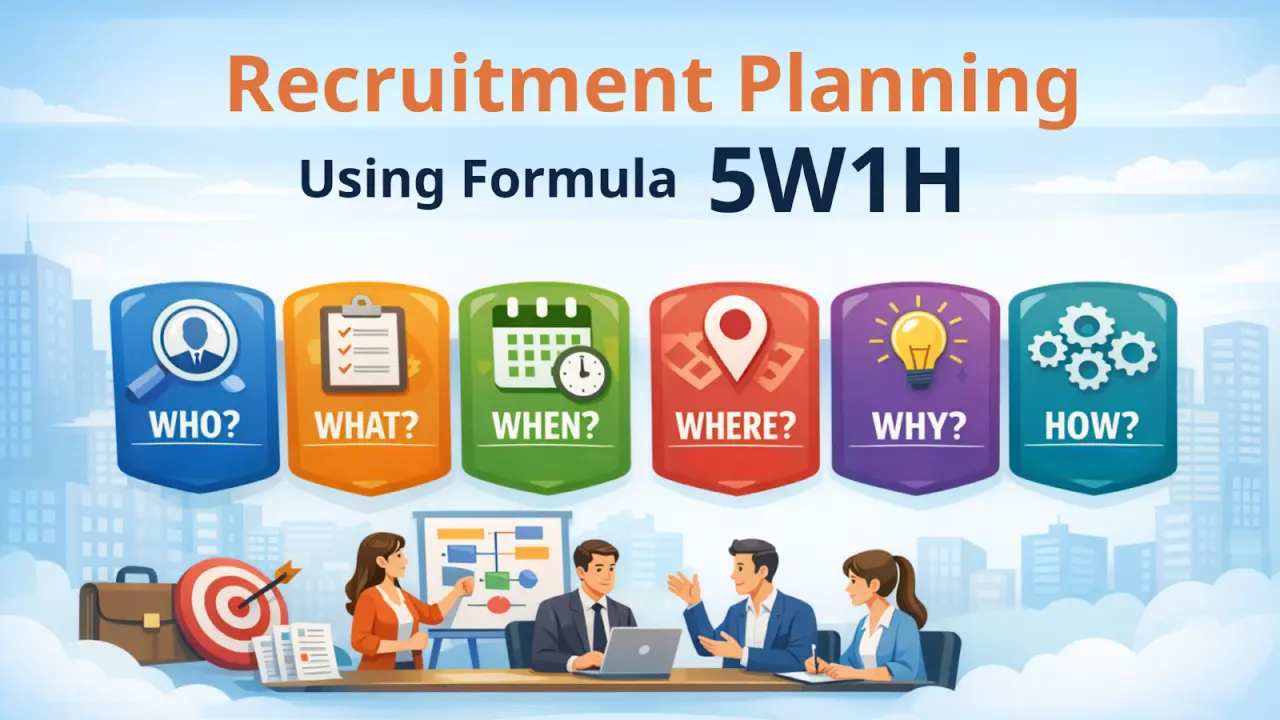
Building a professional recruitment process is essential for sustainable growth. This guide walks you through recruitment planning using the 5W1H framework—a strategic approach to talent acquisition designed to clarify objectives and optimize your hiring outcomes.
What is Recruitment Planning Using the 5W1H Framework?
The 5W1H method is a comprehensive thinking approach used in business and Human Resources to systematically define problem elements. In recruitment planning, the 5W1H framework answers six essential questions: Why (hire?), Who (to hire and who decides?), What (position?), Where (to recruit?), When (to hire?), and How (to recruit?).
Applying this model transforms HR from reactive (hiring only when someone leaves) to proactive (forecasting and preparing resources). A plan built on 5W1H ensures complete coverage—from budget and evaluation criteria to candidate experience. This serves as the foundation for successful recruitment, providing both strategic and detailed views of your talent acquisition campaign.
The Six Elements of 5W1H in Recruitment
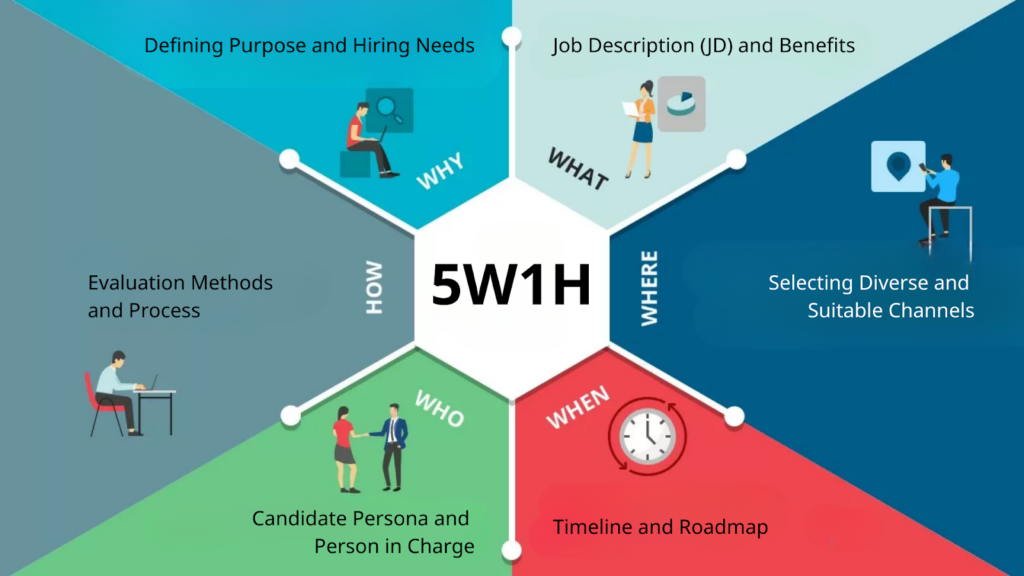
Building successful talent acquisition requires analyzing each element. Each component of 5W1H is crucial and interdependent.
1. Why: Define Purpose and Business Need
The foundation of any recruitment plan is answering: Why do we need to hire for this position now? This justifies budget approval and headcount decisions. Work closely with department heads to identify the root cause: Is it business expansion, replacing departures, or filling a skills gap?
Without clarity on “Why,” recruitment easily derails, resulting in poor hires or unnecessary positions. For example, if sales targets are missing, the issue may not be staff shortfall but process inefficiency or product quality. HR acts as a strategic partner, advising whether hiring is truly the optimal solution.
2. Who: Candidate Profile and Decision Maker
The “Who” element addresses two critical aspects:
- Candidate Profile: Create a detailed portrait beyond technical skills. Define soft skills, attitude, and cultural fit. A highly skilled professional with a negative attitude can damage team cohesion.
- Decision Authority: Clarify roles: Who conducts initial screening (HR), technical interviews (Department Manager), and makes the final decision? Defining this prevents evaluation conflicts and ensures smooth operations.
3. What: Job Description and Value Proposition
Once you know who to hire and why, formalize it: Job Description (JD) and Compensation & Benefits package. A strong job posting is compelling marketing content, not a dry checklist. Highlight: What will candidates do? What value will they create? What do they receive?
“What” also includes defining your Employee Value Proposition (EVP). What differentiates your company? Flexible work, overseas training, clear career paths? This answers the candidate’s question: “What’s in it for me?”
2. Unrealistic Candidate Requirements
Seeking “superstars” at below-market salaries leads nowhere. HR must advise management on realistic expectations.
3. Poor Channel Selection
Posting only on free Facebook pages or buying packages just because they’re discounted misses your actual candidate pool. Choose channels where your target candidates spend time.
Conclusion
Recruitment planning using the 5W1H framework is more than a management tool—it’s a strategic mindset for modern HR. Thoroughly answering all six questions creates a detailed roadmap for finding talent.
In today’s competitive environment, companies that plan thoroughly, understand their market, and use diverse channels (from major platforms like VietnamWorks and TopCV to specialized sites like ViecOi and ITviec) win the talent war. Start reviewing your recruitment process today to build a stronger workforce.
For assistance with recruitment strategy and talent management, contact Wacontre Accounting Services at Hotline: (028) 3820 1213 or email [email protected]. Our experienced team supports Vietnam company formation and HR strategy. (Japanese clients: Hotline (050) 5534 5505.)
4. Where: Select Appropriate Recruitment Channels
The “Where” question determines how you reach target candidates. In the digital age, channel selection significantly impacts application quality. Use a multi-channel recruitment strategy tailored to position specifics:
- General Job Boards: For entry to mid-level positions, platforms like VietnamWorks, TopCV, and CareerBuilder offer high visibility and quick volume.
- Specialized Platforms: For specific needs (Japanese language, technical, manufacturing), niche sites like ViecOi or ITviec provide higher-quality matches than mass-market boards.
- Professional Networks: For leadership roles, LinkedIn is essential for accessing passive candidates.
- Social Media: Facebook and Zalo work well for high-volume or intern/part-time recruitment through industry groups.
When planning recruitment with 5W1H, allocate budgets by channel based on historical performance. Avoid concentrating all resources in one channel.
5. When: Create a Timeline and Roadmap
“When” extends beyond start date to include backward planning from onboarding to present. Calculate:
- Days needed to collect sufficient applications
- Interview round timeline
- Candidate notice period at current employer (typically 30-45 days)
Consider seasonality. Post-Lunar New Year is peak hiring season as employees often change jobs. Year-end is slower. Smart talent acquisition leverages these windows to launch campaigns at optimal times.
6. How: Define Evaluation and Process
“How” specifies your screening and selection approach:
- Screening Method: Phone screening or direct interview? Behavioral (STAR) or situational interviews? Competency or personality assessments (DISC/MBTI)?
- Operational Process: Which tools manage candidate profiles? (Excel, Google Sheets, or professional ATS software).
- Candidate Experience: How are offers or rejection letters handled to maintain professionalism? Using technology allows HR to focus on evaluating people.
Key Benefits of 5W1H Recruitment Planning
1. Reduce Bad Hires and Wasteful Spending
Bad hires carry hidden costs: salary, bonuses, posting fees, training, and lost productivity. Applying 5W1H planning clarifies “Who” and “What” upfront, improving candidate filtering and minimizing unsuitable applications.
2. Standardize Workflows Between HR and Departments
HR-manager conflict is common. The 5W1H framework acts as a Service Level Agreement (SLA). When all elements are agreed in writing beforehand, responsibilities and expectations are transparent, enabling seamless collaboration.
3. Strengthen Candidate Experience and Employer Brand
Candidates evaluate companies too. A chaotic process creates negative impressions. A well-designed process based on 5W1H—from choosing reputable channels to professional interviews—makes candidates feel valued, building strong employer branding.
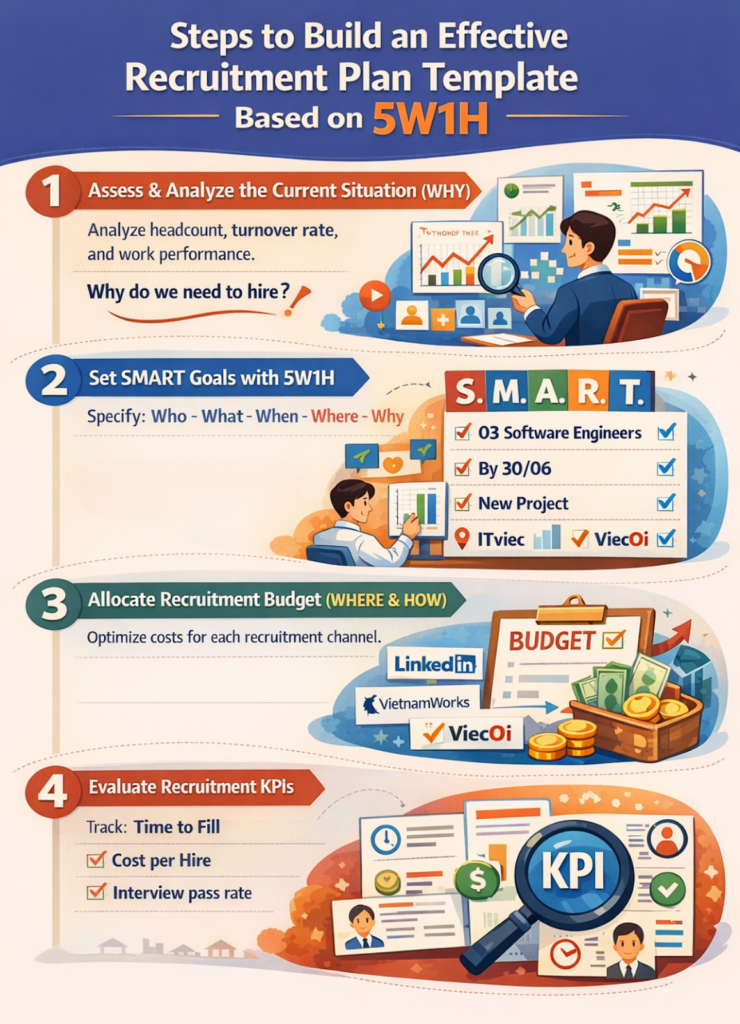
Building an Effective Recruitment Plan: Step-by-Step
1. Assess Current Situation
Analyze your business structure, turnover rates, and past recruitment data. Base the “Why” on solid facts.
2. Set SMART Goals Using 5W1H
Convert needs into SMART targets. Example: “Hire 3 Software Engineers (Who) by June 30 (When) for the new project (Why), via ITviec and ViecOi (Where) with budget of X.”
3. Allocate Budget by Channel
Detail all costs. Allocate smartly: Higher budgets for LinkedIn for director-level roles; job board packages for technical specialists. Always reserve contingency funds.
4. Establish Recruitment Metrics
Track metrics like Time to Fill, Cost per Hire, and Interview Pass Rate. Monitoring enables continuous improvement.
Common Mistakes to Avoid
1. Skipping the “Why” Analysis
Posting jobs without proper analysis leads to overstaffing without productivity gains.
2. Unrealistic Candidate Requirements
Seeking “superstars” at below-market salaries leads nowhere. HR must advise management on realistic expectations.
3. Poor Channel Selection
Posting only on free Facebook pages or buying packages just because they’re discounted misses your actual candidate pool. Choose channels where your target candidates spend time.
Conclusion
Recruitment planning using the 5W1H framework is more than a management tool—it’s a strategic mindset for modern HR. Thoroughly answering all six questions creates a detailed roadmap for finding talent.
In today’s competitive environment, companies that plan thoroughly, understand their market, and use diverse channels (from major platforms like VietnamWorks and TopCV to specialized sites like ViecOi and ITviec) win the talent war. Start reviewing your recruitment process today to build a stronger workforce.
For assistance with recruitment strategy and talent management, contact Wacontre Accounting Services at Hotline: (028) 3820 1213 or email [email protected]. Our experienced team supports Vietnam company formation and HR strategy. (Japanese clients: Hotline (050) 5534 5505.)