Long-term foreign loans provide strategic financing for businesses to fund major investments such as facility expansion, equipment purchases, or capital restructuring. To ensure legal compliance with Vietnam regulations, enterprises must complete the formal registration process established by the State Bank of Vietnam (SBV). This guide explains loan classification criteria, registration procedures, compliance requirements, and risk management essentials.
1. Understanding Long-Term Foreign Loans and Registration Requirements
Definition Under Vietnamese Law
A long-term foreign loan is financing obtained by a Vietnamese company from a foreign entity with a term exceeding 12 months, measured from initial disbursement to final repayment of principal and interest. These loans typically finance extended investment activities including factory construction, equipment acquisition, project development, or financial restructuring. Under Circular 12/2022/TT-NHNN, all long-term foreign loans without Government guarantee require mandatory registration with the State Bank of Vietnam before disbursement.
Long-Term Versus Short-Term Loans
Key distinctions determine regulatory treatment:
- Short-term loans: Terms under 12 months, typically for working capital, with no registration requirement if conditions are satisfied.
- Long-term loans: Terms of 12 months or longer, requiring mandatory SBV registration prior to fund receipt.
Should a short-term loan be extended beyond 12 months, the company must register it as long-term.
Related: Short-Term Foreign Loan Registration
When Registration is Mandatory
SBV registration is required when:
- Original loan term exceeds 12 months;
- Short-term loans are extended or become overdue, extending the actual term beyond one year;
- Funds are designated for long-term investment or capital contribution.
Registration occurs through SBV’s online portal (qlnh-sbv system). Companies may only receive disbursement after SBV approves the application and issues an official loan code.
Exemptions from Registration
Registration is not required for:
- Short-term loans (under 12 months) without extension;
- Loans below SBV’s reporting threshold;
- Internal advances within FDI companies repaid on schedule.
Nevertheless, periodic SBV reporting may still be required for loans exceeding specified thresholds.
Key Legal Framework
Principal regulations governing long-term foreign borrowing include:
- Circular 12/2022/TT-NHNN – comprehensive regulations on loan conditions, registration, fund use, and reporting;
- Decree 219/2013/NĐ-CP – foreign borrowing and repayment without Government guarantee;
- SBV guidance, decisions, and authorized bank instructions.
Understanding these regulations helps companies avoid compliance risks and manage international borrowing effectively.
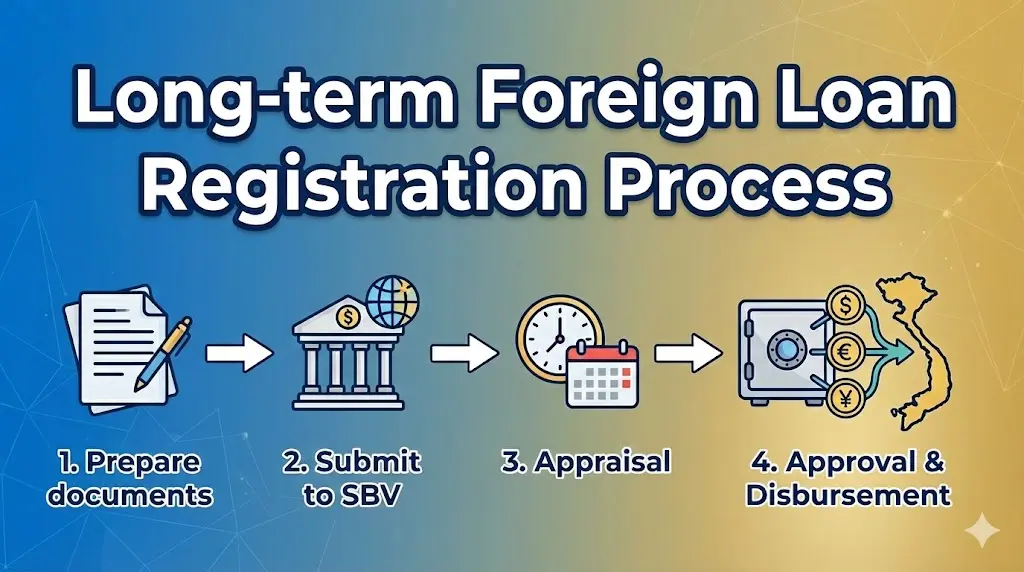
2. Step-by-Step Registration Process
Accurate completion of the registration procedure is essential to ensure legal validity and avoid financial or regulatory risks. Below are the required steps enterprises must follow when registering long-term foreign loans with SBV.
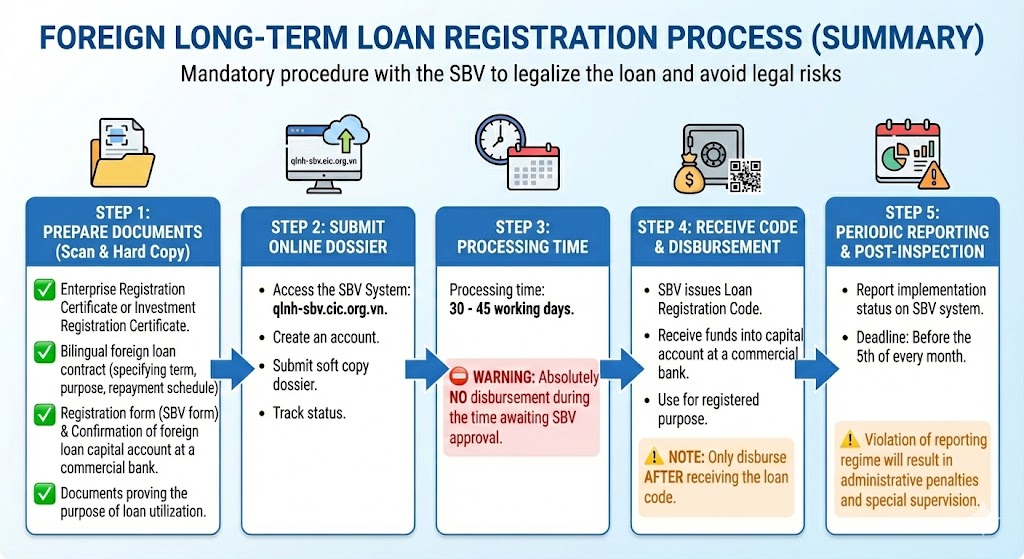
Prepare the Registration Application
Compile a complete application file including:
- Business Registration Certificate or Investment Registration Certificate (for FDI enterprises);
- Bilingual loan agreement clearly stating term, fund purpose, and repayment schedule;
- SBV’s official loan registration form;
- Confirmation of the loan capital account at a licensed commercial bank;
- Supporting documents proving loan purpose (financial statements, investment plan, if requested).
Scan all documents for online submission; retain hard copies for potential authority review.
Submit via SBV Online Portal
Long-term foreign loan registration is completed through SBV’s online system:
https://qlnh-sbv.cic.org.vn
The company must:
- Create an online account;
- Enter all loan details into the system;
- Upload electronic copies of application documents;
- Monitor application status through the portal.
If SBV approves the file, notification appears in the system. Additional document requests will include specific instructions.
Review Timeline and Process
SBV’s review schedule is:
- Standard processing: up to 30 working days for complete, valid applications;
- Extended processing: up to 45 working days when central SBV departments require additional review;
- During review, companies cannot receive disbursement.
Following proper procedures minimizes rejection risk, reduces delays, and maintains credibility with foreign lenders.
Loan Code Issuance and Fund Receipt
Upon approval, SBV issues an official Loan Code authorizing fund receipt.
The company may then:
- Receive loan proceeds into its designated foreign loan capital account at a commercial bank;
- Use funds strictly according to the registered purpose.
Important: Receiving disbursement before obtaining the official Loan Code violates foreign exchange regulations.
Ongoing Compliance and Reporting
Borrowers must submit monthly reports (by the 5th of each month) through SBV’s online portal covering:
- Drawdowns, principal repayments, interest and fees;
- Current outstanding balance;
- Any loan term amendments or changes.
Late or inaccurate reporting may trigger administrative penalties and enhanced regulatory supervision.
3. Managing Common Implementation Challenges
Although SBV has digitalized and simplified the registration process, many companies encounter difficulties due to limited experience or unfamiliarity with legal requirements. Below are common obstacles and solutions.
Typical Obstacles
Common challenges include:
- Uncertainty about online account creation or incorrect form completion;
- Missing required documents such as loan capital account confirmation or bilingual translations;
- Confusion regarding when registration versus periodic reporting applies;
- Failure to meet deadlines or receiving funds before obtaining the official Loan Code.
Responding to SBV Information Requests
When SBV requests additional information:
- Carefully review notifications on the qlnh-sbv portal;
- Provide missing documents in correct format (PDF, bilingual if required);
- Contact the Foreign Exchange Management Division of the local SBV branch if clarification is needed.
Prompt, accurate responses expedite processing and improve approval rates.
Critical Mistakes to Avoid
Common errors causing SBV rejection include:
- Loan agreements missing clear terms such as interest rate, tenure, or detailed repayment schedule;
- Missing signatures, seals, or bank confirmations;
- Incorrect document sequence or missing Vietnamese translations;
- Failure to justify loan purpose or provide clear repayment plans.
Thorough pre-submission review significantly reduces rejection likelihood.
Document Translation and Authenticity
Foreign loan agreements must include Vietnamese translations. While consular legalization typically is not required:
- Documents must bear lawful signatures and the lender’s official seal;
- For handwritten or complex documents, SBV may request originals or additional bank confirmation.
Properly standardized documents facilitate review and minimize rejection risk.
Internal Team Coordination
Accounting and legal departments play essential roles:
- Accounting: monitors disbursement timing, prepares accurate monthly reports, tracks repayments;
- Legal: verifies loan contract validity, prepares application documentation, ensures SBV compliance.
Effective coordination prevents penalties, delays, and loan use interruptions. Professional advisory services are highly recommended if the company lacks expertise.
4. Primary Risk Areas and Mitigation Strategies
Long-term foreign borrowing is a valuable financing tool but carries significant risks if companies fail to comply with legal requirements—particularly regarding registration, proper fund use, and periodic reporting. Below are five major risks and their consequences.
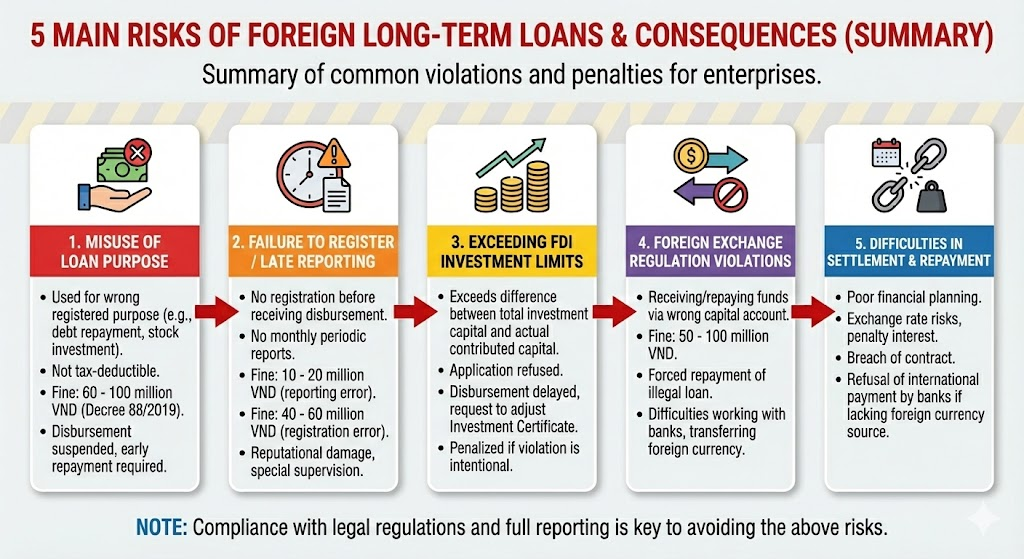
Misuse of Loan Proceeds
A critical violation is using loan proceeds for purposes other than those registered with SBV. Examples include:
- Registering for equipment investment but using funds for debt repayment or securities investment;
- Changing intended use without SBV notification.
Consequences include:
- Interest expense disallowance for corporate income tax purposes;
- Administrative penalties of VND 60–100 million under Decree 88/2019/NĐ-CP;
- Possible disbursement suspension and early loan repayment requirement.
Registration and Reporting Failures
By law, companies must:
- Register long-term loans before disbursement;
- Submit monthly implementation reports.
Violations result in:
- Penalties of VND 10–20 million for reporting failures or inaccurate data;
- Penalties of VND 40–60 million for failure to register;
- Increased regulatory monitoring and credibility damage.
Investment Capital Limits for FDI Enterprises
For foreign-invested companies, long-term foreign loans cannot exceed the gap between total registered investment capital and contributed charter capital.
Exceeding this limit causes:
- Registration application rejection;
- Additional document requests and disbursement delays;
- Penalties for improper borrowing.
Foreign Exchange Compliance Violations
All long-term foreign loans must be processed through a designated foreign loan capital account at a licensed commercial bank. Receiving funds into regular accounts or improper repayment channels results in:
- Penalties of VND 50–100 million;
- Fund recovery requirements;
- Future international transaction difficulties.
Improper compliance may prevent legal foreign currency transfers for debt service.
Repayment Planning and Execution Risk
Companies may experience repayment challenges from inadequate planning or unclear contract terms:
- Late repayment leads to penalty interest and contract violations;
- Exchange rate fluctuations increase repayment costs;
- Insufficient foreign currency reserves may prevent banks from processing international payments.
Solutions include close repayment schedule monitoring, maintaining adequate liquidity reserves, and staying informed of SBV foreign exchange policies.
Long-term foreign loans are effective for expanding investment and enhancing competitiveness, but registration, reporting, and proper fund use requirements are strict. Inexperience or negligence creates legal violations, financial penalties, and long-term business risks. Professional advisory support is highly recommended to ensure compliance, security, and efficiency throughout the borrowing lifecycle.
For assistance, contact Wacontre Accounting Services via telephone (028) 3820 1213 or email [email protected]. Our team specializes in Vietnam accounting, company formation, and tax matters. Japanese-speaking clients may call (050) 5534 5505.