Understanding probation salary is vital for HR compliance. This article covers minimum probation rates, required clauses in probation contracts, and legal compliance to ensure a smooth onboarding process in Vietnam.
What is Probation Salary?
In Vietnam’s modern labor market, probation salary is the remuneration paid by an employer to an employee during a mutually agreed trial period to evaluate the candidate’s capabilities, skills, and suitability for a specific position. The probation period is often viewed as a “trial” between the enterprise and the employee, where cultural fit and professional expertise are tested.
This salary must be clearly negotiated and recorded in writing, whether as a separate probation contract or as a clause within a formal labor contract. In practice, probation salaries are typically lower than official salaries; however, they must strictly adhere to minimum thresholds prescribed by Vietnamese law to prevent labor exploitation. For employees, this income supports their livelihood while adapting to a new environment. For enterprises, probation costs represent a calculated investment to identify qualified talent for the organization. Understanding probation salary helps both parties avoid legal disputes.
Minimum Probation Salary Regulations under the Labor Code
Wage regulations during the probation period are among the most critical provisions of the Labor Code 2019. Vietnamese law establishes legal safeguards to protect employee economic interests, ensuring that even during a trial phase, workers receive fair compensation. Businesses must carefully comply with the percentages and wage floors to establish compliant HR policies.
1. Calculating Probation Salary at the 85% Rate
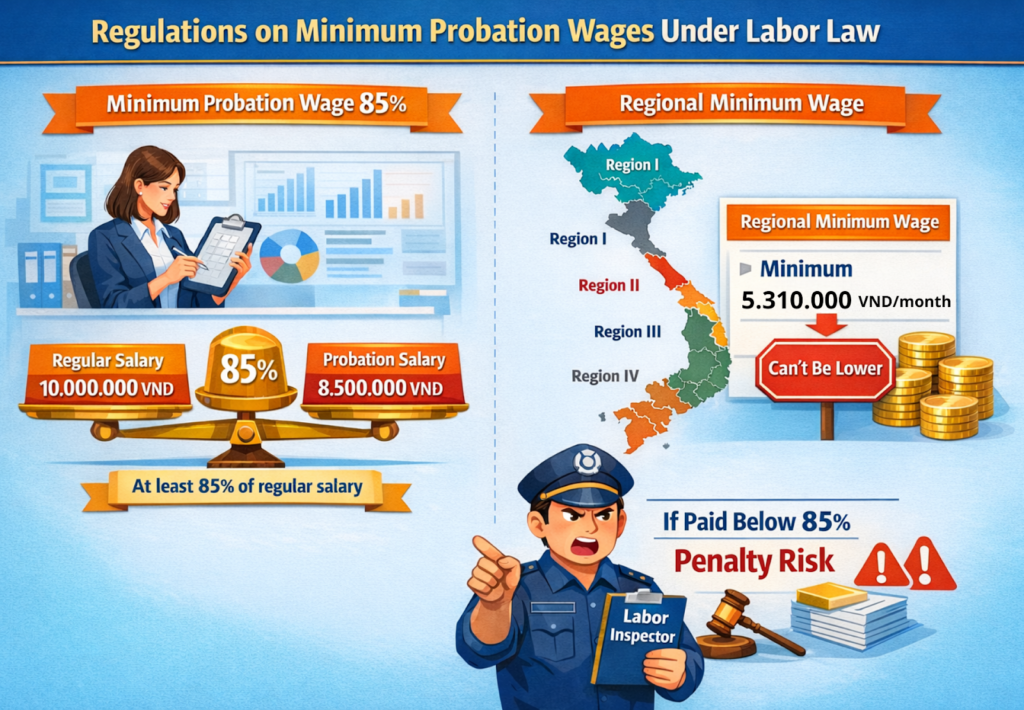
Pursuant to Article 26 of the Labor Code 2019, the salary during the probation period is negotiated by both parties but must be at least 85% of the salary for that specific job. This is a critical benchmark that every HR professional and employee must follow. This means that if a position offers an official salary of 10,000,000 VND upon signing a formal contract, the probation salary cannot be lower than 8,500,000 VND.
It is important to note that this 85% is a legal floor. Enterprises are entirely free to pay 90%, 100%, or higher to attract talent and demonstrate superior welfare from day one. However, if a business pays below 85%, they face the risk of administrative penalties during labor inspections or disputes. This calculation applies to all forms of payment—including hourly, piecework, or production-based wages—ensuring minimum fairness for new employees.
2. Regional Minimum Wage and the Lower Limit of Probation Salary
In addition to the 85% rule, probation salaries are also governed by another floor: the Regional Minimum Wage. According to regulations, the probation salary after calculation (at 85% or higher) must absolutely not fall below the regional minimum wage prescribed by the Government. Vietnam is currently divided into four wage regions based on local economic development.
For example, in major cities in Region I like Ho Chi Minh City or Hanoi, if the regional minimum wage is 5,310,000 VND/month, the actual probation salary received by the employee must be at or above this level. This is particularly crucial for unskilled labor positions where the official salary might be close to the minimum wage. If 85% of the official salary falls below the regional minimum wage, the employer must adjust the probation pay to at least match the regional minimum. Knowing which region your business operates in is essential for HR to set accurate salary frameworks.
Types of Contracts Applicable During Probation
Choosing the format of the written agreement to record the probation relationship is a strategic decision for a business. Depending on management goals and the nature of the position, HR can choose between two common forms permitted by law. Each has distinct advantages and implications regarding procedures and commitment.
1. Probation Clauses within a Labor Contract
According to current regulations, businesses and employees can agree to include probation terms directly within the official Labor Contract. This is a modern approach that helps streamline paperwork. Under this format, terms regarding duration, the 85% salary rate, and evaluation criteria are specified in a dedicated section of the main contract.
The greatest advantage of this approach is the long-term commitment it creates. Employees feel more secure seeing a clear development path from day one. Once the probation period ends successfully, the contract continues automatically without the need for a new signing, saving time for the HR department. However, businesses must draft the termination conditions very clearly in case the candidate does not meet requirements, avoiding potential unlawful dismissal disputes.
2. Separate Probation Contracts
The practice of signing an independent Probation Contract is still widely used, especially for short-term projects or when a business desires maximum flexibility. A separate probation contract expires as soon as the probation period ends. Subsequently, if both parties are satisfied, a completely new Labor Contract is signed.
The advantage of this contract type is its clear separation. It makes it easier for businesses to manage social insurance (SHUI) obligations (often not mandatory if only a separate probation contract is signed, according to certain legal interpretations). It also creates a clear boundary: “You are on trial; prove your worth to join permanently.” However, for highly experienced and senior-level employees, signing a separate probation contract can sometimes feel unstable and may reduce employer brand appeal.
Maximum Probation Duration for Various Positions
Determining the probation period is not at the employer’s discretion; it must strictly follow the professional and technical requirements of the job. Vietnamese law categorizes probation periods clearly to ensure businesses have sufficient time for evaluation without unfairly prolonging the trial status for employees.
1. Management and High-Level Technical Positions
For roles requiring high expertise such as Directors, Department Heads, or technical specialists with university degrees or higher, the maximum probation period is 60 days. However, under the Labor Code 2019, for enterprise managers (as defined by the Law on Enterprises, such as Chairmen of the Board, Board Members, or General Directors), the probation period can extend up to 180 days.
The reason for this extended period is that senior management roles require more time to demonstrate leadership capability, strategic vision, and adaptability to the organization’s management culture. During these 180 days, the probation salary must still follow the minimum 85% rule. Applying an incorrect duration (e.g., giving an office clerk 180 days of probation) is a legal violation, punishable by fines ranging from 2 to 5 million VND, along with the obligation to pay 100% of the salary for the period misclassified as probation.
2. Standard Labor and Skilled Positions
For jobs requiring vocational college, intermediate school, or professional staff levels, the maximum probation period is 30 days. This is considered sufficient for an employee to become familiar with machinery, production processes, or basic office operations.
Notably, for simple, manual labor jobs or jobs with a contract duration of less than one month, probation is prohibited by law. Businesses must be careful here: requiring a trial period for a short-term seasonal hire is illegal. Mastering these timelines helps HR build accurate onboarding roadmaps and prevents unnecessarily prolonging probation status without making a final hiring decision.
Key Considerations for Benefits During Probation
Beyond the salary, insurance and tax issues are often areas of debate between employees and Accounting/HR departments. Understanding the law helps businesses optimize costs and protects employees’ vital rights.

1. Social Insurance (SHUI) Regulations during Probation
This is the most confusing area for many. Under current Social Insurance law, employees working under a labor contract with a term of at least one month are subject to mandatory social insurance.
- Case of a Separate Probation Contract: Currently, legal views vary, but most local Social Insurance authorities advise that if only a “Probation Contract” is signed, mandatory SHUI is not yet required.
- Case of a Labor Contract (with Probation Clauses): Because the document is a Labor Contract, both the employer and employee must pay SHUI, Health Insurance, and Unemployment Insurance from the first month (the probation month).
Many foreign-invested enterprises and large corporations opt to sign labor contracts with probation clauses and pay insurance from day one to attract professional talent and provide absolute peace of mind to candidates.
2. Personal Income Tax (PIT) Calculation for Probationers
Regarding taxes, employees during probation are considered individuals who have not yet signed a long-term labor contract (if a separate probation contract under 3 months is used). Therefore, if the total income paid is 2,000,000 VND or more per payment, the business must withhold 10% PIT before paying the employee.
However, the employee may submit a Commitment Form 08/CK-TNCN (if they estimate their total annual income, after family deductions, will not reach the taxable threshold) to temporarily avoid the 10% withholding. Conversely, if probation is a clause within a Labor Contract (for 3 months or more), the business will calculate tax using the Progressive Tax Table—similar to permanent staff. This is usually more beneficial for the employee as it applies the 11 million VND/month personal deduction.
3. The Right to Terminate Probation without Notice
A significant advantage during the probation phase under Article 27 of the Labor Code 2019 is: During the probation period, either party has the right to cancel the probation agreement without prior notice and without compensation.
This regulation provides absolute flexibility. If an employee feels the environment is not a good fit, they can resign immediately without fear of salary withholding (provided the company pays for days worked). Conversely, if the business finds the candidate fails to meet minimum standards, they can terminate the probation on the spot. However, for ethical HR management, most businesses still provide 1-3 days’ notice to allow both parties to prepare, ensuring minimal disruption to operations.
Conclusion
In summary, probation salary regulations and the trial period are the foundation of a sustainable labor relationship. Complying with the 85% minimum, correctly identifying probation periods for each role, and maintaining transparency in tax and insurance policies is not just a legal obligation—it is a way for businesses to build a strong employer brand. When employees understand this knowledge, they gain the confidence to negotiate and protect their legitimate rights, setting the stage for a stable and prosperous career in Vietnam.
For inquiries, contact Wacontre Accounting Services via Hotline: (028) 3820 1213 or email [email protected] for prompt assistance. With a team of experienced professionals, Wacontre is committed to providing dedicated and efficient service. (For Japanese clients, please contact Hotline: (050) 5534 5505).