
In the context of deep international economic integration and the enforcement of next-generation free trade agreements (such as CPTPP and EVFTA), Vietnam’s labor legal system is undergoing significant transformations. One of the most noteworthy milestones is the enforcement of the Amended Law on Trade Unions, which introduces a series of critical updates.
These new regulations on trade unions directly impact operating costs, human resource policies, and compliance obligations for all economic organizations. For enterprises, particularly Foreign Direct Investment (FDI) companies operating in Vietnam, understanding and strictly adhering to these updates is a prerequisite to maintaining harmonious labor relations and avoiding unnecessary administrative penalties.
1. Context and Importance of the Amended Law on Trade Unions
The Amended Law on Trade Unions was introduced to resolve practical inadequacies while aligning closer with core international labor standards. The law focuses on clarifying trade union independence, optimizing financial resources, and expanding organizational access to new categories of workers.
Failure to timely update these changes may expose enterprises to risks of penalties due to late contributions, tax audits, or collective labor disputes that disrupt production lines and business operations.
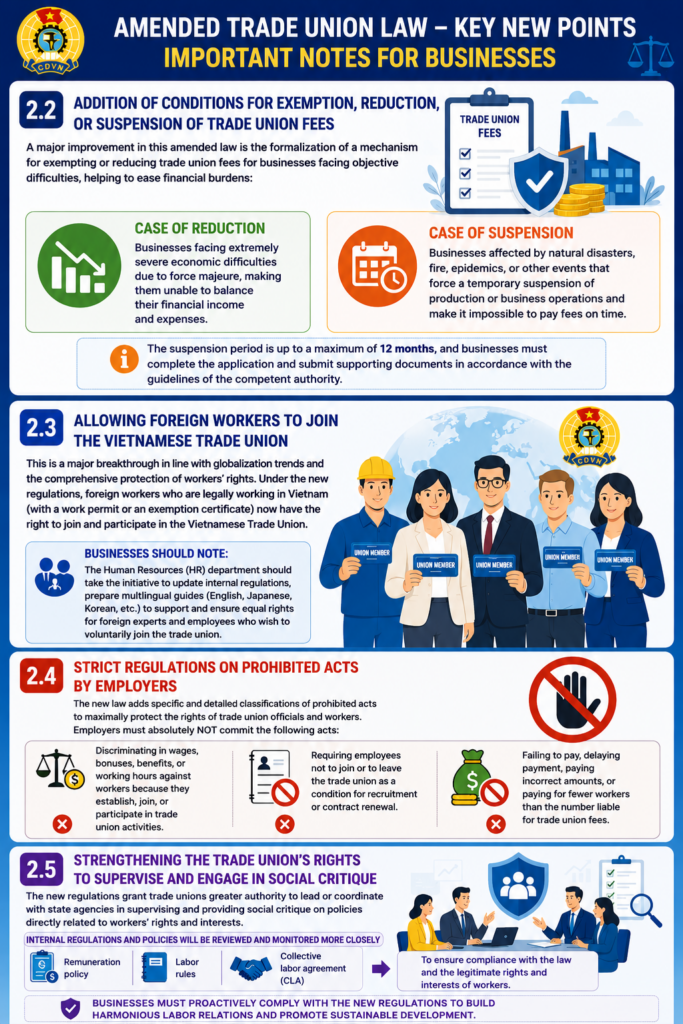
2. 5 Core Changes in Trade Union Regulations Enterprises Must Know
3. Legal Risks: Consequences for Non-Compliance with Trade Union Regulations
Many enterprises, particularly newly established FDI companies, often assume that “If a company has no trade union, it does not need to pay fees” or “Participation and payment are voluntary.” This is a serious legal misconception. Non-compliance with trade union regulations exposes businesses to three major categories of financial and administrative sanctions:
3.1. Administrative Fines and Recovery with Late Payment Interest
According to Government Decree on administrative penalties in labor, social insurance, and trade union sectors, violations regarding fund allocation attract very high fines:
- Fine levels: Businesses that delay payment, underpay, or fail to pay the trade union fund for all employees will face a fine ranging from 12% to 15% of the total outstanding amount at the time the violation is documented (the maximum fine applied to an organization can reach VND 75,000,000).
- Mandatory remedial measures: In addition to administrative fines, enterprises are strictly required to pay the full amount of outstanding or delayed trade union funds into the trade union organization’s account.
- Late payment interest: Enterprises must pay an additional interest amount calculated on the delayed payment based on the highest demand deposit interest rate of state-owned commercial banks announced at the time of sanctioning.
3.2. Tax Risks: Payroll Expenses Disallowed for CIT Deductions
This is a hidden penalty but carries the most significant financial impact on a business. The Vietnamese Tax Authority maintains a tight data-sharing and cross-checking mechanism with trade unions at all levels during periodic tax finalizations.
- If a business fails to present valid receipts or invoices proving the payment of the 2% trade union fund as required, the Tax Authority has the right to disallow all corresponding payroll and wage expenses from deductible expenses when calculating Corporate Income Tax (CIT).
- This means the business will face a 20% CIT clawback on those disallowed expenses, along with additional late payment penalties under current tax administration laws.
3.3. Severe Impact on Legal Reputation and Business Licenses
For businesses, especially the foreign-invested (FDI) sector:
- Trade union law violations are recorded in the compliance history system of the Department of Labor, Invalids and Social Affairs. This directly complicates procedures for business registration amendments, investment project expansions, or applications for visas and Temporary Residence Cards (TRC) for foreign experts coming to work.
- Evading trade union contributions leads to cuts in legitimate welfare benefits for employees (such as gifts, visits, and hardship support). This easily triggers instability in labor relations, increasing the risk of strikes or spontaneous walkouts, which severely impacts order delivery schedules and the company’s reputation with international partners in the supply chain.
4. Risk Mitigation Solutions for FDI Enterprises in Vietnam
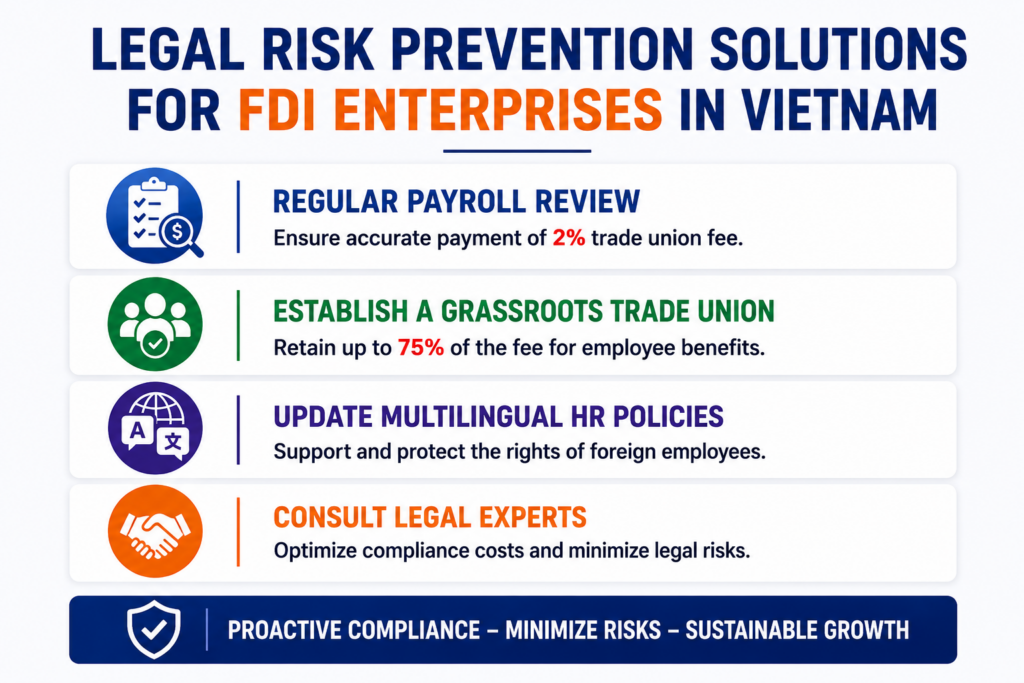
To proactively comply with the new regulations on trade unions and optimize operational cash flow, foreign enterprises should implement the following steps immediately:
- Audit the Payroll Fund Regularly: Re-examine the monthly social insurance salary fund to ensure accurate and full allocation of the 2% trade union contribution, minimizing the risk of retroactive collection or late payment fines.
- Establish a Grassroots Trade Union Early: If the enterprise meets the headcount criteria, forming a grassroots trade union allows the company to retain the 75% portion of the fund to reinvest in employee welfare locally, instead of leaving it entirely under upper-level management.
- Update Multilingual HR Frameworks: Conduct internal orientation sessions (especially for foreign personnel) regarding their rights and obligations when participating in the Vietnam Trade Union to build consensus and cohesion.
- Consult Experts: Labor and trade union laws in Vietnam are often accompanied by intricate guiding decrees. Enterprises should seek advice from reputable corporate and legal service providers to optimize compliance costs legally.
Related Services: Enterprises may refer to Wacontre’s Labor and HR Legal Consulting or Business Registration Amendment services to perfect their management system in compliance with regulations.
Learn more: HR BPO Services: The Optimal Human Resource Management Solution in Vietnam
5. Conclusion and Recommendations
Swift adaptation to new regulations on trade unions not only shields enterprises from legal liabilities and avoids the risk of CIT expense disallowance but also establishes a solid foundation for a sustainable workplace, boosting employee engagement and enhancing corporate reputation in the Vietnam market.
For any inquiries, contact Wacontre Accounting Services via Hotline: (028) 3820 1213 or email [email protected] for prompt assistance. With a team of experienced professionals, Wacontre is committed to providing dedicated and efficient service. (For Japanese clients, please contact Hotline: (050) 5534 5505).