
As digital hiring evolves, the one-way interview is a game-changer. Discover how to assess candidates through video effectively within modern remote recruitment workflows.
What is a One-Way Interview?
A one-way interview (also known as an asynchronous video interview or AVI) is a modern recruitment method where candidates answer pre-set interview questions via a dedicated technology platform without a live recruiter present.
Instead of a face-to-face meeting or a live video call via Zoom or Teams, candidates receive a link to a list of questions. They then record their responses within a specified timeframe and submit them to the company. This method has become essential in digital recruitment in Vietnam due to its superior flexibility.
Recruiters can review these videos at their convenience, compare responses across different candidates using consistent benchmarks, and easily share recordings with hiring managers. For candidates, it offers the opportunity to prepare their environment and mindset, reducing the psychological pressure of an immediate panel interview.
Strategic Benefits of One-Way Interviews for Businesses
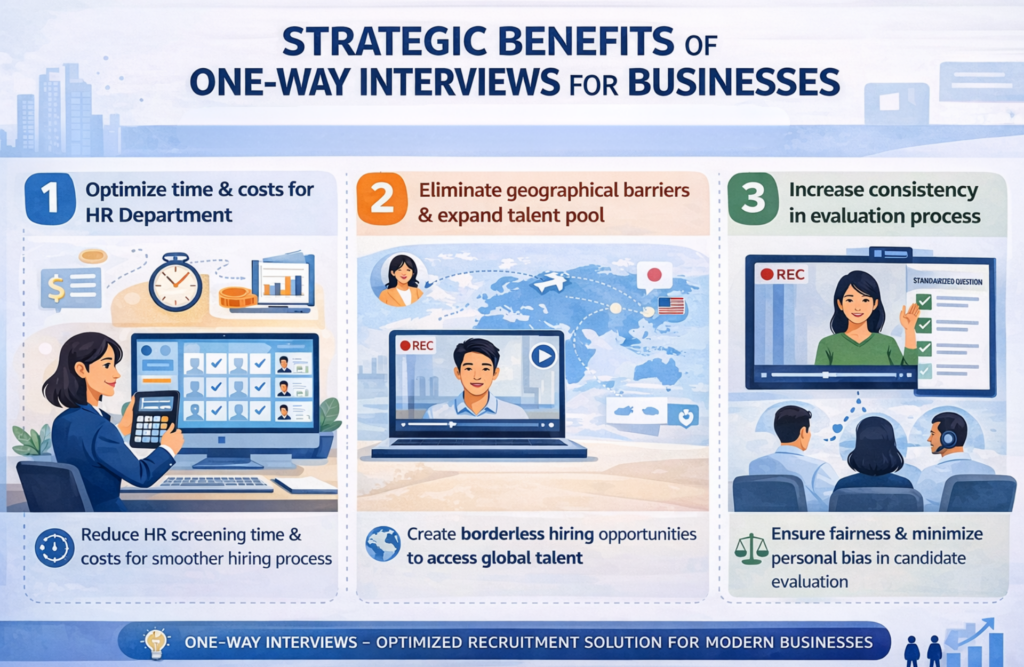
1. Optimizing Time and Costs for HR Departments
In traditional recruitment, scheduling screening interviews for dozens of applicants is often a logistical challenge for HR specialists. Each screening call typically takes 20 to 30 minutes, not including wait times or last-minute cancellations.
With a one-way interview, a recruiter can evaluate a candidate’s response in just 5-7 minutes by focusing on key takeaways. This minimizes “dead time” and allows HR teams to process a significantly higher volume of applications within the same working hours.
Furthermore, operational costs such as meeting room usage and travel expenses are drastically reduced. This allows recruitment budgets to be allocated more effectively toward employer branding activities or improving employee benefits to attract top talent.
2. Eliminating Geographical Barriers and Expanding the Talent Pool
The labor market in Vietnam is no longer confined to major cities like Ho Chi Minh City or Hanoi. Companies are increasingly scouting talent globally or from various provinces for remote or hybrid work arrangements.
A remote interview process via pre-recorded videos completely eliminates time zone and geographical barriers. A candidate based in Japan or the United States can conveniently apply to a Vietnam-based company without worrying about late-night live interviews.
This access to a global workforce provides businesses with a massive competitive edge. You are no longer limited to candidates who can physically visit the office; instead, you can secure rare experts or high-level tech engineers from anywhere in the world.
3. Enhancing Consistency in the Assessment Process
One pitfall of traditional interviewing is inconsistency. Recruiters may inadvertently ask different questions based on conversation flow, or their mood may influence evaluation results.
In a one-way interview, every candidate receives the exact same set of questions, in the same format, with the same preparation time. This creates a “level playing field” where everyone is treated equally, minimizing the impact of subjective emotions.
Video data also allows multiple stakeholders to evaluate a candidate without needing to be present simultaneously. This leads to multi-dimensional, objective feedback and helps mitigate unconscious bias that often occurs in impulsive live interviews.
Accurate and Objective Screen-Based Candidate Assessment
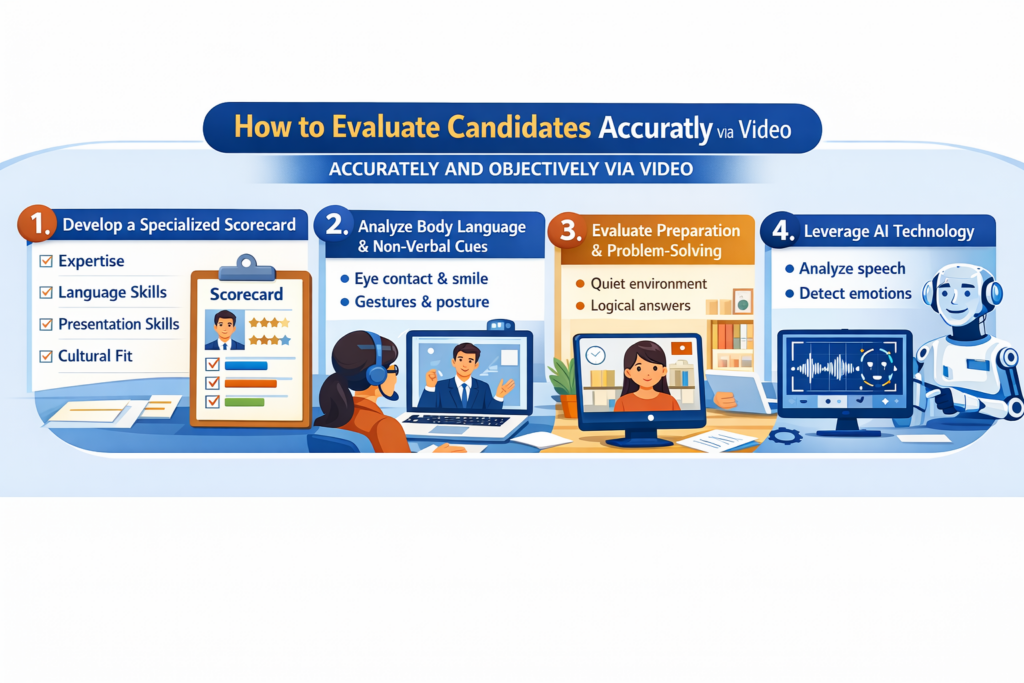
1. Developing a Specialized Evaluation Scorecard
To ensure that candidate assessment via screen does not become subjective, businesses must establish a clear Scorecard before reviewing videos. This scorecard should include specific criteria such as technical knowledge, language skills, presentation ability, and cultural fit.
Each question in the video interview should be linked to a specific competency the company is seeking. For instance, if the question is “Describe a difficult situation you resolved,” the scoring should focus on the candidate’s critical thinking and stress management skills.
Having a standardized framework helps HR professionals maintain focus while reviewing dozens of videos. It empowers the recruitment department to make decisions based on factual data and concrete evidence rather than a mere “gut feeling” about a candidate’s demeanor.
2. Analyzing Body Language and Non-Verbal Communication
Even without direct interaction, recruiters can gather information from a candidate’s body language through the screen. Pay attention to how they maintain eye contact with the camera lens, their natural smile, and hand gestures during explanations.
A confident candidate typically maintains an upright posture, speaks clearly and articulately, and modulates their speaking pace well. These factors often reflect professional communication skills in a digital environment, where online meetings are becoming the norm.
However, it is important to note that some candidates may feel more camera-shy than they would in person. Assessment requires nuance to distinguish between “lack of confidence” and “technological unfamiliarity,” ensuring you don’t overlook highly skilled candidates who simply face technical hurdles.
3. Assessing Preparation and Problem-Solving Mindset
How a candidate conducts a one-way interview speaks volumes about their professional attitude toward a new role. A video with good lighting, a quiet environment, and professional attire indicates that the candidate respects the opportunity and possesses strong preparation skills.
Conversely, videos with excessive background noise may signal a lack of seriousness or poor workspace management. Beyond appearance, the response content must be scrutinized for logical thinking through the structure of their answers.
Since candidates usually have a short period to think before recording begins, evaluate how they structure their responses. Do they get straight to the point? Are their arguments logical? Do they use specific examples to prove their capabilities, or do they rely on vague theoretical statements?
4. Leveraging AI Technology for Candidate Data Analysis
In modern recruitment, Artificial Intelligence (AI) has been deeply integrated into one-way interview platforms. AI can assist recruiters by converting speech to text for keyword analysis or analyzing facial expressions to gauge emotional engagement.
Some modern tools can even provide a preliminary score based on response patterns of top-performing employees currently within the organization. This allows HR to quickly categorize the most promising candidates without having to watch every single video submission.
However, technology should only serve as a supplementary tool for human judgment. The final decision must still rely on human empathy and intelligence to ensure ethics and humanity in hiring, especially in a market like Vietnam that highly values relationships and connection.
Challenges and Considerations for Pre-recorded Interviews
1. Candidate Experience and the Risk of Losing Direct Interaction
The biggest challenge of a one-way interview is the impersonal feeling when a candidate speaks to a screen instead of a human being. This can lead to a negative experience if a company fails to humanize its automated recruitment process.
To overcome this, companies should include a short video introducing the team, the office, and the reason for using this interview format. Explaining the process clearly helps candidates feel more comfortable and understand that this is a modern step designed to save time for both parties.
A good process is one where candidates feel valued. Providing prompt feedback after a video submission and offering detailed technical guides will help maintain a professional employer brand in the eyes of talent.
2. Information Security and Data Privacy Issues
Storing interview videos for thousands of candidates requires a robust security system. In Vietnam, personal data protection regulations (such as Decree 13/2023/ND-CP) require companies to obtain explicit consent from candidates regarding the collection and storage of their image and voice.
Businesses must ensure that interview platforms comply with international security standards (such as GDPR or ISO 27001). Additionally, a clear data deletion policy must be in place once the recruitment process concludes.
Any data breach or misuse of candidate footage can cause irreparable damage to a company’s reputation. Therefore, selecting a reputable platform provider is a top priority when implementing this digital recruitment model.
3. Ensuring Fairness and Avoiding Unconscious Bias
While one-way interviews help standardize questions, they can inadvertently trigger bias regarding a candidate’s appearance or socioeconomic status. For example, a candidate with high-end recording equipment might appear more “professional” than a talented candidate with limited resources.
Recruiters must be trained to recognize these biases and focus solely on the content of answers and actual competencies. Building an assessment mindset based on core values rather than external factors unrelated to job performance is crucial.
Fairness in hiring is not just an ethical issue; it is vital for building a diverse workforce. Diversity in backgrounds and perspectives allows a company to be more innovative and adaptable in today’s volatile business environment.
One-Way Interview Evolution in the Modern Vietnam Market
1. The Rise of AI-Integrated All-in-One Recruitment Platforms
Today, we are seeing an explosion of “All-in-one” recruitment platforms. These platforms go beyond video recording to integrate competency assessments and psychological profiling within a single workflow.
The convergence of video data and behavioral data provides HR departments with a holistic view of candidates without switching between multiple tools. This is a significant step in transitioning from intuitive HR management to data-driven HR.
Pioneering companies that adopt these platforms will have faster candidate response times, increasing their chances of securing top talent before competitors. Technology thus becomes a strategic weapon in the competition for talent.
2. How Japanese Firms in Vietnam Utilize Digital Interviews
Japanese companies are renowned for their meticulousness and rigorous multi-stage interview processes. However, under the pressure of digital transformation, many major Japanese corporations in Vietnam have begun embracing one-way interviews to optimize the initial screening phase.
They often use this method as a primary way to assess language proficiency and etiquette from the outset. For Japanese firms, a well-prepared video interview is seen as evidence of a candidate’s respect and discipline—core values in their work culture.
This blend of traditional values and modern technology is creating a new recruitment style. It ensures the discipline and rigor expected by Japanese management while providing the efficiency and flexibility of digital technology, helping Japanese firms maintain their edge in the Vietnam market.
Conclusion
The one-way interview has officially moved from a “trial” concept to an essential part of modern recruitment trends. By understanding its nature and mastering screen-based assessment, businesses can build a modern and efficient HR process.
However, never forget that technology is merely a tool. The key to success lies in the harmonious combination of AI efficiency and human empathy. Companies that leverage technology to enhance the human experience will be the ones to build a strong workforce for the future.
To empower your business in overcoming HR management challenges and staying fully committed to your strategic goals, we provide specialized solutions:
- [RPO Services]: A comprehensive recruitment process outsourcing solution.
- [BPO Services]: Strategic outsourcing to streamline business processes and optimize operational costs.
For any inquiries, contact Wacontre Accounting Services via Hotline: (028) 3820 1213 or email [email protected] for prompt assistance. With a team of experienced professionals, Wacontre is committed to providing dedicated and efficient service. (For Japanese clients, please contact Hotline: (050) 5534 5505).