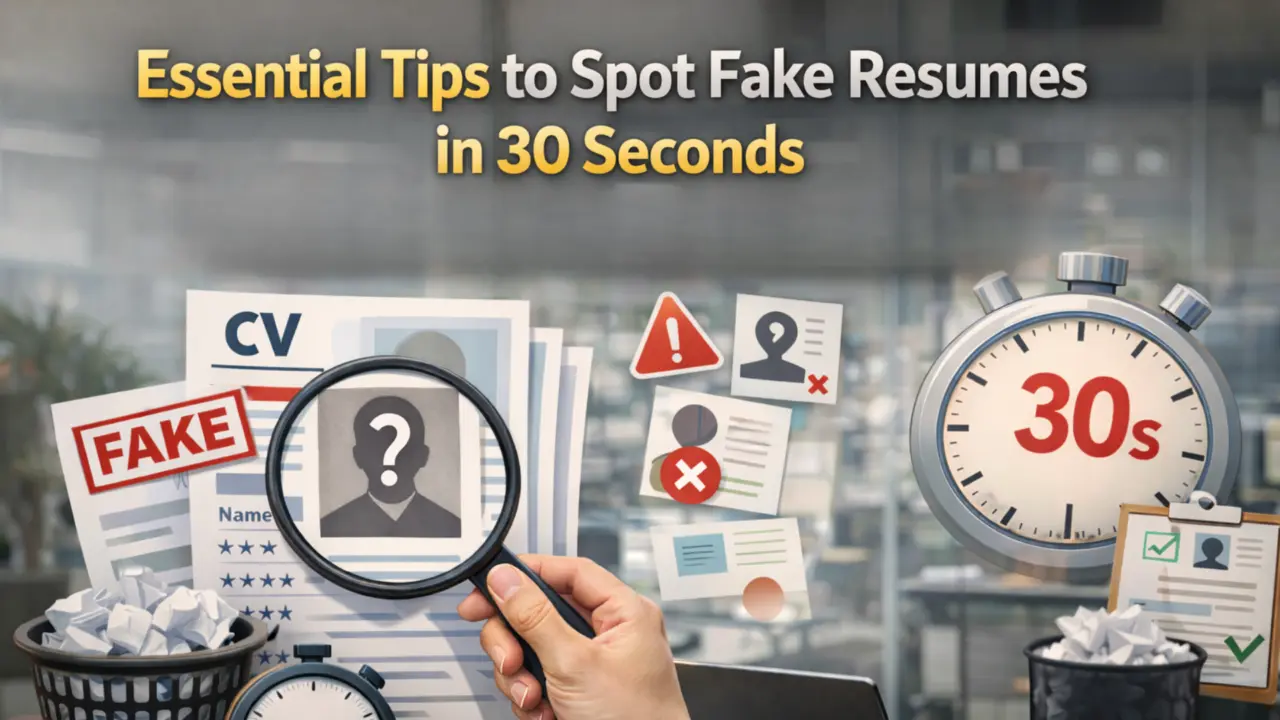
Mastering how to read between the lines of a CV is crucial to spot fake profiles. Effective CV screening will significantly enhance your overall HR recruitment skills.
What Does “Reading Between the Lines of a CV” Mean?
Reading between the lines of a CV is not merely checking surface-level information such as degrees, experience, or skills listed on paper. It is an art and a psychological analytical skill based on indirect data to understand the true portrait of the person behind the words. When a recruiter is adept at “reading” a candidate, they can see through the gaps between lines, identifying the candidate’s attitude, systematic thinking, and level of integrity.
In Vietnam’s competitive labor market, this “reading” ability becomes the first and most critical filter. It helps recruiters distinguish between candidates with genuine competence and “CV writing experts”—those who possess a glamorous resume but whose actual capacity is completely hollow. Understanding the essence of this process prevents HR departments from wasting time on interviews with “fake” profiles.
Furthermore, reading a CV is a way to assess cultural fit from the very first step. A CV that is neatly presented, logical, and contains personal highlights often reflects a professional and meticulous mindset. Conversely, CVs copied verbatim from online templates without customization usually indicate a superficial attitude or lack of creativity. Therefore, this is an indispensable step in building a high-quality human resources team.
The Importance of Screening in Modern Recruitment
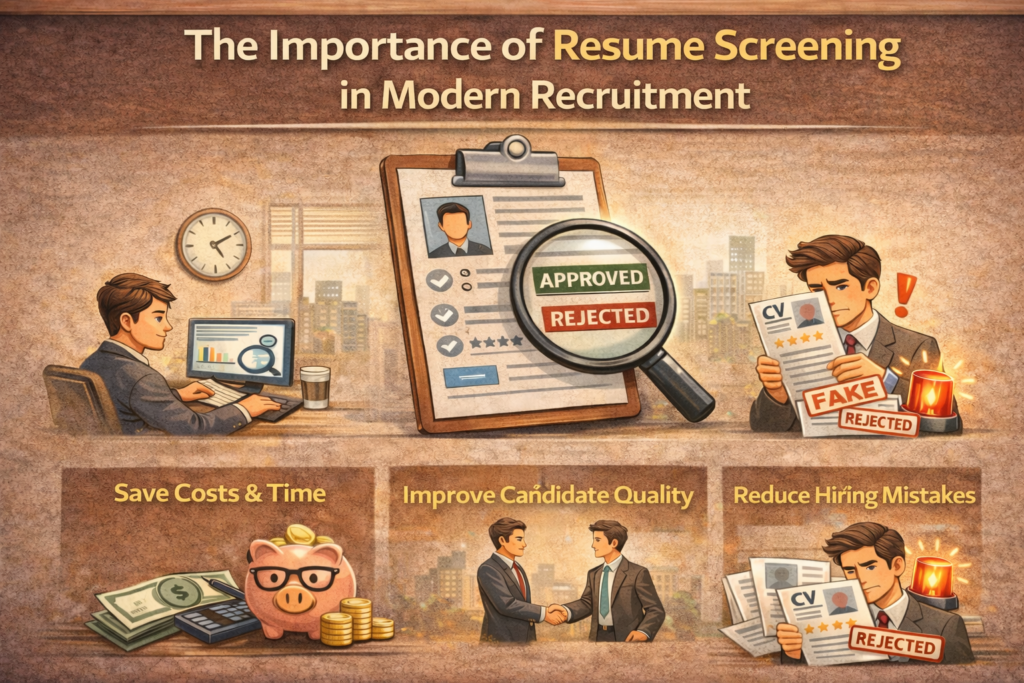
Candidate screening is the “gatekeeping” stage that determines the efficiency of the entire recruitment process within an enterprise. In the digital age, where candidates can send dozens of CVs with a single click, recruiters face severe information overload. Without a rigorous and scientific screening process, businesses can easily lose true talent because they are lost in a sea of unsuitable applications.
1. Saving Costs and Time for the Business
Every working hour of a manager or HR staff has high economic value. Inviting an unqualified candidate to an interview not only wastes the recruitment committee’s time but also extends the vacancy period, affecting overall work progress. By eliminating fake profiles from the start, you focus resources on the most promising candidates, thereby shortening the recruitment cycle and reducing cost-per-hire.
2. Enhancing the Quality of Human Capital Inflow
A thorough screening process helps set a high “standard” from the beginning. When recruiters have the ability to read candidates well, they select those with a mindset aligned with the company’s development strategy. This ensures that everyone entering the in-depth interview round has passed through a quality filter, increasing the conversion rate from candidate to high-performing employee.
3. Mitigating the Risk of a Bad Hire
Hiring the wrong person is one of a business’s most expensive mistakes. According to HR research, the cost to replace a bad hire can be 1.5 to 2 times the annual salary of that position. Early detection of fraud or lack of competence on a CV helps businesses avoid operational risks, security issues, and internal disruption caused by having to terminate an underperforming employee after their probation period.
Red Flags: Identifying “Fake” Profiles and Dishonest Candidates
“Fake” profiles are CVs that are over-inflated regarding achievements or cover up flaws in work history using sophisticated writing techniques. To avoid being misled, recruiters need to train a keen eye to recognize the following abnormalities:
1. Chronological Inconsistencies
One of the most recognizable signs of a dishonest profile is overlapping timelines or large gaps without explanation. For example, a candidate claims to be working full-time at Company A while simultaneously participating in another long-term project in an equivalent position at Company B. More commonly, they may extend the duration of a previous job to hide a period of unemployment or frequent job changes.
2. “Sky-High” Skills Without Specific Evidence
Candidates often tend to list a long string of soft skills and professional skills like “Leadership,” “Strategic Management,” or “Multi-language Programming,” but when looking at their work experience, they fail to provide any specific projects proving those skills. A truly capable candidate will always accompany a skill with a number or a measurable result (KPI, revenue, team size).
3. Overuse of Vague and Cliche Buzzwords
Be wary of CVs filled with “grandiose” words but empty content. Phrases like “Responsible for process optimization” or “Enhanced business efficiency” without detailed description of the implementation method are often signs of copying a job description into the CV. This is how candidates try to trick Applicant Tracking Systems (ATS) with keywords without actually understanding the work.
4. Sloppy Formatting and Basic Typos
Even though technology supports spell-checking, some CVs still arrive full of typos, jumping fonts, or uneven margins. This is the clearest manifestation of a lack of respect for the work and a lack of carefulness. For a position requiring meticulousness—such as accounting, administration, or project management—a small typo on a CV is enough reason to reject a profile within the first 30 seconds.
The 30-Second Process to Accurately Read a CV
To handle hundreds of profiles daily, you cannot read every word from the start. Instead, apply a high-speed “scanning” process to classify profiles within 30 seconds.
1. Core Keyword Scanning (5 seconds)
In the first 5 seconds, look directly at the skills section and the most recent job titles. If the position requires “Digital Marketing” but keywords like “SEO,” “Google Ads,” “Data Analytics,” or “CPA” do not appear, the profile can be discarded immediately. The presence of correct technical keywords shows the candidate understands the industry and the position.
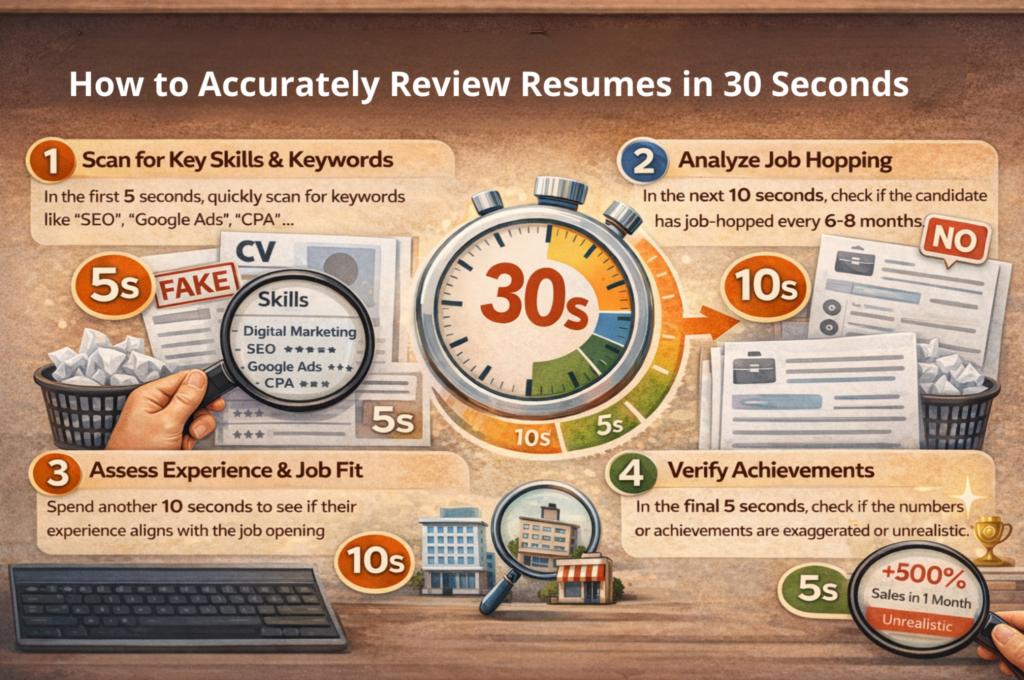
2. Stability Analysis via Job-Hopping History (10 seconds)
In the next 10 seconds, look at the timelines. If a candidate has constantly changed jobs every 6-8 months over the past 3 years, it is a warning sign regarding loyalty or adaptability. Unless the candidate is a freelancer or works on specific projects, excessive job-hopping usually predicts a risk of early resignation if hired.
3. Experience-Role Compatibility Assessment (10 seconds)
In the following 10 seconds, compare the scale of the previous company and previous responsibilities with your current requirements. If you are hiring for a large corporation but the candidate only has experience in small businesses, the gap in systemic thinking and processes can be a major barrier. Look for “action verbs” that demonstrate similarity in the nature of the work.
4. Authenticity Check of Achievements (5 seconds)
In the final 5 seconds, look at the achievement numbers. Numbers that are too “round” or unrealistic (e.g., increasing revenue by 500% in just 1 month without special resources) need to be flagged for verification. A good reader will immediately recognize what is the result of individual effort versus a collective achievement that the candidate is trying to claim for themselves.
The Art of Interviewing to Verify the “Read”
After filtering the profiles, the next step is to use sharp questions to “unmask” the doubts you noted during the CV reading process.
1. Behavioral Interviewing Technique
Instead of asking “Do you have problem-solving skills?”, ask: “Tell me about the most serious incident you ever encountered and the specific steps you took to handle it.” When candidates must describe the action process in detail, it is very difficult to fabricate if they haven’t actually experienced it. Small details in the story will confirm the accuracy of what they wrote in the CV.
2. Using Situational Questions to Expose Fake Profiles
Present a real-world problem occurring at the business and ask the candidate to solve it immediately. Candidates with fake profiles will often be confused or offer vague, theoretical solutions. In contrast, those with hands-on experience will dive deep into analyzing causes and providing feasible action steps.
3. Direct Information Cross-Checking (Reference Check)
Never skip this step for important positions. A short phone call to the candidate’s former manager can provide more information than a long interview. Ask about their work attitude, the real reason they left, and whether the old company would be willing to rehire them. This is the final and most certain way to confirm your “reading” was accurate.
Conclusion
The skill of reading candidates through their CV is a sharp tool that helps recruiters not only find talent but also protect the business from unnecessary HR risks. In a world full of over-“polished” profiles, alertness, logical analysis, and a 30-second screening process will help you become a true recruitment expert. Remember, a CV is just a door—your task is to look through that door to see the true value of the person inside.
To empower your business in overcoming HR management challenges and staying fully committed to your strategic goals, we provide specialized solutions:
- [RPO Services]: A comprehensive recruitment process outsourcing solution for Vietnam company formation.
- [BPO Services]: Strategic outsourcing to streamline business processes and optimize operational costs.
For any inquiries about Vietnam company formation or accounting and HR services, contact Wacontre via Hotline: (028) 3820 1213 or email [email protected] for prompt assistance. With a team of experienced professionals, Wacontre is committed to providing dedicated service. (For Japanese clients, please contact Hotline: (050) 5534 5505).