
Developing confidentiality and non-compete clauses is essential for legal protection. NDA and NCA ensure your business secrets are safe while managing human resources in Vietnam effectively.
- What is Drafting Confidentiality and Non-Compete Clauses?
- The Importance of NDA and NCA for Businesses in Vietnam
- Current Legal Regulations on Confidentiality and Non-Compete
- The Process of Building Accurate Confidentiality Clauses
- Establishing Robust Non-Compete Agreements (NCA)
- Key Notes for Implementing Confidentiality and Non-Compete Clauses
- Conclusion
What is Drafting Confidentiality and Non-Compete Clauses?
In the context of a digital economy and high personnel turnover, the concepts of information security and non-compete commitments have become essential to corporate risk management. Drafting confidentiality and non-compete clauses is the process of establishing legal boundaries to protect an organization’s intangible assets.
A Non-Disclosure Agreement (NDA) is an agreement regarding the non-disclosure of trade secrets, customer data, or internal processes. Meanwhile, a Non-Compete Agreement (NCA) is a contract intended to restrict employees from working for direct competitors for a specific duration and within a certain geographical scope after leaving the company.
Establishing these terms is not merely a matter of drafting documents; it is a strategic HR practice. In Vietnam, these regulations are often integrated into labor contracts or signed as separate agreements. This creates a solid legal foundation for businesses to protect themselves against commercial infringement risks while setting fair “rules of engagement” from the very beginning of the employment relationship.
The Importance of NDA and NCA for Businesses in Vietnam
1. Protecting Intellectual Property and Trade Secrets
In the knowledge economy, intellectual property is the “lifeblood” of every enterprise. Building a rigorous NDA helps create a firewall that prevents the leakage of proprietary formulas, source codes, or unique business strategies.
When employees realize that information disclosure carries clear legal consequences, their sense of responsibility increases. A well-structured NDA system not only helps businesses prevail in legal disputes but also serves as a deterrent, safeguarding core values against internal threats.
Furthermore, standardizing these clauses makes it easier for businesses to collaborate with international partners. Multinational corporations always prioritize entities that maintain professional and systematic information security systems.
2. Maintaining Competitive Advantage in the Market
The Vietnamese market is competitive, where breakthrough ideas can be quickly replicated. A Non-Compete Agreement (NCA) helps you maintain your position by preventing competitors from “headhunting” your talent solely to exploit operational secrets.
Imagine a high-level manager leaving and taking their entire strategic mindset to a direct competitor—the NCA acts as a necessary protective measure. It provides the business with enough time to stabilize its structure and deploy subsequent plans without fear of being “outplayed.”
This ensures that your competitive advantage remains exclusive. Businesses can confidently invest in long-term projects without excessive worry that their achievements will be easily seized by competitors.
3. Preventing Brain Drain and Client Loss
Losing a talented employee is a loss, but losing a loyal customer base to that same employee is a business disaster. NCA terms often include “Non-solicitation” provisions to protect the partner network you have spent years building.
By establishing these barriers, businesses create a stable working environment. Employees understand that the most sustainable path to advancement is contributing to their current organization rather than attempting to leverage the old company’s resources for personal gain elsewhere.
This is also a method to retain dedicated talent. When a work environment is protected by professional rules, ethical employees feel more secure contributing value to the enterprise.
Current Legal Regulations on Confidentiality and Non-Compete
1. Legal Validity of NDAs under the Civil Code and Commercial Law
In Vietnam, the NDA has firm standing in the current legal system. According to the 2019 Labor Code, employers have the right to reach a written agreement with employees regarding the protection of business and technological secrets.
When an NDA is signed voluntarily, it becomes a civil contract with high binding value. This allows businesses to initiate lawsuits and claim actual damages if a violation is proven.
This clarity provides absolute peace of mind for foreign investors. They know that in Vietnam, their intellectual property is seriously protected by law through civil and commercial contract mechanisms.
2. Feasibility of Non-Compete Agreements (NCA) in Labor Relations
Many businesses fear that NCAs violate the “freedom to work,” but the legal reality in Vietnam is shifting positively. Courts are beginning to recognize the validity of NCAs if they satisfy three criteria: Voluntariness, Reasonableness, and Compensation.
Instead of extreme prohibition, building a “reciprocal” commitment turns it into a legal civil agreement. Businesses should skillfully integrate benefits so that the agreement is not perceived as coercing the employee.
This is the art of modern HR management: you protect the company’s interests while still respecting the personal value of the employee, creating a bond based on mutual benefit rather than mere administrative orders.
3. Court Rulings and Commercial Arbitration
Looking at actual case law from commercial arbitration proceedings, the trend of protecting businesses in confidentiality violation cases is becoming increasingly clear. There have been rulings forcing personnel to pay significant compensation for breaching non-compete commitments.
These practical examples are the most valuable evidence of the power of a professionally drafted document. It is not just a piece of paper signed at the start of employment; it is a legal tool that helps a business regain justice.
Monitoring these rulings also helps businesses adjust their terms accordingly. Consequently, future contracts will become increasingly robust and carry higher enforceability before jurisdictional agencies.
The Process of Building Accurate Confidentiality Clauses
1. Defining the Scope of Confidential Information
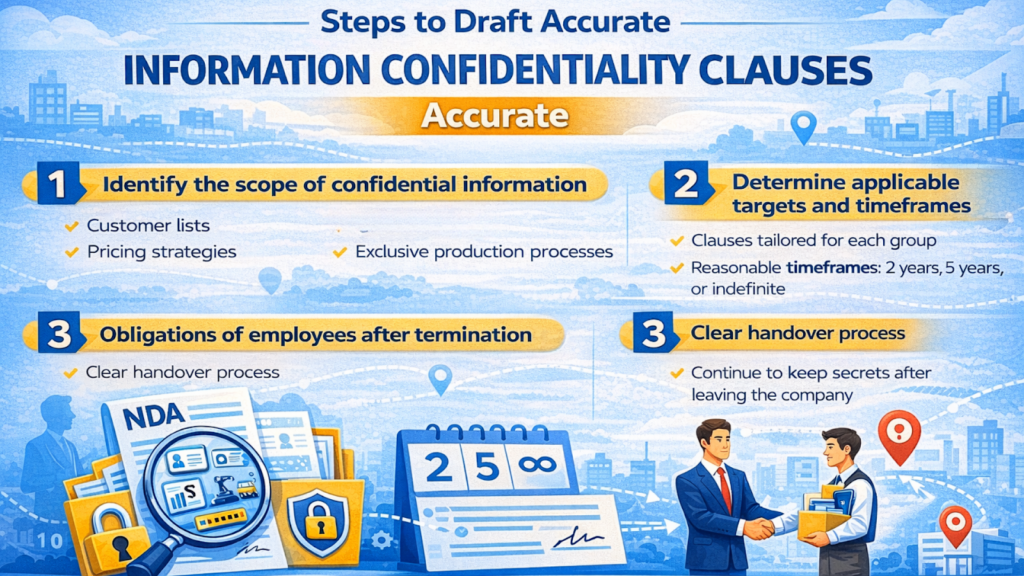
Avoid using generic NDA templates, as this can lead to losses when disputes arise. Categorize your data clearly: from customer lists and pricing strategies to the company’s proprietary production processes.
A smart confidentiality clause must precisely identify “what is a secret” and “where that secret resides.” The more you detail your information categories, the stronger your business’s legal protection becomes.
When the scope of confidentiality is clear, employees cannot claim they “accidentally” disclosed information. This provides the foundation for businesses to enforce disciplinary measures decisively and transparently when necessary.
2. Applicable Subjects and Duration of Confidentiality
Not everyone holds the keys to vital secrets; therefore, you should “tailor” clauses for each group of subjects. Senior personnel require strict constraints, while operational staff may only need basic regulations.
Regarding duration, set realistic milestones: 2 years, 5 years, or indefinite for core secrets. Determining a reasonable timeframe makes the clause more acceptable and more persuasive in court.
This stratification also helps businesses save on risk management costs. You concentrate resources on protecting the most critical “weak points” in your personnel system effectively.
3. Employee Obligations Post-Termination
Every separation requires professionalism and data security. The NDA must clearly stipulate the handover process: from destroying data copies on personal devices to returning the company’s original documents.
More importantly, the obligation to maintain secrecy must extend even after they have left the organization. Businesses should establish a mechanism requiring employees to notify them of their new place of employment for a certain period to monitor potential risks.
This helps prevent “post-employment” information leaks. It creates a closed-loop process, ensuring that sensitive data remains under the company’s control despite personnel changes.
Establishing Robust Non-Compete Agreements (NCA)
1. Specific Regulations on Geographical Scope and Restricted Fields
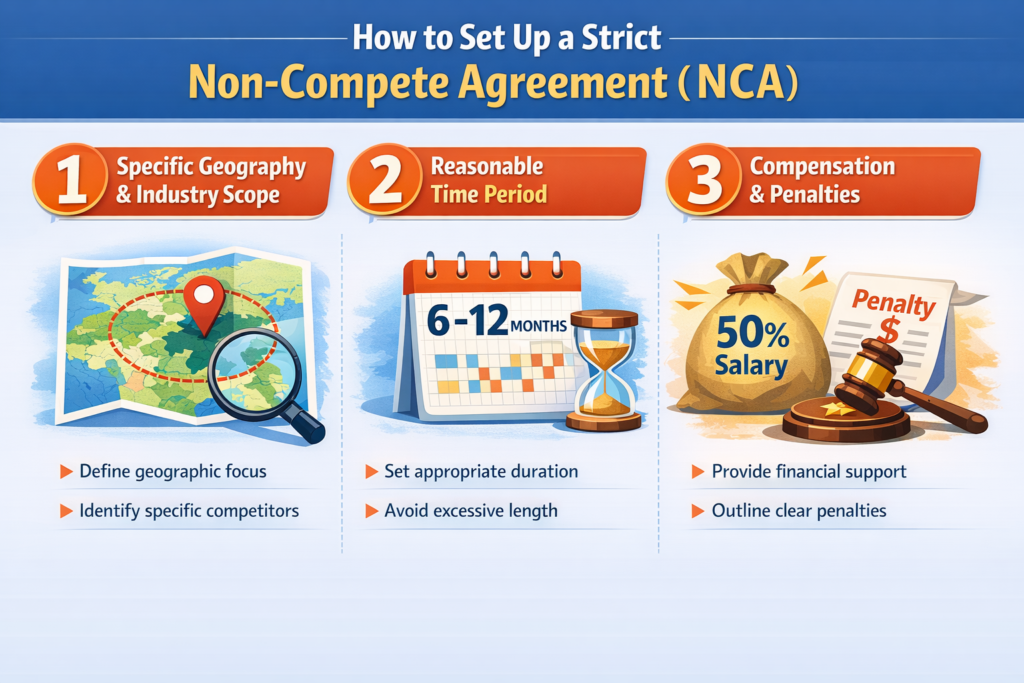
The strength of an NCA lies in its specificity. Prohibiting an employee from working “worldwide” is legally void. Instead, delineate the specific geographical areas where the business actually has significant operations.
Explicitly name direct competitors or equivalent industry groups. A “well-fitted” commitment makes the employee feel treated fairly and minimizes unnecessary legal disputes.
When the scope is clearly defined, the court will more easily accept the business’s request. This demonstrates that the enterprise is merely protecting legitimate interests and not intentionally stifling an individual’s career path.
2. Determining a Reasonable Non-Compete Duration
Time is the “yardstick” for the reasonableness of an NCA. A duration of 6 to 12 months is typically considered ideal for protecting company interests without causing undue hardship for the employee after they leave.
In a rapidly changing business world, the value of information often diminishes over time. Therefore, aligning the restriction period with the “lifecycle” of the trade secret increases the legal standing of the commitment.
Businesses should avoid applying excessively long durations to positions that are not truly pivotal. This flexibility helps the enterprise maintain a professional and humane image in the eyes of the HR community.
3. Compensation Mechanisms and Handling Violations
To give an NCA “teeth,” it must be accompanied by clear compensation mechanisms and penalties. A commitment that includes financial support after resignation (e.g., 50% of salary) serves as strong evidence of legal validity before any court.
Simultaneously, define a penalty for violations (liquidated damages) that is large enough to deter but based on a calculation of actual damage. Transparency regarding figures helps employees recognize their responsibility and the price of a breach.
When financial terms are clarified from the start, voluntary compliance from employees is much higher. This helps businesses avoid prolonged and costly legal battles later on.
Key Notes for Implementing Confidentiality and Non-Compete Clauses
1. Balancing Business Interests and the Freedom to Work
Build trust rather than fear. The HR department should explain to employees that protecting company secrets also safeguards the stability of their own future jobs and income.
Transparency in communication helps reduce the negative feeling of being “bound.” When employees feel respected, they view the NDA and NCA as part of a professional workflow rather than a legal burden.
2. Negotiation Skills for Senior Personnel
With senior leaders or “star” performers, never impose dry template contracts. Turn the signing session into a strategic negotiation where you can adjust the list of competitors or specific support fees.
The HR’s listening and flexibility skills are crucial during this stage. The goal is to achieve maximum security while maintaining a good relationship and the talent’s commitment to contribution.
3. Updating and Adjusting Content According to Market Changes
Do not let your confidentiality clauses become obsolete. In the era of digital technology and remote work, data leakage methods have completely changed compared to traditional paper-based management.
Businesses need to periodically review NDAs and NCAs to adapt to new technological tools and changes in Vietnamese law. Staying updated ensures that the business’s defense system is always in a state of high readiness.
Conclusion
Building confidentiality and non-compete clauses is an essential task for any sustainable business in Vietnam. It is not just a legal barrier but a foundation for creating a transparent work culture. By following the correct process and respecting the law, businesses will protect their competitive advantages in the race of modern commerce.
For any inquiries about Vietnam company formation or accounting and HR services, contact Wacontre via Hotline: (028) 3820 1213 or email [email protected] for prompt assistance. With a team of experienced professionals, Wacontre is committed to providing dedicated service. (For Japanese clients, please contact Hotline: (050) 5534 5505).