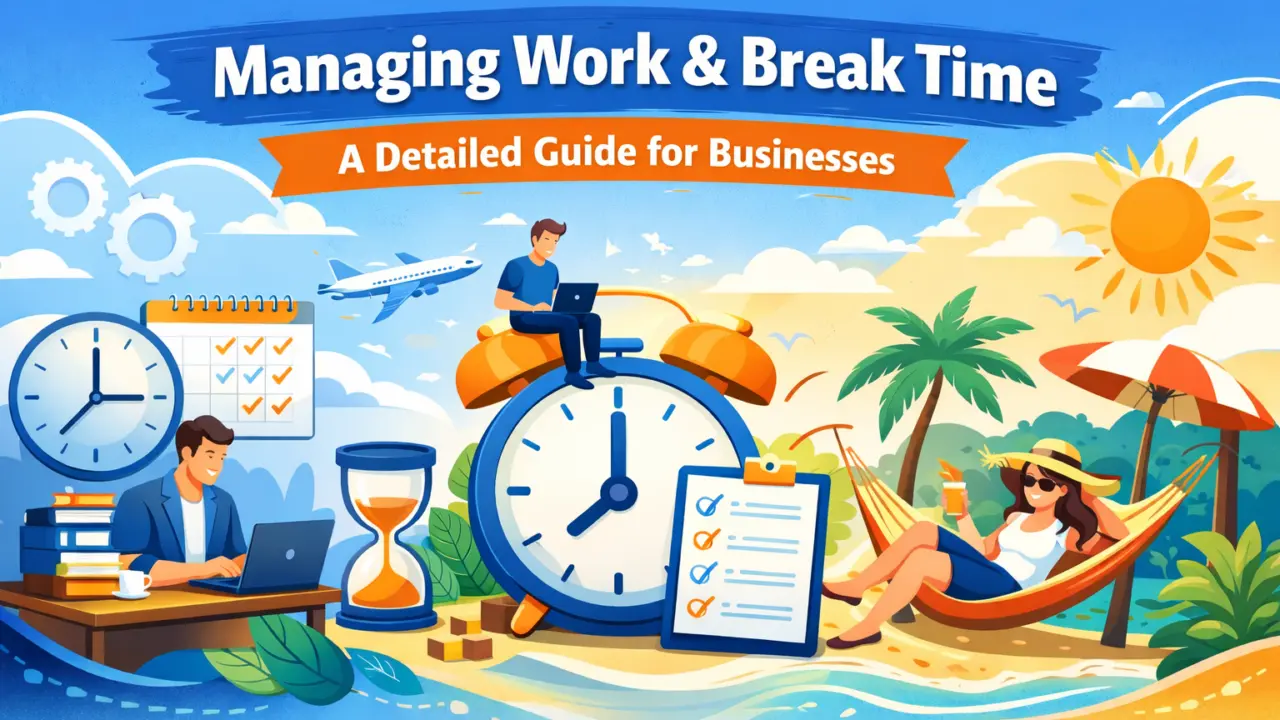
Effective management of working hours and rest periods is vital for legal compliance. We explore key regulations on overtime, night shifts, and rest days to help businesses navigate HR laws in Vietnam.
What is Working Hours and Rest Periods Management?
In modern human resource management, supervising working hours and rest periods involves more than tracking clock-in and clock-out times. It is the balance between labor productivity optimization and employee well-being and regeneration. In Vietnam, this framework sets rules for the time employees must be present to perform duties and the duration they are entitled to rest for physical and mental restoration.
Effective management helps a company establish a stable operational rhythm. If a business is a machine, working hours represent its operating power, while rest periods are the maintenance intervals. Smart managers understand that excessive working hours do not yield sustainable profits; they only lead to burnout and costly legal liabilities.
Statutory Regulations on Normal Working Hours
1. The Golden Rule: 8 Hours per Day and 48 Hours per Week
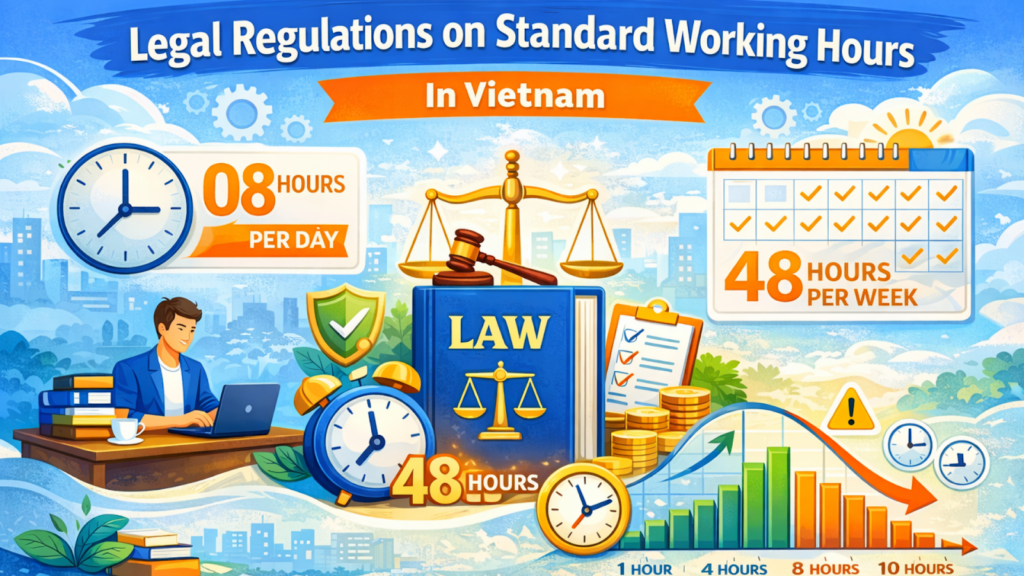
Vietnamese law clearly defines time limits to ensure health and safety. Normal working hours must not exceed 8 hours per day and 48 hours per week. This is the “Golden Rule” that every HR department must follow. Businesses have the flexibility to arrange schedules by day or week, provided that if arranged by week, the total time per day does not exceed 10 hours.
Maintaining this timeframe helps employees sustain peak concentration. Research shows that after the 8th hour, labor productivity gradually declines while error rates increase. Therefore, compliance is not just about following the law—it is a strategic move to protect product quality.
2. Flexibility for Special Occupational Categories
The law is not one-size-fits-all. For heavy, toxic, or hazardous occupations, working hours are shortened to minimize occupational disease risks. For seasonal sectors like agriculture or export garments, enterprises can apply a “cycle-based average hours” model.
This allows businesses to concentrate resources during peak order months and provide compensatory time off during slow periods. However, this flexibility must be specified in the labor contract and clearly communicated to employees. Understanding these exceptions helps businesses optimize resources without violating international labor standards such as the ILO.
3. Internal Labor Regulations (ILR): Your Workplace Legal Framework
All timing regulations become meaningless if they are not officially documented in the Internal Labor Regulations. The ILR is the most critical legal document in the workplace. It must specify: start times, end times, break intervals, and specific shifts.
A transparent ILR, registered with the authorities, acts as a legal shield for the business during inspections or labor disputes. When employees clearly understand when they must be present and when they can rest, workplace discipline is enhanced, reducing disputes over working time.
Detailed Regulations on Overtime and Application Conditions
1. Overtime Limits: Avoiding Legal Violations
Overtime is valuable during peak seasons, but it must be carefully managed. Vietnam’s Labor Code dictates that overtime must not exceed 50% of normal daily hours. Overall, employees cannot exceed 40 overtime hours per month and generally 200 overtime hours per year.
For specific sectors such as electronics, textiles, or emergency troubleshooting, this can extend to 300 hours per year, provided the authorities are notified. Strict management of these metrics is mandatory; exceeding these limits exposes businesses to heavy administrative fines and the risk of losing labor utilization rights or facing labor disputes.
2. The Voluntary Principle: Absolute Prohibition of Forced Overtime
Many enterprises mistakenly believe they can demand overtime at any time. In reality, a prerequisite for organizing overtime is the explicit consent of the employee. This consent should be documented via paper or HR systems with a clear audit trail.
Compelling employees to work overtime violates business ethics and erodes loyalty. When employees feel their extra contribution is based on a mutually beneficial agreement with fair compensation, they work with greater commitment, ensuring quality and progress.
3. Emergency Cases for Unlimited Overtime Mobilization
The law provides exceptions for force majeure situations. In cases such as national defense mobilization, natural disasters, fires, epidemics, or disasters threatening life and property, businesses have the right to mobilize unlimited overtime without the 200 or 300-hour limits.
However, even in emergencies, employee safety must come first. Once the situation is resolved, businesses must provide adequate compensatory rest for recovery. Understanding these terms helps enterprises respond quickly to crises while remaining legally compliant.
Night Shift Management and Compensation
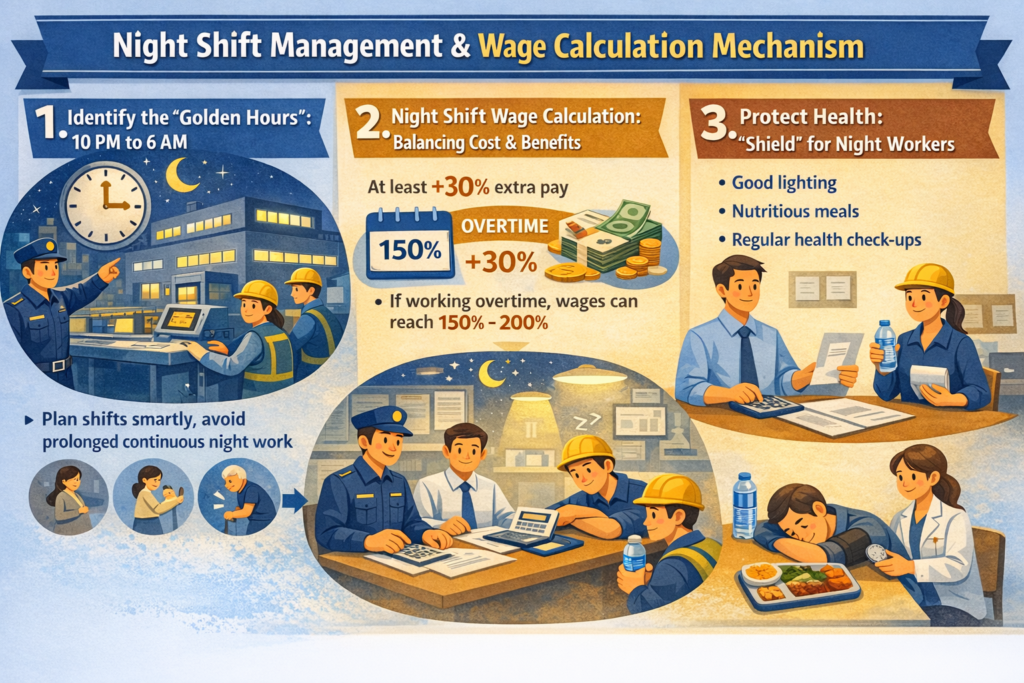
1. Identifying Night Work Hours: 10 PM to 6 AM
Night work in Vietnam is strictly defined from 22:00 to 06:00. This is the period when the human biological clock needs rest. Managing personnel during these hours requires careful attention.
Enterprises must be sensitive to vulnerable groups such as female employees with small children or those with health issues. Shift rotation must be scientific to prevent employees from working consecutive night shifts without recovery time, which leads to weakened resistance and increased accident risks.
2. Night Shift Salary Calculations: Fair Compensation for Challenging Work
Night work incurs higher labor costs. Employees are paid at least an additional 30% of the normal daily wage. If overtime occurs at night, the formula becomes more complex, involving special allowances that can reach 150% to 200% depending on the situation.
Accounting and HR departments must collaborate closely to calculate this accurately. A small error in night shift payroll can trigger labor disputes. Conversely, transparent and fair payment serves as the greatest motivation for employees to undertake challenging shifts.
3. Health Protection: Supporting Night Workers
Due to the demanding nature of night work, businesses should invest more in welfare for night workers. This includes appropriate lighting systems, nutritious shift meals, and clean break areas.
Periodic health checks for these employees are also mandatory. A sustainable business does not just focus on night shift output; it cares for its most valuable asset—the workers’ health. When employees feel cared for, turnover rates in difficult shifts decrease, stabilizing the production line.
Statutory Rest Periods and Leave Entitlements
1. Breaks and Inter-Shift Rest: Essential Recovery Time
Rest time is not wasted time. By law, employees working 6 hours or more are entitled to a break of at least 30 minutes (daytime) or 45 minutes (nighttime). The gap between two shifts must be at least 12 hours.
Violating inter-shift rest regulations is common in businesses facing labor shortages. However, forcing employees back to work too early causes fatigue and errors. View these 12 hours as necessary recovery time for your workforce to perform at their best.
2. Public Holidays and Weekly Rest: Inviolable Rights
Employees are entitled to at least 24 consecutive hours of rest per week, usually Sunday. There are 11 paid public holidays per year. These are vital occasions for employees to regenerate energy and spend time with their families.
If business needs require working on these days, the employer must pay at least 300% of the normal wage. This is a significant cost; therefore, HR needs to plan ahead to optimize holiday staffing and avoid unnecessary expenses.
3. Annual Leave: A Reward for Employee Loyalty
Annual leave (typically 12-16 days) is a basic right. Vietnam’s law provides one additional day of leave for every five years of seniority. This is an excellent tool for employee retention.
Managing leave requires fairness. Implementing an online leave registration system helps employees manage their personal time proactively. When rights are guaranteed, employees remain committed to the organization for the long term.
Solutions for Optimizing Working Hour Management
1. Digital Transformation: Moving from Paper to Technology
Manual management has no place in the modern era. Face ID or GPS-based attendance systems eliminate buddy punching and data errors.
Modern HR management systems can automatically alert managers when an employee nears legal overtime limits. This allows management to make timely personnel adjustments, ensuring both business progress and 100% legal compliance.
2. Building a “Work Smart, Not Long” Culture
Overtime is not a measure of dedication. Businesses should build an output-based culture. Train employees in time management and efficiency so they can complete tasks within the standard 8 hours.
When a company creates an environment where everyone strives to finish on time to be with their families, actual productivity is much higher than when employees simply sit at their desks waiting for overtime pay.
3. Discipline with a Human Touch
Time discipline is the foundation of any strong organization. Enterprises need clear and fair procedures for handling late arrivals or early departures. However, before applying penalties, investigate the root cause.
Sometimes chronic lateness is due to unreasonable shuttle routes or unexpected family difficulties. A flexible policy (such as allowing a 15-minute grace period with make-up time) is often more effective than rigid salary deductions. The combination of rules and empathy creates a self-disciplined and resilient workforce.
Conclusion
Working hours and rest periods management is a management art that requires understanding both law and human nature. By correctly implementing regulations on overtime, night shifts, and leave, a business protects itself from legal risks while building a professional environment where people are central to development. Remember: A well-rested employee is the most productive employee.
For any inquiries about Vietnam company formation or accounting and HR services, contact Wacontre via Hotline: (028) 3820 1213 or email [email protected] for prompt assistance. With a team of experienced professionals, Wacontre is committed to providing dedicated service. (For Japanese clients, please contact Hotline: (050) 5534 5505).