
This guide covers Vietnam’s latest tax policy updates, effective from July 1, 2025. Find out which key changes your business needs to act on now. From July 1, 2025, significant changes to Vietnam’s tax regulations come into force. This article provides an essential update on the latest tax policies, focusing on the 2025 amendments to Value Added Tax (VAT) and Corporate Income Tax (CIT), and outlines what every enterprise needs to know to remain fully compliant.
What Are the New Tax Policies Effective from July 1, 2025?
From July 1, 2025, a wave of new tax policies officially takes effect, directly impacting every business operating in Vietnam. This article offers an in-depth look at these changes, particularly those affecting Value Added Tax (VAT) and Corporate Income Tax (CIT), helping companies stay compliant and optimize their tax burden.
This is not a minor adjustment but a comprehensive tax reform aimed at modernizing tax administration, preventing revenue loss, and aligning Vietnam with international standards. The key focus areas include VAT, CIT, and tax management in the digital economy. The changes affect taxable subjects, deductible expenses, and introduce the Global Minimum Tax. For businesses, this reform brings compliance challenges, but also creates an opportunity to review financial strategies and strengthen competitiveness.
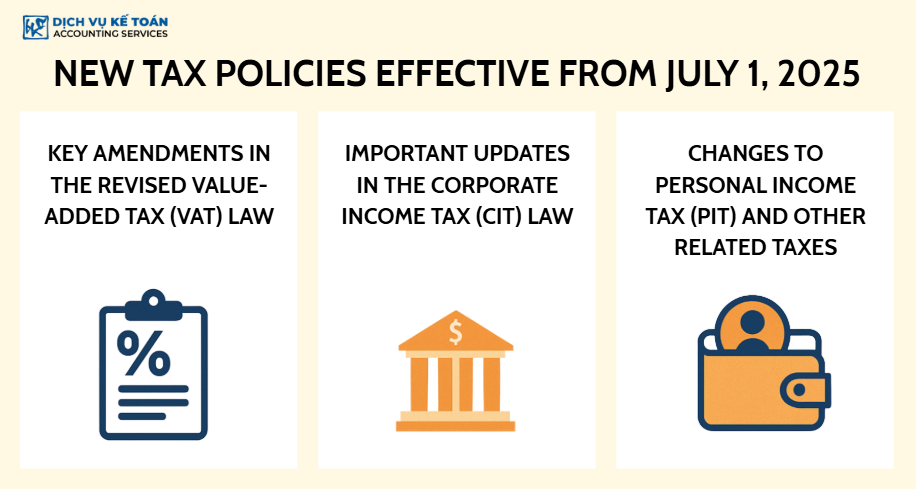
Key Changes in the Revised VAT Law
The revised VAT Law, built on Law No. 13/2008/QH12 and its subsequent amendments, is one of the most important components of this reform.
1. Changes to Non-Taxable Items and 0%-5% Tax Rates
Goods and services previously exempt from VAT may now fall under the 0% or 5% tax rate. For example, software export services are expected to qualify for 0% VAT, allowing full input VAT deductions.
At the same time, goods currently enjoying the 5% preferential rate may be reclassified to the standard 10% rate if they are no longer considered essential. Businesses must carefully review their product classifications to avoid misapplication and the risk of back taxes or penalties under Decree 125/2020/ND-CP.
2. Adjustments to VAT Timing Rules
The revised rules clarify the timing of VAT determination in complex transactions. For example:
- Real estate: VAT is triggered when the buyer pays 95% or more of the contract value, or upon handover.
- Long-term service contracts: VAT is determined at each completion stage or upon invoice issuance.
Failure to issue invoices at the correct time may result in administrative penalties under Decree 123/2020/ND-CP.
3. Stricter Conditions for Input VAT Deductions
Conditions for input VAT deduction have been tightened:
- For fixed assets used for both taxable and non-taxable activities, businesses must allocate the deduction accurately.
- All payments of VND 20 million or more must be made by cashless transfer, and the beneficiary name must match the invoice details; otherwise, the deduction may be denied.
4. E-Invoice Regulations and Digital Compliance
From July 1, 2025:
- Sectors that deal directly with consumers must use e-invoices with tax codes generated by cash registers and integrated with the tax authority’s system.
- Handling of incorrect e-invoices is now more flexible, but excessive amendments will be flagged by tax risk analysis systems.
Read more: What is VAT? Essential information accountants should know about Value added tax (VAT)
Corporate Income Tax (CIT): Strategic Changes Ahead
Built on Circular 78/2014/TT-BTC and its amendments, the revised CIT law introduces several major changes:
1. Implementation of the Global Minimum Tax
Vietnam will apply the OECD Pillar 2 rules from July 1, 2025:
- Multinational enterprises (MNEs) with global revenue of EUR 750 million or more will be subject to a top-up tax if their effective tax rate in Vietnam is below 15%.
- The government may offer indirect incentives (e.g., R&D grants) instead of tax holidays in order to maintain Vietnam’s investment appeal.
MNEs should reassess their investment structures accordingly.
2. Tighter Rules on Deductible Expenses
Key points:
- The interest expense cap remains at 30% of EBITDA (under Decree 132/2020/ND-CP).
- Employee welfare expenses (capped at one month’s average salary) must now be supported by:
- Detailed documentation,
- Inclusion in the company’s financial policy,
- A list of employee beneficiaries.
Non-compliant costs will be disallowed in the annual tax finalization.
3. New CIT Incentives for High-Tech and R&D Sectors
In response to the global tax shift, Vietnam now offers stronger tax incentives tied to genuine economic value:
- Higher deduction caps for R&D costs (up to 200% of the actual amount).
- Enhanced contribution limits to the Science and Technology Development Fund.
To qualify, businesses must meet strict criteria under the Law on High Technology.
4. Strengthened Transfer Pricing and Related-Party Transaction Rules
Under Decree 132/2020/ND-CP:
- The definition of “related parties” now covers both ownership and operational control.
- New rules require more detailed transfer pricing documentation, including a global value chain analysis.
- Failure to file the required transfer pricing appendices may trigger tax reassessments and penalties.
Read more: Corporate Income Tax (CIT): Proper Understanding and Optimizing Efficiency
Personal Income Tax (PIT) and Other Tax Reforms
1. PIT on Capital Transfers and Securities
New rules:
- For securities, taxpayers can choose between:
- 0.1% of the total sale value, or
- 20% on actual gains (if supporting documentation is available).
- For equity transfers in LLCs, the methods for calculating cost basis and transfer value have been clarified to reduce disputes.
2. Special Consumption Tax (SCT) Adjustments
Updates include:
- Sugary soft drinks have been added to the list of taxable goods.
- Continued SCT increases on alcohol and tobacco, in line with a defined roadmap.
Affected businesses must recalculate their costs and pricing strategies accordingly.
3. Tighter Tax Management for E-Commerce
Under Law No. 38/2019/QH14 and Circular 80/2021/TT-BTC:
- Foreign e-commerce providers without a permanent establishment in Vietnam must register, declare, and pay tax directly.
- Local e-commerce platforms must:
- Share seller data with the tax authority,
- Withhold and pay tax on behalf of individual sellers (under Circular 40/2021/TT-BTC).
Read more: Personal Income Tax: Definition and Calculation Methods
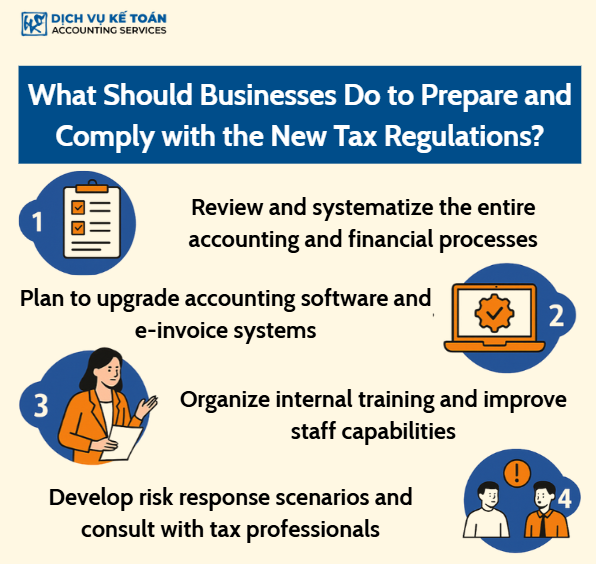
What Should Businesses Do to Prepare?
1. Review and Update Accounting and Finance Processes
Conduct a full audit of your accounting procedures and align them with the new regulations. Identify and fix inconsistencies across internal policies, especially financial regulations.
2. Upgrade Accounting Software and E-Invoice Systems
Make sure your systems comply with the new e-invoicing rules under Decree 123/2020/ND-CP. Work closely with software vendors to ensure proper integration with the tax authority’s system.
3. Train Staff and Raise Cross-Department Awareness
Provide in-depth tax compliance training not only to accounting teams, but also to sales, procurement, and HR departments to ensure organization-wide awareness.
4. Prepare Risk Scenarios and Seek Expert Advice
Develop tax risk management plans proactively. Given the complexity of the new rules, work with professional tax advisors to design the safest and most effective compliance strategy, particularly under the Law on Tax Administration No. 38/2019/QH14.
The sweeping tax reform effective from July 1, 2025 demands proactive adaptation from every business. To not only comply, but also turn these challenges into a competitive advantage, companies must quickly update their processes, upgrade their digital infrastructure, and invest in employee capability.
Given the complexity of these changes, engaging professional tax and accounting advisors is a strategic necessity to ensure stability and growth under the new legal landscape.
For any inquiries, contact Wacontre Accounting Services via Hotline: (028) 3820 1213 or email [email protected] for prompt assistance. With a team of experienced professionals, Wacontre is committed to providing dedicated and efficient service. (For Japanese clients, please contact Hotline: (050) 5534 5505).