
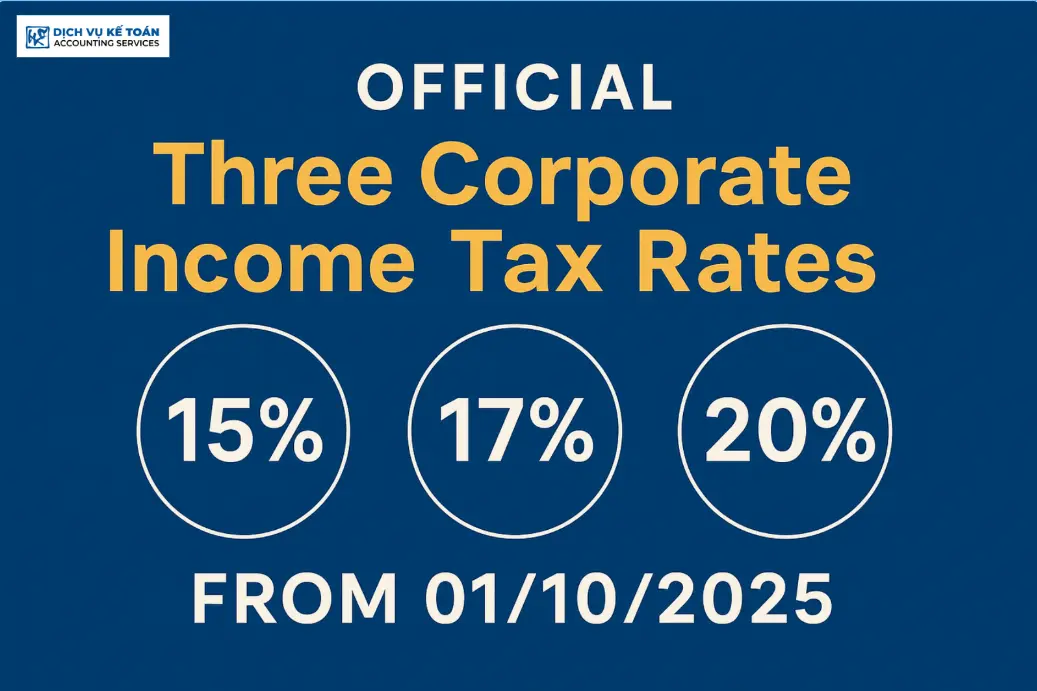
Starting October 1, 2025, Vietnam will officially apply three new Corporate Income Tax (CIT) rates of 15%, 17%, and 20%. This guide explains which rate applies to your business and how to prepare for the transition.
In less than two months, one of the most significant changes to Vietnam’s Corporate Income Tax (CIT) policy in years will take effect. The new three-tier CIT structure brings both opportunities and challenges for the business community. Preparing now will not only ensure legal compliance but also help you optimize costs and reshape your financial strategy for late 2025 and beyond. This article provides a comprehensive overview, in-depth analysis, and a concrete action plan ahead of this major change.
What Are the New Three CIT Rates Effective October 1, 2025?
Under the amended Law on CIT passed by the National Assembly and effective from October 1, 2025, Vietnam’s CIT structure will move from a single standard rate to a multi-tiered model with three levels: 15%, 17%, and 20%. This is a strategic move by the Government to create a fairer tax environment, support small and medium-sized enterprises (the backbone of the economy), and direct investment capital into the high-tech and sustainable sectors prioritized for national development.
The change is more than a numeric adjustment. It reflects a shift in policy philosophy, from a uniform approach to a classified, targeted model. For businesses, this means CIT payable will no longer be a default constant but will depend on company size, industry, and field of operation. Understanding the policy’s intent will help managers not only comply but also leverage the available incentives, turning tax policy into a competitive advantage.
Detailed Analysis: Which Businesses Apply Each New Tax Rate?
Accurately identifying which tax bracket applies to your business is the most critical task at this stage. Below is a detailed breakdown of each rate.
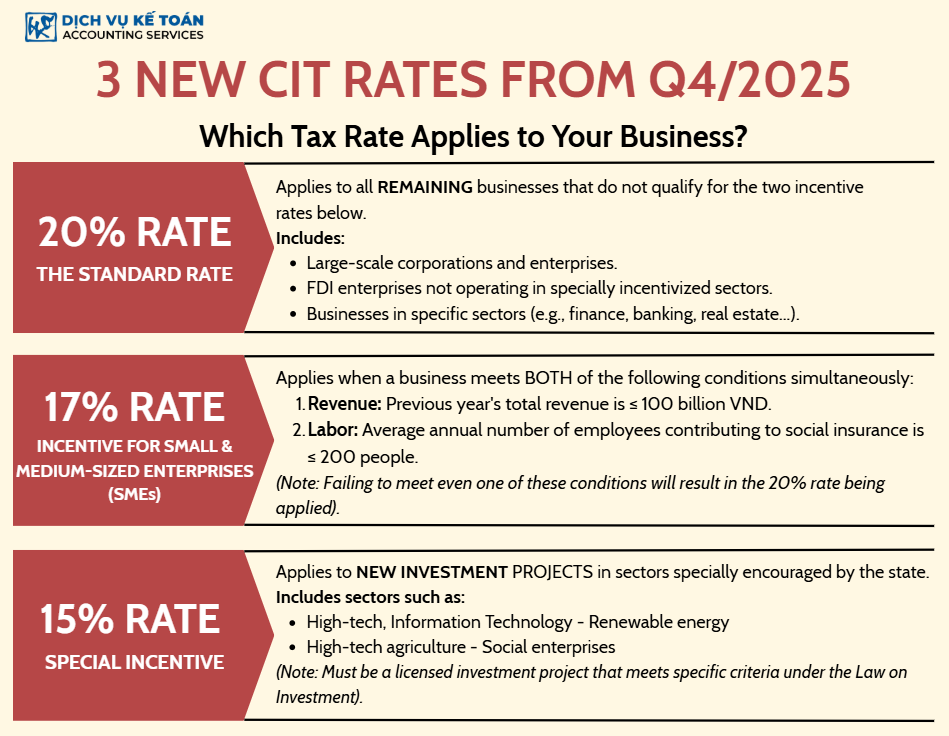
1. The 20% Standard Rate
This remains the standard CIT rate, applicable to most businesses operating in Vietnam that do not qualify for incentives. These include:
- Large corporations and groups with significant capital and revenue.
- Foreign-invested enterprises (FIEs) operating in sectors not on the special investment incentive list.
- Businesses in sectors such as finance, banking, insurance, real estate, and professional services including accounting, auditing, and legal consulting (unless specific rules apply).
- Other businesses that do not meet the criteria for the 17% or 15% rates.
In short, if your business currently applies the 20% rate and there is no change in scale or industry toward an incentivized category, you can expect to continue at this rate.
2. The 17% Preferential Rate for Small and Medium-Sized Enterprises (SMEs)
This is a new measure that directly benefits the private sector, especially SMEs. To qualify for the 17% preferential rate, a business must meet the SME criteria. Specifically, an enterprise is considered an SME when:
- Total revenue in the preceding year does not exceed VND 100 billion.
- AND the average annual number of employees enrolled in Social Insurance does not exceed 200.
This rule reduces the tax burden, giving SMEs more resources to reinvest, expand operations, strengthen competitiveness, and create jobs. Businesses should review their 2024 financial and HR data to determine eligibility for the tax period beginning in Q4 2025. This is a major opportunity for growing companies to accelerate.
3. The 15% Special Preferential Rate for Priority Investment Sectors
The 15% rate is the highest available incentive, reserved for businesses with new investment projects in sectors specifically encouraged by the state to attract high-quality capital and promote sustainable development. These sectors include, but are not limited to:
- High Technology: production of high-tech products, biotechnology, and new materials.
- Information Technology: software production, digital content, and key IT services.
- Renewable Energy: wind power, solar power, and other clean energy projects.
- High-Tech Agriculture: applying biotechnology and automation in agricultural production and processing.
- Social Enterprises: businesses addressing social or environmental issues and reinvesting most of their profits into those goals.
To qualify, a business must operate in one of these sectors and hold a licensed investment project that meets the scale and technology criteria set out in the Law on Investment and related guidance.
Impact of the New CIT Policy on Businesses
The new rates will create multi-dimensional effects, requiring businesses to recalculate and adjust their strategies carefully.
1. Changes in Financial Planning and Cash Flow Forecasting
This is the most direct and visible impact. Businesses will need to recalculate projected CIT for Q4 2025 and prepare a new budget for the full year 2026. Companies moving from 20% to 17% or 15% will see meaningful savings that can be redirected to reinvestment, debt repayment, or contingency reserves. Conversely, an inaccurate rate forecast can lead to under- or over-provisioning of tax expenses, affecting after-tax profit and actual cash flow.
2. Opportunities for Tax Optimization and Compliance Challenges
The new policy creates opportunities to restructure operations to qualify for preferential rates. For example, a company with multiple business lines may consider spinning off its high-tech segment into a separate legal entity to access the 15% rate. However, this also raises significant compliance risk. Misclassifying activities or lacking proper supporting documents can lead to tax arrears and heavy penalties during future audits. Businesses near the upper limit of the SME thresholds in particular should manage growth carefully to avoid a sudden tax-rate jump once those thresholds are exceeded.
3. Key Considerations for Declaring and Finalizing CIT Under the New Law
The tax declaration and finalization process will inevitably change. Provisional CIT forms and the annual finalization template will be updated to include new fields allowing businesses to self-determine the applicable rate. For the 2025 finalization, companies will need to calculate tax in two stages: the first nine months under the old rate, and the final three months under the new one. Accounting teams should be professionally prepared, update their knowledge, and follow tax authority guidance closely to ensure accurate and complete execution.
What Should Businesses Do Now Before October 1, 2025?
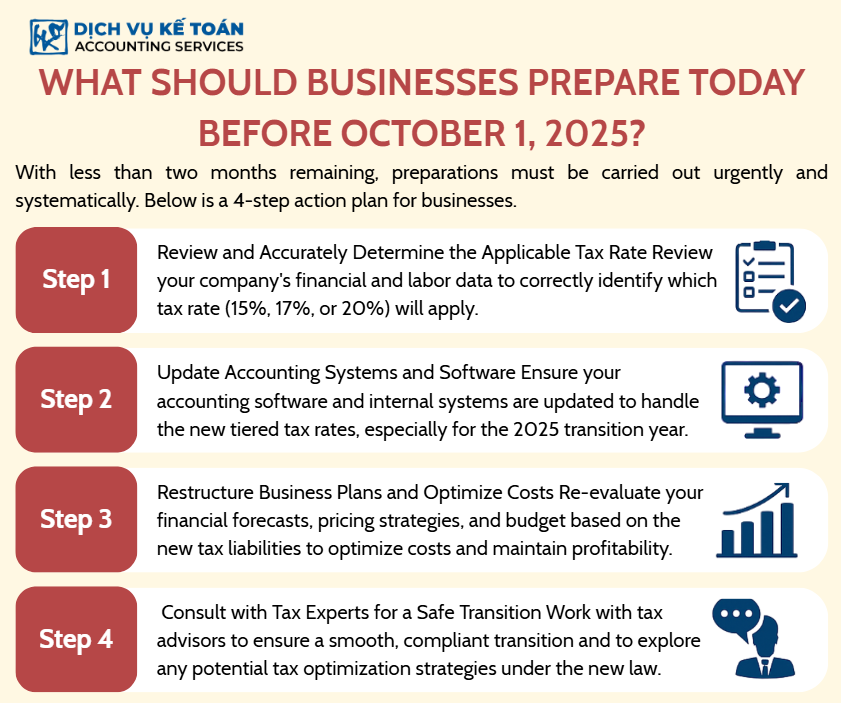
With less than two months remaining, preparation must be carried out promptly and systematically. Below is a four-step action plan.
Step 1: Review and Accurately Determine the Applicable Tax Rate
This should be done immediately. Management and accounting teams should compare 2024 revenue and headcount data, along with the current field of operation, against the criteria above. There must be a definitive answer to the question: “From October 1, 2025, which rate will our company apply?” This determination is the foundation for every subsequent step.
Step 2: Update Accounting Systems and Software for the New Regulations
Contact your accounting software provider promptly to confirm the update roadmap for a version capable of calculating CIT at multiple rates. Do this early so that by October 1, 2025, your system is ready to accurately record transactions and prepare the Q4 provisional declaration, avoiding manual errors.
Step 3: Rebuild Business Plans and Optimize Costs
Based on the newly determined rate, update the financial plan for the final months of 2025 and the projection for 2026. If your tax burden decreases, define a clear plan for using the savings: where to reinvest, which markets to expand into, or how to enhance employee benefits. If you remain at 20%, consider strategies for optimizing deductible expenses to improve pre-tax profit.
Step 4: Consult Tax Experts for a Safe Transition Roadmap
Given the scope of the change and the many binding conditions, interpreting the law alone can be risky. Engage professional accounting and tax consulting firms. They can help you correctly identify your applicable rate, advise on restructuring solutions where appropriate, assist with legal documentation, and ensure your transition is safe, compliant, and as efficient as possible.
The three-tier CIT policy taking effect from October 1, 2025 is a positive signal of the Government’s effort to support businesses and attract selective investment. While any change brings initial challenges, this is also an opportunity for businesses to reflect, restructure, and reshape their strategies for more sustainable growth. Proactive, careful, and timely preparation over the next two months will be the decisive factor in helping your business enter this new phase with confidence and fully capture the benefits the policy offers.
For any inquiries, contact Wacontre Accounting Services via Hotline: (028) 3820 1213 or email [email protected] for prompt assistance. With an experienced professional team, Wacontre is committed to providing dedicated and efficient service. (For Japanese clients, please contact Hotline: (050) 5534 5505.)