

The K-Factor for e-invoice risk management has become an important tool that helps tax authorities monitor businesses and prevent fraud. In this article, we explain what the K-Factor is, how it relates to e-invoice risks, and the latest information every business should know.
What Is the K-Factor in E-Invoice Risk Management?
The K-Factor is an index used to assess the risk level associated with the issuance and use of e-invoices by businesses. Tax authorities rely on this index to classify enterprises into different risk tiers, from low to high, enabling more focused and effective tax administration, inspection, and auditing.
The K-Factor is calculated periodically by the tax authority’s data system based on multiple criteria, including tax compliance history, financial status, business type, and invoicing behavior. Applying the K-Factor strengthens the ability of tax authorities to detect risks and tax fraud, while allowing compliant businesses to enjoy administrative advantages.
The Role of the K-Factor in Tax Risk Management
1. How the K-Factor Is Applied in Invoice Monitoring
The K-Factor is a behavioral analysis tool that helps tax authorities identify businesses at risk of violating tax regulations. Enterprises with a low K-Factor are generally subject to fewer inspections, while those with a high K-Factor are monitored more closely.
This approach allows tax authorities to allocate resources more efficiently by focusing on high-risk entities rather than carrying out broad, inefficient inspections. With the nationwide rollout of e-invoicing in Vietnam, the K-Factor helps detect anomalies quickly.
2. Key Criteria That Affect a Business’s K-Factor
Several factors influence the K-Factor, including:
– Tax compliance history
– Timeliness of financial and invoice reporting
– Sudden changes in revenue, profit, or invoice volume
– Outstanding tax liabilities or administrative violations
– Business type and industry sector
Each criterion is scored by the tax authority’s risk management system and then aggregated into an overall K-Factor rating.
3. Risk Levels and K-Factor Classification
Although the full details are not publicly disclosed, the K-Factor is generally classified into three levels:
– Low (K1): Compliant businesses with minimal risk
– Medium (K2): Some indicators require closer monitoring
– High (K3): Multiple irregularities with a high risk of fraud
This classification directly influences how businesses are supervised and supported by the tax authorities.
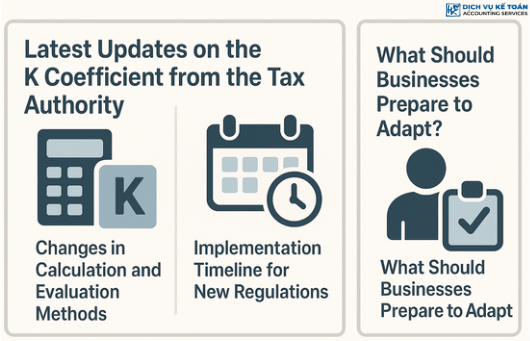
Latest Updates on the K-Factor from Tax Authorities
1. Changes in Assessment and Calculation Methods
From 2024 onward, tax authorities have started using Big Data analytics and Artificial Intelligence (AI) to update the K-Factor in real time. This advancement allows for faster and more accurate risk detection. The system automatically cross-checks abnormal indicators across tax declarations, invoice usage, and cash flow.
In addition, the K-Factor assessment criteria have been expanded to more accurately reflect a company’s financial health and legal compliance.
2. Timeline for Implementing the New Regulations
These changes have been in force since Q2 2024. Businesses identified as high-risk receive electronic alerts through the tax administration system. While these alerts do not carry immediate legal consequences, they serve as a basis for businesses to review and correct their operations.
The tax authority also works with banks and customs departments to gather more comprehensive data for risk assessment.
3. How Businesses Should Prepare to Adapt
Businesses should establish transparent accounting systems, properly archive invoices, and ensure the timely submission of all required reports. Using compliant accounting and e-invoicing software is a key factor in improving the K-Factor.
Business leaders should also stay informed about tax policy updates and strengthen staff training to ensure long-term compliance.

Steps to Explain Your K-Factor to the Tax Authority
1. Prepare clear, complete, and convincing explanatory documents
– Sample letter explaining the K-Factor
– Economic contracts and purchase/sale invoices
– Receipts, payment vouchers, sales lists, and purchase journals
– Photos or videos of the company’s business activities (if necessary)
2. Contact the tax authority and attend the working session
– After submitting the documents, the tax officer in charge may invite you to a working session
– Be ready to explain clearly and provide full supporting evidence
– If needed, request the officer to conduct an on-site inspection of the business location
The K-Factor is more than a technical metric — it is a critical tool in tax risk management. Enterprises must clearly understand its significance, how it works, and the factors that influence it in order to adjust their operations accordingly. In the era of comprehensive digital transformation in the tax sector, maintaining a favorable K-Factor is essential for businesses to grow sustainably, transparently, and efficiently.
For any inquiries, contact Wacontre Accounting Services via Hotline: (028) 3820 1213 or email [email protected] for prompt assistance. With a team of experienced professionals, Wacontre is committed to providing dedicated and efficient service. (For Japanese clients, please contact Hotline: (050) 5534 5505).
Click here to register and access the form.