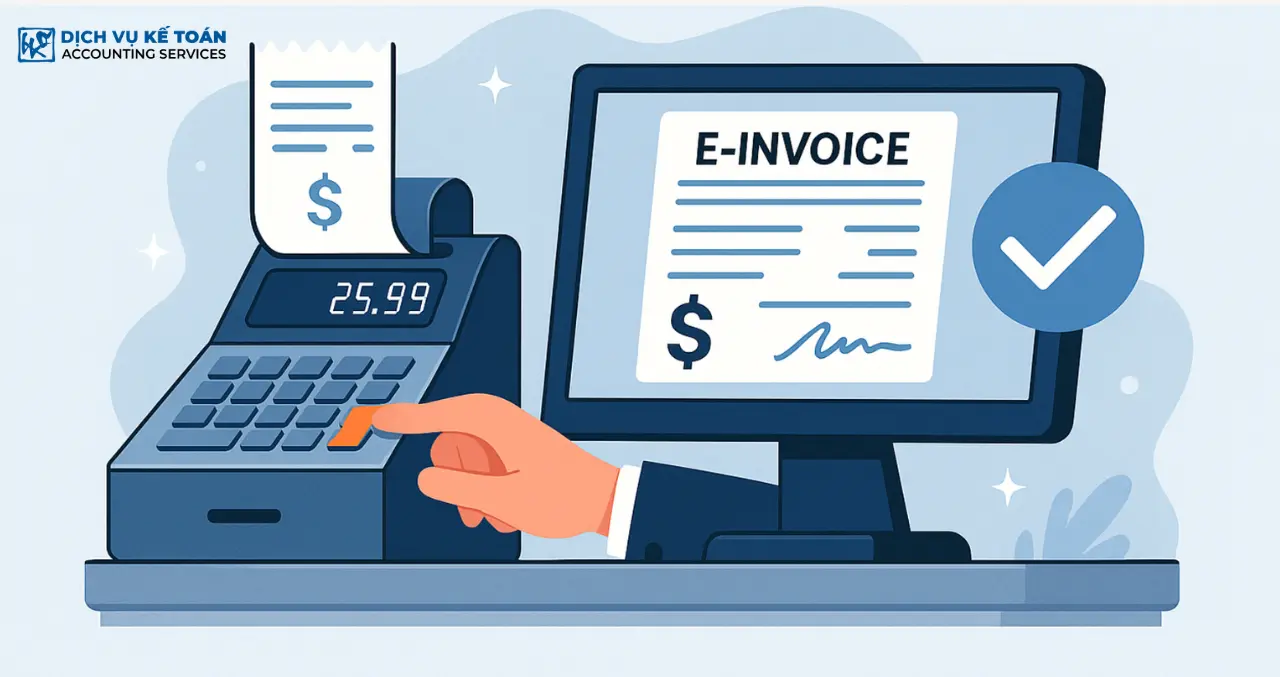
Issuing e-invoices directly from cash registers helps businesses in Vietnam operate efficiently, stay compliant with tax regulations, and reduce costs.
Connecting your POS systems to e-invoicing is a modern solution that saves time, streamlines financial management, and meets the latest legal requirements. This article walks you through the full process and key benefits of integrating e-invoicing directly with your point-of-sale systems.
- Guidelines for Issuing E-Invoices from Cash Registers in Compliance with Regulations
- What Is E-Invoicing from Cash Registers?
- Benefits of Issuing E-Invoices from Cash Registers
- Process for Issuing E-Invoices from POS Systems
- Legal Regulations to Note When Using POS Systems for E-Invoicing
- Common Issues and Solutions in E-Invoicing from POS Systems
Guidelines for Issuing E-Invoices from Cash Registers in Compliance with Regulations
Issuing e-invoices from cash registers allows businesses to manage operations more efficiently, remain compliant with tax law, and cut operating costs.
Generating electronic invoices directly from cash registers is a modern approach that helps enterprises meet tax regulations, save time, and optimize financial management. Read on to learn more about the process and benefits of using e-invoices connected directly to POS systems.
What Is E-Invoicing from Cash Registers?
E-invoicing from a cash register is the process of generating and issuing electronic invoices through terminal devices such as POS (Point-of-Sale) systems. It is a major step in the digital transformation and modernization of accounting and sales management for businesses.
Under Decree 123/2020/NĐ-CP and Circular 78/2021/TT-BTC, certain businesses are required to use tax-coded e-invoices integrated with POS systems. These systems automatically transmit invoice data to the tax authority after each transaction, ensuring transparency and legal compliance.
This method reduces manual processing, prevents the loss of paper invoices, and improves revenue and cost control.
Benefits of Issuing E-Invoices from Cash Registers
1. Save Time and Operating Costs
Compared to traditional paper invoices, e-invoicing eliminates printing, storage, shipping, and manual processing costs. Issuing an e-invoice takes just a few seconds, streamlining the transaction process and improving the customer experience.
2. Minimize Human Error
Automation helps prevent common manual errors such as incorrect data entry, miscalculations, or missing signatures. POS systems integrated with e-invoice software ensure data accuracy and consistency.
3. Greater Transparency and Easier Data Management
All invoices are stored on cloud-based platforms, making it easy for businesses to search records, analyze revenue, and prepare financial reports. Transparent sales information also reduces fraud and customer disputes.
4. Comply with Legal Tax Requirements
Tax authorities require certain industries to use e-invoices connected directly to cash registers. Compliance helps businesses avoid legal risks and administrative penalties.
Process for Issuing E-Invoices from POS Systems
1. Prepare E-Invoice Integration Software
Businesses should select an e-invoice software provider authorized by the General Department of Taxation. The software must be compatible with the company’s existing POS systems.
2. Register and Integrate with the Software Provider
Once the software is ready, the business must register with the tax authority and integrate the POS system with the invoicing software. This step usually requires technical assistance or IT personnel.
3. Configure Invoice Format and Business Information
Configure invoice templates, symbols, invoice types, and key information such as company name, tax ID, and address to ensure proper issuance.
4. Automatically Issue and Send Invoices to Customers
When a transaction occurs, the POS system automatically generates the invoice and sends it to the buyer by email or SMS. At the same time, it transmits the data in real time to the tax authority’s system.
5. Store and Manage E-Invoices
All issued invoices must be stored for the legally required period (typically 10 years) and can be retrieved at any time through the software, making audits and tax finalization much easier.
Legal Regulations to Note When Using POS Systems for E-Invoicing
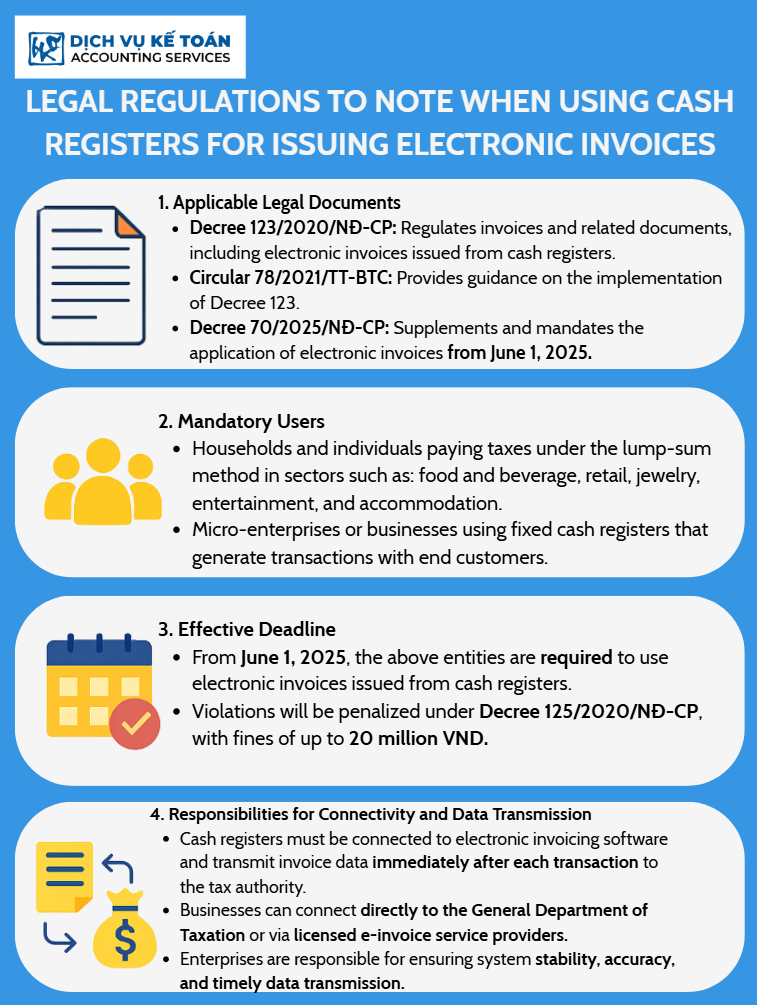
1. Applicable Legal Documents
Businesses must comply with the following regulations when implementing e-invoicing from POS systems:
- Decree 123/2020/NĐ-CP: Regulations on invoices and documents, including POS-based e-invoices.
- Circular 78/2021/TT-BTC: Guidelines for Decree 123, detailing invoice formats and data submission procedures.
- Decree 70/2025/NĐ-CP: Amendments to Decree 123, especially Article 11, which makes POS-based e-invoicing mandatory for certain sectors starting June 1, 2025.
Keeping up with these regulations is essential for lawful operations and for avoiding administrative penalties.
2. Mandatory Target Groups
Under Clause 8, Article 1 of Decree 70/2025/NĐ-CP, mandatory users of POS-based e-invoices include:
- Tax-registered households and individuals operating in:
- Food and beverage services (restaurants, cafes)
- Retail of consumer goods
- Jewelry trading
- Entertainment services (karaoke, massage, beauty)
- Hospitality (hotels, motels)
- Micro-enterprises and businesses with fixed POS systems that serve end consumers.
Confirming whether your business falls into this category is the first step toward timely and accurate implementation.
3. Mandatory Implementation Timeline
As stipulated in Decree 70/2025/NĐ-CP:
- From June 1, 2025, designated businesses and individuals must begin using POS-based e-invoices.
- Non-compliance may result in penalties under Decree 125/2020/NĐ-CP, with fines of up to 20 million VND depending on the violation.
Businesses should prepare early by upgrading their systems, training staff, and choosing reliable software providers.
4. Data Transmission Responsibilities
A key requirement is the real-time transmission of invoice data:
- POS systems must be connected to e-invoice software that sends invoice data to the tax authority immediately after each transaction.
- Businesses may not delay data transmission except in cases of officially acknowledged technical failures.
Available options include:
- Direct connection to the General Department of Taxation’s system
- Connection via licensed e-invoice service providers
Businesses are responsible for maintaining system integrity, ensuring accurate and timely data transmission, and resolving any issues that arise.
Common Issues and Solutions in E-Invoicing from POS Systems
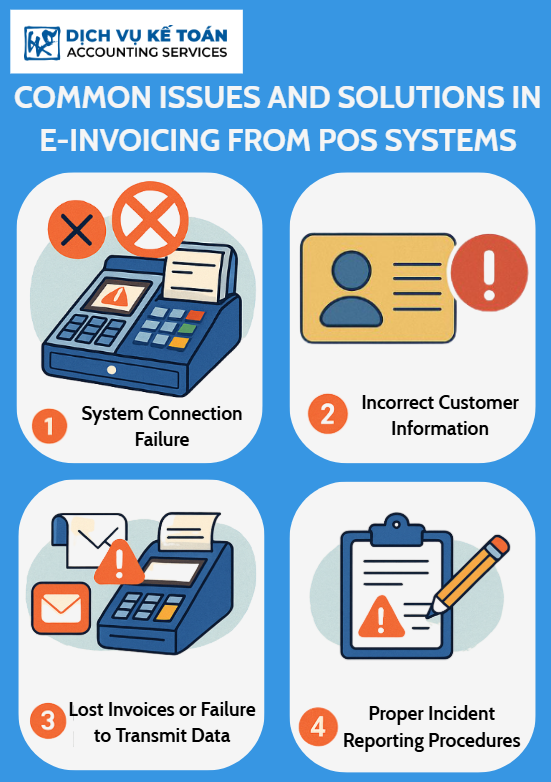
1. System Connection Failure
Usually caused by incorrect configuration or incompatible software. Businesses should contact their software provider for technical support.
2. Incorrect Customer Information
Often caused by human error. Solutions include implementing validation systems and requiring confirmation before each invoice is issued.
3. Lost Invoices or Failure to Transmit Data
This may result from network issues, software bugs, or system outages. Businesses should implement backup plans and conduct regular system checks.
4. Proper Incident Reporting Procedures
In the event of any incident, businesses must document the issue, retain records, and submit a report to the tax authority within two working days to avoid penalties.
Issuing e-invoices from POS systems is not only a legal requirement but also a strategic step to improve management efficiency, reduce costs, and increase financial transparency. With new regulations taking effect on June 1, 2025, businesses must act now to ensure compliance and embrace sustainable digital transformation.
For any inquiries, contact Wacontre Accounting Services via Hotline: (028) 3820 1213 or email [email protected] for prompt assistance. With a team of experienced professionals, Wacontre is committed to providing dedicated and efficient service. (For Japanese clients, please contact Hotline: (050) 5534 5505).