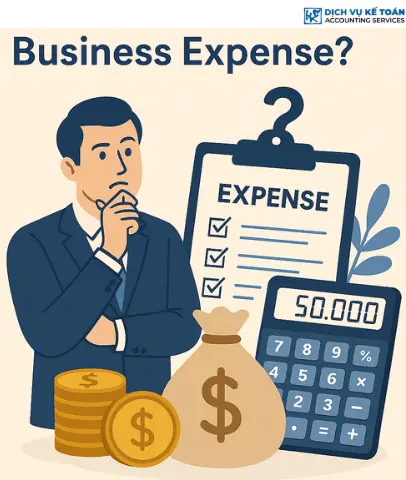
Understand what qualifies as a deductible business expense in Vietnam and how to correctly apply the regulations when calculating corporate income tax (CIT). Properly identifying deductible expenses is essential for businesses to optimize costs and remain fully compliant with Vietnamese tax law.
What Are Deductible Business Expenses?
In the course of normal production and business activities, enterprises incur a wide range of expenses. However, not all of these expenses are accepted by the tax authorities when calculating corporate income tax (CIT). Correctly identifying which costs qualify as deductible expenses is therefore critical: it allows businesses to comply with tax law while optimizing their overall cost structure.

Criteria for Determining Deductible Expenses Under Tax Regulations
1. Directly Related to the Enterprise’s Business Activities
Deductible expenses are those that directly support the enterprise’s business operations. Examples include the cost of raw materials, employee salaries, depreciation of fixed assets, office rent, and utilities. Each of these costs must contribute to generating revenue or maintaining day-to-day operations.
2. Supported by Complete and Legally Valid Invoices and Documents
An expense is only considered deductible when it is supported by complete documentation, including VAT invoices, sales invoices, commercial contracts, and liquidation records, in accordance with current regulations. Missing or incomplete documentation will result in the expense being disallowed.
3. Paid Using Legally Recognized Payment Methods
Under current regulations, any invoice with a value over VND 20 million, or multiple invoices from the same supplier issued on the same day totaling more than VND 20 million, must be paid through non-cash methods such as bank transfer or payment authorization in order to be recognized as a deductible expense.
4. Within Normal Spending Levels and Prescribed Limits
Expenses that are unusually high relative to revenue, such as salaries, client entertainment, or office supplies, may be partially disallowed. Enterprises must adhere to the spending ratios and caps prescribed by the Corporate Income Tax Law.
5. Recorded in the Correct Accounting Period
No matter how legitimate an expense may be, if it is recorded in the wrong period, for example posted to an incorrect fiscal year or an incorrect account, it will not be accepted by the tax authorities.

Non-Deductible Expenses for CIT Purposes
Non-deductible expenses are costs incurred by an enterprise during its operations that do not meet the requirements for deductibility when calculating taxable income.
Common examples include payments made for individuals unrelated to the business, expenses lacking complete and lawful documentation, and depreciation that exceeds regulatory limits.
Any expense deemed non-deductible will be disallowed, which increases the amount of CIT payable.
Efficient Accounting and Documentation of Deductible Expenses
Properly recording and storing expense documentation not only helps businesses control costs effectively but also provides essential evidence during tax inspections and audits. Enterprises should follow these key principles:
– Record each expense under the correct accounting account and within the correct accounting period.
– Retain all supporting documents, including invoices, payment vouchers, contracts, acceptance reports, and liquidation records. These documents must be original, clearly legible, legally valid, and bear all required signatures and seals.
– Use reliable accounting software or an ERP system to track and store documents electronically, reducing the risk of loss or damage.
– Train accounting staff regularly so they stay up to date with tax regulations and proper documentation procedures.

Common Questions About Deductible and Non-Deductible Expenses
Example 1: Paying salaries to employees who have a valid labor contract, where the employees sign the payroll and salary payments follow the company’s official salary and bonus policy.
=> Recognized as a deductible expense.
Example 2: Paying monthly office rent of VND 30 million with a valid lease agreement, a VAT invoice issued by the landlord, and payment made from the company’s bank account.
=> Recognized as a deductible expense.
Example 3: The director takes his personal car in for maintenance, has the VAT invoice issued in the company’s name, and requests reimbursement so the cost can be booked as a company expense.
=> Not recognized and must be excluded, since the vehicle is personal property and is not used for production or business activities.
Example 4: Purchasing office supplies at a small grocery store where the seller does not issue an invoice and provides only a handwritten sales receipt with a cash payment slip.
=> Not recognized and must be excluded, as no legally valid invoice is available.
Understanding and correctly applying the rules around deductible expenses helps businesses save on legitimate costs while avoiding risks during tax audits and inspections. Enterprises should work closely with their accounting and finance teams, as well as legal advisors, to build a cost system that is transparent, reasonable, and efficient.
For any inquiries, please contact Wacontre Accounting Services via Hotline: (028) 3820 1213 or email [email protected] for prompt assistance. Backed by a team of experienced professionals, Wacontre is committed to delivering dedicated and efficient service. (For Japanese clients, please contact Hotline: (050) 5534 5505.)