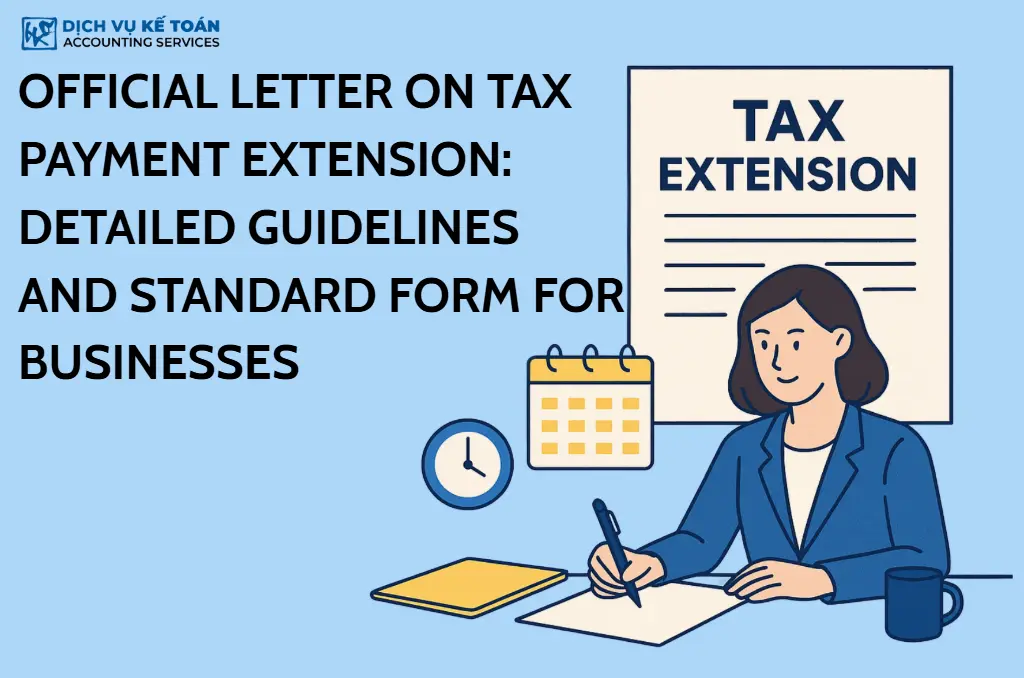
A tax payment extension letter allows businesses in Vietnam to legally defer tax deadlines. This guide provides a standard template and a detailed procedure.
The tax payment extension letter allows businesses to request a lawful tax deferral from the authorities. This article provides a standard template and a step-by-step procedure tailored for companies operating in Vietnam.
What is a tax payment extension request letter?
A tax payment extension request letter is an official administrative document prepared by businesses, economic organizations, or household businesses to request that the local tax authority allow a postponement of the deadline for paying one or more types of due taxes. The document must follow the prescribed template and clearly state the reason for the extension, the legal basis, the types of taxes involved, the duration of the extension, and a commitment to fulfill the tax obligations after the deferment period.
Amid the current economic challenges in Vietnam, such as global inflation, rising production costs, shrinking export markets, and tighter monetary policies, many businesses are facing liquidity issues and operational uncertainty. Geopolitical instability and higher capital costs have added further financial pressure. In this context, tax payment extensions serve as a timely fiscal tool to ease cash flow burdens, sustain business operations, and gradually restore competitiveness.
Note: A tax deferral is not a waiver or reduction of tax obligations. If the request is approved, the taxpayer is not charged late payment interest during the extension period, which reduces legal and financial risks.
Legal basis:
- Law on Tax Administration No. 38/2019/QH14 (Article 62)
- Decree 126/2020/NĐ-CP
- Annual guidelines such as Decree 12/2023/NĐ-CP and Decree 82/2025/NĐ-CP
Benefits of requesting a tax extension
1. Supports cash flow and reduces financial pressure
Allows businesses to temporarily retain significant funds for urgent needs such as payroll, operations, debt repayment, or short-term investments.
2. Strengthens legal compliance
Following the proper procedure ensures the business is not penalized for late payment and reinforces a professional, law-abiding image with tax authorities and business partners.
3. Minimizes the risk of administrative penalties
If a business runs into difficulty and does not request an extension, late payment penalties apply. An approved extension, however, avoids both penalties and interest.
4. Provides flexibility during external challenges
In times of economic downturns, natural disasters, or pandemics, tax extensions provide macro-level policy support, giving businesses time to recover and maintain operations.
Eligibility and conditions for tax extension requests
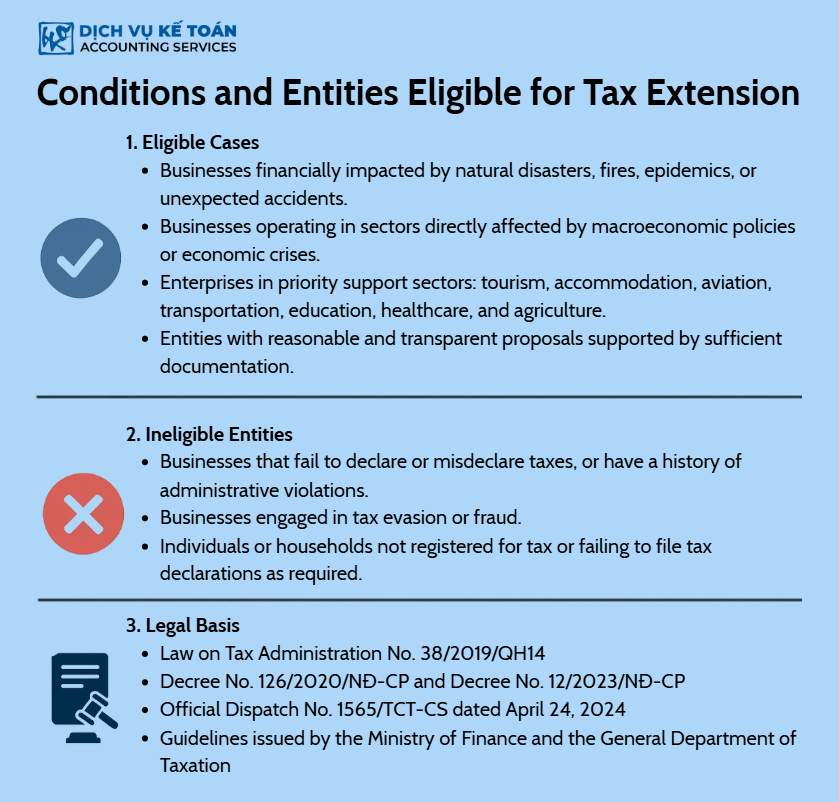
1. Eligible cases:
- Businesses that have suffered financial losses due to natural disasters, fires, epidemics, or unexpected accidents.
- Businesses affected by macroeconomic policy shifts or economic crises.
- Enterprises in prioritized sectors such as tourism, lodging, aviation, transport, education, healthcare, and agriculture.
- Requests must be reasonable, transparent, and supported by documentation.
2. Ineligible cases:
- Businesses that have intentionally failed to declare or have misdeclared taxes, or that have a history of administrative violations.
- Entities involved in tax evasion or fraud.
- Individuals or households that are not registered for tax or have failed to submit the required declarations.
3. Legal references:
- Law on Tax Administration No. 38/2019/QH14
- Decree 126/2020/NĐ-CP
- Decree 12/2023/NĐ-CP (dated 14/04/2023)
- Official Letter 1565/TCT-CS (dated 24/04/2024)
- Future decrees and updates from the General Department of Taxation or the Ministry of Finance
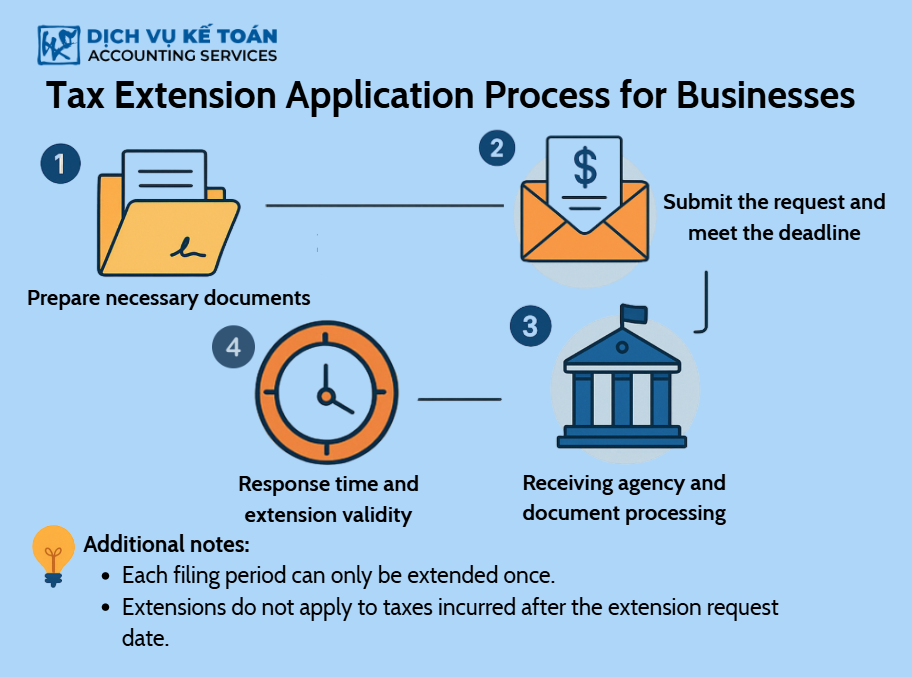
Tax extension request process
1. Prepare the required documents:
- Extension request letter (template per Decree 82/2025/NĐ-CP)
- Documents supporting the reason for the extension
- List of taxes to be deferred (e.g., CIT, VAT)
- Power of attorney (if signed by someone other than the legal representative)
2. Submit the request and meet the deadline:
Per Decree 82/2025/NĐ-CP, the request must be correctly formatted, timely, and submitted by:
- Submission methods:
- Through the electronic tax system (eTax)
- In person at the tax office
- By postal mail
- Deadline: On or before May 30, 2025, for all eligible taxes
3. Types of tax and new deadlines:
VAT:
- Feb 2025 → New due date: Sep 20, 2025
- Mar 2025 → Oct 20, 2025
- Apr 2025 → Nov 20, 2025
- May & Jun 2025 → Dec 20, 2025
- Q1/2025 → Oct 31, 2025
- Q2/2025 → Dec 31, 2025
CIT:
- Q1/2025 → Oct 30, 2025
- Q2/2025 → Dec 30, 2025
Important note: Late submissions are not eligible for the extension and will be subject to late payment penalties.
4. Processing authority and response timeline:
- Received by the local Tax Department
- Processing time: 7–10 working days
- If the application is incomplete, the tax office will issue a request for corrections
5. Response and extension validity:
- If the application is valid, no reply is needed; the extension is automatically updated in the tax system
- If the application is invalid or lacks documentation, the tax authority will notify the applicant
Extension validity: Begins after the original due date and is extended based on the specific type of tax.
- No late payment interest is charged during the extension period
Additional notes:
- Each declaration period can only be extended once
- Extensions do not apply to tax amounts incurred after the requested deferral date
Latest tax extension request letter template
1. Structure:
- National title and slogan
- Company name, tax code, and head office address
- Addressed to: the direct tax authority
- Request details: types of taxes and deferment duration
- Reasons: specific and verifiable
- List of attached documents
- Commitment to fulfill tax obligations after the extension
- Signed and stamped by the legal representative
2. Form-filling notes:
- Do not leave any section blank
- Keep the explanation concise and supported by data
- Use formal administrative language
- Include all necessary documents, with verification if required
Download the form template here insert hyperlink
Preparing a tax extension request letter reflects a business’s proactive and responsible compliance with its tax obligations. It provides not only temporary financial relief but also a legal safeguard against penalties during difficult periods.
To stay compliant and up to date, businesses should regularly monitor announcements and guidance from the tax authorities.
For any inquiries, please contact Wacontre Accounting Services via Hotline (028) 3820 1213 or email [email protected] for prompt assistance. With a team of experienced professionals, Wacontre is committed to providing dedicated and efficient service. (For Japanese clients, please contact Hotline (050) 5534 5505.)