Under Vietnamese accounting regulations, newly established enterprises incorporated within the last 90 days of the fiscal year may consolidate their first-year financial statements into the following year’s report. This provides a practical option for start-ups to reduce administrative burden while remaining fully compliant.
What Is Consolidation of Financial Statements?
Consolidation of financial statements (FS) is a special provision that allows enterprises established shortly before the end of a fiscal year to combine their first-year FS with those of the following fiscal year. The provision is optional, not mandatory, and is a practical choice for reducing accounting workload, saving costs, and aligning reporting with the company’s actual start-up activity.
Under Circular 200/2014/TT-BTC and related guidance, a business established within 90 days before the end of the fiscal year is permitted to skip a standalone first-year FS and consolidate it with the FS of the following year. This applies provided that no tax authority, auditor, investor, or other relevant party specifically requires a separate report.

Why Consolidation Into the Following Year Is Permitted
1. Legal framework on the fiscal year and incorporation timing
Under the Accounting Law and related guidance, the standard fiscal year runs from January 1 to December 31. For newly established enterprises, however, the operating period in the first year can be too short to meaningfully reflect business performance. Preparing a standalone FS that covers only a few weeks would not provide an accurate picture of the company’s financial position and would waste resources.
For this reason, the law allows enterprises incorporated within 90 days before fiscal year-end to consolidate their report into the next year. This flexibility better matches real-world business management.
2. Why a 90-day threshold? Practical significance
The 90-day threshold balances reliable financial disclosure with reduced administrative burden for new businesses. During the final three months of the year, most start-ups are still in set-up mode—hiring staff, completing licensing, and recording few economic transactions. A mandatory standalone report in such circumstances would not faithfully represent the company’s operations.
The 90-day window also gives management adequate time to decide whether to consolidate and to set up the accounting system properly from day one.
Procedures and Documentation for FS Consolidation
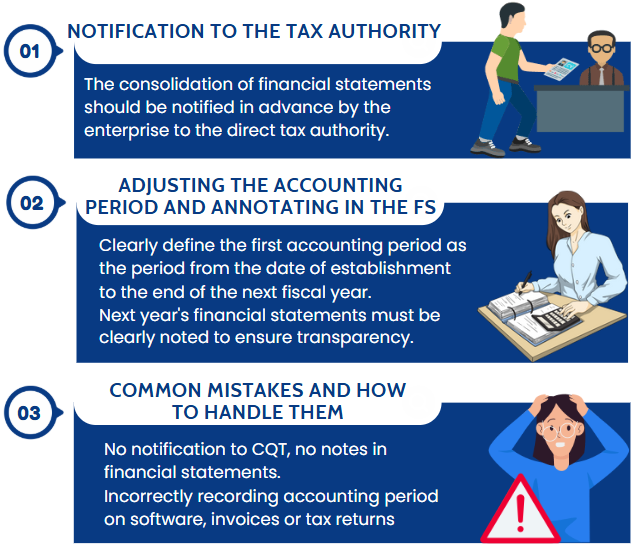
1. Notification to the tax authority
Prepare an official letter requesting FS consolidation and submit it directly to the tax authority at the enterprise’s registered office. The letter must clearly state the reason, demonstrate that the enterprise meets the conditions, and cite the applicable legal basis.
FS consolidation should be reported in advance to the managing tax authority to avoid any misunderstanding regarding missed first-year reporting obligations.
2. Adjusting the accounting period and disclosing it in the FS
The enterprise must define its first accounting period as running from the incorporation date to the end of the following fiscal year. The following year’s FS must clearly disclose, for example: “The financial statements include data from the first year (from the incorporation date to December 31 of the following year) in accordance with Circular 200…”, to ensure transparency.
3. Common mistakes and how to handle them
Some enterprises fail to notify the tax authority or omit the required disclosure in the FS, which can lead to administrative penalties or requests to submit additional reports. Incorrectly recording the accounting period in accounting software, invoices, or tax declarations can also create confusion.
The solution is to review all documents and accounting systems from the outset and to consult a qualified tax accountant to ensure full compliance.
Tax and Audit Considerations When Consolidating FS
1. Impact on first-year tax finalization
Even when the FS is consolidated, the enterprise must still declare and pay any taxes incurred in the first year, such as VAT, business license tax, and personal income tax. While no standalone FS is filed, the underlying data must still be compiled and retained for inspection and audit purposes.
In particular, the business license tax must still be paid in the year of incorporation (unless an exemption applies under Decree 22/2020/ND-CP).
2. Audit and transparency in the following year
If the enterprise is subject to audit, the auditor must be given full supporting documentation covering the entire first year, even when the report is consolidated. The audit must rely on complete data in order to issue an appropriate audit opinion.
Investors, banks, and business partners may also ask for an explanation of why the report was consolidated, so the enterprise should keep complete supporting documents on hand to maintain credibility.
Consolidating financial statements for newly established enterprises is a flexible mechanism that supports start-up operations in their earliest stages. To apply it correctly and avoid legal risk, businesses must understand the conditions, follow the proper procedures, and continue to meet all tax declaration obligations during the consolidation period. Planning the accounting framework from day one, notifying the tax authority, and ensuring transparency in the FS will help companies save costs while remaining fully compliant with Vietnam’s accounting regulations.
For any inquiries, contact Wacontre Accounting Services via Hotline: (028) 3820 1213 or email [email protected] for prompt assistance. With an experienced team of professionals, Wacontre is committed to providing dedicated and efficient service. (For Japanese clients, please contact Hotline: (050) 5534 5505.)
Click here to register and access the form.