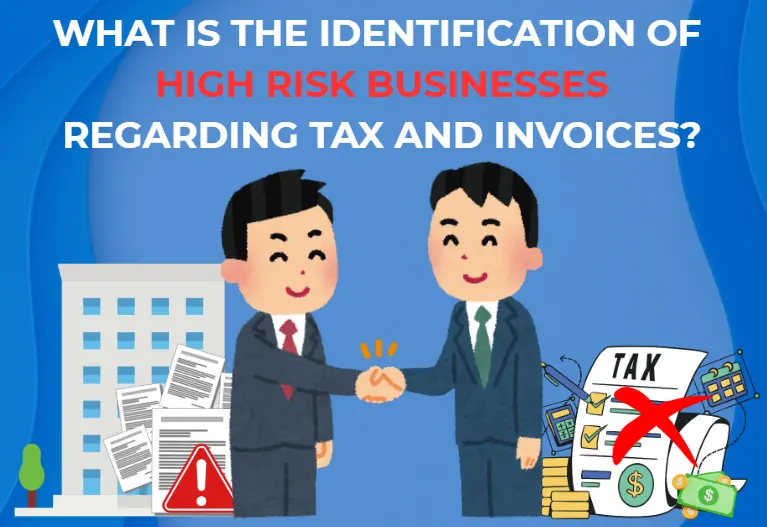
Learn the signs and factors that identify businesses with high tax and invoice risks, helping minimize exposure and ensure full legal compliance. Without strict internal controls, companies can easily run into tax- and invoice-related issues. Identifying these risks early allows businesses to prevent errors and avoid penalties.
What does it mean to identify high-risk businesses in terms of tax and invoices?
Identifying businesses with high tax and invoice risks is essential to protecting a company from legal exposure. If such risks are not detected and addressed promptly, they can seriously affect operations.
Correctly recognizing the factors and warning signs of at-risk businesses enables companies to take appropriate preventive measures, reduce costs, and avoid penalties.
Warning signs of businesses with high tax and invoice risks
According to Official Dispatch No. 1873/TCT-TTKT dated June 1, 2022 on strengthening reviews and inspections to detect taxpayers showing signs of invoice risk and to combat VAT refund fraud, the following warning signs of high-risk businesses should be noted:
1. Businesses that change their legal representative two or more times within 12 months, or change their legal representative and business location at the same time.
2. Businesses that change their operating status or business location two or more times within a year.
3. Newly established businesses with an unstable business location (changing location multiple times within 1-2 years of operation).
4. Businesses that change their business location after receiving a Notice of inactivity at the registered address.
5. Enterprises established by individuals with close family relationships contributing capital, such as spouses or siblings.
6. Newly established enterprises whose directors or legal representatives previously ran a company that the tax authority has flagged as having abandoned its business address (with tax arrears) or temporarily suspended operations.
7. Enterprises that were established years ago without generating revenue and were later resold or transferred.
8. Enterprises that issue invoices for resources and minerals despite holding no mineral exploitation license.
9. Enterprises whose purchased or sold goods do not match the conditions and characteristics of the local region.
10. Enterprises that have not contributed the full charter capital as registered.
11. Enterprises involved in purchases, sales, or mergers valued at less than VND 100 million.
12. Enterprises operating in industries such as supermarkets (retail of consumer goods and electronics); food and beverage, restaurants, and hotels; transportation; construction materials; petroleum; mining of soil, stone, sand, and gravel; minerals (coal, kaolin, iron ore, etc.); agriculture and forestry (wood chips, panels, bars, etc.); or labor leasing showing sharp increases.
13. Sudden revenue spikes: a previous declaration period reports very low revenue (close to zero) while the following period shows a sudden surge (three times or more above the average of prior periods), yet the value-added tax (VAT) payable remains low (VAT payable < 1% of revenue for the period).
14. Revenue is large but warehouse capacity is disproportionate, or there is no warehouse and no warehouse rental costs.
15. Annual declared revenue exceeds VND 10 billion but the tax payable is low, under VND 100 million (1%).
16. Enterprises that use invoices in large volumes (500 to 2,000 invoices), with a high rate of cancelled invoices averaging around 20% of those issued.
17. Enterprises using electronic invoices under Decree No. 123/2020/ND-CP and Circular No. 78/2021/TT-BTC that show an unusual decrease in the number of e-invoices compared with the volume previously used under Decree No. 51/2010/ND-CP.
18. Enterprises that have no invoice issuance notice, or have an issuance notice but fail to submit (or are late in submitting) reports on invoice usage.
19. Enterprises whose value of goods sold and output VAT are equal to, or only marginally different from, the value of goods purchased and input VAT.
20. Enterprises whose goods and services sold do not align with the goods and services purchased.
21. Enterprises with large revenue and significant output and input VAT but no tax payable, and negative VAT balances across multiple periods.
22. Enterprises that hold no fixed assets, or whose fixed asset value is very low.
23. Enterprises with suspicious banking transactions (funds received and withdrawn on the same day).
24. Enterprises whose workforce is disproportionate to the scale and nature of their industry.
25. A single individual (legal representative) establishing and operating multiple enterprises.
Consequences of failing to identify tax and invoice risks
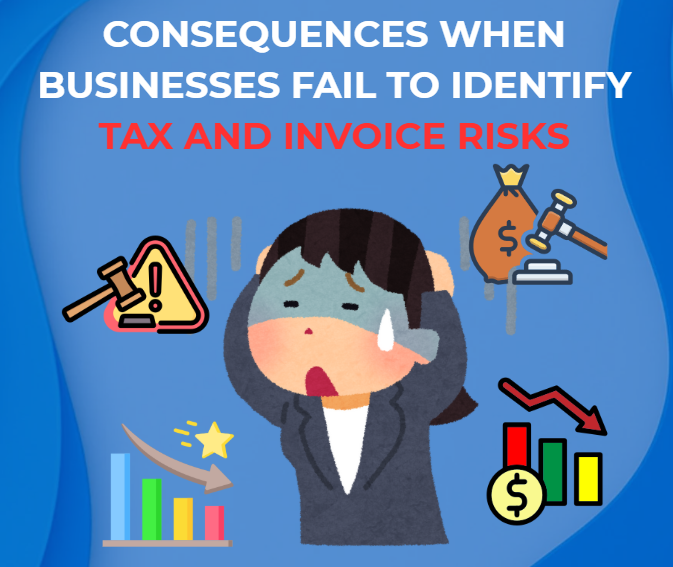
1. Fines and back-tax collection
If a business fails to fully comply with tax and invoice regulations, it may face penalties from the tax authorities, including fines and back-tax collection on disallowed expenses.
2. Higher financial costs from violations
In addition to fines, businesses must bear the costs of correcting errors, adjusting invoices, and re-filing tax reports. These expenses can raise operating costs and erode profits.
3. Damage to reputation and relations with tax authorities
Once a business is found to have committed tax violations or used illegal invoices, its reputation can suffer and its relationship with the tax authorities may become strained, making future cooperation and business relationships more difficult to maintain.
How businesses can minimize tax and invoice risks
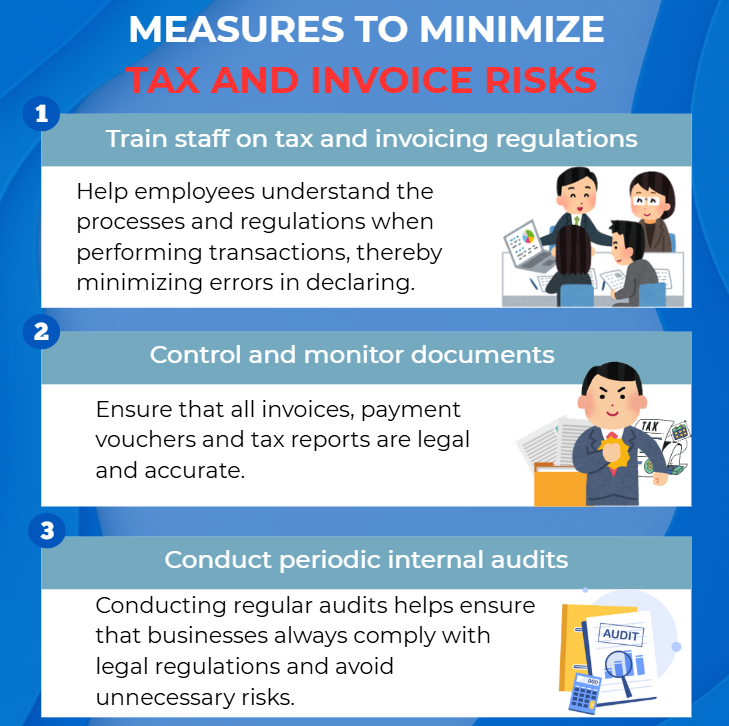
1. Train staff on tax and invoice regulations
Training employees on the legal regulations governing taxes and invoices is critical. It helps staff understand the proper procedures for transactions, reducing errors when declaring taxes and issuing invoices.
2. Strengthen document control and monitoring
Enterprises should put in place a strict document control system to ensure that all invoices, payment vouchers, and tax reports are valid and accurate. Regular review and monitoring help detect errors early and enable timely corrections.
3. Conduct periodic internal audits
Internal audits help businesses identify tax and invoice issues before the tax authorities step in. Periodic audits ensure ongoing compliance with the law and help avoid unnecessary risks.
Identifying and managing tax and invoice risks is an indispensable part of any company’s financial management. Understanding the warning signs of high-risk businesses and the potential consequences of poor control enables companies to implement effective preventive measures, minimize costs, avoid penalties, and maintain strong relationships with tax authorities and business partners.
For any inquiries, contact Wacontre Accounting Services via Hotline: (028) 3820 1213 or email [email protected] for prompt assistance. With a team of experienced professionals, Wacontre is committed to providing dedicated and efficient service. (For Japanese clients, please contact Hotline: (050) 5534 5505).