A complete overview of every case eligible for import-export tax exemption under Vietnam’s 2025 Law on Export-Import Tax. Learn the conditions and procedures to optimize your costs.
Vietnam’s new 2025 Law on Export-Import Tax is now in force. This guide details every category of import-export tax exemption, explaining the latest tax policies and procedures that allow businesses to legally reduce their tax burden.
- What is Import-Export Tax Exemption under the 2025 Law?
- Summary of Cases Eligible for E-I Tax Exemption Under the New Law
- 1. Tax Exemption for Goods Serving Investment Projects
- 2. Tax Exemption for Goods Used in Processing and Export Production
- 3. Tax Exemption for Goods Serving Security, Defense, Education, and Science
- 4. Tax Exemption for Foreign Organizations and Individuals Enjoying Privileges and Immunities
- 5. Other Exemption Cases (Humanitarian Aid, Gifts, etc.)
- Required Procedures and Documents for E-I Tax Exemption
- Common Mistakes and Risks When Applying for Tax Exemption
What is Import-Export Tax Exemption under the 2025 Law?
Under the 2025 Law on Export-Import (E-I) Tax, tax exemption means that the State does not collect tax on certain exported or imported goods. It is an important policy tool used to achieve a range of objectives, such as encouraging investment in priority sectors, promoting domestic production, fulfilling international commitments, and supporting humanitarian, security, and national defense purposes.
It is essential to clearly distinguish “tax exemption” from related concepts such as “tax refund” and “tax reduction.”
Tax Exemption: Eligible goods are not taxed at all when customs procedures are carried out.
Tax Refund: The enterprise pays tax upon import but is later refunded once it meets the required conditions (for example, goods imported to produce exported goods).
Tax Reduction: The enterprise is allowed to pay only a portion of the standard tax amount.
A clear understanding of “tax exemption” helps businesses prepare the right documents from the import stage, optimizing cash flow and avoiding complex procedures later on.
Summary of Cases Eligible for E-I Tax Exemption Under the New Law
The 2025 Law on Export-Import Tax consolidates, amends, and supplements many regulations on tax-exempt cases. Below is a detailed list of the most common categories that businesses should be aware of.
1. Tax Exemption for Goods Serving Investment Projects
This is a particularly important exemption category, applied to enterprises with investment projects in sectors encouraged by the State.
Tax-exempt goods include: machinery, equipment, components, spare parts, and molds used directly to create fixed assets for the project.
Raw materials, supplies, and components: used in the production of projects in sectors with special investment incentives, particularly high-tech projects or those producing high value-added products.
Construction materials that cannot be produced domestically: used directly for building factories and infrastructure for the project.
Example: An FDI company imports a brand-new semiconductor chip production line. The machinery cannot be produced in Vietnam and directly serves a high-tech investment project. The company is fully exempt from E-I tax on that machinery shipment.
2. Tax Exemption for Goods Used in Processing and Export Production
This is the most common exemption case in the manufacturing and processing sectors for exported goods.
Tax-exempt goods include: raw materials, supplies, and components imported for processing and the production of goods for export.
Finished products: goods produced in Vietnam from imported raw materials and subsequently exported abroad.
Example: A garment company imports fabric from overseas to cut and sew into clothing, which is then exported to the European market. The company is exempt from import tax on the fabric and from export tax on the finished garments.
3. Tax Exemption for Goods Serving Security, Defense, Education, and Science
The State uses tax exemption policies to support social, scientific, and national security objectives.
Tax-exempt goods in this category include: goods directly serving security and defense, such as specialized equipment, weapons, vehicles, and specific medical supplies.
Goods serving education and science: books, textbooks, teaching equipment, and scientific research machinery that cannot be produced domestically.
Example: A university imports a modern spectrophotometer for scientific research. The equipment is exempt from import tax provided it meets the prescribed standards and procedures.
4. Tax Exemption for Foreign Organizations and Individuals Enjoying Privileges and Immunities
This exemption applies to specific entities defined by international and Vietnamese law.
Eligible beneficiaries include: diplomatic missions and international organizations, for goods imported to support their activities, including vehicles.
Diplomatic officials and staff of international organizations: for goods imported for personal use during their term of duty in Vietnam.
5. Other Exemption Cases (Humanitarian Aid, Gifts, etc.)
In addition to the major cases above, the 2025 Law on Export-Import Tax provides exemptions for several smaller but equally important cases, including:
Humanitarian and non-refundable aid: goods sent from abroad to Vietnam to support areas affected by natural disasters, epidemics, and similar emergencies.
Gifts and presents: within the prescribed tax-free limit (for example, below a certain value and not on the list of prohibited items).
Goods for temporary import for re-export or temporary export for re-import: goods brought into Vietnam temporarily for trade fairs, exhibitions, or repairs, or otherwise returned within a specified period.
Required Procedures and Documents for E-I Tax Exemption
To obtain a tax exemption legally and smoothly, businesses must follow the correct procedures and prepare a complete set of documents.
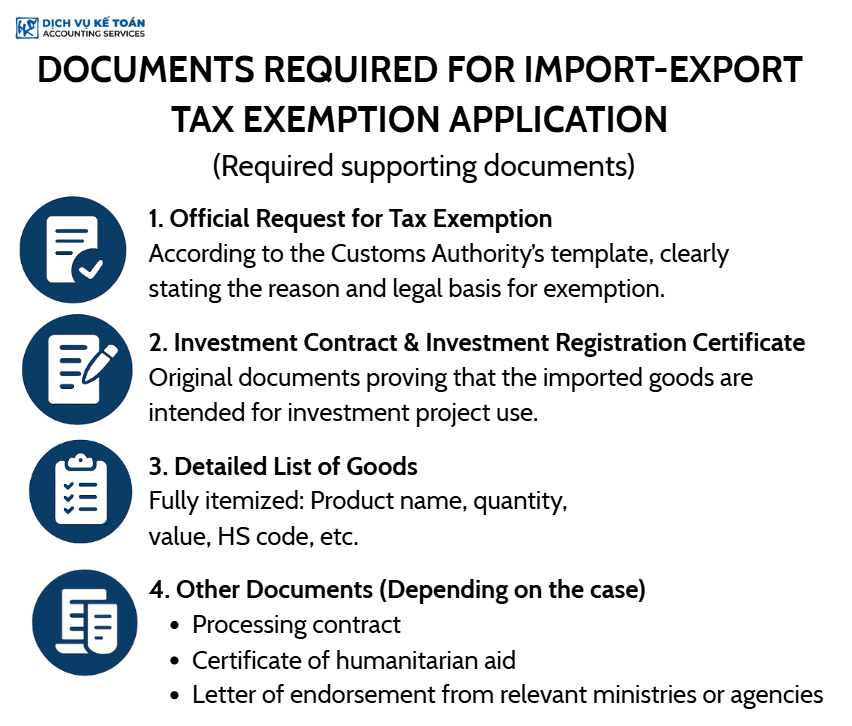
1. What Documents Are Required for the Tax Exemption Application?
The tax exemption application is usually submitted together with the customs declaration dossier when carrying out import procedures. A complete file typically includes:
A written request for tax exemption: in the form prescribed by the customs authority, clearly stating the type of goods, their intended use, and the legal basis for the exemption.
Contracts and the Investment Registration Certificate: key documents proving that the goods are for an investment project.
A detailed goods list: with complete information on item name, quantity, value, HS code, and so on.
Other documents: processing contracts (if any), aid certifications (if any), and letters of introduction from the governing ministry or sector.
2. Submission Process and Review Timeline
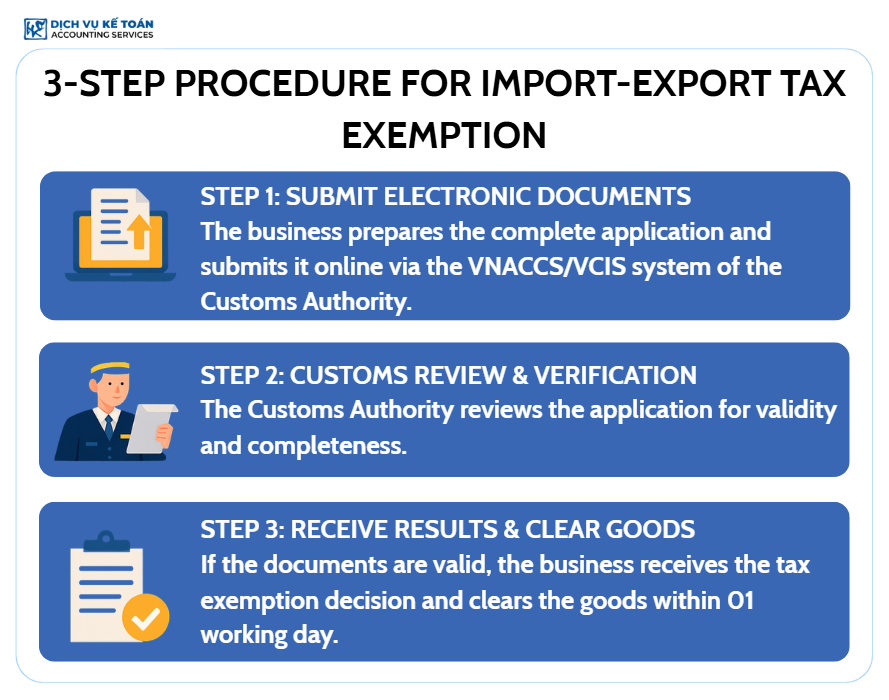
The submission process for a tax exemption application is as follows:
Step 1: The enterprise prepares the documents and submits them to the Customs authority. The file is submitted electronically through the Customs VNACCS/VCIS system.
Step 2: The Customs authority receives and reviews the file, checking the validity and completeness of all documents.
Step 3: A tax exemption decision is issued. If the file is valid, the Customs authority issues the exemption decision and clears the goods without collecting tax. The review time is usually quite fast — about one working day for straightforward cases.
Common Mistakes and Risks When Applying for Tax Exemption
While tax exemptions offer significant benefits, without careful preparation businesses can run into serious mistakes and risks.
1. Errors in Identifying the Eligible Subject and Conditions
This is the most common mistake. Businesses may misunderstand or misapply the exemption rules — for example, importing machinery for production when the same equipment can be produced domestically, or pursuing an exemption for an investment project that does not meet the incentive criteria. The consequence is that the business is denied the exemption and must pay the full amount of tax.
2. Errors in Documents, Certificates, and Actual Conditions
A tax exemption application requires absolute accuracy. A missing document, inconsistent information in the goods list, or failure to demonstrate the link between the imported goods and the investment project can lead to the application being rejected. Even a small error can cost businesses time and result in storage and yard fees while goods are held pending supplementary documentation.
3. Risk of Retroactive Tax Collection When Goods Are Used for the Wrong Purpose
This is the most serious risk. Tax-exempt goods must be used only for the declared purpose. If a business sells, gives away, or otherwise uses tax-exempt goods for a different purpose (for example, using imported raw materials to produce goods for domestic consumption rather than for export), the Customs authority has the right to retroactively collect the full amount of the exempted tax, along with late payment interest and administrative penalties.
The import-export tax exemption policy under the 2025 Law on Export-Import Tax is a powerful tool that helps businesses optimize costs and strengthen competitiveness. However, applying this policy is not simple. It requires a deep understanding of legal regulations, thorough document preparation, and strict compliance with the conditions after the exemption is granted. To ensure the process is safe and effective, consulting with E-I tax experts from the outset is a smart choice, helping businesses fully leverage the benefits of this policy in a legal and sustainable manner.
For any inquiries, contact Wacontre Accounting Services via Hotline: (028) 3820 1213 or email [email protected] for prompt assistance. With a team of experienced professionals, Wacontre is committed to providing dedicated and efficient service. (For Japanese clients, please contact Hotline: (050) 5534 5505).