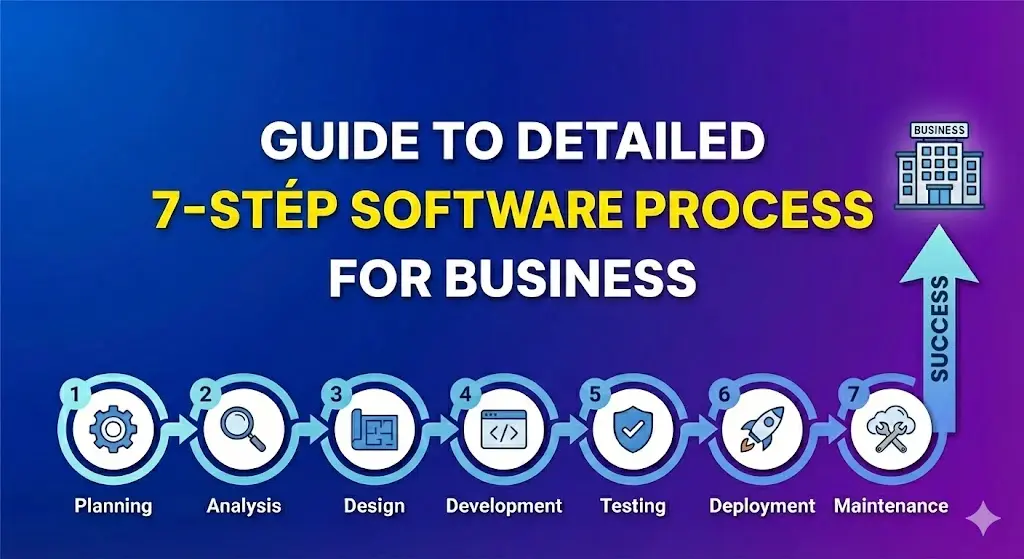
The 7-step software development process is a foundational framework in Vietnam that ensures product quality while helping businesses record software revenue accurately and transparently in accordance with accounting standards. This guide explains each step—from requirement analysis to product release—enabling businesses to apply it to practical management and accounting.
Understanding the 7-Step Software Development Process
1.1. What Is It?
The 7-step software process is a regulatory framework issued by Vietnam’s Ministry of Information and Communications to standardize all activities in software development. Each step represents a production lifecycle stage—from concept, design, and programming to release—with distinct deliverables and required documentation.
1.2. Key Objectives
- Ensure software products meet established quality standards.
- Support businesses in recording software revenue accurately and in compliance with accounting regulations.
- Provide legally valid documentation for tax and accounting purposes.
1.3. Regulatory Foundation
- Circular 09/2013/TT-BTTTT – Software product list and production processes.
- Circular 219/2013/TT-BTC – VAT regulations for software activities.
- VAS 14 – Accounting Standard on Revenue and Other Income.
Implementing the 7-Step Software Development Process
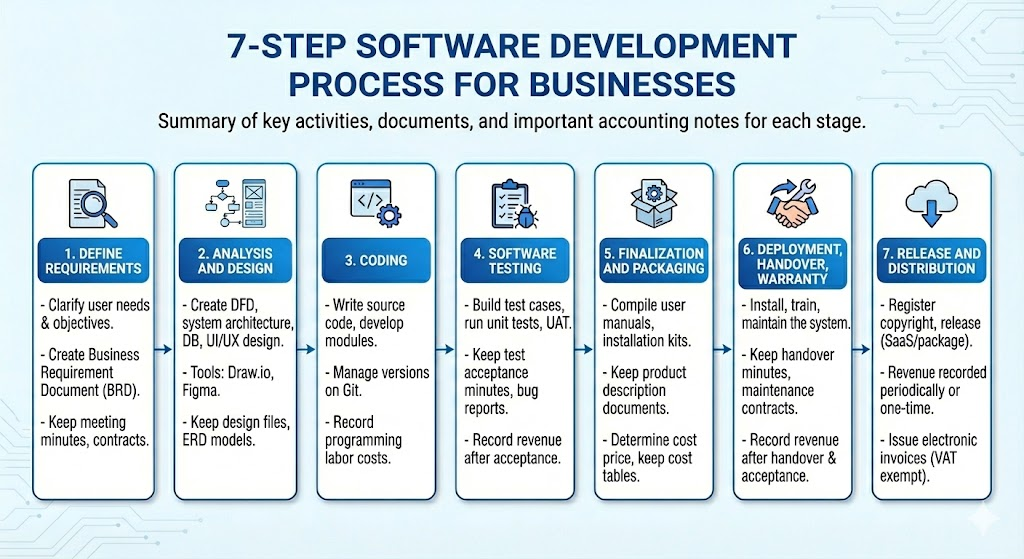
Step 1: Requirements Definition
Objective: Clarify user needs and product goals.
Key Tasks:
- Meet with clients to gather requirements.
- Prepare a Business Requirements Document (BRD).
- Define project scope and acceptance criteria.
Required Documentation: Meeting minutes, functional specification sheets, technical requirement agreements.
Accounting Note: Record survey and research costs as R&D expenses.
Step 2: Analysis and Design
Key Tasks:
- Create data flow diagrams (DFD).
- Design system architecture, database structures, and security specifications.
Recommended Tools: Draw.io, Figma, UML diagram tools.
Required Documentation: Design dossier, entity-relationship diagrams (ERD), UX/UI interface mockups.
Accounting Note: Allocate design costs to work-in-progress (WIP) production expenses.
Step 3: Programming (Development)
Key Tasks:
- Develop source code and software modules.
- Perform system integration.
Internal Management: Maintain version control via Git; tag commits by module.
Accounting Practice: Record developer labor costs separately from maintenance expenses.
Step 4: Software Testing
Key Tasks:
- Build test cases and conduct unit tests, integration tests, and user acceptance testing (UAT).
Required Documentation: Test acceptance reports, bug reports.
Critical Accounting Requirement: Software revenue can only be recognized after internal acceptance or customer acceptance is completed.
Step 5: Finalization and Packaging
Key Tasks:
- Prepare user manuals and documentation.
- Standardize installation packages.
Required Documentation: Product description sheets, installation manuals.
Accounting Tip: This stage determines software cost of goods sold (COGS), so retain complete cost breakdown records.
Step 6: Installation, Handover, and Warranty
Key Tasks:
- Install software on the client’s system.
- Provide user training, bug fixes, and maintenance support.
Required Documentation: Handover minutes, maintenance contracts, acceptance forms.
Critical Accounting Rule: Revenue is only recognized once delivery is completed and the client signs the acceptance certificate.
Step 7: Release and Distribution
Key Tasks:
- Register copyright, release the software, or provide SaaS services.
Accounting Treatment:
- Revenue is recognized periodically for subscription-based SaaS models.
- Revenue is recognized once for one-time software transfers.
Tax Reminder: Always issue electronic invoices and confirm that software production is VAT-exempt.
Documentation and Revenue Management
Required Legal Documentation
Each step must include supporting documents:
- Requirement specifications
- Design diagrams
- Testing and acceptance reports
- Handover contracts
These documents serve as proof that the enterprise legitimately engages in software production according to regulatory standards.
Software Revenue Recognition Timing
Under accounting standards, revenue can only be recognized when the software is completed and delivered to the client. For periodic maintenance services, revenue must be allocated over the contract term.
Cost Accounting Method
- Design and programming costs → Work-in-progress (WIP) – Account 154
- Sales and marketing expenses → Account 641
- Project management and administrative costs → Account 642
Internal Revenue Control System
Set up a specific software project code in the accounting system (such as MISA, FAST, Bravo ERP) to track revenue, expenses, and profit by each development phase.
Accounting Considerations for the 7-Step Process
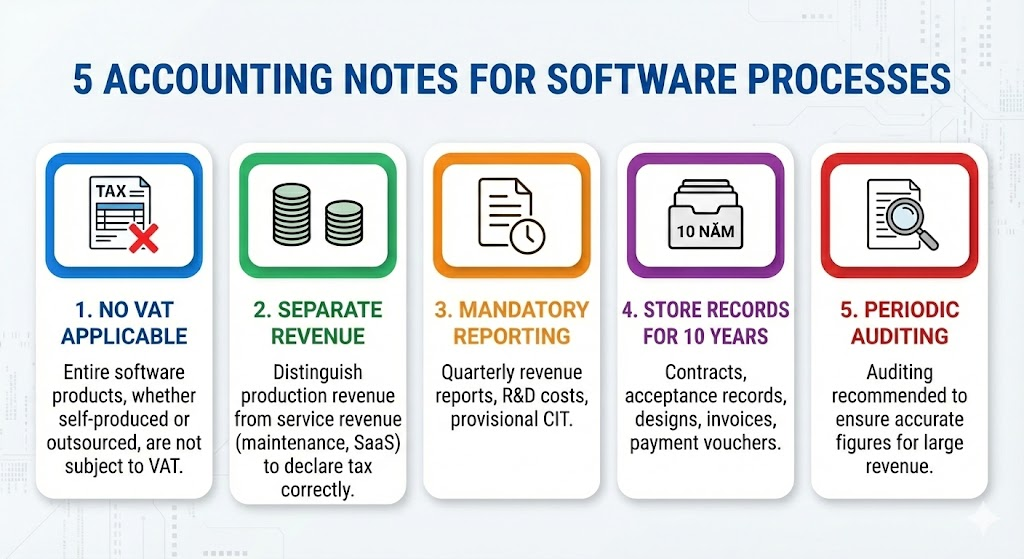
VAT-Exempt Software Products
All software products that are self-developed or outsourced for development by the enterprise are VAT-exempt under current Vietnam regulations.
Separating Software Production and Service Revenue
If the enterprise provides additional services such as maintenance, upgrades, or SaaS subscriptions, separate revenue by service type to avoid incorrect tax declarations.
Mandatory Accounting Reports
Enterprises must prepare and submit:
- Quarterly software revenue reports
- Software R&D expense reports
- Quarterly provisional corporate income tax (CIT) reports
Record Retention Requirements
Enterprises must retain all of the following documents for at least 10 years:
- Contracts and quotations
- Acceptance reports
- Software design documents
- Electronic invoices
- Payment vouchers
Software Audit Requirements
Enterprises with significant software revenue should conduct periodic audits to ensure that accounting data accurately reflects the software production process and complies with legal requirements.
Optimizing the Software Development and Revenue Management
Use Project Management Tools
Utilize tools such as Trello, Jira, or Asana to track each stage of the 7-step process. This makes reconciling development progress with accounting reports easier.
Automate Accounting Processes
Integrate accounting software (MISA, Fast Accounting, etc.) with the software development system to automatically record revenue and expenses, minimizing manual errors.
Review Processes Regularly
Regularly update internal procedures in line with new regulations issued by Vietnam’s Ministry of Information and Communications and Ministry of Finance to ensure all steps and documentation comply with the law.
Build Technical Accounting Expertise
Accounting staff should understand the software development lifecycle to properly record transactions—especially for SaaS models and packaged software products.
Coordinate Departments
The enterprise should coordinate accounting, technical, and legal departments to synchronize the 7-step process, ensuring a complete documentation chain from development to revenue recognition.
Mastering the 7-step software development process ensures high-quality software products and guarantees accurate, lawful, and transparent software revenue recognition. Each step represents a critical accounting checkpoint, requiring corresponding documentation and cost records.
When implemented correctly, the process helps enterprises:
- Optimize production efficiency
- Maximize available tax incentives
- Strengthen long-term financial management
For inquiries, contact Wacontre Accounting Services at Hotline: (028) 3820 1213 or email [email protected] for prompt assistance. Wacontre’s team of experienced professionals provides dedicated and efficient service. (Japanese clients, contact Hotline: (050) 5534 5505).