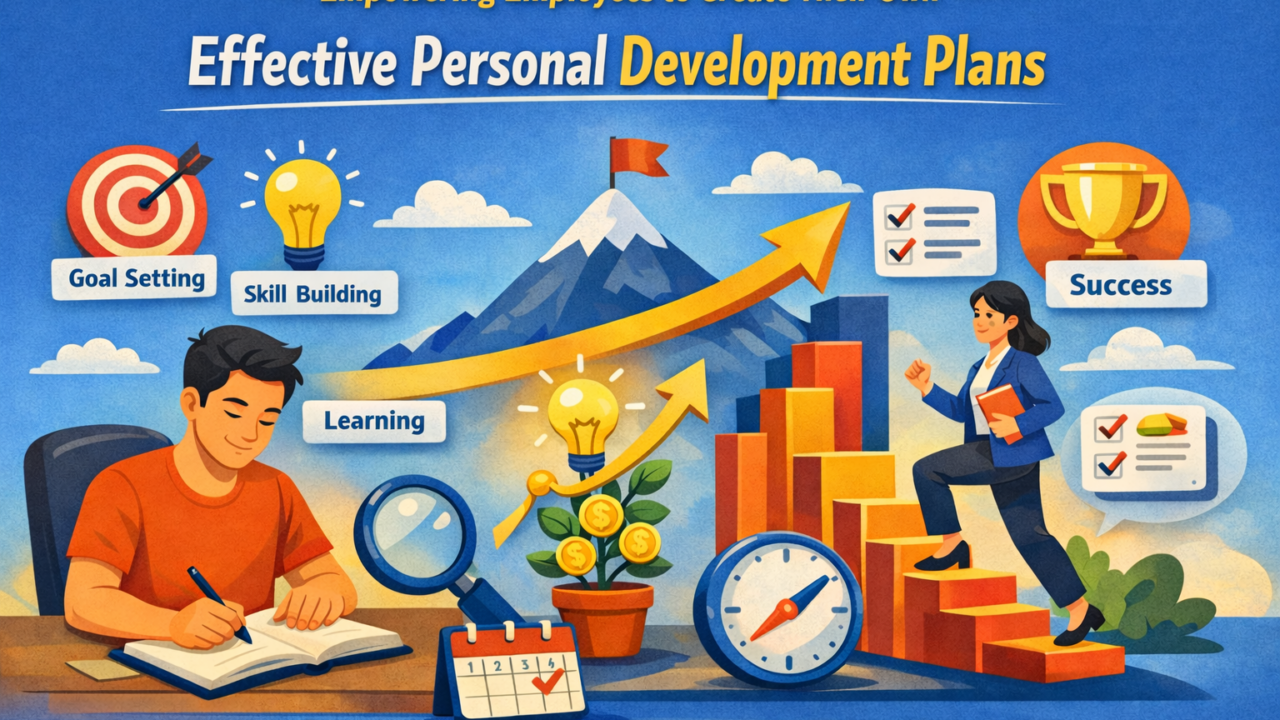
How can we encourage employees to proactively create an Individual Development Plan (IDP)? By fostering intrinsic motivation and career growth, we empower them to take charge of their professional journey.
What is an Individual Development Plan (IDP)?
An Individual Development Plan, commonly known as an IDP, is more than just a list of training courses an employee should attend. In reality, it is a highly personalized strategic document that helps employees clarify their short-term and long-term career goals, thereby outlining specific steps to achieve them. In the context of Vietnam’s labor market shifting strongly toward a knowledge economy, the IDP acts as a “treasure map” that empowers individuals to unlock their maximum potential. This plan typically includes assessing current skills, identifying competency gaps, and selecting appropriate training methods such as classroom learning, experiential learning, or mentoring.
The hallmark of a successful IDP is proactivity. When implemented correctly, it is not a pressure from the company but a tool that supports the employee’s rights and interests. It helps employees feel their voices are heard and their career paths are respected. Instead of having HR “hold their hands,” a voluntary IDP reflects the true aspirations and passions of the employee, creating sustainable commitment. For businesses, a workforce with clear IDPs is an invaluable asset, enabling the organization to stay agile amidst market fluctuations thanks to high adaptability.
Why Are Employees Often Passive in Development Planning?
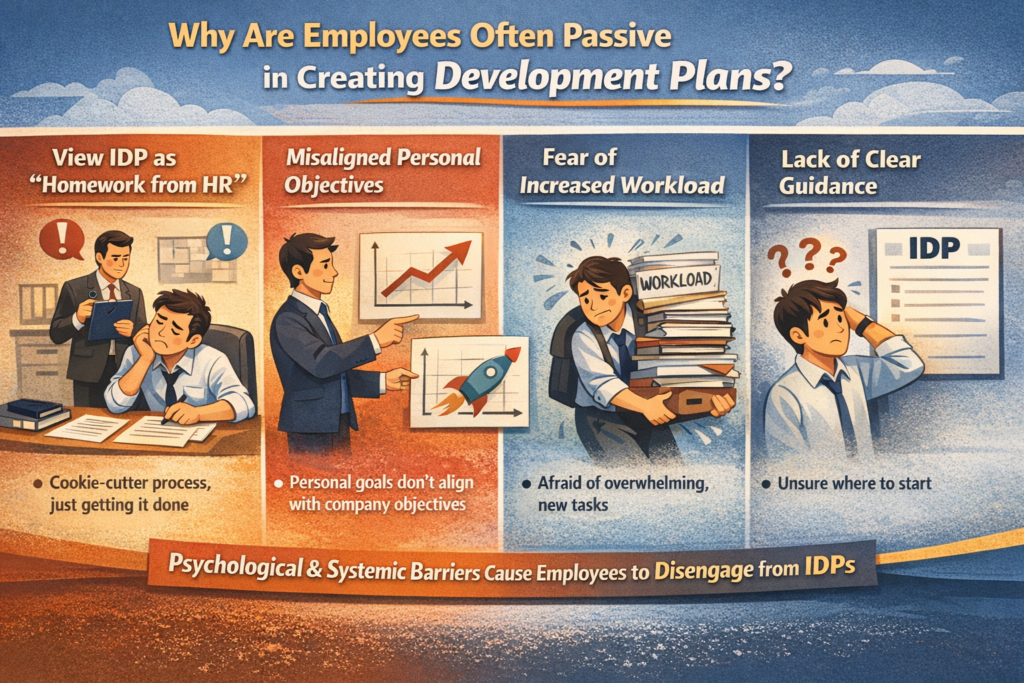
Despite the undeniable benefits of IDPs, many businesses in Vietnam face employee indifference during implementation. To eliminate the need for “nudging,” we must understand the psychological and systemic barriers preventing them from taking initiative.
1. The “HR Homework” Mentality
In many offices, whenever HR requests an IDP update, employees sigh and view it as a useless administrative procedure. They perceive the IDP as mandatory “homework” rather than an opportunity for self-growth. This stems from a top-down approach where HR acts like a supervisor checking assignments. When employees see no real value for their own future, they respond by simply filling out templates to get it over with. This coercion inadvertently kills creativity and the desire for self-improvement.
The consequence is the creation of “copy-paste” plans that lack depth and practicality. Employees do not take the time to reflect on their strengths and weaknesses but choose generic skills to satisfy superiors. This results in a waste of corporate resources as subsequent training programs do not address actual development needs. When the IDP is viewed as an administrative burden, it loses its core meaning: self-awareness and the ambition for professional advancement.
2. Lack of Alignment Between Personal and Organizational Goals
A common mistake is that L&D programs often focus only on what the company needs, forgetting what the employee wants. If a marketing employee wants to learn data analysis but the company forces them into basic communication skills, this misalignment leads to frustration. Employees will wonder, “Why should I spend time on things that don’t help me achieve my dreams?” When personal and organizational goals do not intersect, the IDP becomes a fragmented, lifeless document incapable of driving intrinsic motivation.
3. Fear of Increased Workload
Many talented employees refuse to create development plans because they fear that “being better means doing more.” In their minds, registering for a new skill means taking on extra projects while their current workload is already overwhelming. They worry the IDP will become a trap for the company to extract more labor without proportional compensation in income or rest. Consequently, they choose to stay in their comfort zone to protect themselves from burnout, leading to a passive attitude toward learning.
4. Lack of Specific Tools and Guidance
Sometimes, employees want to develop but don’t know where to start. An IDP template that is too complex or too vague can be discouraging. If a company simply hands an employee a blank sheet of paper and says, “write your 5-year plan,” the result is usually a stalemate. The lack of a clear competency framework or guidance from mentors makes employees feel lost. This ambiguity about the future, combined with a lack of professional support tools, is the main reason many plans remain only on paper.
Strategies for Building a Culture of Autonomy
To have employees self-initiate plans without HR nudging, businesses must fundamentally change their organizational culture. Autonomy is not about letting employees “do whatever they want,” but creating an environment where they feel responsible for their own careers.
1. Shifting Mindset from “Management” to “Empowerment”
Leadership and HR must stop controlling every step of the employee’s development journey. Instead of saying “You must learn this,” ask “What do you want to achieve in the next 12 months, and how can we support you?” Empowerment allows employees to decide the learning methods that suit them best. When employees feel they own the plan, they take higher responsibility for the final results. This shift requires trust from management, accepting that each individual has a different development pace.
2. Linking IDP to Personal Meaning
Every human being longs to do meaningful work. When employees understand that mastering a skill will help solve real customer problems or contribute to general growth, they have stronger motivation. HR should help employees see the “big picture.” Help them connect the dry text in an IDP with specific achievements they can reach. When work is no longer a burden but a means to affirm personal value, development planning becomes an internal need.
3. The Role of Direct Managers in Inspiring Motivation
Line managers have a greater influence on employees than HR. A good manager acts as a coach, observing and evoking hidden strengths. Instead of just meeting about weekly KPIs, dedicate time for regular career coaching conversations. When managers show genuine concern for an employee’s future, the employee feels encouraged to proactively propose development plans.
Furthermore, managers need to lead by example. When employees see their superiors striving to update knowledge and openly sharing what they learn, they see it as a cultural norm. Support from direct managers isn’t just words but also providing time and resources. A timely compliment when an employee hits a milestone in their IDP is more encouraging than any formal corporate recognition.
4. Creating a Safe Environment to Fail and Learn
Fear of failure is the enemy of growth. If a business always punishes minor mistakes, employees will never dare to try new things or learn skills outside their safety zone. A healthy learning culture is one where experimentation is welcomed and failure is seen as a valuable lesson. When employees feel psychological safety, they will be more confident in including breakthrough goals in their IDPs instead of just sticking to old skills to stay safe.
Practical Steps to Encourage Proactive IDPs
Once the cultural foundation is laid, businesses need specific actions to turn IDP creation into a natural and enjoyable habit.
1. Organize Career Inspiration Workshops
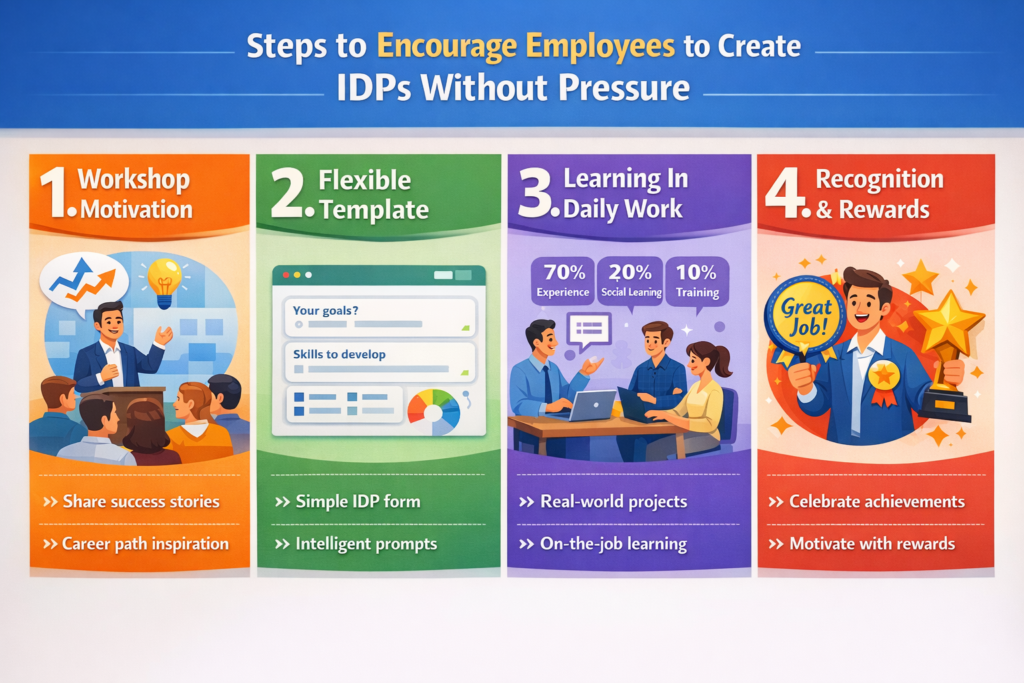
Don’t start with processes; start with inspiration. Invite industry experts or successful internal employees to share their career paths. Real stories about overcoming difficulties through continuous learning have a stronger impact than any HR memo. These workshops should be open-ended, allowing employees to discuss new trends and future skills they are excited to conquer.
2. Provide Flexible and User-Friendly Templates
Simplicity is the ultimate sophistication. Provide lean, intuitive IDP templates, perhaps digital dashboards instead of long Word files. This framework should include smart prompts that help them self-reflect on current competencies. For example: “Which skill do you want to use more every day?” or “What challenge do you want to conquer next quarter?” When tools become user-friendly, technical barriers are completely removed.
3. Integrate Learning into Daily Workflow
Learning should not be an activity entirely separate from actual work. Encourage the 70-20-10 model: 70% learning through experience, 20% from others, and 10% through formal training. HR can facilitate participation in cross-functional projects as part of the development plan. When learning becomes an integral part of the daily routine, employees see the IDP as necessary to complete challenging new tasks.
4. Use Recognition and Rewards as Leverage
Humans tend to repeat behaviors that bring positive rewards. However, rewards here don’t necessarily mean money. Recognition from leadership, a virtual badge on the internal system, or the opportunity to lead a new initiative are very effective forms of psychological reward. When an employee completes an IDP goal and is recognized by the company, it creates a ripple effect, inspiring others to start their own plans.
Leveraging Technology and Data for Personalization
In the 4.0 era, technology is the “extended arm” that helps HR move from a nudging role to a talent facilitator.
1. Use Learning Experience Platforms (LXP)
Unlike traditional Learning Management Systems (LMS), an LXP is employee-centric. It uses AI to suggest content based on individual interests and career goals, much like Netflix suggests movies. When employees find content truly interesting and relevant, they will automatically access and update their IDPs frequently without any prompting from HR.
2. Automated Skill-Gap Analysis
Technology can help employees objectively and accurately self-assess their competencies. Data analysis tools can compare an employee’s current skills with the requirements of the position they aspire to in the future. The result is a visual chart showing what they lack to advance. This “data-driven awakening” is often more persuasive than subjective feedback, pushing employees to proactively seek training solutions to fill the gaps.
3. 360-Degree Feedback Systems for Self-Reflection
A continuous feedback system allows employees to receive input from peers and subordinates at any time. This data is a valuable input for the IDP. Instead of waiting for year-end reviews, employees can adjust their development plans immediately based on real-world feedback. Technology ensures this process is transparent, fair, and constructive, turning self-improvement into a continuous, automated cycle.
Conclusion
Encouraging employees to self-initiate IDPs without HR nudging is a modern management art. It requires a profound shift from a control mindset to a support and empowerment mindset. When businesses build a safe environment, provide flexible tools, and apply smart technology, the IDP is no longer an administrative burden. Instead, it becomes a compass helping employees confidently walk their career path while creating sustainable growth momentum for the entire organization. The most brilliant growth always comes from within, when each individual realizes the value of learning.
To empower your business in overcoming HR management challenges and staying fully committed to your strategic goals, we provide specialized solutions:
- [RPO Services]: A comprehensive recruitment process outsourcing solution.
- [BPO Services]: Strategic outsourcing to streamline business processes and optimize operational costs.
For any inquiries, contact Wacontre Accounting Services via Hotline: (028) 3820 1213 or email [email protected] for prompt assistance. With a team of experienced professionals, Wacontre is committed to providing dedicated and efficient service. (For Japanese clients, please contact Hotline: (050) 5534 5505).