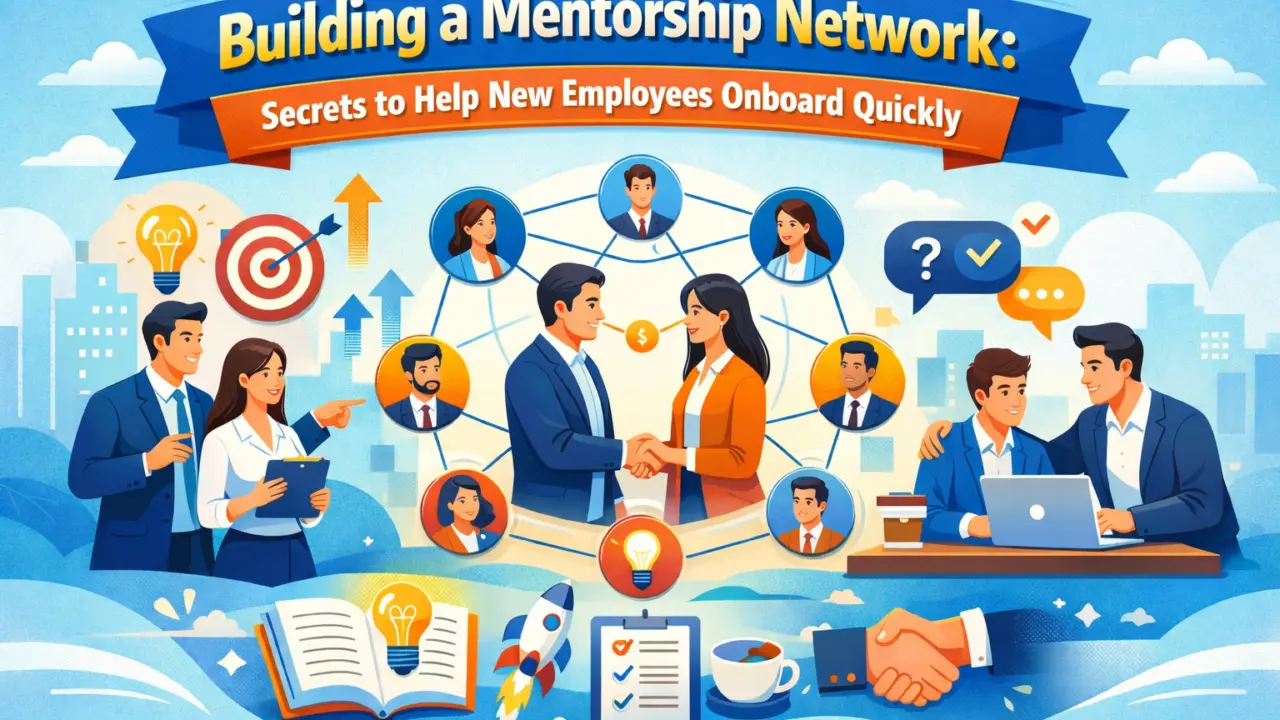
Building a mentorship network for new employees through a structured Mentorship program is vital for successful Onboarding. This approach enhances internal training, supports talent retention, and empowers HR mentoring to drive long-term business growth.
- What is a Mentorship Network for New Employees?
- Strategic Benefits of Mentorship Programs for Businesses in Vietnam
- The 5-Step Process to Building a Professional Mentorship Network
- Common Challenges and Solutions in Mentorship Implementation
- Modern Mentoring Models Suited for Gen Z and Gen Alpha
- Conclusion
What is a Mentorship Network for New Employees?
Building a mentorship network for new employees is far more than simply assigning a senior staff member to show a newcomer the ropes. It is a strategic internal relationship and knowledge management system where experienced individuals (Mentors) volunteer or are selected to support, lead, and inspire new joiners (Mentees).
In the context of Vietnam’s highly volatile labor market, this network acts as a psychological and professional “anchor,” helping rookies overcome culture shock and work pressure within their first 90 days. Implementing this model systematically allows businesses to create a continuous flow of knowledge, ensuring that core values are preserved.
A modern mentorship network is not limited to job-specific training; it encompasses cognitive connection, career orientation, and the building of social ties within the company. Unlike short-term Training, a Mentorship program focuses on the sustainable development and holistic adaptation of an individual within the corporate ecosystem.
For businesses in Vietnam, especially startups or scale-ups, a mentorship network is the ultimate solution for optimizing operating costs. Instead of overspending on external training, companies leverage internal “brainpower” to nurture the next generation, creating a form of “compound interest” investment for both veterans and newcomers.
Strategic Benefits of Mentorship Programs for Businesses in Vietnam
1. Shortening Probation Periods and Cultural Integration
The “ramping up” period—the time it takes for an employee to reach maximum productivity—typically lasts 3 to 6 months. However, with the support of a strong mentorship network, this can be cut in half. New hires are no longer left to “sink or swim” through dry documents or struggle to decipher the unwritten rules of company culture.
Mentors act as navigators, helping them quickly understand the “rules of the game,” from using work management systems to coordinating across departments. When initial confusion is eliminated early, productivity surges during the probation period, allowing the business to see a faster return on investment from new resources.
2. Increasing Talent Retention in a Competitive Market
In Vietnam, turnover rates among young workers (Gen Z) remain high, often due to a feeling of being “abandoned” or lacking a clear development roadmap. A Mentorship program creates a strong bond between the employee and the organization. When new hires feel someone is genuinely invested in their progress, they develop loyalty.
HR advisors help them envision their own future within the general growth of the company. This emotional connection is a key factor in retaining talent, minimizing the risk of personnel fluctuations, and saving re-recruitment costs for the HR department.
3. Promoting a Culture of Knowledge Sharing and Internal Training
A business that stops learning is a business that is slowly dying. A mentorship network transforms a company into a “learning organization” where practical skills and “battle-scar” lessons are passed down. This prevents “brain drain” when senior personnel depart without having a chance to hand over their expertise.
Knowledge sharing helps standardize work quality across the entire system. It ensures that every employee has access to best practices, thereby naturally and continuously raising the collective competency level of the organization.
4. Developing Leadership Skills for Mentors
Don’t mistake this for a one-sided benefit for the Mentee. Those taking on the Mentor role have a golden opportunity to hone management, empathy, and communication skills. To guide others effectively, Mentors must scientifically systematize their own knowledge.
This serves as a perfect stepping stone for core personnel preparing for higher management positions. They learn to listen, ask open-ended questions, and resolve conflicts—core leadership skills that no theoretical course can truly replace.
The 5-Step Process to Building a Professional Mentorship Network
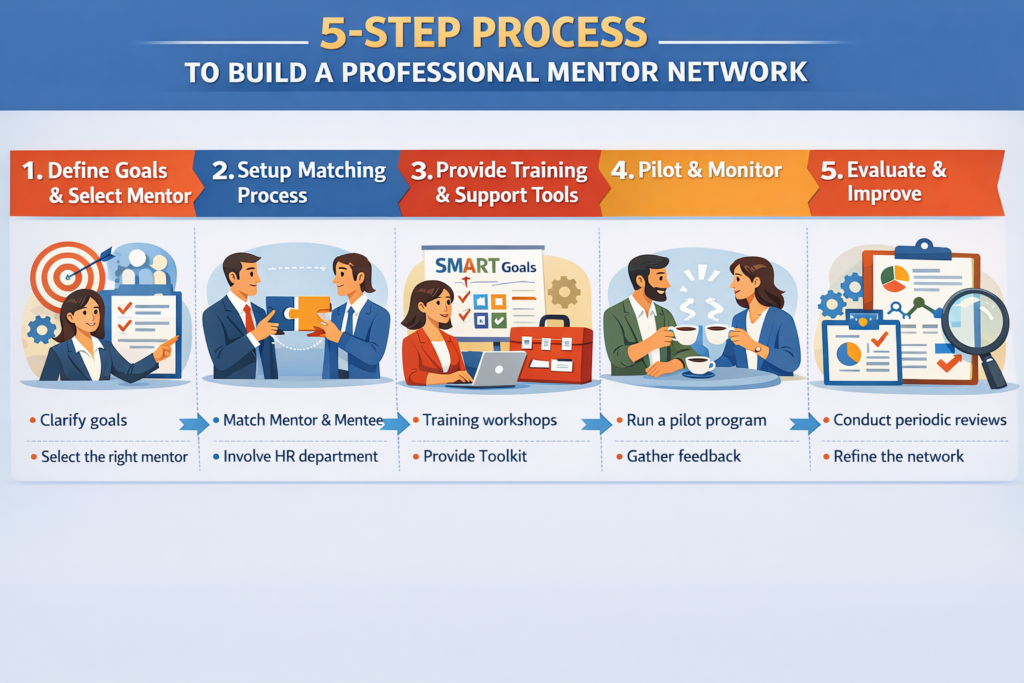
1. Define Goals and Criteria for Selecting Suitable Mentors
The first step is knowing what the business needs: lower turnover, increased sales, or an improved culture? Once goals are set, the selection of Mentors must be rigorous. A great Mentor is not just technically proficient but also open-minded and deeply aligned with the company’s core values.
Avoid forcing employees into the Mentor role; instead, frame it as a privilege and a recognition of their value to encourage voluntary commitment. When a Mentor participates with pride, their guidance is far more effective than if performed as a dry administrative task.
2. Establish a Matching Process Between Mentor and Mentee
The success of mentoring depends heavily on the “chemistry” between the two individuals. The matching process can be based on professional skills (the Mentee’s gaps and the Mentor’s strengths) or personality types via scientific assessments.
In Vietnam, similarities in life perspectives also help break down initial communication barriers quickly. A robust matching system should involve the HR department to ensure objectivity and alignment with the organization’s long-term human resource development strategy.
3. Develop a Training Roadmap and Provide Support Tools
Businesses should provide a “Toolkit” including mentor handbooks, sample open-ended questions, and evaluation systems. Short workshops should be held to teach Mentors how to provide constructive feedback and set SMART goals so both parties can easily track progress.
With a clear roadmap, both sides know what they need to do and what to expect from one another, avoiding wasted time. Standardizing the process ensures the Mentorship program runs professionally and achieves consistent results at scale.
4. Implement a Pilot Phase and Monitor Interactions
Starting with a small group (Pilot) is a wise strategy for HR to closely monitor meeting frequency and feedback. Some pairs will hit it off instantly, while others may need re-adjustment to achieve better results.
Recognizing small wins during this phase creates momentum for the entire company. Encourage informal meetings like morning coffee or lunch to create a comfortable space for sharing, rather than restricting interactions to formal meeting rooms.
5. Evaluate Effectiveness and Periodically Improve the Network
After each term (usually 3 or 6 months), a comprehensive evaluation is needed based on metrics such as the new employee’s task completion speed and satisfaction levels. Collect feedback from both sides to identify bottlenecks in the current process.
The HR world is always changing, and your mentorship network must be updated accordingly. Periodic improvements ensure the program stays relevant to new trends and the psychological characteristics of younger generations entering the market.
Common Challenges and Solutions in Mentorship Implementation
1. Communication Gaps and Generational Expectations
The intersection of Gen X, Gen Y, and Gen Z often creates underlying conflicts in work styles. A mentor from an older generation might favor discipline, while a young Mentee prefers freedom. The solution lies in building Empathy through dialogue.
Companies should organize sharing sessions regarding generational differences before launching the program. Emphasize that Mentoring is a mutual learning process where experience meets innovation, rather than a one-way imposition of views.
2. Mentors Lacking Pedagogical Skills or Being Overwhelmed by Work
When professional workloads are too heavy, Mentors often neglect supporting new hires. To solve this, leadership must recognize mentoring time as official working time and adjust a portion of the Mentor’s professional KPIs accordingly.
Additionally, rewards, “Mentor of the Month” honors, or including mentoring results in salary and promotion reviews provide significant motivation. Training in communication skills also helps Mentors feel more confident in their role as the “teacher” within the enterprise.
3. Lack of Commitment from Leadership and Related Departments
If leadership does not believe in the value of Mentorship, the program will likely remain a mere “trend” without substance. Commitment must come with resources: budgets for networking, personnel time, and necessary technical infrastructure support.
HR must present a clear Return on Investment (ROI) to show leaders that the cost of mentoring is far lower than the loss incurred when talent leaves. With high-level support, the program carries more weight and gains better coordination from all departments.
Modern Mentoring Models Suited for Gen Z and Gen Alpha
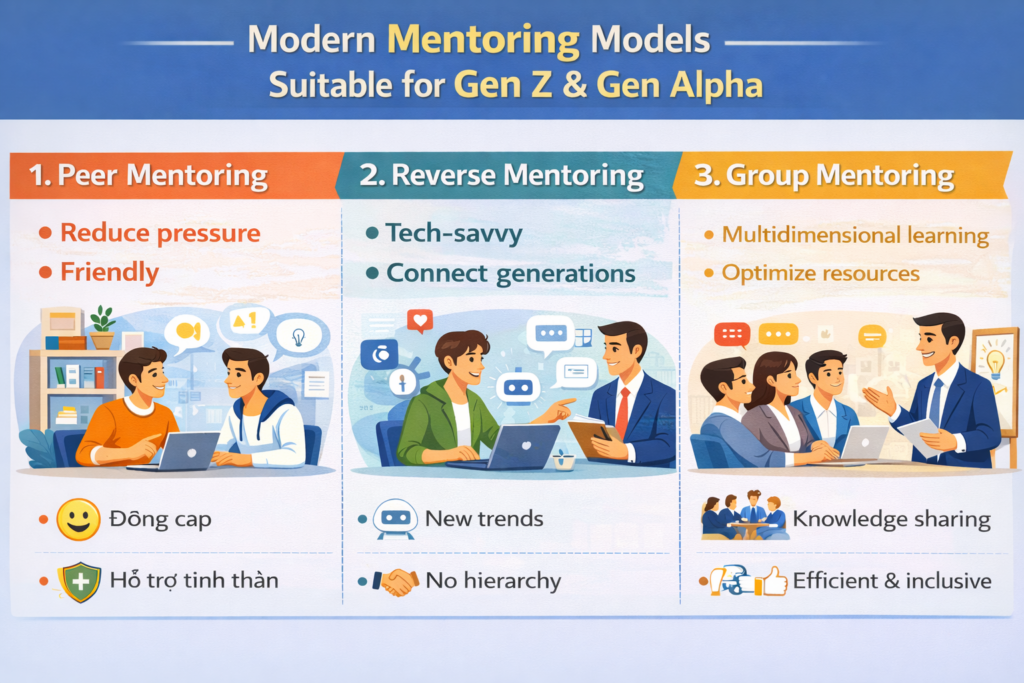
1. Peer Mentoring: Reducing Psychological Pressure
Peer Mentoring uses individuals at the same level who joined 6-12 months earlier to guide newcomers. Proximity in age and similar experiences make it easier for new hires to share difficulties they might be hesitant to mention to a direct manager.
This model is extremely effective in building a psychological support network quickly. It creates a friendly work environment where new employees feel understood and protected from their very first days.
2. Reverse Mentoring: Driving Innovation
In this model, new hires (often tech-savvy youth) mentor senior managers on new trends like AI or social media. This breaks down hierarchical barriers, making new employees feel valued immediately.
Reverse Mentoring helps leaders stay current in the digital age while fostering a culture of respect for differences. It is an excellent way to bridge generations and maximize the strengths of the younger workforce.
3. Group Mentoring: Optimizing Resources for SMEs
If a business lacks enough Mentors, one person can lead a group of 3-5 new hires. This approach creates a small community where new employees can learn from one another under the coordination of an experienced expert.
This model promotes teamwork skills and creates a multi-dimensional discussion environment. It optimizes the Mentor’s time while ensuring all new hires receive the guidance and support necessary to integrate.
Conclusion
Building a Mentorship network is not a short-term project but a long-term investment in people. For businesses in Vietnam, this is the shortest path to building a strong, cohesive, and agile workforce.
When new employees feel dedicated guidance, they work not just for a paycheck, but out of respect and a desire to contribute. Start laying the first bricks today to reap the rewards of a prosperous and sustainable business.
To empower your business in overcoming HR management challenges and staying fully committed to your strategic goals, we provide specialized solutions:
- [RPO Services]: A comprehensive recruitment process outsourcing solution.
- [BPO Services]: Strategic outsourcing to streamline business processes and optimize operational costs.
For any inquiries, contact Wacontre Accounting Services via Hotline: (028) 3820 1213 or email [email protected] for prompt assistance. With a team of experienced professionals, Wacontre is committed to providing dedicated and efficient service. (For Japanese clients, please contact Hotline: (050) 5534 5505).