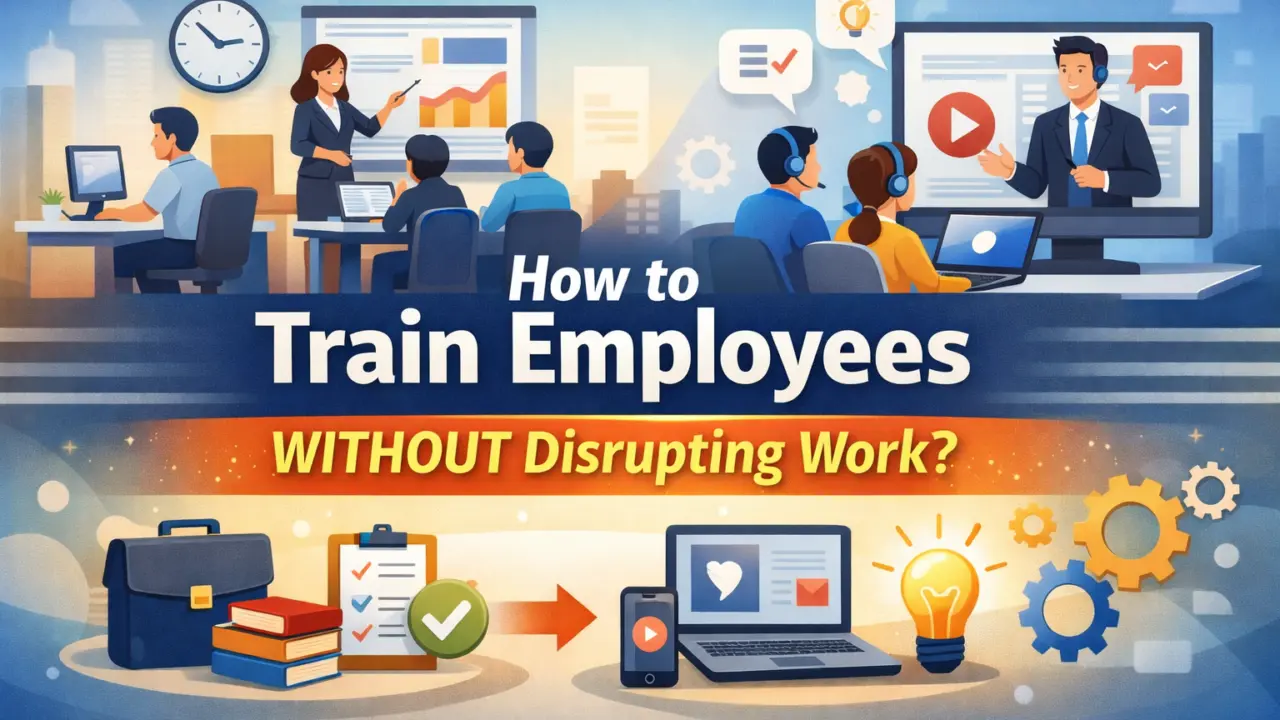
Seeking ways for training without disrupting daily operations? Implementing On-the-Job Training (OJT) and micro-learning is essential to enhance professional skills without sacrificing your team’s current workflow and output.
What is Training Without Disrupting Operations?
Training without disrupting operations is a strategy that integrates learning directly into the daily workflow, rather than isolating employees from their professional roles. Instead of multi-day seminars that stall projects, businesses apply flexible methods to ensure knowledge is transferred continuously and naturally.
This approach blurs the line between theory and practice, helping employees view learning as a tool for problem-solving rather than a burden. For managers, this is the perfect solution to balance workforce quality enhancement with the maintenance of stable production and business KPIs.
The Importance of Maintaining Operations During Training
1. Ensuring Project Progress and Client Commitments
Clients prioritize results and deadlines. If training consumes too much official working time, supply chains break down, directly impacting the company’s reputation. Non-disruptive training maintains the workflow, ensuring all outputs are delivered on schedule.
Continuous operation also helps businesses avoid late-delivery penalties and handle arising issues promptly. This demonstrates organizational adaptability without compromising service quality, building a foundation of trust with partners and clients.
2. Minimizing Psychological Pressure on Employees
Forcing employees into intensive training followed by overtime to catch up often leads to burnout and silent resistance. Employees may perceive training as a punishment rather than a growth opportunity. When stress rises, the effectiveness of knowledge absorption drops significantly.
In contrast, an integrated approach facilitates a “steady drip” of knowledge, increasing engagement. When learning doesn’t cause missed deadlines, staff become more enthusiastic about new skills, maintaining mental health and fostering long-term creativity.
3. Optimizing Opportunity Costs for the Business
A major portion of training costs lies in the “opportunity cost” when personnel stop producing. For high-intensity businesses, removing staff from the line just for theory causes significant economic loss. Every lost hour of work directly impacts the organization’s net profit.
Implementing on-the-job training keeps the workforce at their stations, generating continuous surplus value while skills improve. This is a smart economic strategy to optimize resources and free up budget for reinvestment, harmonizing human development with profitability.
Modern Training Methods for Time Optimization

1. Applying Micro-learning: Bite-sized Knowledge
Micro-learning breaks content into 3-5 minute segments, fitting the habits of Gen Z and Millennials. Instead of 4-hour lectures, employees access short videos or infographics daily, learning during breaks or immediately before a specific task.
This approach ensures deep retention without cognitive overload. Quick quizzes after each module reinforce knowledge instantly, turning learning into an engaging experience similar to an online game without encroaching on official working hours.
2. On-the-Job Training (OJT)
OJT allows employees to learn directly on actual equipment and processes under a Mentor’s guidance. This method eliminates the gap between theory and reality, turning every daily task into a lesson and every mistake into an opportunity for behavioral adjustment.
Employees mature quickly at their desks without the business incurring venue costs or personnel interruptions. OJT also strengthens colleague relationships through instructional interaction, effectively transferring culture and specific professional secrets.
3. Social Learning: Leveraging Internal Interaction
Social Learning relies on observation and interaction via platforms like Slack, Teams, or Zalo. Employees freely share tips and creative solutions, allowing learning to happen spontaneously through daily work conversations.
This format builds a collective knowledge base without expensive formal classes. It breaks down hierarchical barriers and encourages mutual support. As knowledge flows freely, the team’s competency improves uniformly without dry textbooks.
4. Utilizing Learning Management Systems (LMS)
An LMS is the core platform for personalizing learning paths based on actual skill gaps. Employees can access materials anytime, anywhere, avoiding time wasted on topics they’ve already mastered, thus increasing actual training efficiency.
The system automatically records progress, allowing HR to track results without manual effort. Employees feel respected when they have a customized career development path. An LMS is a powerful ally for businesses in the digital age.
A 5-Step Process for Implementing Non-Disruptive Training
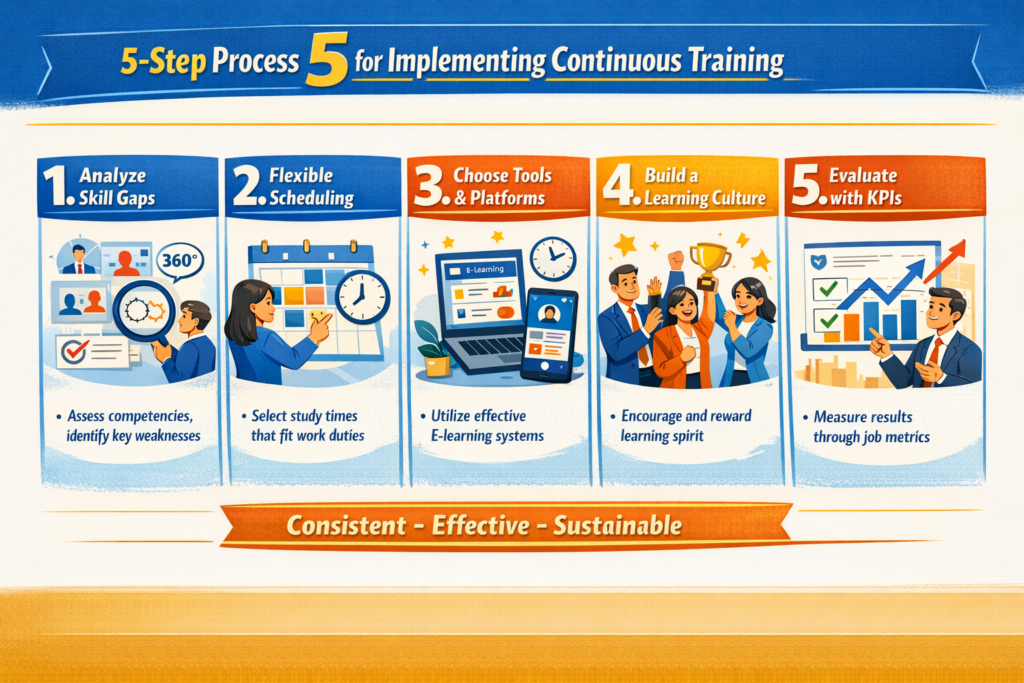
1. Analyzing Skill Gaps for Targeted Training
Before starting, businesses must identify the specific skills the team lacks to avoid wasteful, generalized training. This is typically done through competency tests or 360-degree feedback. Once the “skill gap” is defined, training focuses on the weakest links to optimize resources.
“Right person, right task” ensures employees don’t feel the learning is futile. When new knowledge directly solves current difficulties, proactive participation increases. A proper analysis from the start saves hundreds of hours wasted on non-practical content.
2. Establishing Flexible Scheduling
Flexibility is key to ensuring learning doesn’t conflict with professional priorities. Rather than imposing fixed hours, managers should let employees choose “learning windows” based on their biological rhythms and workload—for example, 30 minutes in the morning or after completing daily reports.
Utilizing “dead time” in operations also helps employees maintain ownership of their progress. This eliminates anxiety over deadlines or overtime. When employees have autonomy over their time, they absorb knowledge with a voluntary mindset and high focus.
3. Selecting Appropriate Tools and Technology
Technology acts as the “bloodstream” for knowledge transfer without mass gatherings. Businesses should choose E-learning platforms or mobile apps with friendly interfaces and multi-device compatibility. Complex or buggy technology becomes a disruptor and a source of frustration.
Modern tools should include smart notifications for reminders without being intrusive. Integration with project management software like Jira or Trello synchronizes learning with the workflow. Proper investment in tech bridges physical barriers, making training a natural part of the workday.
4. Building a Proactive Learning Culture
No system is effective without a culture that values human development. Businesses must build an environment where learning is celebrated at all levels, starting with leadership. When employees see executives investing in skills, they naturally adopt a sense of responsibility for their own growth.
A proactive culture transforms training from a “mandatory” activity into a self-driven need for advancement. Companies can host recognition ceremonies or offer rewards for excellence to create momentum. A strong culture self-regulates behavior, helping staff balance learning and work without HR’s constant pressure.
5. Evaluating Effectiveness Based on Actual KPIs
All training efforts must eventually be measured by business results rather than just test scores. Businesses should set specific KPIs to compare performance before and after training, such as increased closing rates or decreased technical errors. Linking learning to performance shows the actual value of the investment.
Actual KPI data provides the basis for HR to streamline the process. If content doesn’t improve performance, the business must courageously change methods or eliminate it to avoid wasting time. Realism and transparency in evaluation lead to sustainable growth for both individuals and the organization.
Common Pitfalls to Avoid in Personnel Training
1. Cramming Too Much Knowledge in a Short Time
Impatient businesses often organize high-intensity courses with massive amounts of information. This leads to “cognitive overload,” preventing effective digestion and retention. Consequently, employees end up exhausted and discouraged while the knowledge is quickly forgotten, wasting both budget and time.
Instead, apply sustainable learning principles by distributing content over time. Creating breaks between modules allows for practice and reflection. A steady flow of manageable knowledge creates a more permanent shift in quality than “crash courses.”
2. Lack of Commitment and Support from Direct Managers
Non-disruptive training fails if middle management doesn’t truly believe in the program. If HR pushes learning but a direct supervisor expresses frustration when staff take time to study, employees will quit. Managers must understand their role as Coaches, responsible for providing space and resources.
Conflict between company messaging and managerial action creates immense psychological pressure. Therefore, alignment from the executive level down to frontline management is vital. When a manager sees employee development as part of their own KPI, the program gains authentic support.
3. Failure to Measure Professional Application
A common mistake is organizing training that is too heavy on academic theory and detached from real-world situations. If employees see no use for the knowledge in their daily tasks, they will view it as a waste of time. This disconnect kills motivation and reduces HR’s credibility.
Businesses must ensure all content is highly practical and “immediately applicable” to specific problems. There should be feedback mechanisms and post-course assessments via short reports or direct observation. When training truly solves work difficulties, it becomes an essential asset rather than a disruption.
Non-disruptive training is a modern management art. By combining Micro-learning, OJT, and LMS technology, enterprises can turn the workplace into an “open school.” This is the smartest investment to enhance sustainable competitiveness in the challenging digital era.
To empower your business in overcoming HR management challenges and staying fully committed to your strategic goals, we provide specialized solutions:
- [RPO Services]: A comprehensive recruitment process outsourcing solution.
- [BPO Services]: Strategic outsourcing to streamline business processes and optimize operational costs.
For any inquiries, contact Wacontre Accounting Services via Hotline: (028) 3820 1213 or email [email protected] for prompt assistance. With a team of experienced professionals, Wacontre is committed to providing dedicated and efficient service. (For Japanese clients, please contact Hotline: (050) 5534 5505).