Peer-to-peer learning is revolutionizing workplace learning, significantly boosting training effectiveness through knowledge sharing and hands-on employee development.
What is Peer-to-Peer Learning?
Peer-to-Peer Learning is an educational and skill development model in which individuals at the same level or rank within an organization learn from one another, rather than relying solely on an external instructor. This is not merely casual water-cooler talk; it is a systematic knowledge exchange process where practical experience is transmitted naturally. In the context of modern Vietnamese enterprises—where technology and market trends shift at breakneck speed—waiting for formal training programs can often be too slow. At such times, “comrades” in the same trenches, who best understand the ground-level challenges, become the most exceptional teachers.
Peer-to-Peer Learning operates on the principle that every employee possesses a niche of expertise or a specific “know-how” that others may lack. When we create a safe space for sharing, we unlock a vast treasury of internal knowledge that often remains hidden within the organization. Moving away from rigid “top-down” models, this approach promotes a “horizontal” structure where bilateral interaction ensures deeper knowledge retention. This is particularly effective within Vietnamese work culture, which highly values professional camaraderie and mutual support in daily operations.
Evidence suggests that knowledge shared by a peer often carries higher credibility and persuasiveness because it has been “field-tested” within that specific company. For instance, a new sales recruit will learn more from the “secret sauce” of a senior colleague than from generic sales theories found in textbooks. This method transforms every individual into both a learner and a teacher, creating a continuous loop of development for the enterprise.
Why is Peer-to-Peer Learning Twice as Effective as Traditional Training?
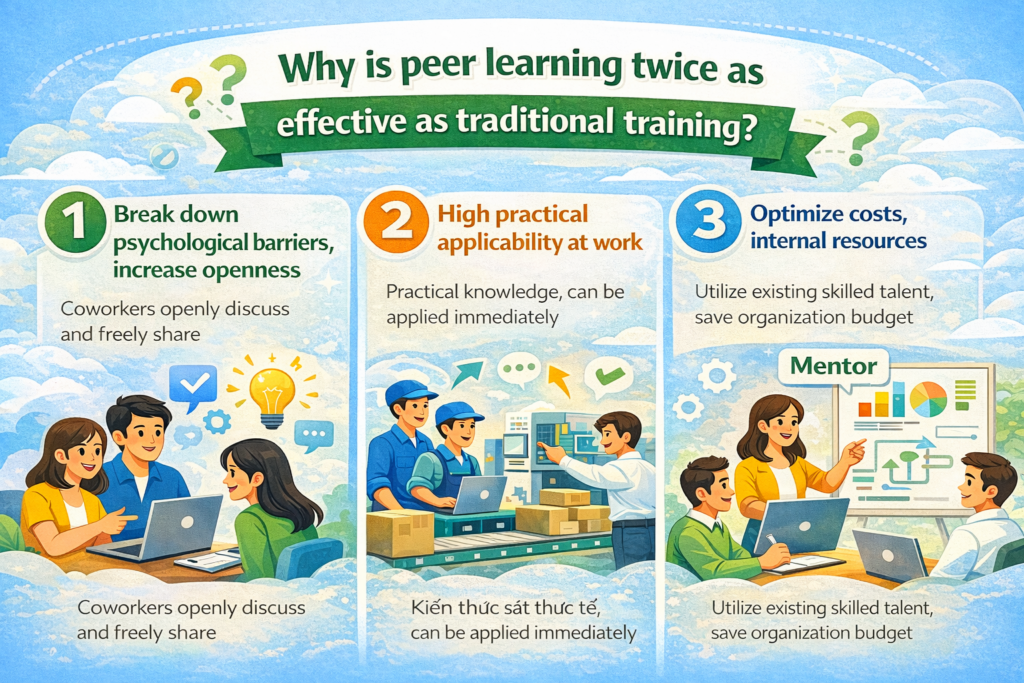
1. Breaking Psychological Barriers and Enhancing Openness
In traditional training sessions led by external consultants or senior executives, employees often feel hesitant to ask questions for fear of appearing incompetent. However, when learning with peers, the atmosphere becomes significantly more intimate and relaxed. The shared status allows them to admit knowledge gaps and discuss solutions without reservation. This eliminates communication “dark zones,” where critical questions are often suppressed in formal classrooms.
When openness reaches its peak, the efficiency of knowledge acquisition increases in direct proportion to the established trust. Employees no longer feel “lectured at” in a one-way stream; instead, they participate in a constructive dialogue. This positive psychological state allows the brain to expand its capacity for memory and analysis. In the long run, this openness dissolves latent internal conflicts, laying the foundation for a cohesive team. A pressure-free learning environment is the key to unlocking the full creative potential of every individual.
2. High Practical Applicability in Work Contexts
Traditional training often relies on generic case studies that may not fully align with the specificities of Vietnamese businesses. In contrast, Peer-to-Peer Learning focuses on real-time issues occurring right in the office or factory floor. Colleagues share how to handle a specific difficult client, troubleshoot internal software bugs, or operate specialized machinery. This “combat-ready” knowledge is derived from actual experience and professional sweat.
The bridge between theory and practice is minimized when the instructor is someone performing the task daily. After a sharing session, employees can return to their desks and immediately apply what they have learned to their workflows. This eliminates the time wasted when staff must “translate” academic theories into practical reality. This immediacy and relevance are precisely why this method achieves double the results of traditional training.
3. Optimizing Costs and Internal Corporate Resources
One of the most immediate benefits of this method is the significant financial savings for the organization. Businesses do not need to allocate massive budgets for guest speakers, venue rentals, or expensive copyrighted curricula. The most valuable “textbooks” are the collective intelligence and skills of the current workforce, who already understand the company culture intimately. Leveraging internal resources not only cuts costs but also optimizes the performance of existing talent.
Furthermore, allowing top performers to become mentors is an effective way to honor individual value. When employees feel their expertise is recognized and valued by the company, their level of commitment and engagement increases significantly. This is a smart knowledge management strategy, transforming recurring training costs into a sustainable investment in human capital. Instead of suffering from “brain drain” to the outside, the business creates a self-sufficient knowledge ecosystem.
Popular Peer Interaction Models in Vietnamese Enterprises
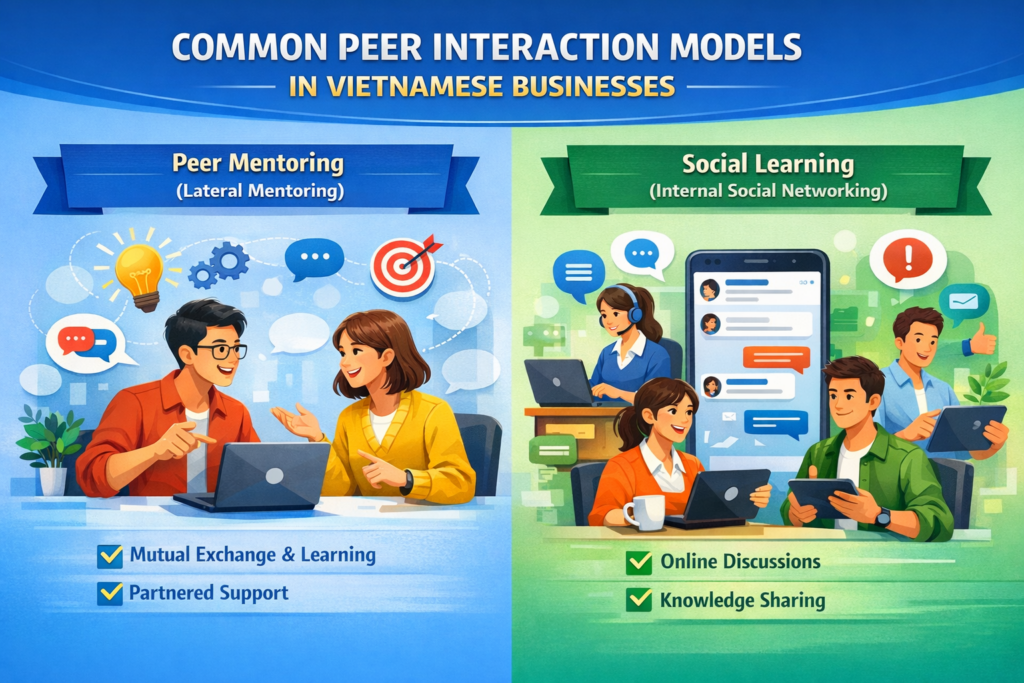
1. Peer Mentoring Model
This is the most popular model in Vietnam today, especially within technology and creative service firms. Unlike traditional mentoring (Manager-to-Staff), Peer Mentoring connects two people of similar rank but with different strengths. For example, a technically proficient employee can guide a colleague who excels in soft skills, and vice versa. This reciprocal exchange fosters mutual improvement without the pressure of authority.
This relationship typically evolves based on voluntarism and mutual trust. In the absence of hierarchical barriers, feedback and suggestions are much more candid and objective. It creates a sustainable partnership where trust is built on shared growth and a deep understanding of the work. Peer Mentoring helps employees feel they are not walking alone on their career path, thereby boosting overall team spirit.
2. Social Learning Model (Internal Social Networks)
With the explosion of tools like Workplace, Slack, Zalo, or Microsoft Teams, social learning has become an essential part of office life. Professional groups are established where employees can post questions and receive answers from anyone in the company within minutes. These online discussions leave a knowledge trail, making it easy for others to search later. This is a form of decentralized learning that removes all geographical barriers between branches.
Through these platforms, the flow of information within the business remains seamless and transparent. Employees from different departments can contribute ideas to problems outside their direct expertise. This fosters multi-dimensional thinking and helps the business discover “hidden gems” of talent within the organization. Turning chat platforms into a “living library” is the most effective way to maintain continuous learning in the digital age.
Challenges and Solutions for Implementation
1. Overcoming Initial Hesitation and Lack of Trust
A major hurdle in many Vietnamese enterprises is the “knowledge hoarding” culture or the fear that a more skilled colleague will take away one’s opportunities. To solve this, HR departments must build a “psychologically safe” environment where sharing is encouraged and celebrated rather than judged. Senior leadership should lead by example, being willing to admit what they don’t know to set a precedent for staff. When people feel safe, they will willingly share their professional secrets.
Building trust is not an overnight process; it requires a long-term roadmap from management. Small workshops or team-building activities combined with knowledge sharing can serve as excellent stepping stones. Once employees realize that sharing does not diminish their value but rather earns them more respect, the flow of knowledge will naturally surge. Turn sharing into a cultural standard where those who know more help those who know less to progress together.
2. Ensuring the Accuracy of Shared Knowledge
When knowledge is passed orally between peers, there is always a risk of information distortion or the spread of bad work habits. To fundamentally address this, businesses need a control unit or “core experts” to act as coordinators. Any critical new information or solutions should be systematized into official documentation after a group discussion. This ensures that what employees learn aligns with the best industry standards.
The combination of vivid real-world experience from colleagues and professional verification from experts creates a perfect knowledge source. Businesses should also regularly organize “knowledge audits” to update the latest market changes. Maintaining a standard theoretical framework as the foundation for peer discussions will keep the method from veering off track. Accuracy and practicality must always go hand-in-hand to produce optimal training results.
Conclusion
Peer-to-Peer Learning is not just a training method; it is a modern, flexible, and deeply human HR management philosophy. By trusting in the team’s capabilities and providing them with the opportunity to shine, businesses not only gain double the training effectiveness but also build a cohesive community of professionals. In an era of constant change, the businesses that know how to leverage the power of knowledge from within will be the ones leading the charge.
To empower your business in overcoming HR management challenges and staying fully committed to your strategic goals, we provide specialized solutions:
- [RPO Services]: A comprehensive recruitment process outsourcing solution.
- [BPO Services]: Strategic outsourcing to streamline business processes and optimize operational costs.
For any inquiries, contact Wacontre Accounting Services via Hotline: (028) 3820 1213 or email [email protected] for prompt assistance. With a team of experienced professionals, Wacontre is committed to providing dedicated and efficient service. (For Japanese clients, please contact Hotline: (050) 5534 5505).