
Effective Training Budget Management plays a pivotal role in sustainable organizational growth. This article guides you on planning smart HR training budgets and provides solutions to optimize corporate training costs, ensuring that every investment in human capital delivers tangible value and high returns.
What is Training Budget Management?
Training Budget Management is not simply allocating a certain amount of money for courses or seminars during the year. According to modern HR management practices, this is the process of planning, allocating, tracking, and evaluating the effectiveness of financial resources used to develop employee knowledge, skills, and capabilities. This process involves identifying direct costs such as tuition fees and instructor fees, as well as indirect costs and opportunity costs that are often overlooked.
An effective Training Budget Management system requires close collaboration between the HR department and the Finance department. The ultimate goal is not to spend the entire allocated amount, but to ensure that every dollar spent serves the company’s strategic objectives. Without strict management, the HR training budget can easily become a “financial drain” consuming resources without bringing measurable improvements to workforce productivity. Therefore, correctly understanding this concept is the first step in shifting mindset from “expense liability” to “asset investment.”
Strategic Importance of Controlling Training Budgets
Many businesses, especially Small and Medium Enterprises (SMEs) in Vietnam, often underestimate the training budgeting phase or perform it superficially. However, poor control in Training Budget Management can lead to serious financial consequences and missed development opportunities. Strict control of this budget brings three core strategic benefits:
1. Ensuring Financial Health and Cash Flow
Every business activity requires cash flow to sustain operations, and training activities are no exception. Detailed HR training budget planning helps businesses forecast the cash flow needed for each quarter or month. This prevents unexpected budget shortfalls where sudden training expenses impact working capital for production, business operations, or payroll.
Having a clear budget plan allows the finance department to proactively arrange capital sources, avoiding sudden cuts to important training programs when the company faces temporary difficulties. Moreover, good control eliminates wasteful, redundant expenses such as enrolling too many employees in the same skill course without a knowledge-sharing strategy, or investing in expensive programs unrelated to actual work. Transparency in training finance builds trust between HR and senior management.
2. Aligning HR Development with Business Goals
One of the most common mistakes is training based on trends or personal employee preferences without connecting to organizational objectives. Training Budget Management forces managers to answer: “How will this investment contribute to our annual revenue target?”. The budget acts as a compass, directing all learning and development activities toward business strategy.
When financial resources are limited, businesses must prioritize budgets for core training programs that address current capability gaps. For example, if this year’s goal is to expand to Japan, budget should focus on Japanese language and business culture training rather than general soft skills. This approach ensures corporate training cost optimization from the planning stage, maintaining complete alignment between individual development and organizational growth.
3. Basis for Measuring ROI (Return on Investment) in HR
In modern HR management, all activities must prove effectiveness through measurable results, and training faces the greatest pressure to demonstrate ROI. How do you determine if your sales skills training program was effective without knowing the total cost? Precise Training Budget Management provides the denominator for the ROI formula: ROI = (Net Benefit / Cost) × 100%.
Tracking each cost item in detail helps businesses analyze the effectiveness of each training delivery method. For instance, you can compare cost and results between outsourced instructors and in-house training. Accurate budget data enables HR Managers to confidently present training investment efficiency to leadership, making it easier to secure budget approval for future years. Without precise cost tracking, all training effectiveness reports lack credibility.
Core Cost Categories in HR Training Budgets
To build a comprehensive budget, training managers need a comprehensive perspective to avoid missing any costs. An incomplete budget leads to overspending and complications during settlement. Below are 4 core cost groups requiring detailed tracking.
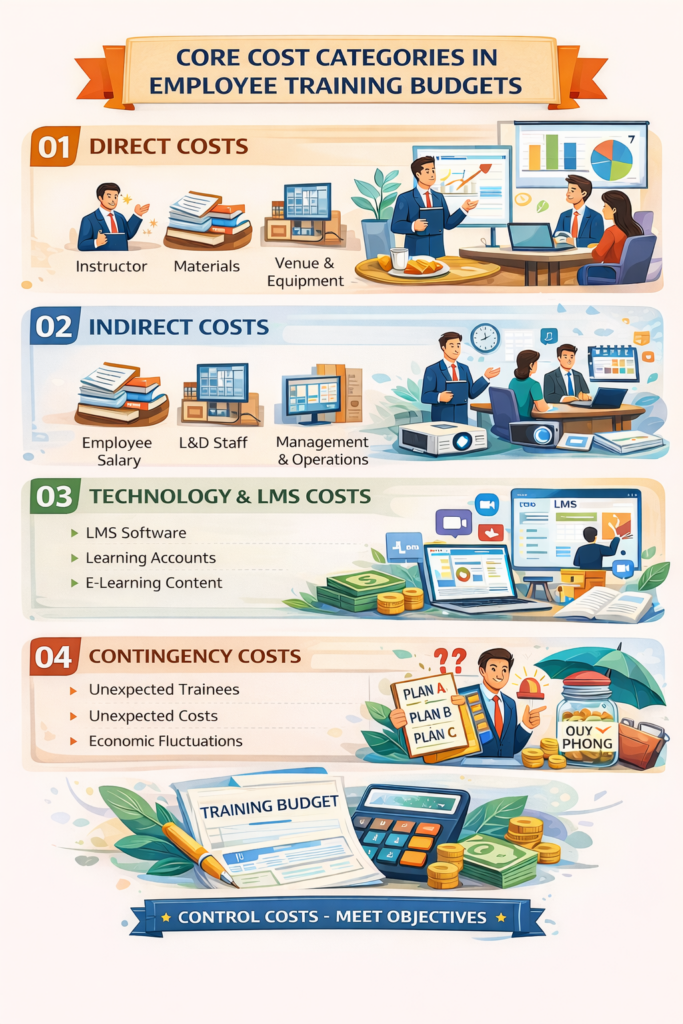
1. Direct Costs: Instructors, Materials, Venue, Accommodation
This is the most visible cost category and typically represents the largest portion of the total budget. First is instructor or training provider costs, which may be hourly rates, per-session fees, or project-based packages. For premium courses or international experts, this figure can be substantial and requires careful negotiation.
Next are venue rental costs (if the business lacks adequate conference facilities) and associated equipment such as sound systems, lighting, and projectors. Printing costs for materials, textbooks, stationery, and participant gifts must also be calculated per person. Additionally, full-day or off-site courses require budgets for refreshments, meals, and travel plus accommodation (hotels, air tickets) for both instructors and participants. Include applicable taxes and fees in contracts with service providers.
2. Indirect Costs: Employee Time, Management Expenses
This is the “hidden” cost that many businesses overlook during Training Budget Management, resulting in underestimated total costs. The largest indirect cost is employee salaries during training hours instead of productive work. When an employee takes 2 days for training, the business still pays full salary while bearing the opportunity cost from work disruption or reduced productivity.
Additionally, HR department operating costs must be allocated to the training budget. This includes HR staff salaries, time spent designing programs, coordinating with partners, and managing sessions. Even office utilities and facility depreciation during in-house training are indirect costs that should be considered for accurate ROI calculation. Identifying these costs clearly enables better decisions about training timing and format to minimize impact on business operations.
3. Technology Investment and LMS (Learning Management System) Costs
In the digital era, corporate training cost optimization increasingly involves technology adoption. Therefore, budgets need significant allocation for technical infrastructure. This includes costs for purchasing or subscribing to Learning Management Systems (LMS), online platforms like Zoom or Microsoft Teams, and accounts for services like Udemy or Coursera.
Beyond software licensing, businesses must invest in digital content creation (E-learning content production). Recording and editing instructional videos, designing interactive presentations, or purchasing course licenses all involve upfront costs. However, this is a long-term investment since materials can be reused across multiple employee cohorts without additional instructor fees. System maintenance, upgrades, and user training also require budgeting.
4. Contingency Costs for Risk Management
Any financial plan requires contingency reserves for unforeseen fluctuations. In Training Budget Management, this contingency fund typically represents 5% to 10% of total budget. Risks include unexpected venue rental increases, last-minute instructor cancellations requiring expensive replacements, or higher-than-expected participant numbers.
Economic shifts or strategic changes can also generate unplanned training needs. For example, new machinery requires urgent operator training. Without a reserve fund, the HR department faces delays requiring complex budget adjustment procedures that disrupt schedules. A contingency fund is your “safety net” protecting plan feasibility.
5-Step Process for Building and Managing Effective Training Budgets
To transform Training Budget Management from theory into effective practice, follow a methodical process. The 5-step approach below draws from multinational corporation practices, adapted for the Vietnam business environment.
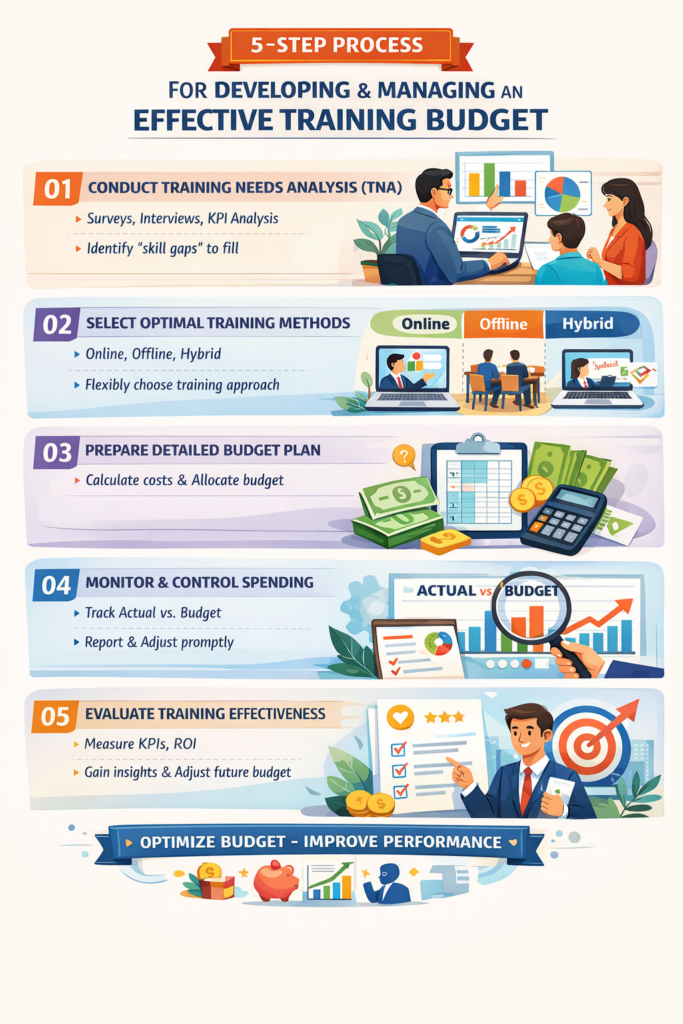
1. Conduct Realistic Training Needs Analysis (TNA)
The first and most critical step is Training Needs Analysis (TNA). A sound budget cannot be built on assumptions. HR must conduct employee competency assessments, interview department leaders, and review performance data to identify capability gaps.
TNA must answer: Who needs training? What skills are needed? Why is training urgent now? Thorough analysis eliminates non-essential courses and focuses resources on immediate priorities. The TNA output is a prioritized training program list, essential input for cost estimation.
2. Select Optimal Training Methods: Online, In-Person, or Hybrid
After determining “what to teach,” decide “how to teach.” Training method directly impacts cost structure. In-person training offers high interaction but significant organizational costs (venue, travel, accommodation). Online training reduces operating expenses but requires upfront technology investment and content development.
Hybrid Learning is becoming the preferred approach for optimizing corporate training costs. Theory can be delivered online for self-study (saving gathering time), while hands-on and discussion sessions are conducted in-person. Matching delivery method to content not only reduces costs but also enhances learning outcomes and flexibility.
3. Create Detailed Cost Estimates and Resource Allocation
This step requires specific numbers. Based on the training program list and chosen methods, obtain quotes from at least 3 providers for objective comparison. Break down estimates by month or quarter to match company cash flow patterns.
Apply the Pareto 80/20 principle: allocate 80% of budget to the 20% of personnel or critical skills delivering greatest business value. Clearly assign budget responsibility for each cost item to specific HR team members. Greater detail and transparency in estimates increase Board approval likelihood and streamline budget distribution.
4. Establish Periodic Spending Tracking and Control Systems
Even excellent plans fail without oversight during execution. Training Budget Management is dynamic and requires continuous monitoring. Establish regular budget reports (monthly or quarterly) comparing actual spending versus budgeted amounts.
When significant variances occur, investigate immediately. Are market prices higher? Did actual participant counts differ? Did management allow waste? Early variance detection enables timely adjustments: reducing unnecessary expenses in subsequent months or renegotiating supplier terms. Expense management software or ERP systems automate this more accurately than manual Excel tracking.
5. Evaluate Training Effectiveness to Guide Future Budgets
Budget management cycles complete at the effectiveness evaluation stage. Assess whether spending produced proportionate results through changes in employee behavior, increased productivity, or revenue growth after training.
This evaluation data is invaluable for the next year’s budget. If a program consumes resources but shows low effectiveness, reduce or change providers. High-ROI programs deserve budget increases for expanded reach. Continuous evaluation and adjustment make HR training budgets increasingly optimized, efficient, and effective over time.
Strategies to Optimize Corporate Training Costs While Maintaining Quality
Amid budget constraints, HR professionals must “achieve more with less.” Below are smart strategies to reduce costs without sacrificing quality or diminishing the learning culture.
1. Maximize Internal Trainer Resources
A valuable yet often-overlooked resource is existing staff expertise. Building an Internal Trainer team is the most sustainable corporate training cost optimization approach. Middle managers and technical specialists understand company culture, processes, and practical challenges better than outside consultants.
Instead of hiring external experts at high cost, develop training skills in key personnel and have them teach. This reduces outsourcing costs while delivering practical, contextually relevant knowledge. Recognition as an internal trainer also motivates talented employees and provides career development pathways.
2. Leverage Digital Transformation and E-Learning to Reduce Operating Costs
Digital transformation is inevitable. One-time investment in an e-learning system can serve thousands of employees for years. Content like onboarding, company policies, product knowledge, and Standard Operating Procedures (SOPs) are ideal for digitization.
E-learning eliminates travel, accommodation, and venue costs. Employees learn anytime, anywhere, reducing “nonproductive” office hours and lowering indirect costs. Additionally, free or low-cost quality learning resources available online (MOOCs) enrich training libraries without major budget impact.
3. Negotiate Effectively with Training Service Partners
Training staff negotiation skills directly impact cost efficiency. Never accept initial quotes. Build long-term relationships with quality training providers to secure better rates. Committing to larger participant numbers or annual contracts typically reduces costs by 10-20% versus individual enrollments.
Consider barter arrangements when possible. For example, provide your venue or products in exchange for courses. Compare options and request customized packages matching your budget to avoid paying for unnecessary content.
4. Apply the 70:20:10 Model for Optimal Budget Allocation
The 70:20:10 model guides smart budget allocation: 70% of knowledge comes from work experience, 20% from peer learning (mentoring, coaching), and only 10% from formal courses. Yet formal training often consumes 90% of the budget.
Optimal strategy shifts budget toward the 70% and 20% components. Instead of expensive formal programs, invest in mentorship, job rotation, and challenging projects. These activities cost less upfront but yield superior capability development. Reallocating budget this way maximizes efficiency and effectiveness.
Conclusion
Training Budget Management is not a limitation—it is a foundation for talent development. Detailed planning, strict control processes, and flexible optimization strategies resolve the dual challenge: enhancing workforce capabilities while ensuring financial health.
In knowledge-driven competition, businesses that convert training costs into profitable people investments gain sustainable competitive advantage. Review your budget processes today, apply strategic thinking shared here, and observe improved organizational performance. Smart investment in people is never wasteful.
For questions or support, contact Wacontre Accounting Services at (028) 3820 1213 or [email protected]. Our experienced professionals provide comprehensive, efficient service tailored to your needs. (Japanese-speaking clients: (050) 5534 5505)