For any business, well-drafted internal labor regulations are essential to maintaining order, improving productivity, and reducing legal risk. More than a simple HR document, internal labor regulations form the legal basis for disciplinary action and the resolution of internal disputes. This is especially true for newly established companies, where putting clear regulations in place from day one lays the foundation for a sustainable workplace culture.
In this article, we provide a detailed guide on how to draft and implement internal labor regulations for new companies in Vietnam, in line with the latest legal requirements.
What Are a Company’s Internal Labor Regulations?
Definition Under Vietnamese Law
Under Article 118 of the 2019 Labor Code, internal labor regulations are a set of rules issued by the employer that govern disciplinary matters and the work obligations of employees. Companies with fewer than ten employees are not required to register their internal regulations, but doing so is still recommended for effective labor management. The regulations must be issued in writing and communicated to all employees to ensure transparency and legal compliance, and they serve as a key legal basis for resolving labor disputes when they arise.
Are Internal Labor Regulations Mandatory?
Vietnamese law does not require every business to issue internal labor regulations. However, companies with ten or more employees must issue and register their labor regulations. Whether or not a company has such rules directly affects its ability to handle violations and discipline employees. Even small businesses are encouraged to adopt a basic set of internal regulations to clarify core principles, codes of conduct, and work standards. This helps reduce risk and improve day-to-day operational efficiency.
How Do Internal Regulations Differ from Employment Contracts?
A common misconception is that internal labor regulations and employment contracts are the same. In reality, they are two distinct legal documents.
An employment contract is a bilateral agreement between the employer and the employee that sets out the specific rights and obligations of each party.
By contrast, internal labor regulations are a unilateral document issued by the employer and applied to all employees within the organization. They serve as a general management framework that complements employment contracts by maintaining order and providing a legal basis for handling violations.
Employee Responsibilities Under the Regulations
Every employee who signs an employment contract is responsible for complying with the company’s internal labor regulations. Compliance is mandatory, and breaches may lead to disciplinary action as set out in the regulations, including reprimands, delayed pay increases, or dismissal. The regulations also help employees understand their rights, obligations, and the workplace behavior expected of them. For this reason, employers should gather employee feedback when drafting their internal regulations to ensure the rules are practical and widely accepted.
How to Draft Internal Labor Regulations
Drafting internal labor regulations means establishing the in-house rules that govern employee behavior, duties, and rights within the organization. A comprehensive set of regulations not only keeps the workplace orderly but also provides a foundation for sustainable HR management. For newly established companies, working from a standard template saves time and helps ensure compliance with Vietnamese labor law requirements on workplace rules.
Structure of a Standard Set of Internal Regulations
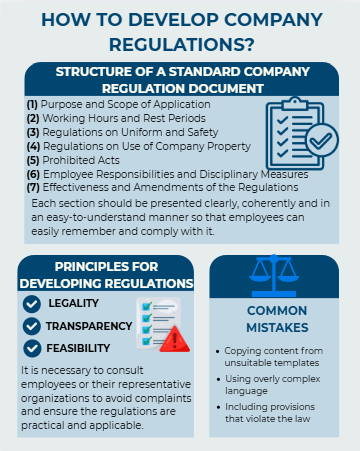
A standard set of internal labor regulations typically consists of seven main sections:
- Purpose and Scope of Application
- Working Hours and Rest Periods
- Dress Code and Occupational Safety
- Use of Company Property
- Prohibited Acts
- Employee Responsibilities and Disciplinary Measures
- Effective Date and Amendments
Each section should be written clearly, logically, and in plain language so that employees can easily remember and follow the rules. Companies may adapt the structure to suit their specific industry, provided that all legal elements required by the Labor Code are included.
Key Principles for Drafting Internal Labor Regulations
To draft effective internal labor regulations, companies should follow three core principles: legality, transparency, and feasibility.
- Legality means the content must not contradict current laws and regulations.
- Transparency ensures that employees can understand and follow the rules with ease.
- Feasibility means the provisions must be practical and aligned with how the company actually operates.
It is also important to consult employees or their representative organization (if any) when drafting the regulations to minimize complaints and ensure that the rules can be effectively applied in practice.
Common Mistakes When Drafting Internal Regulations
Many businesses, especially newly established ones, make the following mistakes when drafting internal regulations:
- Copying templates that do not match their industry or operations.
- Using overly complex or legalistic language that is hard for employees to understand.
- Including unlawful provisions, such as monetary fines on employees, which are prohibited under the Labor Code.
- Lacking a clear structure or a transparent process for handling violations.
- Failing to communicate the regulations effectively to employees.
To avoid these pitfalls, companies should seek advice from legal professionals or use specialized consulting services when drafting their internal labor regulations, ensuring the final document is both compliant and practical.
What Should a Sample Set of Internal Regulations Include?
For newly established companies, having a clear, easy-to-understand, and legally compliant set of internal regulations is essential. The regulations help employees understand their rights and obligations, while also providing a basis for handling violations, maintaining discipline, and improving work efficiency. A good sample regulation should be logically structured and tailored to the company’s industry and scale.
Basic Internal Regulations Template
A basic template for internal labor regulations generally covers core provisions that apply to most businesses. The main sections usually include:
- Working hours and rest periods
- Dress code
- Code of conduct
- Use of company assets and equipment
- Occupational safety and fire prevention
- Reward and disciplinary policies
- Procedures for handling violations
This template is suitable for companies with fewer than 10 employees or those not required to register their internal regulations with the authorities. Businesses can use it as a framework and customize it to fit their operations.
Internal Regulations Template for Manufacturing and Construction Companies
For manufacturing and construction companies, where operations involve higher risks and hazards, internal regulations must place particular emphasis on occupational safety, the use of machinery and protective equipment, and on-site work procedures.
In addition to general provisions, this type of regulation should include details such as:
- Shift work and rest schedules
- Regular safety inspections
- Team coordination rules
- Prohibited acts, such as smoking in flammable areas, failing to wear protective gear, or operating machinery without authorization.
These additions help ensure compliance with safety standards and prevent workplace accidents.
Internal Regulations Template for Trade and Service Businesses
For businesses in the trade and service sectors, such as supermarkets, distribution companies, travel agencies, spas, and restaurants, the internal regulations should focus on:
- Working hours and punctuality
- Customer service conduct
- Confidentiality of information
- Professional behavior and communication
Typical clauses include:
- Maintaining a proper service attitude toward customers
- No use of personal phones during working hours
- No meeting with external clients without prior approval
- Procedures for handling customer complaints
This type of regulation should be flexible and updated regularly to reflect service characteristics and customer feedback.
Notes on Using Pre-Made Templates
Using pre-made regulation templates can be convenient, but it also carries risks if they are applied mechanically or copied from unofficial sources. Some templates may:
- Be outdated and fail to reflect the latest legal provisions
- Contain unlawful clauses, such as monetary fines on employees, which are prohibited under the Labor Code
- Be unsuitable for the company’s size, culture, or industry
For these reasons, companies should treat sample templates as references only and adapt them to their specific needs. Where possible, businesses should consult lawyers or HR legal experts to ensure that their internal labor regulations are legally valid and practical to implement.
Do Internal Labor Regulations Need to Be Registered?
Which Businesses Must Register Their Internal Regulations?
Under Article 119 of the 2019 Labor Code, companies with 10 or more employees are required to issue written internal labor regulations and register them with the local labor authority. Depending on where the company is registered, this is either the District Labor, War Invalids and Social Affairs Office or the Provincial Department of Labor, War Invalids and Social Affairs (DOLISA).
Companies with fewer than 10 employees are not required to register their internal regulations. However, if such regulations are issued in writing, they should still be clearly communicated to all employees.
Failure to register when required may cause the regulations to lose legal validity, making it difficult to resolve labor disputes.
Required Documents for Registration
To register their internal labor regulations, businesses must prepare a dossier that includes:
- An application for registration of internal labor regulations, using the form issued under Circular No. 10/2020/TT-BLĐTBXH.
- The internal labor regulations, duly signed and stamped by the company’s legal representative.
- Minutes or written comments from the employee representative organization (if there is a trade union or collective labor representative).
The dossier should be compiled as a single complete set and submitted either in person or online via the provincial e-Government service portal for the location of the company’s head office.
Where to Submit the Registration
The receiving authority depends on the company’s scale and type:
- District-level Labor, War Invalids and Social Affairs Office: for small and medium-sized enterprises.
- Provincial Department of Labor, War Invalids and Social Affairs (DOLISA): for large enterprises and foreign-invested companies.
Businesses must make sure the dossier is submitted to the correct authority to avoid rejection or delays.
In many provinces and cities, the registration process can now be completed online, saving both time and administrative costs.
Processing Time and Procedure
Once a complete and valid dossier is received, the labor authority must process and respond within seven (07) working days.
If the dossier is incomplete, the company will be notified to make corrections or additions.
If no response is issued after the statutory time limit, the internal regulations are automatically deemed effective, and the company may begin applying them.
Companies should keep all submission receipts and proof of registration for future legal reference.
After approval, the regulations must be publicly communicated to all employees through channels such as:
- Posting them at the workplace or on notice boards
- Sending them via internal email
- Publishing them on the company intranet or HR system
Common Reasons for Rejection and How to Address Them
In some cases, the labor authority may reject the registration if the regulations:
- Contain unlawful provisions,
- Lack clarity or transparency, or
- Are missing required documents.
For example, rules that impose monetary fines on employees or discriminate in disciplinary actions are prohibited under the Labor Code.
If the registration is rejected, the company should review and revise the regulations based on the authority’s feedback before resubmitting.
We strongly recommend that businesses consult legal experts or professional HR advisors when drafting or revising their internal labor regulations to ensure the document is legally valid and practically enforceable.
What Are the Benefits of Issuing Internal Labor Regulations?
Issuing internal labor regulations is not only a legal requirement for certain businesses, it also brings significant practical benefits for management and day-to-day operations. A well-structured and transparent set of rules helps foster a positive corporate culture and a professional working environment, while reducing potential legal risks. Below are five key benefits companies can gain from a proper set of internal regulations.
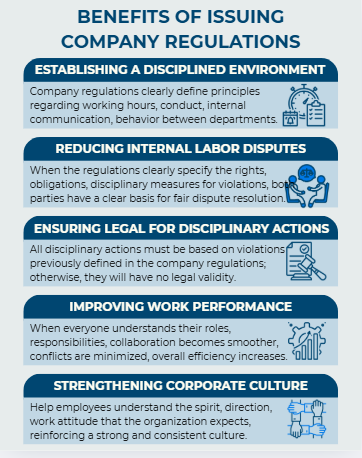
1. Establishing a Disciplined Working Environment
One of the most visible benefits of issuing internal labor regulations is the creation of an organized and disciplined workplace. The rules clearly define principles on working hours, behavior, internal communication, and cross-department interaction, helping each employee understand what the company expects and where the boundaries lie.
For newly established companies, applying a standard template from the outset helps shape proper workplace norms early on and avoids disorder and inconsistency during the start-up phase.
2. Reducing Internal Labor Disputes
Clear and comprehensive internal labor regulations provide a legal foundation for resolving disputes between employers and employees. When the rules clearly set out rights, obligations, and penalties for violations, both parties have a common reference point for fair and lawful dispute resolution.
This is especially important in organizations with multiple departments and employees, as it helps minimize personal conflicts, complaints, and unnecessary lawsuits. Transparent regulations also give employees confidence that the rules are applied fairly across the board.
3. Providing a Legal Basis for Disciplinary Actions
When an employee breaches company policy or fails to meet their obligations, the internal regulations serve as the legal basis for disciplinary action. Under Vietnamese labor law, any disciplinary measure must be based on conduct that has been clearly stated in the registered internal regulations; otherwise, the action may have no legal validity.
As a result, without properly drafted (and, where required, registered) regulations, employers with 10 or more employees may find it difficult to enforce discipline. A well-prepared set of regulations thus protects both the employee and the employer by ensuring that violations are handled lawfully and fairly.
4. Improving Work Efficiency
When everyone in the organization understands their roles, responsibilities, and behavioral standards, teamwork becomes smoother, conflicts are reduced, and productivity improves.
Internal regulations also help new employees adapt to the company culture more quickly, reducing onboarding time. Clear, standardized rules prevent inconsistent practices across staff and departments, supporting alignment and operational efficiency throughout the company.
5. Strengthening Corporate Culture
Beyond being a management tool, internal labor regulations are an essential part of corporate culture. When designed to reflect the company’s core values, they help employees understand the spirit, vision, and work ethic the organization expects. Well-implemented regulations act as a bridge between management and staff, building trust, transparency, and a sense of unity. Fair and transparent enforcement also reflects the company’s professionalism and strengthens its image among employees and business partners alike.
Issuing internal labor regulations is therefore more than a legal obligation for businesses with 10 or more employees — it is a strategic step in long-term HR management. A well-prepared set of rules enables a company to maintain discipline, resolve disputes lawfully, and build a cohesive workforce. For newly established businesses, the sample regulations outlined above can be adapted to fit specific operations. If you are unsure about the process or need professional support, consider working with legal advisors or HR service providers to ensure your internal regulations fully comply with the law.
For any inquiries, contact Wacontre Accounting Services via Hotline: (028) 3820 1213 or email [email protected] for prompt assistance. With a team of experienced professionals, Wacontre is committed to providing dedicated and efficient service. (For Japanese clients, please contact Hotline: (050) 5534 5505.)