For every business, establishing a clear and transparent salary policy is essential to ensuring fairness in the payment of salaries, bonuses, and allowances to employees. A well-defined salary policy not only helps a company comply with legal requirements but also serves as a powerful tool for motivating staff, improving performance, and fostering a fair working environment. This article provides detailed guidance on the latest 2025 salary and bonus policy template, together with relevant regulations and methods for calculating salaries, bonuses, and allowances—helping you build a compliant and effective compensation system within your organization.
1. What Is a Salary Policy?
A salary policy is a set of internal regulations issued by a company that governs the payment of salaries, bonuses, allowances, and other employee benefits. It is a key tool for ensuring fairness and transparency in compensation while maintaining compliance with labor laws. The salary policy is an indispensable component of both human resources and financial management within an organization.
Purpose and Importance of a Salary Policy
The main goal of a salary policy is to ensure a fair, transparent, and reasonable compensation system for all employees. A well-designed policy not only helps the company comply with wage-related legislation but also acts as a strong motivator for staff. When employees clearly understand their rights and entitlements, they feel more secure, which boosts work efficiency and supports healthy labor relations between staff and the company.
Essential Elements of a Salary Policy
To ensure fairness and consistency, a salary policy should include the following core components:
- Basic Salary: The amount paid to an employee for working under normal conditions, excluding allowances, bonuses, or other support payments.
- Allowances: Supplemental payments that support employees, such as lunch allowances, transportation or fuel subsidies, phone allowances, responsibility allowances for managerial roles, and other forms of support.
- Bonuses: The policy should clearly define each type of bonus, including revenue-based bonuses, year-end bonuses, performance bonuses, innovation bonuses, and other incentive payments.
- Welfare Benefits: Provisions for paid leave, social insurance, sick leave support, wedding and bereavement gifts, accident assistance, and other special benefits.
How Does a Salary Policy Affect Employees?
A salary policy is not merely a cost control tool for the business—it also forms the foundation that protects employees’ rights. When the policy is openly published, clear, and fair, it builds transparency and trust between staff and management. Employees feel more secure when they know exactly how their salary, allowances, and bonuses are calculated, and when they are confident that they are treated fairly compared with their colleagues.
Benefits of a Salary Policy for Businesses
A well-structured salary policy delivers tangible benefits to both employers and employees:
- Reduces Conflict: Clear salary rules minimize wage-related disputes, since all details are pre-defined and openly communicated.
- Boosts Work Performance: When employees see that their pay reflects their effort and contributions, they are more motivated to perform at a high level.
- Legal Compliance: A formal salary policy ensures the business complies with labor laws regarding wages, bonuses, allowances, and employee entitlements, helping to avoid legal risks.
- Improves Employee Satisfaction: A fair pay structure contributes to a professional, equitable, and supportive workplace.
2. Latest 2025 Salary and Bonus Policy Template
A comprehensive and detailed salary and bonus policy template is a critical foundation for transparent and fair employee compensation. It not only ensures compliance with labor laws but also acts as a key motivational tool, encouraging employees to contribute their best efforts to the company. Below are the core regulations included in the latest 2025 salary and bonus policy template.
Regulations on Basic Salary and Allowances
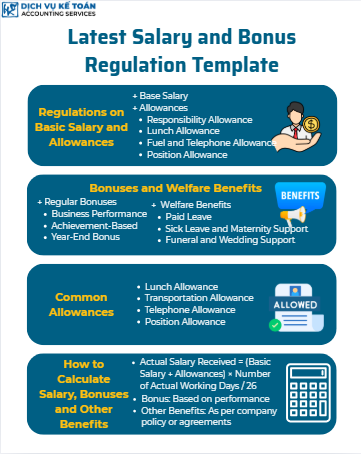
In the 2025 salary policy template, the basic salary is defined as the amount an employee receives for working under normal conditions. It may be adjusted in line with the regional minimum wage and is determined based on the nature of the job and the employee’s position within the company.
- Base Salary: The salary paid to an employee for working under standard conditions and fulfilling the agreed working hours and responsibilities. The base salary is clearly stated in the labor contract and may be adjusted in line with the company’s business and production performance.
- Allowances: In addition to the base salary, employees are entitled to various allowances. Common types include:
- Responsibility Allowance: For positions such as department heads, directors, and other management roles.
- Lunch Allowance: Provided to all long-term employees.
- Transportation and Phone Allowance: Typically granted to roles that require frequent travel or communication.
- Position Allowance: Applied to higher-responsibility roles, such as managers and directors.
Regulations on Bonuses and Welfare Benefits
No salary policy is complete without rules on bonuses and welfare benefits. Bonuses play a crucial role in motivating employees to perform well and contribute to the company’s growth.
- Performance-Based Bonuses: Awarded annually based on the company’s business results and the individual’s contributions.
- Achievement Bonuses: Granted to individuals or teams that deliver outstanding results.
- Year-End Bonus: A portion of the company’s profits may be distributed to all employees, depending on overall business performance.
Welfare benefits typically include support in specific cases such as:
- Paid Leave: Employees are entitled to paid leave in accordance with company policy.
- Health and Maternity Support: Financial assistance during illness or maternity leave.
- Life Events Support: Financial support for weddings, childbirth, or bereavement.
Common Allowances in a Salary Policy
One key feature of the 2025 salary and bonus policy template is its detailed specification of allowances. These not only increase employee income but also reflect the company’s commitment to employee well-being. Common allowances include:
- Lunch Allowance: Provided to all long-term employees to help cover daily meal expenses.
- Travel Allowance: Given to employees who travel frequently for work, covering transportation costs.
- Phone Allowance: For employees whose roles require frequent phone communication.
- Position Allowance: Offered to staff in senior positions to fairly compensate their additional responsibilities.
How Salaries, Bonuses, and Other Support Payments Are Calculated
Salary and bonus calculations in 2025 depend on several factors, with working days and allowances playing a key role in determining the final amount.
- Base Salary Calculation:
Actual Base Salary = (Basic Salary + Allowances) × Actual Working Days ÷ 26 - Bonus: Calculated based on the company’s financial performance, individual contributions, and targets such as revenue or output. The year-end bonus depends on company profits and may vary depending on financial conditions.
- Other Support Payments: In addition to salaries and bonuses, employees may receive additional financial support for health issues, maternity leave, personal life events, or business travel expenses.
3. Forms of Salary Payment and Allowances in a Salary Policy
Every business has different requirements and job characteristics, so choosing the right form of salary payment is essential. The chosen payment method affects both cost management and employee motivation. A salary policy should clearly define each form of salary payment and the associated allowances to ensure fairness and operational efficiency.
What Is Time-Based Salary Payment?
Time-based salary payment is a method of paying employees according to the number of hours or days they actually work within a given period—usually monthly. This approach is common in companies with stable operations that do not rely on output or performance metrics. Salaries are calculated based on actual working hours or days.
The main advantages of this method are simplicity of management and payroll calculation, plus flexibility in employees’ working hours. A limitation is that it may not strongly encourage productivity, since pay is not directly tied to specific work results.
Time-based salary formula:
Monthly Salary = (Basic Salary + Allowances) / Standard Working Days × Actual Working Days
What Is Product-Based Salary Payment?
Product-based salary payment is a method in which pay is calculated based on the quantity and quality of products produced or tasks completed by the employee within a specific period. It is common in manufacturing, processing, and other industries where output can be measured. Employees are paid according to the number of products they complete in each pay period.
This method encourages higher productivity, as employees earn in proportion to their output and its quality. For it to be effective, however, the company must implement a clear and fair performance measurement system.
Product-based salary formula:
Product-Based Salary = Number of Products × Unit Price per Product
What Is Contract-Based Salary Payment?
Contract-based (lump-sum) salary payment is based on a predetermined amount paid for completing a specific job or task, regardless of the time required. It is typically used for clearly defined work volumes, such as special projects or jobs without fixed hours.
This approach reduces the need for close supervision and motivates employees to complete tasks efficiently. However, if not properly managed, it can lead to inconsistent work quality, as employees may prioritize speed over thoroughness.
Contract-based salary formula:
Lump-Sum Salary = Fixed Payment per Job × Job Completion Rate
Other Bonuses and Allowances in a Salary Policy
In addition to base salary, bonuses and supporting allowances are essential components of a company’s salary policy. These additional payments motivate employees to perform well and contribute to the company’s overall success.
Performance Bonuses
Performance bonuses are awarded to individuals or teams that deliver outstanding results. Employees may receive bonuses for boosting revenue, improving quality, or hitting targets set in the company’s strategic plan. These bonuses recognize achievement and motivate staff to keep improving.
Revenue-Based Bonuses
Revenue-based bonuses are tied directly to the company’s business results. Employees—especially those in sales or other roles with revenue targets—may receive a percentage of the revenue they generate. Bonus levels depend on actual revenue and individual contributions.
Business Travel Allowances
For employees required to travel for work, companies provide allowances covering meals, transportation, and accommodation. These reimbursements vary depending on the destination and length of the trip. Business travel allowances reduce employees’ out-of-pocket expenses and form part of the company’s welfare policy.
Read more: Complete Guide to the Latest Salary Calculation Methods
4. How to Build a Legally Compliant Salary Policy
Building a reasonable, legally compliant salary policy is essential—not only for ensuring fairness in employee compensation, but also for protecting employee rights and minimizing legal risk. The policy must be detailed and clear so as to avoid misunderstandings or disputes over salaries, bonuses, allowances, and other benefits.
What Should a Salary Policy Include?
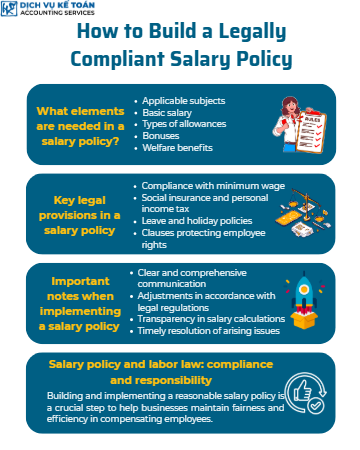
A legally sound salary policy should be comprehensive and include the following elements:
- Applicable Personnel: The policy must clearly define who it applies to—for example, all employees, probationary staff, full-time contract staff, part-time staff, or other categories of workers.
- Basic Salary: Clearly define the basic salary for each role or title within the company, taking into account the position, qualifications, and experience of the employee.
- Types of Allowances: Specify each type of allowance or subsidy that employees may receive, such as lunch allowances, transportation or fuel allowances, position allowances, and travel allowances.
- Bonuses: Clearly outline each bonus type, such as performance bonuses, revenue-based bonuses, year-end bonuses, and innovation bonuses.
- Welfare Benefits: Include details on employee welfare such as paid leave, public holidays, social insurance, health insurance, and other applicable benefits.
Key Legal Provisions in a Salary Policy
To ensure full compliance with Vietnam’s labor regulations, your salary policy must include the following key legal components:
- Minimum Wage Compliance: The policy must align with regional minimum wage rules as set out in Decree 38/2022/NĐ-CP. Minimum wages vary by region and are reviewed periodically.
- Social Insurance and Personal Income Tax: Salaries, bonuses, and allowances must comply with the laws on social insurance and personal income tax as set out in the Labor Code and related government decrees.
- Leave and Public Holidays: Clearly specify annual leave entitlements and official public holidays in accordance with the Labor Law and national calendar.
- Employee Rights Protection: Include clauses that safeguard employee rights, such as eligibility for periodic salary reviews, access to training programs, and full insurance and welfare benefits.
Important Considerations When Implementing a Salary Policy
To ensure your salary system is both reasonable and legally compliant, keep the following in mind when implementing the policy:
- Clear and Full Disclosure: The salary policy must be clearly communicated to all employees so that they fully understand their rights and responsibilities.
- Legal Updates: Update the policy regularly to reflect any changes in labor laws, government regulations, or company circumstances.
- Transparent Calculations: Ensure full transparency in how salaries, bonuses, and allowances are calculated. A clear reporting system helps prevent salary disputes.
- Timely Issue Resolution: Establish procedures to address and resolve any salary-related issues or conflicts promptly, protecting the interests of both employees and the employer.
Salary Policy and Labor Law: Compliance and Responsibility
Your salary policy must fully comply with the Labor Code and regulations on wages, social insurance, and employee welfare. Legal compliance protects your business from risk and ensures employees’ rights are upheld. Implementing a proper salary policy also strengthens your company’s reputation, promotes a fair and professional working environment, and helps you attract and retain top talent.
In Summary:
Building and implementing a fair, legally compliant salary policy is an essential step for any business. It ensures both legal compliance and employee satisfaction, creating a transparent and positive work environment. A strong policy also motivates employees to perform at their best and supports the sustainable growth of the business.
If you need help developing or updating your company’s salary policy, do not hesitate to contact a professional accounting or HR service for accurate, timely advice.
For any inquiries, please contact Wacontre Accounting Services via Hotline: (028) 3820 1213 or email [email protected]. With a team of experienced professionals, Wacontre is committed to delivering dedicated and efficient service. (For Japanese clients, please contact Hotline: (050) 5534 5505.)