
Meeting tax obligations is a mandatory requirement for every business from the moment it is established. Paying taxes is not only a legal duty but also reflects a company’s responsibility to society and the state. However, understanding which taxes must be paid, how to file them, and the related legal regulations can be complex. This article helps businesses grasp the essential types of taxes and the key information needed to ensure legal compliance and avoid unnecessary risks.
What Is Tax? The Role of Taxation for Businesses
Definition of Tax
Tax is a mandatory financial obligation that individuals and organizations must pay to the government. Unlike fees or service charges that provide a direct exchange of value, tax payments are non-refundable. Tax revenue funds public services such as education, healthcare, infrastructure, and national defense.
Types of Taxes: Direct and Indirect
- Direct Taxes: Levied directly on the income or assets of taxpayers, such as Corporate Income Tax (CIT) and Personal Income Tax (PIT).
- Indirect Taxes: Applied to transactions or consumption, such as Value-Added Tax (VAT) and Special Consumption Tax (SCT). These taxes are typically included in the price of goods or services.
The Role of Taxation for Businesses
Taxation is not only a legal obligation but also a way for businesses to demonstrate compliance with the law. Paying taxes correctly helps companies build credibility, avoid legal risks, and contribute to social development.
Consequences of Non-Compliance with Tax Obligations
Businesses that violate tax regulations may face administrative penalties, legal liability, or enforcement measures such as business suspension. These outcomes can severely damage a company’s reputation and operations.
Types of Taxes Businesses Must Pay
What Is License Tax (Business License Fee)?
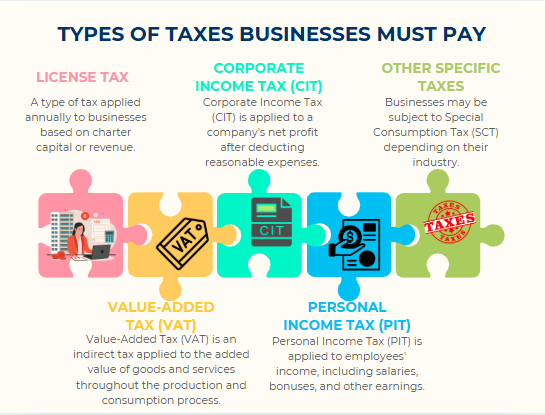
License tax, also known as the business license fee, is an annual tax imposed on businesses based on their charter capital or revenue.
Tax Rates: License tax ranges from VND 300,000 to VND 3,000,000 per year, depending on business size.
Exemption for Newly Established Businesses: Under Decree 22/2020/ND-CP, newly established businesses are exempt from license tax in their first year of operation.
Learn more: 10 Cases Exempt from License Tax Payment
What Is Value-Added Tax (VAT)?
Value-Added Tax (VAT) is an indirect tax imposed on the added value of goods and services at each stage of production and consumption.
VAT Declaration Methods:
- Deduction Method: Applied to large enterprises that issue VAT invoices and can deduct input VAT.
- Direct Method: Applied to small businesses that calculate VAT based on revenue without deducting input tax.
Learn more: What Is VAT? Essential Information Accountants Should Know About Value-Added Tax
What Is Corporate Income Tax (CIT)?
Corporate Income Tax (CIT) is applied to a company’s net profit after deducting reasonable expenses.
Current Tax Rates:
- The standard CIT rate is 20%.
- Certain industries may qualify for preferential tax rates lower than 20%.
Learn more: Corporate Income Tax: Essential Information You Need to Know
What Is Personal Income Tax (PIT)?
Personal Income Tax (PIT) applies to employees’ income, including salaries, bonuses, and other earnings.
Employer’s Responsibility:
Businesses are responsible for withholding and remitting PIT on behalf of their employees.
Current Family Deduction Rates:
- VND 11,000,000 per month for the taxpayer.
- VND 4,400,000 per month for each dependent.
Learn more: What Is Personal Income Tax (PIT)? Definition and Legal Regulations
Other Specific Taxes
In addition to the major taxes, businesses may be subject to Special Consumption Tax (SCT), Resource Tax, or Import-Export Tax, depending on their industry and operations.
Tax Declaration and Payment Process
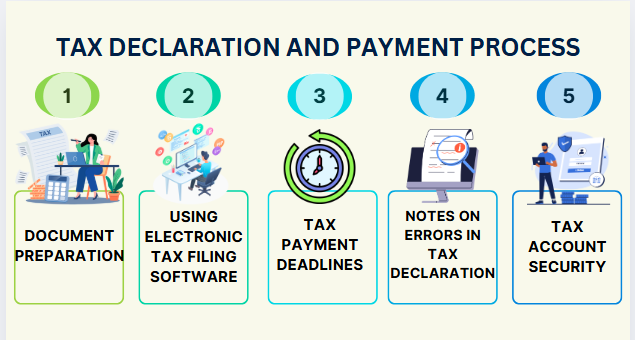
Document Preparation
Preparing tax declaration documents is the first and most critical step to ensure a smooth filing process. Businesses must collect and organize relevant records such as input and output invoices, payroll documents, employment contracts, and other supporting paperwork.
Key Requirements:
- Documents must follow the official forms issued by the tax authority.
- Proper and complete preparation reduces errors during filing and verification.
- Missing or incorrect documents may lead to rejected filings or penalties for non-compliance.
Using Electronic Tax Filing Software
Electronic tax filing software is now mandatory for most businesses. The HTKK (Tax Declaration Support) system provided by the General Department of Taxation allows companies to submit tax returns online without visiting the tax office, saving time and improving accuracy.
In addition to HTKK, other software such as MISA and Fast also supports tax filing. Businesses should keep their software up to date to comply with the latest regulations.
Tax Payment Deadlines
Each type of tax has its own deadline:
- License Tax: Must be paid before January 30 each year.
- VAT and PIT: Paid monthly or quarterly, depending on revenue scale.
- CIT Finalization: Must be completed before March 31 of the following year.
Businesses should monitor their tax payment schedule to avoid delays, which can affect credibility and trigger late payment penalties.
Common Mistakes in Tax Filing
Tax filing errors are common, especially for new businesses. Frequent mistakes include:
- Entering incorrect figures.
- Failing to declare certain income or expenses.
- Not attaching required supporting documents.
These errors can lead to rejected filings or requests for additional documentation. Businesses should review their tax filings carefully before submission to minimize risk.
Tax Account Security
Electronic tax accounts are essential for tax submission. Businesses must protect their account credentials to prevent misuse or cyberattacks.
Key security measures include:
- Updating passwords regularly.
- Not sharing login details with unauthorized individuals.
- Using security software to prevent unauthorized access.
Latest Legal Regulations on Taxation
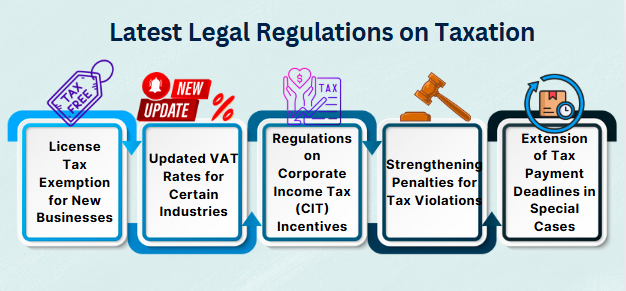
License Tax Exemption for New Businesses
Under Decree 22/2020/ND-CP, newly established businesses are exempt from license tax in their first year of operation. This policy is designed to encourage startups and support small businesses during their challenging early phase.
✅ Important Notes:
- Businesses must accurately declare their tax exemption in the initial tax filing.
- Late or incorrect filings may still result in administrative penalties.
Updated VAT Rates for Certain Industries
The standard Value-Added Tax (VAT) rate is 10%. However, specific industries such as tourism, public transportation, and education qualify for a preferential 5% VAT rate to support post-pandemic economic recovery.
✅ Business Impact:
- The tax reduction lowers costs and stimulates consumer demand.
- Businesses in these sectors should stay updated on policy changes to maximize tax benefits.
Corporate Income Tax (CIT) Incentives
Companies operating in high-tech, scientific research, and environmental protection sectors may qualify for preferential CIT rates ranging from 10% to 15%.
✅ Key Considerations:
- Tax incentives can apply for 5 to 10 years, depending on the industry.
- To qualify, businesses must register with the tax authorities and meet specific criteria, such as investment scale and economic impact.
Stricter Tax Penalty Regulations
Tax penalties have been tightened to strengthen compliance. Late payments, incorrect declarations, and tax evasion now face stricter fines.
✅ New Penalty Rates:
- Late payment penalty: 0.03% per day.
- Maximum fines can reach hundreds of millions of VND.
- Businesses must strictly comply with tax laws to avoid financial penalties.
Tax Payment Extensions in Special Cases
The government has issued decrees allowing extensions for VAT, CIT, and PIT payments in special cases such as natural disasters, pandemics, or economic downturns.
✅ How to Apply for an Extension:
- Businesses must submit a formal request on time to be considered for an extension.
- This measure helps companies ease financial pressure and maintain operations during difficult periods.
Business Tax Support Services
Benefits of Using Tax Support Services
Tax support services help businesses file and pay taxes on time while minimizing errors and compliance risks. Tax experts can also provide strategic advice on how to legally take advantage of tax incentives, leading to cost savings and improved operational efficiency.
Legal Tax Consulting
One of the biggest advantages of tax support services is detailed legal consulting. This includes:
- Keeping businesses up to date on the latest tax regulations.
- Guiding the preparation of tax documents.
- Answering tax-related questions to help businesses avoid legal violations.
This service ensures businesses comply with tax laws and avoid unnecessary penalties.
Online Tax Filing and Payment Assistance
Modern tax support services go beyond traditional tax filing; they also assist with electronic tax submission through government portals. This ensures accuracy and efficiency, which is especially valuable for large businesses handling complex tax data.
Tax Auditing and Risk Management
Tax auditing is a critical part of tax support services. It helps businesses identify potential errors and risks early, allowing them to:
- Improve internal tax processes.
- Be better prepared for tax inspections.
- Avoid unexpected fines and penalties.
Cost-Effective and Highly Efficient
Tax support services are available at reasonable rates, making them suitable for businesses of all sizes. The benefits of reduced risk and optimized tax costs far outweigh the initial investment, allowing businesses to focus on their core activities.
Ensuring Tax Compliance for Sustainable Business Growth
Understanding the different types of taxes and fulfilling tax obligations is essential for business sustainability and legal compliance. Key taxes, including License Tax, VAT, Corporate Income Tax (CIT), and Personal Income Tax (PIT), provide the legal foundation for every business in Vietnam.
Using professional accounting services helps businesses manage taxes efficiently, save time, and focus on growth. Staying current with tax regulations is crucial to ensure timely compliance and avoid penalties.For any inquiries, contact Wacontre Accounting Services via Hotline: (028) 3820 1213 or email [email protected] for prompt assistance. With a team of experienced professionals, Wacontre is committed to providing dedicated and efficient service. (For Japanese clients, please contact Hotline: (050) 5534 5505.)